
Monday Reads: Third Branch Governance
Posted: February 26, 2018 Filed under: Afternoon Reads | Tags: Arthur "Mister Okra" Robinson, DACA, Grey Gardens, Little Edie, Public School Integration, Staunch characers, white fragility 24 Comments Good Afternoon Sky Dancers!
Ever so often, I get the calling to be a full on eccentric. It usually happens when I’m exposed to the kind’ve white bread ickiness and utter banality that I grew up around. It’s nothing I use to have to face on a daily basis since living here in New Orleans as long as I stayed out of Jefferson Parish and away from the North Shore. The one good thing about obvious white flight areas is that you know what will be there so you just don’t go there. One indicator is the types of churches that locate there. These are those churches that only reach out with the offering plate and never with the offerings.
So, I always get a belly laugh when a herd of chubby, hyper ivory burbies show up in the hood and find out no one can totally sanitize their cheap ass ‘real’ New Orleans vacation experience here. I wish I had a picture of the crowd on the porch next door I saw while walking Temple on Friday. It was a nice chilly day and their icky fish white, sadly plump arms and legs were on display in tanks and shorts. I was told by the BNB dominatrix they were not happy about an early morning fight between my friend and her friend. It woke them out of their safety bubble.
I wonder if they were around for the dozen or so cop cars the evening before capturing a guy in the back yard that had just broken into the house 2 doors down from me and the apartment of the local drug druggie moments before. Or, for that matter if they realize the abandoned Navy Base 5 doors down holds about 100ish prime examples of the opioid “crisis”, the reality of homelessness down here since affordable rentals have been replaced by reality tourist dens, and how this country finds its mentally ill expendable.
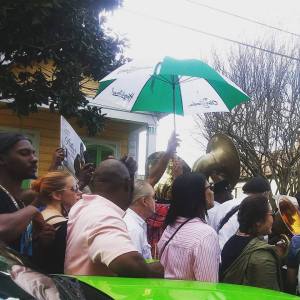
 However, the culture vultures did get to see us send off Arthur “Mr Okra” Robinson yesterday. His funeral and second line ended at our shared favorite dive bar which has also been appropriated for the fetishists of poverty porn.
Stuff keeps changing down here in the 9th ward but you also get glimmers of our glory. I’ve lived on the wrong side of the tracks for 20 years now and my only hope is that that’s the part that endures. All the Chads and Beckies, all the AirBnB parasites and the tourists they’ve brought like locusts cannot stomp on my memories. Mister Arthur, you brought me fresh food–after Katrina–when MacD didn’t even find enough of us to exploit. Carry on to glory and make a path and a light with your song and we will know where to go when the time comes.
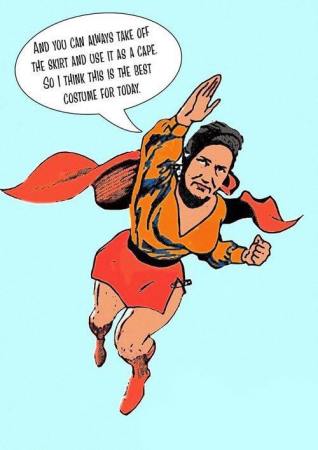
Meanwhile, today, I’m little Edie of Grey Gardens. Watch me twirl!
 We’re dependent on one branch of government these days. The others have been completely stocked with toxic white men. SCOTUS won’t hear Trump’s bid to end DACA. Well, it’s one positive thing they’re doing. We’ll need to worry about our right to form unions soon.
The Supreme Court said on Monday that it will stay out of the dispute concerning the Deferred Action for Childhood Arrivals program for now, meaning the Trump administration may not be able to end the program March 5 as planned.
The move will also lessen pressure on Congress to act on a permanent solution for DACA and its roughly 700,000 participants — undocumented immigrants who came to the US as children.
Lawmakers had often cited the March 5 deadline as their own deadline for action. But the Senate failed to advance any bill during a debate earlier this month, and no bipartisan measure has emerged since.
Originally, the Trump administration had terminated DACA but allowed a six-month grace period for anyone with status expiring in that window to renew. After that date, March 5, any DACA recipient whose status expired would no longer be able to receive protections.
Monday’s action by the court, submitted without comment from the justices, is not a ruling on the merits of the DACA program or the Trump administration’s effort to end it.
 The case reached SCOTUS after several Federal and District courts issued injunctions.
Federal district judges in California and New York have issued nationwide injunctions against ending the program, siding with states and organizations challenging the administration’s rescission. The court orders effectively block the Trump administration from ending the program on March 5, as planned.
No appellate court has reviewed those decisions, and it would have been exceedingly rare for the Supreme Court to take up a case without that interim step. In the past, the court has granted such cases only in matters of grave national importance, such as the controversy over President Richard Nixon’s White House tapes or solving the Iranian hostage crisis.
The litigation now will take its usual course, and the issue probably won’t return to the Supreme Court before the next term. In the meantime, the White House and Congress can continue to seek a political resolution.
Trump, at a meeting with governors at the White House, reacted to the court’s decision by saying: “We’ll see what happens. That’s my attitude.”
In an official statement, the White House did not criticize the justices for declining to take up the case, but said the DACA program “is clearly unlawful.”
“The district judge’s decision unilaterally to reimpose a program that Congress had explicitly and repeatedly rejected is a usurpation of legislative authority,” said Raj Shah, a White House spokesman. “The fact that this occurs at a time when elected representatives in Congress are actively debating this policy only underscores that the district judge has unwisely intervened in the legislative process.”
California Attorney General Xavier Becerra (D), among those who challenged the way the Trump administration ended the DACA program, said the Supreme Court was right to deny the government’s “unusual and unnecessary request to bypass the appeals

The Trump administration’s move was unusual to say the least and it’s a good thing SCOTUS didn’t buy into it.
His administration has asked the Supreme Court to take the unusual step of overturning the first injunction, issued by U.S. District Judge William Alsup, now instead of letting it go through the normal appeals process.
…
Trump declared he would rescind DACA in September, claiming it was unconstitutional. The White House aimed to terminate the program in phases, allowing recipients whose work permits and deportation protections would expire by March 5 to apply for renewal during a four-week window, but barring all new applicants. The plan was that Dreamers whose permits were set to expire after March 5 would be unable to apply for renewal, creating that deadline for Congress to act before an estimated 1,000 people per day began losing protections.
Under the injunctions, however, those who have been approved for DACA are eligible to keep renewing it until the courts decide otherwise.

Little Edie applying make-up at Grey Gardens, 1976
Public Unions may not be quite so blessed. Of course, all eyes are on the judge put there by KKKremlin Caligula.
The Supreme Court grappled Monday with a reprise of a case that could significantly weaken public employee unions, but Justice Neil Gorsuch added mystery to the proceedings by remaining silent throughout the arguments and offering no hint of how he might vote.
Last year, the high court was widely expected to rule that states could no longer force public employees to pay fees for union representation — a ruling that could have significantly undercut the power of unions in one of the few sectors where they are still relatively common.
However, the unexpected death of Justice Antonin Scalia offered unions a reprieve of sorts, with the court issuing a brief, 4-4, ruling that left in place a 40-year-old precedent allowing such ‘fair share’ fees to cover matters like collective bargaining and grievance processes. The addition of Gorsuch was widely seen as likely to give plaintiffs the fifth vote they need to outlaw the non-member fees.
Aside from Gorsuch’s silence, the most striking aspect of Monday’s argument was Justice Anthony Kennedy’s hostility to the unions’ position. He repeatedly tore into lawyers for the State of California and for a major union as they defended the ‘fair share’ practice.
 Sam Baker–writing for AXIOS–believes SCOTUS will “kneecap” them.
The Supreme Court is very likely on the verge of dealing a devastating blow to public-sector unions — one of the last remaining strongholds of organized labor, and a critical part of the Democratic Party’s base.
What to watch: The court will hear oral arguments today in a challenge to the fees public-sector unions collect from non-members. But the writing is already on the wall here. It would take a huge surprise for unions to get a reprieve.
The details: Public-sector unions collect dues from their members. They’re also allowed to collect so-called “agency fees” from people who work in unionized workplaces but aren’t members of the union.
- The Supreme Court ruled in 1977, in a case called Abood v. Detroit Board of Education, that non-members couldn’t be forced to pay for unions’ political activity, but that agency fees were OK because they only fund the union’s collective bargaining — which non-union employees still benefit from.
- Conservatives have been taking aim at agency fees, urging the court to overrule Abood. They say agency fees are a form of compelled speech, and violate workers’ rights not to support unions’ message. Because they’re government employees, the challengers argue, even collective bargaining is political.
The impact: Even though the money at stake in this case is separate from the money public-sector unions pump into Democratic campaigns, weakening unions in the workplace would almost certainly weaken their political muscle as well. That’s why conservative activists have taken such a strong interest in this line of cases.
The odds: They’re definitely against the unions.
- This is the third time the high court has taken a crack at this issue. In 2014, the justices issued a narrow ruling, but the conservatives suggested they might be willing to overturn Abood.
- They got their chance in 2016, but Justice Antonin Scalia died shortly after oral arguments. That case ended in a 4-4 deadlock — which gave the unions a reprieve, but indicated that if Scalia had lived, or if he was replaced with a like-minded justice, Abood would be out.
- That time has come. Barring any big surprises today from the four justices who were ready to strike down agency fees in 2016 — or a shocking pro-union bent from Justice Neil Gorsuch — this is likely the end of the road for Abood. And it’s the beginning of a new, weaker era for the unions that represent teachers and other public-sector employees.
A ruling is expected by the end of June.

 Indeed, the charter school movement and the school choice movement
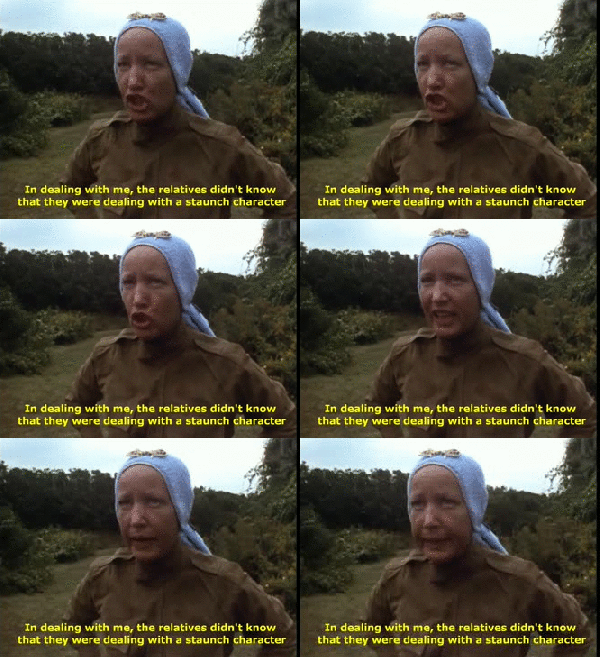
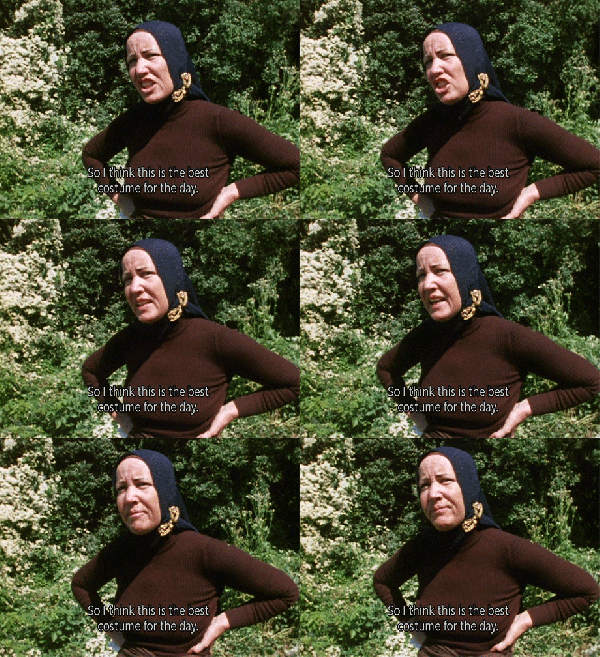 So, there are connections in my thoughts here watching culture vultures come to my neighborhood, soak in the “color”, and then retreat to the white bubbles of the North Shore or Metarie. No white person who hates that kind of sterility should have to wear the label of “staunch character” to be seen as comfortable in place filled with diversity nor should we have to sanitize our lives to make others feel comfortable.
Monday Reads
Posted: November 14, 2016 Filed under: Afternoon Reads | Tags: Maya Angelou, Neil Postman, Steven Bannon, white fragility 68 Comments Well, I’m not sure what to say … still …
The first bad news is that Steven Bannon is the new Karl Rove. There will be a white nationalist who hates women in charge of policy strategy. This is from a petition at SPLC. Please consider signing it.
Bannon presided over a news empire where he, according to former staffers, ”aggressively pushed stories against immigrants, and supported linking minorities to terrorism and crime.”
“We’re the platform for the alt-right,” Bannon said in July, using a term that is really just a rebranding of traditional white nationalism.
Under Bannon, Breitbart published a call to “hoist [the Confederate flag] high and fly it with pride” only two weeks after the Charleston massacre when the country was still reeling from the horrors of the murders.
Under Bannon, Breitbart published an extremist anti-Muslim tract where the author wrote that “rape culture” is “integral” to Islam.
Worse perhaps, Bannon personally insinuated that African Americans are “naturally aggressive and violent.”
 The second bit is that Lamar White, Jr. is likely right that media theorist Neil Postman who wrote Amusing Ourselves to Death: Public Discourse in the Age of Show Business was astoundingly prescient. Has America “amused itself to death”? The media played right into proving Postman’s hypothesis imho.
From the moment he announced his candidacy on June 16, 2015, bizarrely gliding down the escalator of his eponymous tower, America was hooked.
It didn’t matter how absurd he behaved or who he insulted; that was part of the fun, and instead of marginalizing him, it became a justification for the media to focus on him even more. He became must-see TV, not because he said anything substantive or even remotely realistic about domestic or foreign policy. In fact, he made it repeatedly clear that he had very little idea what he was talking about. According to non-partisan fact-checking organizations, more than 70% of what he said on the campaign trail was either mostly false or completely false. He lied far more often than he told the truth.
No, he became must-see TV, because like any good salesman and showman, Donald Trump understood his audience. He spoke in vague platitudes and pitched a slogan- “Make America Great Again”- that could fill in for an answer on any question. He surrounded himself with media professionals. His son-in-law owns The New York Observer, a paper that was more than happy to publish thinly-sourced gossip about his opponent as if it was gospel truth. He counted Sean Hannity, the conservative talk show radio host and FOX News celebrity, as a top adviser, along with Roger Ailes, the Republican political operative who built FOX News into a media empire before being forced to resign amid allegations of sexual harassment. And he hired Steve Bannon, the anti-Semitic editor of the popular conservative news website Breitbart, as his campaign’s chief executive.
In the immediate aftermath of his stunning victory, which shocked even Trump himself and which practically no one had predicted, there was a tendency to believe that Trump’s message of “economic populism” was the critical key to his success. He flipped enough working-class white voters in the Rust Belt because his message resonated with them.
This, I’m afraid, gives far too much credit to what truly motivated those voters, because Trump, despite all of his bluster about renegotiating trade deals and being the only person on the planet that could solve America’s problems, never had a serious plan to help the working class. His message was not about “economic populism;” it was about nativist resentment. It was not about inspiring “the forgotten man and woman,” as he suggested shortly after winning the presidency; it was about stoking their anger: Mexicans are illegally depriving you of a job; the Chinese are ripping us off; Muslims are terrorizing us; African-Americans are disrespecting “law and order” by protesting against police brutality; a global cabal of financiers are secretly conspiring to plunder our wealth (you shouldn’t need a history degree to figure out what that was about).
These Rust Belt voters, who determined the election despite the fact that Hillary Clinton is expected to win nationwide by at least 2 million votes, weren’t parsing through detailed policy papers from both candidates; they weren’t reading the objective economic analysis about the ways in which Clinton’s plans would add 10 million jobs to the workforce while Trump’s would result in a loss of 3 million jobs.
Please read the entire essay. You’ll be glad did.
Amanda Marcotte–writing for Salon–says “Yes, the white male anger that fueled Trump’s victory was real — but it isn’t valid.”
The anger that Donald Trump voters feel is very real. You don’t fling a proto-fascist pussy-grabbing monstrosity into the White House unless you really want to convey that fuck-you sentiment.
Because this anger is so real and so palpable, there’s been an unfortunate tendency in much of the media to assume that this anger must also be valid. The entire election cycle was a clusterfuck of articles demanding empathy for Trump voters, insisting that their rage must have some rational roots — perhaps economic insecurity?
The persistence of the “economic insecurity” angle in the face of overwhelming evidence against it was a testament to the power of hope over reason. If economic insecurity drives this rage, then something can be done about it. But if the rage is driven by less savory factors — unrepentant sexism and racism — then there is no way to mollify it without throwing women and people of color under the bus. It is also not for nothing that most “economic insecurity” theorists were themselves white men, perhaps eager for a narrative that makes people who look like them seem a little more sympathetic.
But wishing doesn’t make something true, or we’d be chatting about a President-elect Hillary Clinton today.
No doubt Trump supporters are people who felt they’ve lost something. But what they’ve lost is something that wasn’t rightly theirs to begin with: Unearned privilege. The Trump revolution was driven by white men who are watching women and people of color making gains that put them closer to equality. They are rebelling at the erosion of the sense that white men are better and more important than everyone else, simply because they exist.
 Rebecca Solnit at The Guardian writes: “Don’t call Clinton a weak candidate: it took decades of scheming to beat her.”
Sometimes I think I have never seen anything as strong as Hillary Clinton. That doesn’t mean that I like and admire everything about her. I’m not here to argue about who she is, just to note what she did. I watched her plow through opposition and attacks the like of which no other candidate has ever faced and still win the popular vote. To defeat her it took an unholy cabal far beyond what Barack Obama faced when he was the campaign of change, swimming with the tide of disgust about the Bush administration. As the New York Times reported, “By the time all the ballots are counted, she seems likely to be ahead by more than 2m votes and more than 1.5 percentage points. She will have won by a wider percentage margin than not only Al Gore in 2000 but also Richard Nixon in 1968 and John F Kennedy in 1960.”
You can flip that and see that Trump was such a weak candidate it took decades of scheming and an extraordinary international roster of powerful players to lay the groundwork that made his election possible. Defeating Clinton in the electoral college took the 2013 gutting of the Voting Rights Act by Republican appointees to the supreme court. It took vast Republican voter suppression laws and tactics set in place over many years. It took voter intimidation at many polling places. It took the long Republican campaign to blow up the boring bureaucratic irregularity of Clinton’s use of a private email server into a scandal that the media obediently picked up and reheated.
Kurt Eichenwald continues to be a voice worthy hearing. His Newsweek headline reads: “THE MYTHS DEMOCRATS SWALLOWED THAT COST THEM THE PRESIDENTIAL 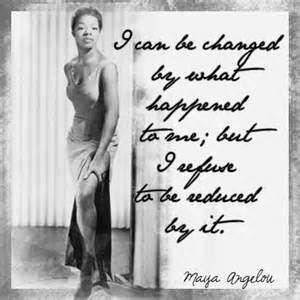 ELECTION.”
A certain kind of liberal makes me sick. These people traffic in false equivalencies, always pretending that both nominees are the same, justifying their apathy and not voting or preening about their narcissistic purity as they cast their ballot for a person they know cannot win. I have no problem with anyone who voted for Trump, because they wanted a Trump presidency. I have an enormous problem with anyone who voted for Trump or Stein or Johnson—or who didn’t vote at all—and who now expresses horror about the outcome of this election. If you don’t like the consequences of your own actions, shut the hell up.
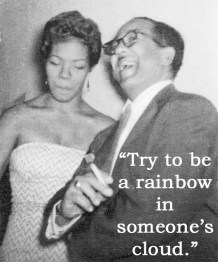
So, I could post dozens of links about stuff here but I think it’s best you share what resonates with you today. Meanwhile, just let a little bit of Maya’s wisdom wash all over you!!!
What’s on your reading and blogging list today?

 peej
peej Carissa
 bostonboomer
 dakinikat
 ecocatwoman
 mablue2
 Mama Lopez
 peggysue22
 quixote
 skydancingguestblogger
 Mona (aka Wonk the Vote)



 Sky Dancing
Recent Comments