
The Voodoo They All do so well
Posted: December 31, 2010 Filed under: Barack Obama, Democratic Politics, Surreality, U.S. Economy, U.S. Politics, We are so F'd | Tags: budget rule, Cutgo rules, Paul Krugman, Paul Ryan crazy, voodoo economics 21 Comments I’m not sure what exact delusional or fugue state describes Paul Ryan’s psyche. Dammit Jim, I’m an economist not a psychologist! I do, however, recognize b$gf$ck crazy when I see and hear it. It makes me want to avoid whatever part of Wisconsin that votes him into office because there must be something in their water or air. It amazes me that one small section of our country can wreck so much havoc on the rest of us by sending a loony tune to Washington, D.C. I’m beginning to think that Miami University should ask him to turn his degree back in and issue him a refund. I certainly would be ashamed if he were the product of any of my economics classes.
Paul Ryan is an outstanding example of everything that is wrong within that damnable beltway. He’s Daddy knows best on Acid. He wants to usher in the Republican Big Daddy state. In January, his type of crazy will dominate the House Budget committee. As a mater of fact, it’s already starting and it’s alarming.
RYAN’S RADICAL RULE?…. House Republicans quietly advanced procedural budget rules last week, which would be funny if they weren’t so ridiculous. But there’s a second part of this that shouldn’t go overlooked.
We talked the other day about Republicans’ “Cutgo” rules. The policy allows the GOP to try to keep slashing taxes, without having to pay for them, while requiring spending cuts to pay for new or expanded programs.
As Paul Krugman explained this morning, “Spending increases will have to be offset, but revenue losses from tax cuts won’t. Oh, and revenue increases, even if they come from the elimination of tax loopholes, won’t count either: any spending increase must be offset by spending cuts elsewhere; it can’t be paid for with additional taxes.” The Nobel laureate labeled this “the new voodoo.”
And then there’s the other part of House Republicans’ new budget rules.
A little-noticed detail in the new rules proposed by House GOP leaders would greatly increase the power of Rep. Paul Ryan, R-Wis., the incoming chairman of the House Budget Committee. As National Journal’s Katy O’Donnell reports, the new rules say that, for fiscal 2011, the chairman will set spending limits without needing a vote.
If that sounds insane, that’s because it is. Under the proposed rules, Ryan would be empowered to single-handedly establish spending levels if the House and Senate struggle to agree on a budget resolution. Just as important, Ryan’s levels would be binding on the chamber, without even be subjected to a vote.
Fascism doesn’t creep with Ryan in charge of things. It sprints. It’s typical of the radical right/Bircher mentality to think that when one can’t get to where they want with reasoned thought and plurality, it’s okay to lie about it and sneak things in under the radar. Thankfully, Paul Krugman has a bully pulpit at the NYT. Krugman’s description of the entire thing is right on. There’s only one problem. Krugman consistently ignores just how much Obama has been enabling the voodoo. It is, afterall, the Obama-McConnell Tax Cuts for Billionaires (TM) law. In fact, I’m willing to go out there on limb and say Obama believes the voodoo and that other Democrats perpetually cut-and-run rather than hold ground on it. Krugman seems to set on pointing out the sin on one side of the aisle and ignoring the same behavior on the other side. Let’s ignore that for a moment and concentrate on the good stuff Krugman offers.
But the tone changed during the summer, as B-day — the day when the Bush tax breaks for the wealthy were scheduled to expire — began to approach. My nomination for headline of the year comes from the newspaper Roll Call, on July 18: “McConnell Blasts Deficit Spending, Urges Extension of Tax Cuts.”
How did Republican leaders reconcile their purported deep concern about budget deficits with their advocacy of large tax cuts? Was it that old voodoo economics — the belief, refuted by study after study, that tax cuts pay for themselves — making a comeback? No, it was something new and worse.
To be sure, there were renewed claims that tax cuts lead to higher revenue. But 2010 marked the emergence of a new, even more profound level of magical thinking: the belief that deficits created by tax cuts just don’t matter. For example, Senator Jon Kyl of Arizona — who had denounced President Obama for running deficits — declared that “you should never have to offset the cost of a deliberate decision to reduce tax rates on Americans.”
It’s an easy position to ridicule. After all, if you never have to offset the cost of tax cuts, why not just eliminate taxes altogether? But the joke’s on us because while this kind of magical thinking may not yet be the law of the land, it’s about to become part of the rules governing legislation in the House of Representatives.
It’s one thing to say “That’s just crazy talk” to Republicans but to turn around and excuse or ignore the enabling and facilitating role that the President and Democratic members play is to commit a big sin of omission. That troubles me when you’re one of the few economists with a very public bully pulpit.
There’s obfuscation on all sides of this stupidity however. BostonBoomer asked me about a response to Krugman’s  criticism here that’s grounded in something wonky at JustOneMinute. The writer of that post tries to call out Krugman by screaming “deception and misdirection”, then referring to Ricardian economics. You must use the Wayback Machine for this one. The article is like reading a critique of modern democracy based on what they did in Athens around 500 BC.
David Ricardo was born in 1772 and made a fortune as a stockbroker and loan broker.[1] At the age of 27, he read An Inquiry into the Nature and Causes of Wealth of Nations by Adam Smith and was energized by the theories of economics. His main economic ideas are contained in Principles of Political Economy and Taxation (1817). This set out a series of theories which would later become theoretical underpinnings of both Marx’s Das Kapital and Marshallian economics, including the theory of rent, the labour theory of value and above all the theory of comparative advantage.
Ricardo wrote his first economic article ten years after reading Adam Smith and ultimately, the “bullion controversy” gave him fame in the economic community for his theory on inflation in 19th century England. This theory became known as monetarism, the theory that excess currency leads to inflation.[2] He was also a factor in creating classical economics,[3] which meant he fought for Free trade[4] and free competition without government interference by enforcing laws or restrictions.[5]
Yes, that’s right. Ricardo is an early 19th century economist philosopher writing during the time when the main sector of all economies was agriculture using technology like horses and slaves under a system called Mercantilism. That’s the reason to criticize Krugman. Yes, we academic economists teach Ricardian concepts, models, and principles still. However, it’s just because it’s an easy entry for people that do not have good calculus skills and are unfamiliar with the most basic economic concepts. These simple models weird enough people out as it is. Also, it’s the original, early attempt at theory that under pins classical economics. Tons of empirical data and computer models plus advances in mathematics have pushed us beyond all that. Most of the Ricardian stuff has been reformulated–as has a lot of the Keynesian stuff and that’s only from about 100 years ago–and tested empirically. To put it in blunt terms, some of the impacts have the right sign and do exist, but they show up as so trivial that no one takes them seriously when you’re dealing with real world economic policy. A really good example of this is the ‘crowding out effect’. Another is what Tom Maguire points out at JustOneMinute. Let me refer to a thing via new school on Barro who is one of the reformulaters.
Almost immediately, Barro turned on his Keynesian roots and joined the Rational Expectations revolution with two central pieces: his celebrated “Ricardian Equivalence Hypothesis” (1974) and his famous money neutrality paper (1976). Under a particular set of assumptions (e.g. intergenerational altruism or immortality, perfect capital markets, lump sum taxation, and the condition that debt not grow faster than the economy), Barro’s (1974) “Ricardian Equivalence Hypothesis” argues that every bond-financed deficit must be met by a future tax increase, that this tax increase would be forseen by living agents and that these agents would care enough about posterity to adjust their present consumption accordingly. In short, this implies that agents do not take a bond-financed fiscal expansion as a lucky windfall but rather will save the entire proceeds in anticipation of the future tax burden – and thus not raise their demand for goods and services. Thus income received by agents from government deficit-spending is all saved – and hence has no effect on consumption (thus no multiplier) – and that these savings go into the demand for the very same bonds that were supplied to finance that government spending (so bond demand rises exactly to meet higher bond supply, and money demand is unchanged) and thus there is no effect on interest rates either.
Barro’s “Ricardian Equivalence Hypothesis” has spawned a virtual research industry of its own as a whole generation of economists have climbed over each other tortuously examining, assailing, and verifying the validity and implications of Barro’s theorem (his 1974 paper is among the most-referenced papers in economics today). Barro’s 1976 paper on the neutrality of monetary policy (i.e. that changing money supply growth would not affect output or interest or any real variables) followed up on the work of Lucas and Sargent and although less unique, it was no less controversial.
This stuff is at the root of the conflict between the freshwater (Neoclassical) and the saltwater economists (NeoKeynsian) economists. I highlighted the most germane thing in all of this above and that is the phrase “under a particular set of assumptions”. It takes just as many unrealistic assumptions to make a free market economy work as it does to create a Marxist Utopia. The most suspect assumption of all is that of perfect capital markets.
Joseph Stiglitz earned his Nobel Prize for a career spent outlining all the ‘frictions’ in markets. That would be all the stuff in reality that make markets so damned imperfect. Stiglitz’s big thing is asymmetries of information which is something I talk about a lot when it comes to financial markets. The capital markets are loaded with them; especially now. Then, there’s the little friction involved with basic market structures. Back in the Ricardian days it was possible to point to the market for wheat and label it a somewhat ‘perfect market’. We’re way past that. We’ve got so many monopolies and oligopolies and so much government regulation and rules, that what Ricardo and Smith describe is as arcane as Marxism. Greg Mankiw is probably the closest ‘real economist’ source I can name that still ambles along those lines. However, he does so with a huge amount of caution. No one serious denies the role of frictions in markets.
The most silly thing about the JustOneMinute commentary is it ignores the source of Krugman’s Nobel–international trade–which starts with the Ricardian ‘comparative advantage’ framework. It also ignores Krugman’s writings outside of the NYT. Here’s an example from MIT that’s still standing called ‘Ricardo’s difficult idea’. Krugman writes this in the 1990s. Now, why was that so difficult to Google?
And so one is prepared to be sympathetic after reading a passage like the following, on the first page of Sir James Goldsmith’s The Trap: “The principal theoretician of free trade was David Ricardo, a British economist of the early nineteenth century. He believed in two interrelated concepts: specialization and comparative advantage. According to Ricardo, each nation should specialize in those activities in which it excels, so that it can have the greatest advantage relative to other countries. Thus, a nation should narrow its focus of activity, abandoning certain industries and developing those in which it has the largest comparative advantage. As a result, international trade would grow as nations export their surpluses and import the products that they no longer manufacture, efficiency and productivity would increase in line with economies of scale and prosperity would be enhanced. But these ideas are not valid in today’s world.” (Goldsmith 1994:1). On close reading, the passage seems a bit garbled; but maybe he is just a careless writer (or the translation from the original French is imperfect). One expects him to follow with a discussion of some of the valid reasons why one might want to qualify Ricardo’s idea — for example, by referring to the importance of external economies in a high-technology world.
But this expectation is utterly disappointed. What is different, according to Goldsmith, is that there are all these countries out there that pay wages that are much lower than those in the West — and that, he claims, makes Ricardo’s idea invalid. That’s all there is to his argument; there is no hint of any more subtle content. In short, he offers us no more than the classic “pauper labor” fallacy, the fallacy that Ricardo dealt with when he first stated the idea, and which is a staple of even first-year courses in economics. In fact, one never teaches the Ricardian model without emphasizing precisely the way that model refutes the claim that competition from low-wage countries is necessarily a bad thing, that it shows how trade can be mutually beneficial regardless of differences in wage rates. The point is not that low-wage competition never poses a problem. Rather, what is significant is that despite ostentatiously citing Ricardo, Goldsmith completely misses one of the essential lessons of his argument.
It’s really obvious that Krugman–indeed, most of us–don’t see the Ricardian model as anything but an early attempt to take economics out of the realm of philosophy and apply the scientific method and models. It’s like yelling at a learned Psychologist for not continually citing Freud as a modern authority or a learned Molecular Biologist for not continually citing Darwin as the be all and end all on evolutionary theory. These guys started modernizing their fields, but a lot of new evidence, tools, and data have arisen since then.
So, my bigger question is why do we have Republicans pushing a 19th century world view when it comes to economics? I then would also like to know why Democrats–especially a Democratic POTUS–enable them? Well, according to The Hill, Democrats are ripping the proposed rule. Democrats always seem really skilled at shaking their tiny fists before anything really happens.
Democrats argue the provision would give unilateral power to Ryan and flies in the face of GOP promises of transparency.
“Allowing incoming Chairman Ryan to have unilateral power to set spending limits — instead of subjecting those limits to a vote on the floor of the House — flies in the face of promises by House Republicans to have the most transparent and honest Congress in history,” said Doug Thornell, spokesman for incoming House Budget Committee ranking member Chris Van Hollen (D-Md.), in an e-mailed statement.
“Unfortunately, the House GOP is reverting back to the same arrogant governing style they implemented when they last held the majority and turned a surplus into a huge deficit,” he added.
Drew Hammill, spokesman for incoming Minority Leader Nancy Pelosi (D-Calif.), also criticized the rule change. He said the decision to cede power to Ryan “runs counter to the Republicans’ promises of transparency and accountability.”
The deal is will they actively FIGHT it and stop it? Then the bigger question is will Krugman talk about the complicity of the Democratic congress critterz and the President in enabling their stupidity?
Forehead, meet palm.
Tax Pandering is the Problem
Posted: December 13, 2010 Filed under: jobs, The Great Recession, the villagers, U.S. Economy | Tags: Kevin Drum, Mother Jones, voodoo economics 11 Comments So, now there’s a bunch of polls showing that the public basically approves of most of the tax cuts. yhe village chattering class (e.g Kevin Drum of Mother Jones)sees this as a sign of potential support for Obama and the Democrats.
To me, that’s about like polling on the question: Would you look a gift horse in the mouth? Of course, every one likes some change in their pockets. But at what cost? The polls aren’t asking that question. The one part of the tax deal that came out with a disapproval was the cut in payroll taxes. But, that’s the big Obama win, right? So, the villagers have to explain why EVERY one should just love that.
The explanation given by Drum is that every one is really dumb and thinks this will bankrupt social security because no one will pay into to it for a few years. He’s thinking people don’t see the promised government IOU. He’s got a list of how dumb he thinks we are about this and you’ll see it at the bottom of the post. So, now we do economic policy on polls? Can I get a witness that just because people like something doesn’t mean it’s good or wise policy? It doesn’t even mean that if they see the hamburger today, they’ll be willing to pay for its cost on Tuesday either. My guess is when the tab comes, there will be some unhappy polls then.
The major economic argument for this package is basically that you don’t raise taxes in a weak economy. That is basic Keynesian thought and it’s odd to see the entire Republican party joining hands and singing “We’re all Keynesians now”. A secondary argument is that any thing bartered away at this point is worth it because we extend long term unemployment benefits.
What you don’t see is a larger discussion of this all in terms of the economic situation and what is called for in these circumstances except in economist circles. This really worries me. Did you notice this ABC poll doesn’t ask people how they feel about giving cash subsidies to corn growers or the deal on equipment write offs? Those are also components of this tax giveaway. The poll also doesn’t ask people about what they think this will do to the deficit in the future and the cost of government borrowing. (Even Moody’s is threatening to downgrade our debt on the merits of this plan.) This poll basically asks, “Would you like more money in your pocket or not?” I can only image the naysayers like me either know their economics or they’re like me and not getting anything from this tax bill but the bill.
So, rather than listen to the failed lawyers who make up our policy decision=making class and the spoiled, rich little nitwits that write the punditry blogs in the MSM, let’s check out what some economists have to say. We’re going for three of them here. There will be four if you count me.
I linked down page on the morning reads thread to a blogger named Chevelle who was a government economist who now works at an asset management firm. She has a very good short piece up on why these tax cuts are a very “dumb” idea. Her basic analysis actually sounds a lot like Larry Summers’ parting shot in Time Magazine. Another similar voice can be read in the WSJ and comes from Nobel prize winning economist Joseph Stiglitz who calls for a second stimulus package that’s not tax cut loaded. The tax cuts may be politically popular but they don’t really take care of our problems right now. The money used for the tax cuts would be a lot more powerful and useful if it was targeted at the problem in the form of Government Expenditures. That’s what all three of them say in their commentary and that’s what I’m arguing for here. It’s your basic expenditure multipliers stuff from Economics 101.
We’ll start with Larry Summers who answers the question “what is holding the economy back?”. I’m actually beginning to think this parade of economists out of the West Wing door is ominous. This article just gives me more of those willies. Here’s the problems per LaLa.
• When unemployment has been above 9% for 19 straight months,
• When the job vacancy rate is at near record low levels,
• When 8 million houses and countless square feet of office and retail space sit empty,
• When capacity utilization in the nation’s factories and on its railways and highways is nearly as low as it has been in any period since the Second World War,
• There cannot be any question that the constraint on our economy now and for the next several years will be lack of demand.
I am under no illusion that increased demand alone is sufficient to restore America’s economic health, but it is an unquestionably necessary component of a full recovery.
Unfortunately, the approaches we have become used to over the last fifty years for supporting demand in a market economy are not open to us today.
Base interest rates cannot fall below their current level of zero.
And, in the face of excess capacity and excess debt, it is not clear that, even if they were possible, falling interest rates would be effective in convincing consumers and businesses to spend more.
That sounds a lot like what Stiglitz wrote too.
“The first stimulus package had too much emphasis on tax cuts. Those were relatively ineffective and not enough aid for the states,” Stiglitz told reporters on the sidelines of a seminar in Chile’s capital.
A new stimulus package should include a revenue-sharing program to make up for a shortfall in state revenue and should pick up the states’ investments that had to be stalled. Also, there should be a special focus on human capital, in particular on education and training, he said.
“We have to believe that the economy will eventually recover…[W]hat kinds of jobs will we want to have in five years…[W]e need to have people trained for that,” Stiglitz said.
Additionally, Stiglitz argued the U.S. Federal Reserve’s quantitative easing bond-purchasing program is creating an excess of liquidity, which is flowing into emerging-market nations.
Emerging-market economies such as Chile’s are growing at a much faster pace than the U.S. and have comparatively higher interest rates, making them attractive destinations for investors looking for higher returns.
According to Stiglitz, the $600 billion bond-purchasing program has created a large amount of “liquidity looking for relatively safe high returns” that aren’t found in the U.S. but can be found in many emerging-market nations.
As many emerging markets are trying to discourage capital inflows, “the liquidity goes to the places where they haven’t yet put barriers for the inflows,” Stiglitz told reporters.
Okay, now to blogger Chevelle from Models & Agents. She begins by explaining how most people are back on their life time budgets as measured by the PCE or Personal Consumption Expenditure/per employed person. It’s back to the lackadaisical pre financial crisis level. We actually all have a life time expenditures patterm that tends to be consistent over our lifetime. Some times we borrow and over spend a little. Other times we panic and save. Eventually, we get back to the mean. Employed people are at that now. It’s the unemployed that aren’t anywhere near their usual budget. This package does nothing about that.
That the problem with the economy is not that (employed) Americans don’t consume enough; it is that we have too many unemployed people who can’t consume, not even the basics. And this is my first reason why giving a tax gift to employed Americans is a completely dumb policy: Not only is it unfair to the unemployed; it is questionable whether those Americans with jobs and with comfortable cash positions are going to spend this tax gift, if they are already close to reaching their long-term consumption growth. So much for a “targeted”, “efficient” fiscal “stimulus”.
She also argues that we do face a potential government debt problem in the intermediate future and doing more dumb tax cuts is just going to exacerbate the problem down the road. That also has disturbing implications. Then, there’s the payroll tax cut. That’s what Kevin doesn’t grok.
What does the cut in the payroll tax do? If anything, it reduces labor supply. This is because employed workers could work fewer hours and still end up with the same amount of disposable dollars as before the tax cut. So, at the margin, they would reduce the hours they offer to work. (To throw a bit of jargon, the labor supply curve shifts to the left: i.e. less labor is offered for a given wage).
Now, this might (temporarily) close part of the labor supply-demand gap—i.e. reduce unemployment. But that’s a reduction for the wrong reason! What we really need is for unemployment to get reduced due to an increase in labor demand (ie policies to shift the labor demand curve to the right!). So, in theory, *if* the government had cash to spare, and *if* companies’ reluctance to hire were driven by a liquidity constraint, the appropriate policy response to raise employment (and thus, consumption, GDP growth and so on) would be to give a temporary cut in the employers’ portion of the payroll tax, not the employees’.
What she’s saying here is that a payroll tax cut is likely to make employed people work less hours, but it is unlikely to cause employers to hire more people. She also continues to explain the impact on long term borrowing for the government of doing this kick-the-can-down-the-road policy.
So, while Kevin Drum is excited about is that warm tingling leg feeling he gets speculating that if people like the policy that might make people like Obama and the Democrats a bit more now. Then, he can feel good about himself again as a Progressive (TM). What he’s really missing is that it’s going to make the situation worse that’s got people peeved at Obama and the Democrats now. It’s not even robbing Peter to pay Paul. It’s borrowing money from both Peter and Paul. It’s giving money to people who will most likely put it into places where it will go stimulate the economies of emerging markets. It’s not going to do much here at all.
What we’ve got going is a long term unemployment problem with all that implies, and as Larry Summers said, a long term consumption problem. The people who get this tax cuts aren’t going to change their spending behavior at all and that’s not going to help the economy. If anything, the money going to the rich will head off overseas quicker than a credit card call center. It’s going to add to the deficit which will create long term debt problems. It does nothing to ensure the long term unemployed will maintain marketable job skills and their ability to eat and stay in their homes. It does nothing to really stimulate buying where it possibly could help. It’s an expensive gesture and that’s about it.
The one thing good that came out of the Reagan years was that we learned that the shot gun approach to tax cutting is just not that effective in doing anything but increasing the deficit. Former Congressman Jack Kemp actually showed that some targeted tax cuts and targeted expenditures could actually make a difference. This is what led to the go-zones we see now in rural and urban places that were difficult to develop in the past. It showed that if you want to kill a big beast, it’s best you get a sharp shooter and the best rifle. The targeted approach is best. So, in this sense, even the Republicans are dooming us all to repeat their past mistakes instead of the few successes they actually delivered. The Democrats have forgotten the past altogether.
I find this very worrisome that we continue to see tax cuts put out by a Democratic administration that play right into that big old VooDoo economics myth. Kevin Drum just seems to miss that point. He thinks you’ll be able to head off the Republican hand wringing in the future. He thinks every one is stupid because this is a good deal for the middle class. The problem is that it isn’t and it just sets us up for worse things in the future. This package will fail worse than the first stimulus for many of the same reasons. Two years down the road, every one will be just as discouraged. Even Larry Summers sees that.
So, here’s the promised list of why Kevin thinks were all dummies who need skooling.
Possible answers: (a) people don’t really understand that cutting payroll taxes means they’ll see an immediate increase in their take home pay, (b) people associate payroll taxes so strongly with Social Security solvency that they don’t want to cut them, (c) people fantastically overestimate how likely they are to have a $5 million estate when they die, (d) lots of people have a strong instinctive view that people should be able to pass on their wealth to their kids no matter how much it is, (e) people are just generally confused about all this stuff and it’s hopeless to try and figure out what’s really going on.
In any case, I’ll say this again to wavering lefties who have suddenly decided that the tax deal is no good because the payroll tax cut will never be undone and Social Security’s finances will be decimated: yes,
Republicans will engage in their usual Democrats are raising your taxes! demagoguery when the tax cut expires next year, but no, it won’t be very effective. There are lots of good reasons for this, and this poll provides evidence for one of them: the public isn’t all that keen on cutting the payroll tax in the first place. They want Social Security fully funded, and that argument, in the end, will carry the day. Never underestimate the power of AARP.
So, Kevin, the deal is this. You’re putting the money into the wrong hands and you’re expanding the deficit in the future and probably making it more expensive for the government to keep putting money back into social security. Afterall, it’s just another government “IOU” to the Social Security Trust Fund. People haven’t liked the idea in the past. They don’t like it when the government ‘borrows’ from the trust fund and they don’t like it now. The Social Security Trust fund is invested in Treasuries. You know, those things Moody’s wants to down grade?
It makes no sense to help out people that don’t need it, borrow a ton of money that won’t really accomplish anything, and still come out with a bad economy two year down the road during the next election season. I really don’t think people are as confused as you are. It’s voodoo economics. It doesn’t make any difference if it’s the Republican or the Democratic brand on it. No one’s going to look a gift horse in the mouth. Still, to think anything good will come of any of this is just plain foolish.
If the Turkey didn’t put you to sleep …
Posted: November 26, 2010 Filed under: The Great Recession, U.S. Economy | Tags: Bruce Bartlett, Bush tax cuts, deflation, FOREX, inflation, Martin Feldstein, QE2, supply side fairy tales, voodoo economics 9 CommentsEconomics doesn’t take holidays. It’s probably why we economists are so grim. Just in case you need a good nap, here’s some of my pointy head friends with 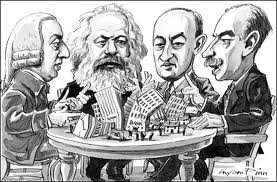 bow ties discussing things economic. I was going to try to spare you out of holiday cheer, but Mark Thoma reeled me in and now I must share.
I’ve mentioned recently how absolutely baffled I am by the number of “conservative” (i.e. radical) Republicans who keep buying into economic fallacies that even conservative (i.e. authentically conservative) economists can’t support. I mentioned Nobel Prize winning and father of the Monetarists Milton Friedman’s huge study on the Great Depression. His thesis was that very poor Fed policy made the Great Depression. In 2002, Bernake even agreed and apologized to him for the FED’s errant ways. Friedman was a consummate free marketer and wrote pop books and pop Newsweek columns during his heyday as a conservative icon. I’m sure he would not be suffering these fools were he alive today.
Thoma points to two recent columns by two former Reagan Team economists. One article is from Martin Feldstein who is probably the closest thing remaining to Milton Friedman in terms of conservative, free market, economic thought. The other is from Bruce Bartlett who was one of the fathers of Supply Side economics during the Reagan years but has since repented. He’s really adapted the Friedman statement “We’re all Keynesians now”. Both economists are intent on stopping this current batch of policy nincompoops from recreating The Great Depression.
The first Thoma thread references Feldstein who writes on the QE2 at Project Syndicate. Feldstein was Chair of Reagan’s Council of Economic Advisors and was President of the NBER. You may recall that NBER dates business cycles for the country. I want to hit his bottom line first so those of you that are using this for nap material can see that it’s ludicrous to think the QE2 is wild-eyed and out-there policy experimentation.
In short, the Fed’s policy of quantitative easing is likely to accelerate the rise of the renminbi – an outcome that is in China’s interest no less than it is in America’s. But don’t expect US officials to proclaim that goal openly, or Chinese officials to express their gratitude.
China is experiencing inflation. We are experiencing deflation. The reason this is good for both countries is that it will offset each of these pressures. Feldstein explains the goal of the QE2 in terms of US policy first. I’ll cover that quote. You’ll need to go read the explanation for the China side of the equation too.
The United States Federal Reserve’s policy of “quantitative easing” is reducing the value of the dollar relative to other currencies that have floating exchange rates. But what does the new Fed policy mean for one of the most important exchange rates of all – that of the renminbi relative to the dollar and to other currencies?
The effect of quantitative easing on exchange rates between the dollar and the floating-rate currencies is a predictable result of the Fed’s plan to increase the supply of dollars. The rise in the volume of dollars is causing the value of each dollar to fall relative to these currencies, whose volume has remained constant or risen more slowly.
The Fed’s goal may be to stimulate domestic activity in the US and to reduce the risk of deflation. But, intended or not, the increased supply of dollars also affects the international value of the dollar. American investors who sell bonds to the Fed will want to diversify the dollars that they receive from it. One form of that diversification is to buy foreign bonds and stocks, driving up the value of those currencies.
The result of this move will be to make our exports more competitive abroad and to make every one else’s exports–including those countries that have pegged their currencies to the dollar in an unfair manner–less competitive. We are simply turning the tables on the beggar-thy-neighbor growth policy China and others have adopted. The Fed is doing this because there is no will on the part of domestic policy makers to stimulate the demand in our country for consumers or government. There are 4 major parts of GDP. If fiscal policy doesn’t stimulate Consumption or Government demand, then there remain Investment and Exports. Investment is the least reliable form of demand and is rather small compared to the rest of the economy. The Fed is trying to tackle the aggregate demand shortage as best it can in response to the laws that compel it to act when unemployment is high.
Which brings me to the Bruce Bartlett thread. Bartlett has a piece today up at The Fiscal Times called ‘Starve the Beast: Just Bull, not Good Economics’. As some one who is currently suffering from a governor who has selectively adopted the policy as a path to the White House, I personally can tell you that it is very much Bull and causes a lot of undue suffering. It is ideology chosen over fact, logic, and above all, compassion. Bartlett goes straight to the heart of Voodoo Economics by using data to show that Dubya Bush’s embrace of of tax cuts in his first term as president did nothing to further economic growth and did everything to drive us in to unnecessary deficit spending.
It ought to be obvious from the experience of the George W. Bush administration that cutting taxes has no effect whatsoever even on restraining spending, let alone actually bringing it down. Just to remind people, Bush inherited a budget surplus of 1.3 percent of the gross domestic product from Bill Clinton in fiscal year 2001. The previous year, revenues had been 20.6 percent of GDP, spending had been 18.2 percent, and there had been a budget surplus of 2.4 percent.
When Bush took office in January 2001, we were already well into fiscal year 2001, which began on Oct. 1, 2000. He immediately pushed for a huge tax cut, which Congress enacted. In 2002 and 2003, Bush demanded still more tax cuts, even as the economy showed no signs of having been stimulated by his previous tax cuts. The tax cuts and the slow economy caused revenues to evaporate. By 2004, they were down to 16.1 percent of GDP. The postwar average is about 18.5 percent of GDP.
Spending did not fall in response to the STB decimation of federal revenues; in fact, spending rose from 18.2 percent of GDP in 2001 to 19.6 percent in 2004, and would continue to rise to 20.7 percent of GDP in 2008. Insofar as the Bush administration was a test of STB, the evidence clearly shows not only that the theory doesn’t work at all, but is in fact perverse.
There is nothing better than an addict who has fought their demons and comes out the other side to explain exactly why the demon should die. Bartlett succinctly explains why the Republicans continue to support the ideology and the drivel despite evidence that everything they believe is quite false.
Nor was Bush’s budgetary profligacy limited to programs that could be justified, however loosely, on national security grounds. As I detailed last week, he and a Republican Congress created a massive new entitlement program, Medicare Part D, to buy the votes of seniors and buy themselves reelection in 2004. Among those voting for this monstrosity were many Republicans still in Congress today who are unjustly considered to be staunch fiscal conservatives, including incoming Speaker of the House John Boehner, House Majority Leader Eric Cantor, and House Budget Committee chairman Paul Ryan.
Because of its obvious ridiculousness, one seldom hears conservatives say openly that tax cuts automatically reduce spending. But it still underpins the entire Republican budget strategy — tax cuts never have to be paid for, no meaningful spending cuts are ever put forward, earmarks and foreign aid are said to be the primary sources of budget deficits, and similar absurdities.
Both of these men have written tractable–albeit, tough–reads on policy decisions that people really need to understand. I know there is a tendency this time of year to wallow in football games, shopping binges, and short term feel good embrace of childhood memories, but really, there is a lame duck congress in session and an incoming group of Congressional morons with a President in office who wants to play Let’s Make a Deal with them.
If you can awake from tryptophan dreams long enough to read these two articles thoroughly, please do so. We can’t afford any more Voodoo policy mistakes.
We come now to bury Supply Side Economics
Posted: July 25, 2010 Filed under: Team Obama, The Bonus Class, The Great Recession, The Media SUCKS, U.S. Economy, Voter Ignorance | Tags: voodoo economics, why things were so good during the Clinton years Comments Off on We come now to bury Supply Side EconomicsI’ve been having a major hissy fit about the extraordinary bad policy measures proposed and undertaken by Republicans for sustaining tax cuts and deficits for as long as I can 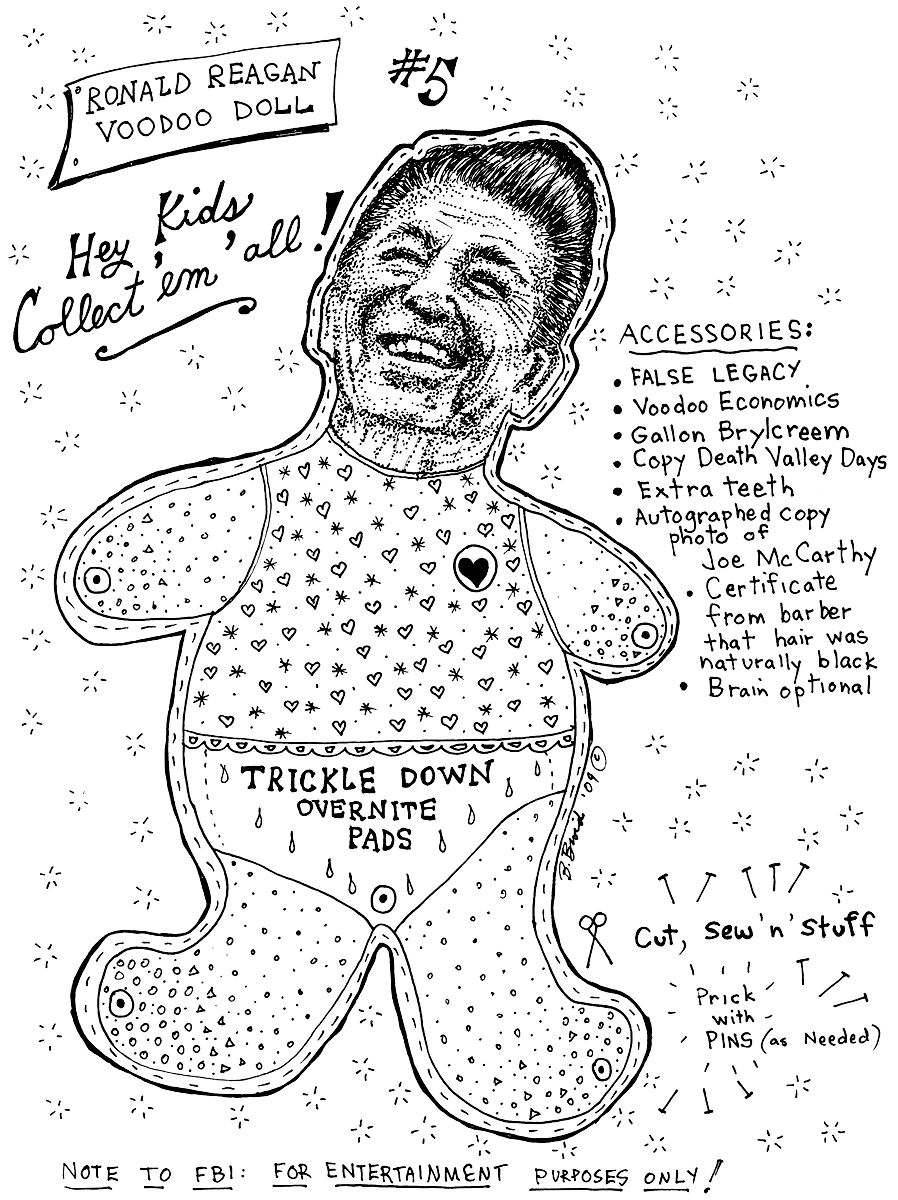 remember. The deal is, however, nobody likes it when you tell them they can’t have a free lunch when Ronnie Raygun repeated it ad infinitum. That is very much how the Republicans have achieved political victory since the Reagan years. Basically, they promise to cut taxes no matter what the circumstances and spend money on every military adventure and toy that comes down the pike and chock it up to preserving American exceptionalism. Ronald Reagan and Dubya Bush are responsible for the deficit today and the people that benefited from their tax cuts–and voted for them–should be asked to clean up the mess.
I was ever so pleased to read this article by FT’s Martin Wolf that recognizes ‘supply-side economics’ for what it is. It has nothing to do with a good economy and has everything to do with good politics. It’s a policy of promising and delivering everything and then screaming about the huge bill when a Democrat is in office. Every 8 years or so they do one huge Dine and Dash on the country. Wolf realizes this and basically calls Dubya’s tax cuts “massive, irresponsible, and unsustainable”. He also rightly calls the Reagan years for what they were. Reagan was a premier example of Keynesian policy. Ronald Reagan spent us out of the recession of the early 1980s. The only thing that was supply side about it was the high supply of bull shit rhetoric that went along with it. Some one needs to correct the message.
Ronald Reagan was the country’s premier Keynesian. Then Bill Clinton got into office and led us to a very long,very good business boom by doing what Keynes said to do during that time. You only deficit spend when the economy sucks. It had improved by the beginning of the 1990s. Bill Clinton was frugal. I can never forget the day that Dubya/Cheney looked at those surpluses they inherited and Cheney said, deficits don’t matter, Reagan showed us that. Then they immediately started two wars and gave away the Treasury to every corporation and rich person in the country. It’s damn ironic now that every Republican and Blue running Dawg thinks deficits matter. This is the time when we need them. We should’ve paid more attention to them like five years ago. But Cheney of no heart has brass balls and a spine. If only we had a Democrat in elected office with spine and balls.
Anyway, here’s Wolf’s nutshell description of supply side economics. It’s a good one.
To understand modern Republican thinking on fiscal policy, we need to go back to perhaps the most politically brilliant (albeit economically unconvincing) idea in the history of fiscal policy: “supply-side economics”. Supply-side economics liberated conservatives from any need to insist on fiscal rectitude and balanced budgets. Supply-side economics said that one could cut taxes and balance budgets, because incentive effects would generate new activity and so higher revenue.
The political genius of this idea is evident. Supply-side economics transformed Republicans from a minority party into a majority party. It allowed them to promise lower taxes, lower deficits and, in effect, unchanged spending. Why should people not like this combination? Who does not like a free lunch?
How did supply-side economics bring these benefits? First, it allowed conservatives to ignore deficits. They could argue that, whatever the impact of the tax cuts in the short run, they would bring the budget back into balance, in the longer run. Second, the theory gave an economic justification – the argument from incentives – for lowering taxes on politically important supporters. Finally, if deficits did not, in fact, disappear, conservatives could fall back on the “starve the beast” theory: deficits would create a fiscal crisis that would force the government to cut spending and even destroy the hated welfare state.
In short, Republicans chose one side of Keynesian economics–the side that uses government spending or tax cuts to spur an economy that should be used only during recessions–and applied it like the apple cider vinegar of economic policy. One spoonful of tax cuts fits all! Decades of data have shown economists that that is the farthest thing from truth, however, the political windbags of the right have managed to continue the charade that every one can have everything and not pay for it as long as we just cut taxes. (That is until a democratic president takes office). It’s like saying 1 + 1 = 4. Problem is that many people still buy that. It’s like thinking there were Dinosaurs in a literal Garden of Eden.
The truth is that tax cuts NEVER pay for themselves. Even one of Dubya’s advisors has said as much.
Indeed, Greg Mankiw, no less, chairman of the Council of Economic Advisers under George W. Bush, has responded to the view that broad-based tax cuts would pay for themselves, as follows: “I did not find such a claim credible, based on the available evidence. I never have, and I still don’t.” Indeed, he has referred to those who believe this as “charlatans and cranks”. Those are his words, not mine, though I agree. They apply, in force, to contemporary Republicans, alas,
Since the fiscal theory of supply-side economics did not work, the tax-cutting eras of Ronald Reagan and George H. Bush and again of George W. Bush saw very substantial rises in ratios of federal debt to gross domestic product. Under Reagan and the first Bush, the ratio of public debt to GDP went from 33 per cent to 64 per cent. It fell to 57 per cent under Bill Clinton. It then rose to 69 per cent under the second George Bush. Equally, tax cuts in the era of George W. Bush, wars and the economic crisis account for almost all the dire fiscal outlook for the next ten years (see the Center on Budget and Policy Priorities).
The Democratic leadership must get out ahead of this misleading set of facts and stories. It doesn’t help that they are also adding to the confusion by dissing the Clinton/Gore economic record. Indeed, if any of them would ever get around to reminding the public how good they had it in the 90s, the message would go far. I also remember the Reagan Years. My first house loan came with an interest rate of %16.7. Both my exhusband and I lost our first jobs out of college because of a bad economy. I lost my job at a huge S&L that went bankrupt. He lost his at the Federal Land Bank because of the bad ag economy. The Reagan period was not morning again in America and the Democrats need to step up the game to remind people of that.
Why is it that the Republicans so clearly and convincingly get people to buy the snake oil and the Democrats can event manage to agree on a coherent message? Of course, it would help if they’d stuff that dead racoon of a hairmet in Senator Ben Nelson’s mouth every time he goes rogue, but it would also help if they mentioned how everything was just fine during the Clinton years.
Here let me remind you. The unemployment rate hit a 30 year low in 1999. It was 4.2% and it was low for all groups including

Find the good trend.
blacks, women and hispanics. (It was 7.3% when he took office). From 1993 to 1999, the economy added 20.4 million jobs. There were also increases in blue collar jobs like construction.
20.4 Million New Jobs Created Under the Clinton-Gore Administration. Since 1993, the economy has added 20.4 million new jobs. That’s the most jobs ever created under a single Administration – and more new jobs than Presidents Reagan and Bush created during their three terms. Under President Clinton, the economy has added an average of 245,000 jobs per month, the highest of any President on record. This compares to 52,000 per month under President Bush and 167,000 per month under President Reagan.
92 Percent — 18.8 Million — of the New Jobs Have Been Created in the Private Sector. Since President Clinton and Vice President Gore took office, the private sector of the economy has added 18.5 million new jobs. That is 92 percent of the 20.4 million new jobs – the highest percentage since Harry S. Truman was President and presiding over the post-World War II demobilization.
We had the fastest and the longest Real Wage growth in two decades. Inflation was the lowest it had been since the 1960s.
Under President Clinton, real wages are up 6.5 percent, after declining 4.3 percent during the Reagan and Bush years. Real wage growth in 1998 reached 2.6 percent — the largest increase since 1972.
Okay, so now, tell me. What policies were highly successful? Which policies lead us to peace and prosperity? Why aren’t we seeing the Democrats today try to reinvigorate the policies of Clinton/Gore instead of putting through legislation that comes from the Heritage Foundation? Why are they even dicking around the Republicans at this juncture?
The Obama apologists wonder why Obama–the greatest things since FDR?–is not getting due credit for all these massively huge bills that his congressional chorus line has passed. Well, it’s the economy stupid! First things should’ve been put first. We got a half assed stimulus bill the same way we now have assed financial reform and half assed health insurance reform. If he’d have put all of his political capital into solving the country’s economic problems (JOBS) first, he’d have had enough to run the gambit on the rest. And I would be willing to bet you we wouldn’t have to wonder why a bunch of half-baked Heritage Foundation plans got implemented under a Democratic presidency and majority.
What is so wrong with so many people that they can’t just point to the Clinton years and say, let’s just do that again? Of all things, why can’t the Democrats take and sell that message seriously?

 peej
peej Carissa
 bostonboomer
 dakinikat
 ecocatwoman
 mablue2
 Mama Lopez
 peggysue22
 quixote
 skydancingguestblogger
 Mona (aka Wonk the Vote)



 Sky Dancing
Recent Comments