
VP Debate Thursday: Pre-Live Blog Politicizing!
Posted: October 11, 2012 Filed under: 2012 elections, 2012 presidential campaign | Tags: Romney Ryan Debate, VEEP debat 29 Comments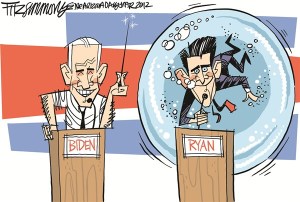
Here we go again!
It’s VP Debate Time!
Here’s some punditry projections and hope-a-cizing!
The outcome of the debate is likely to hinge on whether Biden can hang Ryan’s past positions around his neck, or Ryan is able to dodge and wiggle away from the positions he’s held during seven terms in the House of Representatives.
For his part, Biden enters the debate in the immediate aftermath of Mitt Romney’s post-debate bump in the polls, and needs to have a strong performance to regain some momentum. Obama’s actual performance wasn’t that awful – a snap-poll of 500 undecided voters conducted by CBS at the end of the debate found that a majority thought it was either a draw or that Obama won – but the media narrative following it has been, and Biden needs to change the conversation.
TO: VPOTUS
FROM: Robert Reich
RE: Debate
Beware: Paul Ryan will appear affable. He’s less polished and aggressive than Romney, even soft-spoken. And he acts as if he’s saying reasonable things.
But under the surface he’s a right-wing zealot. And nothing he says or believes is reasonable – neither logical nor reflecting the values of the great majority of Americans.
Your job is to smoke Ryan out, exposing his fanaticism. The best way to do this is to force him to take responsibility for the regressive budget he created as chairman of the House Budget Committee.
Ryan won’t be able to pull a Romney — pretending he’s a moderate — because the Ryan budget is out there, with specific numbers.
It’s an astounding document that Romney fully supports. And it fills in the details Romney has left out of his proposals. Mitt Romney is a robot who will say and do whatever he’s programmed to do. Ryan is the robot’s brain. The robot has no heart. It’s your job to enable America to see this.
I suggest you hold up a copy of the Ryan budget in front of the cameras. You might even read selected passages.
Emphasize these points: Ryan’s budget turns Medicare into vouchers. It includes the same $716 billion of savings Romney last week accused the President of cutting out of Medicare – but instead of getting it from providers he gets it from the elderly.
It turns Medicaid over to cash-starved states, with even less federal contribution. This will hurt the poor as well as middle-class elderly in nursing homes.
Over 60 percent of its savings come out of programs for lower-income Americans – like Pell grants and food stamps.
Yet it gives huge tax cuts to the top 1 percent – some $4.7 trillion over the next decade. (This is the same top 1 percent, you might add, who
have reaped 93 percent of the gains from the recovery, whose stock portfolios have regained everything they lost and more, and who are now taking home a larger share of total income than at any time in the last eighty years and paying the lowest taxes than at any time since before World War II.)
As a result it doesn’t reduce the federal debt at all. In fact, it worsens it.
The deeper we drilled into the regulations in Ryan’s plan, the more they sounded like the very plans he was arguing against.
For instance, he didn’t like that in Obamacare, “You’re having a person design how insurance can be sold.” Then how does his plan make sure people aren’t sold defective products? “In the Patient’s Choice Act, we do an actuarially equivalent minimum in each exchange that’s equal to the Blue Cross/Blue Shield Standard Option.” Well, isn’t that pretty much what Obamacare does?
What followed was health-care word salad. “The Senate bill goes a lot further than that. You need to define what insurance is. I agree with that. But what we’re trying to achieve here is a system in which the patient is the driver of it, not government bureaucrats.” Then how come you’ve got government bureaucrats deciding what insurance is?
In effect, Ryan’s plan and Obama’s plan would regulate insurance products sold through the exchanges in pretty much the same way. But Ryan didn’t want to say that. So he basically offered a lot of convincing sounding words on the topic. If you parse his response, it’s not terribly convincing. But you really need to know the issues to parse his response. The fact that you’ve caught Ryan in a bit of a contradiction doesn’t mean he’s going to admit it.
That said, Ryan is very good at admitting when you’ve got a point. He doesn’t do this when you’ve got a point that undermines his point, but he does it, and generously, when you’ve got a point that he can agree to. He’s also very good at admitting when Republicans have strayed from conservative ideals in the past. You can see that in our discussion of the economy, where he suggests he’s eager to fight Republicans over paying for their budget promises, even though he himself was one of those Republicans voting not to pay for anything in the Bush years.
The result is that, while he’s a highly ideological thinker, he doesn’t come off as particularly ideological. He comes off as an affable, decent, conservative guy who holds strong views, but recognizes that he doesn’t have all the answers and that his party hasn’t always lived up to its promises.
ABC’ Sarah Parnass on “Getting to Know ABC News VP Debate Moderator Martha Raddatz”:
Martha Raddatz was named senior foreign affairs correspondent for ABC News in November 2008 after serving as White House correspondent during the last term of President George W. Bush’s administration. She first joined ABC News as the State Department correspondent in January 1999. Before that, she covered foreign policy, defense and intelligence issues for National Public Radio.
Her coverage has won numerous awards, including the Fred Friendly First Amendment Award this spring.
In her acceptance speech for that award, Raddatz said she wants “people to know about the world.”
“I want people to remember,” she said. “I want people to feel. I want people to question.”
Raddatz has traveled to Iraq to cover the conflict there 21 times. She is the author of a New York Times bestselling book about her experiences there, “The Long Road Home — a Story of War.”
After decades of reporting on foreign affairs, Raddatz said she is honored to sit down with two men who have devoted so much of their lives to public service. Both Rep. Ryan, R-Wis., and Biden first came to Washington in their 20s and have remained there ever since.
NBC News and 10 things to watch for:
Biden told reporters last week that his top priority in preparing for the Thursday debate was a thorough review of Ryan’s budget and policy proposals.
“What I’ve been doing mostly quite frankly is studying up on Congressman Ryan’s positions on the issues,” he said. “And Governor Romney has embraced at least everything I can see.”
Foremost among those positions espoused by Ryan are those contained in the two budgets he authored as House Budget Committee chairman. Several aspects of the original 2011 Ryan budget – which includes a complete overhaul of Medicare – are staples in Biden’s stump speech. He gives visceral examples, telling audiences to imagine their 80-something mothers using “coupons” to shop around for a good insurance deal.
What are you looking for tonight?
ONE hour to go!
Meanwhile you cn watch this great YOUTube by Joseph Cannon our friend at Cannonfire:

 peej
peej Carissa
 bostonboomer
 dakinikat
 ecocatwoman
 mablue2
 Mama Lopez
 peggysue22
 quixote
 skydancingguestblogger
 Mona (aka Wonk the Vote)



 Sky Dancing
Recent Comments