
Monday Reads: Broken Institutions Edition
Posted: March 4, 2024 Filed under: just because | Tags: 2024 Supreme Court Rulings, The Donnie Dotard Club House, US most dysfunctional Advanced democracy 9 Comments Good Day, Sky Dancers!
The big news is that after taking its sweet time, the Supreme Court unanimously decided that states cannot remove Trump from their ballots even though they may have their own version of the 14th Amendment. “Supreme Court keeps Trump on ballot, rejects Colorado voter challenge. While the decision was unanimous, the liberal justices wrote a sharp concurrence that accused the conservative majority of going further than needed.” This is from the Washington Post and reported by Ann E. Marimow.
The Supreme Court on Monday unanimously sided with Donald Trump, allowing the former president to remain on the election ballot and reversing a Colorado ruling that disqualified him from returning to office because of his conduct around the Jan. 6, 2021, attack on the U.S. Capitol.
The justices said the Constitution does not permit a single state to disqualify a presidential candidate from national office, declaring that such responsibility “rests with Congress and not the states.” The court warned of disruption and chaos if a candidate for nationwide office could be declared ineligible in some states, but not others, based on the same conduct.
“Nothing in the Constitution requires that we endure such chaos — arriving at any time or different times, up to and perhaps beyond the inauguration,” the court said in an unsigned, 13-page opinion.
While the decision was unanimous, the court’s three liberal justices also wrote separately, saying the conservative majority went further than necessary in the ruling and decided an issue that was not before the court in an attempt to insulate itself and Trump from “future controversy.”
The court’s decision to keep Trump on the ballot leaves him as the leading candidate for the Republican nomination and for now removes the Supreme Court from directly determining the path of the 2024 presidential election. The justices fast-tracked the challenge from voters in Colorado and issued their decision one day before Super Tuesday, when that state and more than a dozen others hold nominating contests. The ruling applies to other states with similar challenges to Trump’s candidacy.
In a sign of the high court’s awareness of the election calendar, the justices took the unusual step of announcing the opinion on the Supreme Court’s website on a day when the court is not in session, instead of issuing it from the bench later this month.
 I think the high court’s awareness was more based on the intense criticism they are getting right now for slowing down the process of getting Trump into the Federal Court to face charges. Maybe this is a sign of hope that we’ll hear their take on “Presidential Immunity.” Plus, Clarence Thomas is facing denunciation for his absolute refusal to recuse himself from participating in cases where he has apparent conflicts of interest. Liz Dye at Public Interest makes it even more pronounced. “The Supreme Court saves Trump’s bacon.”
The Supreme Court sparked general outrage last week when it agreed to hear Donald Trump’s claim of absolute presidential immunity in his election interference case, with commentators predicting the end of democracy as we know it if the Court rules that a president is immune for crimes committed while in office.
Histrionics serve no one, however, and so it bears speaking plainly: The Supreme Court is not going to find that Donald Trump is immune from prosecution for crimes committed in office. That’s ridiculous.
But the Court’s right-wing majority is going to run exactly the same playbook they did in 2020, when they gifted the then-president almost two years of delay in turning over his financial documents to prosecutors in New York and investigators in Congress. By the time Trump wound up having to comply, he was already out of office.
This time, the consequences of delay will be even more profound. Thanks to the Supreme Court, Trump will now be able to stand for election again without facing trial for his attempts to overturn the last one.

The Supreme Court has joined the House of Representatives in becoming a dysfunctional, political, conflicted institution. The Washington Diplomat had this blunt headline last month. “US political dysfunction a threat to world stability: report.” We can no longer be trusted to behave like a developed, functioning democracy. This loss cannot be overstated in historical terms or ramifications. They refer to the US as the world’s most “dysfunctional advanced democracy.”
Many in the United States look beyond their borders and see a dangerous world with raging wars, surging violence and deepening instability.
But a new report by the Eurasia Group, a leading political risk firm, suggests that Americans would be well advised to look in the mirror and recognize that political dysfunction and threats of violence in the United States are frightening people around the world and constitute a serious threat to international stability.
“Fully one-third of the global population will go to the polls this year, but an unprecedentedly dysfunctional U.S. election will be by far the most consequential for the world’s security, stability, and economic outlook,” the Top Risks 2024 report argues.
“The outcome will affect the fate of 8 billion people, and only 160 million Americans will have a say in it, with the winner to be decided by just tens of thousands of voters in a handful of swing states… The world’s most powerful country faces critical challenges to its core political institutions: free and fair elections, the peaceful transfer of power, and the checks and balances provided by the separation of powers.”
The Eurasia Group, which was created in 1998 by political scientist and entrepreneur Ian Bremmer, analyzes global affairs through the prism of political developments and risks. Bremmer, the president of the Eurasia Group, and Cliff Kupchan, its chairman, are the authors of this year’s report, which outlines the 10 top risks the world faces. The report also discusses several issues that are less serious than they appear.
“Three wars will dominate world affairs: Russia vs. Ukraine, now in its third year; Israel vs. Hamas, now in its third month; and the United States vs. itself, ready to kick off at any moment,” the report says.
Political polarization and social disarray in the United States are seen in the report as the most serious global risk. It predicts that this year’s presidential election “will worsen the country’s political division, testing American democracy to a degree the nation hasn’t experienced in 150 years and undermining U.S. credibility on the global stage.”
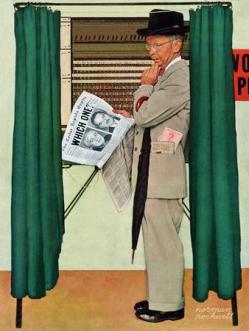
“Undecided” November 4, 1944. Man in voting booth w/newspaper. by Norman Rockwell
In a June 2023 article at The Atlantic, Peter Turchin writes “America Is Headed Toward Collapse. History suggests how to stave it off.”
How has America slid into its current age of discord? Why has our trust in institutions collapsed, and why have our democratic norms unraveled?
All human societies experience recurrent waves of political crisis, such as the one we face today. My research team built a database of hundreds of societies across 10,000 yearsto try to find out what causes them. We examined dozens of variables, including population numbers, measures of well-being, forms of governance, and the frequency with which rulers are overthrown. We found that the precise mix of events that leads to crisis varies, but two drivers of instability loom large. The first is popular immiseration—when the economic fortunes of broad swaths of a population decline. The second, and more significant, is elite overproduction—when a society produces too many superrich and ultra-educated people, and not enough elite positions to satisfy their ambitions.
This is a long read but worth your time. Several events point to the shift in power due to our dysfunctional federal institutions. NATO is just one of the institutions that a return of Trump will endanger. This is from The Guardian. “Norway, Sweden, and Finland host NATO military exercises. Nordic Response aims to strengthen cooperation between countries and bolster alliance’s ability to defend region.”
Trump complains that NATO nations are slackers. The Europeans more than understand the current threat from Putin’s Russia. NATO must stand united with its most significant military defender of democracy in place for the continent to be safe. Miranda Bryant reports on the event.
A first-of-its-kind training exercise involving more than 20,000 soldiers from 13 countries has launched across northern Norway, Sweden and Finland as the region prepares to become a fully Nato territory within days.
The joint defence exercise, which runs until 14 March, was previously known as Cold Response and held in northern Norway, a founding Nato member, every other year. In recognition of Finland’s recent membership of the western military alliance, and with Sweden expected to join imminently, this year it is being designated Nordic Response for the first time.
The training exercise across air, land and sea – which will also include soldiers from the UK, US, Denmark, France, Germany, Italy, Spain, the Netherlands, Belgium and Canada – will incorporate a cross-border operations exercise in the Arctic Circle.
The Norwegian military said the exercise was intended to demonstrate “a unique level of cooperation and interoperability as they cross borders on land, sea and air”.
Nordic Response is part of an ongoing series of Nato exercises, Steadfast Defender, involving 90,000 soldiers. It is also closely aligned with the UK-led naval exercise Joint Warrior, which ran between Scotland, Norway and Iceland last week.
The latest exercise, which started on Sunday, will involve more than 50 submarines, frigates, corvettes, aircraft carriers and amphibious vessels at sea, over 100 combat, maritime surveillance and transport aircraft, and thousands of soldiers on the ground using artillery systems, tanks and tracked vehicles.
Most of the activity will be centred on northern Troms county and the west of Finnmark county in Norway, but there will also be maritime activity along the coast of the north of the country and exercises across borders in northern Finland and Sweden.
The newly elected Finnish president, Alexander Stubb, the Norwegian prime minister, Jonas Gahr Støre, and the Swedish crown princess Victoria are all scheduled to visit.
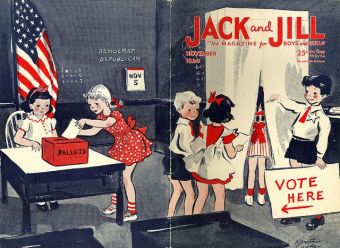
November 1940, illustrated by Dorothea Cooke.
There are many headlines today about how Trump is more trusted than Biden and rated as better at handling all kinds of things, including the economy. Then there’s the Biden is ‘too old’ headlines (”Biden’s mental acuity is doubted by 6 in 10 Americans, AP-NORC survey finds” via the AP) concurrent with headlines like this one from The Independent. Trump crowd goes silent as he confuses Biden and Obama again.”
They’re both too damn old, frankly Plus, some wonderful people aren’t stale old white men out there. But please, Biden is sane and moral. Trump has the worst personality disorders possible and definitely has dementia. Plus, Trump cheats at everything and lies about it! Here’s the latest on the Trump Team’s campaign of deceit. And yes, it’s yet another headline from across the pond. They are old buddies, the Brits. The BBC reports that “Trump supporters target black voters with faked AI images.” This is on top of Russia outwardly influencing Republican Congress members!
Donald Trump supporters have been creating and sharing AI-generated fake images of black voters to encourage African Americans to vote Republican.
BBC Panorama discovered dozens of deepfakes portraying black people as supporting the former president.
Mr Trump has openly courted black voters, who were key to Joe Biden’s election win in 2020.
But there’s no evidence directly linking these images to Mr Trump’s campaign.
The co-founder of Black Voters Matter, a group which encourages black people to vote, said the manipulated images were pushing a “strategic narrative” designed to show Mr Trump as popular in the black community.
A creator of one of the images told the BBC: “I’m not claiming it’s accurate.”
The fake images of black Trump supporters, generated by artificial intelligence (AI), are one of the emerging disinformation trends ahead of the US presidential election in November.
Unlike in 2016, when there was evidence of foreign influence campaigns, the AI-generated images found by the BBC appear to have been made and shared by US voters themselves.
One of them was Mark Kaye and his team at a conservative radio show in Florida.
They created an image of Mr Trump smiling with his arms around a group of black women at a party and shared it on Facebook, where Mr Kaye has more than one million followers.
How do people not see this man’s severe Personality Disorders? I will end here with a political analysis from the Washington Post by Philip Bump. “The institutions of government aren’t going to protect democracy.” This is why it is up to ‘We the People’ to fucking VOTE! If I can hold my nose to vote for Biden twice, you certainly can, too!
The effort to reframe Trump’s actions as understandable, if not acceptable, has been broadly successful. It is not only the case that most Republicans think that Biden’s election was illegitimate, it is also the case that traditional media outlets have at times treated as controversial not the question of whether Trump met the unclear standard of “insurrection” but even whether he tried to subvert the election results. Other Republicans have internalized the idea that the way in which Trump responded to his loss was within the bounds of acceptability — not only by petulantly refusing to concede defeat but by treating the relentless, norm- and law-bending effort to wring victory from defeat as part of the process of winning power.
Because there has been no accountability for Trump.
On Monday morning, the Supreme Court offered its assessment of a state Supreme Court decision in Colorado barring Trump from the ballot. Unsurprisingly — given the ideological constitution of the court — it declined to endorse the idea that Trump was ineligible to hold the presidency. But the decision was unanimous.
“Responsibility for enforcing Section 3 against federal officeholders and candidates rests with Congress and not the States,” the decision read. “The judgment of the Colorado Supreme Court therefore cannot stand. All nine Members of the Court agree with that result.”
Justice Amy Coney Barrett emphasized that latter point again in a concurrence.
“All nine Justices agree on the outcome of this case,” the Trump appointee wrote. “That is the message Americans should take home.”
But several liberal members of the court added some nuance, arguing that the conservative majority also decided “novel constitutional questions to insulate this Court and petitioner” — that is, Trump — “from future controversy.”
“Today, the majority goes beyond the necessities of this case to limit how Section 3 can bar an oathbreaking insurrectionist from becoming President,” Justices Sonia Sotomayor, Elena Kagan and Ketanji Brown Jackson write. “Although we agree that Colorado cannot enforce Section 3, we protest the majority’s effort to use this case to define the limits of federal enforcement of that provision.”
The superficial agreement on the decision erodes in the details, which isn’t uncommon. The result, though, is that the institution of the Supreme Court has decided that the institution of Congress is the only element of the American system that can apply the 14th Amendment to a candidate. And Congress, very obviously, won’t do so for Trump.
One would assume that a democratic system predicated on checks and balances would have some process in place to enforce punitive measures when democracy itself was threatened or undermined, but it does not. It has decisions from motivated actors, enough of whom agree politically or ideologically with Trump that his specific actions are waved away. Instead of a defense of democracy, we are repeatedly asked to believe that anything short of Trump retaining power doesn’t count as a substantive challenge to democracy and, therefore, that his participation in the democratic process should be defended.
Had he retained power after Jan. 20, 2021? Then, perhaps, his efforts to do so would have been considered a legitimate threat. And by then, the system that we would assume might hold him to account would already be destroyed.
What’s on your reading and blogging list today?

 peej
peej Carissa
 bostonboomer
 dakinikat
 ecocatwoman
 mablue2
 Mama Lopez
 peggysue22
 quixote
 skydancingguestblogger
 Mona (aka Wonk the Vote)



 Sky Dancing
Recent Comments