
The Year of Dangerous Rhetoric
Posted: March 7, 2011 Filed under: Federal Budget, U.S. Economy | Tags: John Boehner, Treasuries, US government debt 25 Comments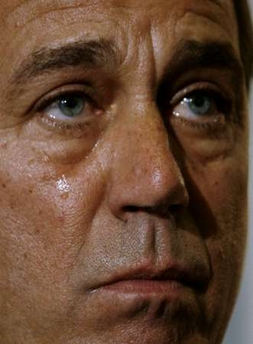 Pols always seem to use over-the-top rhetoric when trying to get elected. We’ve had smear campaigns and unfulfilled campaign promises for as long as there has been some one running for an elected office. Journalists enjoy making headlines out of this rhetoric and we’ve entered an age where they don’t even hesitate to join in on the pitch. The Supremes have upheld free speech rights for NAZIs parading in Jewish neighborhoods, opportunistic gay hating religionists spewing bile at the funerals of US soldiers, and megacorporations. No one wants to draw any lines on freedom of expression these days.
The first amendment is a beautiful thing. So is, however, self-restraint. Just because you have a broad right, a big mouth, and some urge to purge doesn’t necessarily mean you should avail yourself of the opportunity. This was always made clear to me as a kid with the example of ‘Don’t yell fire in a crowded theater if there’s no fire’. Evidently Weeper of the House John Boehner slept through that part of the social studies curriculum.
Markets–especially financial markets–thrive on information. Financial markets even trade on them. I remember working in the Treasury area of a large savings and loan in the 1980s while we were trying to package and sell mortgages, hedge using GNMA futures, and then price jumbo CDs to customers. All of this was in the era of Paul Volcker and yo yo interest rates. The Fed used to make announcements on Friday afternoons. The entire market would shut down in anticipation of the Fed’s announcements. The last few hours of business would screech to a halt until the information came out. We had one bond salesman that used to call us and read us jokes from a file box during the waiting hour. It was a weird time for all.
The Fed noticed how disruptive that was and ended the practice. Current Fed Chair Bernanke is so aware of how his words impact the market he even has a policy of ‘managing expectations’ in that he always makes some kind of statement on monetary policy when releasing any information. He also does speeches to businesses where he clarifies how the Fed will be dealing with the markets for Treasuries. This is supposed to end a lot of instability and speculation that can damage investment positions unnecessarily. You really don’t want to mess with Treasury markets because they represent the base, risk-free rate upon which everything else gets priced.
That brings me to to a few people in politics that don’t seem to connect market instability to policy maker rhetoric. It seems every one has learned that lesson except the outrageous Speaker of the House John Boehner who appears to want to make the markets as shaky as his hands.
House Speaker John Boehner routinely offers this diagnosis of the U.S.’s fiscal condition: “We’re broke; Broke going on bankrupt,” he said in a Feb. 28 speech in Nashville.
Boehner’s assessment dominates a debate over the federal budget that could lead to a government shutdown. It is a widely shared view with just one flaw: It’s wrong.
“The U.S. government is not broke,” said Marc Chandler, global head of currency strategy for Brown Brothers Harriman & Co. in New York. “There’s no evidence that the market is treating the U.S. government like it’s broke.”
The U.S. today is able to borrow at historically low interest rates, paying 0.68 percent on a two-year note that it had to offer at 5.1 percent before the financial crisis began in 2007. Financial products that pay off if Uncle Sam defaults aren’t attracting unusual investor demand. And tax revenue as a percentage of the economy is at a 60-year low, meaning if the government needs to raise cash and can summon the political will, it could do so.
Speaker Boehner’s staff answers any criticism of his rhetoric with the usual false equivalency. Interestingly enough, the Bloomberg article I’m quoting is finally taking on the ridiculousness of equating our government with family finances. Every financial economist loses a bowtie whenever that happens.
“If an American family is spending more money than they’re making year after year after year, they’re broke,” said Michael Steel, a spokesman for Boehner.
A person, company or nation would be defined as “broke” if it couldn’t pay its bills, and that is not the case with the U.S. Despite an annual budget deficit expected to reach $1.6 trillion this year, the government continues to meet its financial obligations, and investors say there is little concern that will change.
Still, a rhetorical drumbeat has spread that the U.S. is tapped out. Republicans, including Representative Ron Paul of Texas, chairman of the House domestic monetary policy subcommittee, and Fox News commentator Bill O’Reilly, have labeled the U.S. “broke” in recent days.
Chris Christie, the Republican governor of New Jersey, said in a speech last month that the Medicare program is “going to bankrupt us.” Julian Robertson, chairman of Tiger Management LLC in New York, told The Australian newspaper March 2: “we’re broke, broker than all get out.”
The U.S. government is not one big dysfunctional family unit. People die. Their estates have to be settled. They can’t print money. They can’t tax any one else’s assets. Their incomes don’t grow in perpetuity into the trillions of dollars. Politicians who continually make this false equivalency are not only wrong, they are dangerously wrong.
When Governor Christie makes these ridiculous statements the biggest damage he can do is limited. At the very worst, the market may price New Jersey’s bond issues as riskier. The resale market for NJ bonds may get thinner. This is especially true if Christie shows any willingness to entertain the idea of state bankruptcy which at this point can’t even happen. If he shows unwillingness to use the state’s taxing powers to clear up the mess, he can also create some havoc in the market. Every one knows a government can get the funds to pay its debt one way or another. Showing the world you won’t do it in a timely way just makes your bondholders extra nervous.
Speaker of the House Boehner has a bigger job that includes the budget of the U.S. He can unnecessarily influence financial markets while repeating such craziness. The U.S. cannot technically go bankrupt but speculation and uncertainty can impact the rate of interest we will pay on our debt. It can also cause the FED to enact money supply increases to maintain low levels of interest which can create inflationary pressures. Boehner is at a level of power that careless political rhetoric can influence markets. He needs to be more mature and less cavalier with his ignorant pronouncements on US debt and the US economy.
I swear that these guys are purposefully trying to tank the economy.

 peej
peej Carissa
 bostonboomer
 dakinikat
 ecocatwoman
 mablue2
 Mama Lopez
 peggysue22
 quixote
 skydancingguestblogger
 Mona (aka Wonk the Vote)



 Sky Dancing
Recent Comments