
Currency Devaluations + Nifty Graph
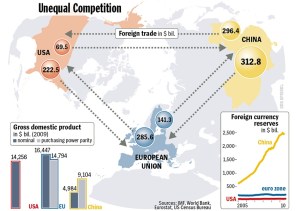
Posted: November 5, 2010 Filed under: Global Financial Crisis | Tags: APEC, currency devaluation, trade imbalances 8 CommentsYou had to know that it was eventually coming. I can’t pass up the chance to use a nifty graph for discussing stuff surrounding economics. This is from Der Spiegel. It will show you the value of trade between the U.S., China and the Eurozone plus a few other stylized facts. One set of data is GDP which is in the table down in the left. The other set in the right corner is foreign currency reserves which is a bunch of money sitting out there with lots of places to go. That is, unless you don’t have a pile and the EU and the U.S. don’t have a pile. (China had been using its pile to purchase U.S. Treasuries. )
 Here’s a bit of a primer on APEC from the WSJ. The issues of currency devaluation and QE2 are bound to come up, eventually.
Korn, noting that many Asian central banks have been intervening to defend the dollar and slow their own currencies’ rises, complained that the baht’s 11% gain this year is hurting Thai exporters by making them less price-competitive.
In one possible rift, APEC ministers from Southeast Asia countered a U.S. push to quantify the goals for reducing imbalances. At the recent G-20 meeting, the U.S. sought to specify that countries would aim to limit their current-account imbalances to 4% of gross domestic product by 2015, but the group rejected putting any numbers on what were watered down to “indicative guidelines.”
Members of the Association of Southeast Asian Nations, meeting on the APEC sidelines, were set to warn that such a move would promote protectionism and hamper free trade.
“Asean has concerns that specific targeting of the current account could lead to measures being employed that may be detrimental to the principle of free trade,” says a draft statement from the group, seen by Dow Jones.
The Asean ministers are likely to take this issue up with U.S. Treasury Secretary Timothy Geithner early Saturday.
If you’d like to learn more about Currency Devaluation and Revaluation, here’s a link to a short FAQ from the NYFED.
Under What Circumstances Might a Country Devalue?
When a government devalues its currency, it is often because the interaction of market forces and policy decisions has made the currency’s fixed exchange rate untenable. In order to sustain a fixed exchange rate, a country must have sufficient foreign exchange reserves, often dollars, and be willing to spend them, to purchase all offers of its currency at the established exchange rate. When a country is unable or unwilling to do so, then it must devalue its currency to a level that it is able and willing to support with its foreign exchange reserves.A key effect of devaluation is that it makes the domestic currency cheaper relative to other currencies. There are two implications of a devaluation. First, devaluation makes the country’s exports relatively less expensive for foreigners. Second, the devaluation makes foreign products relatively more expensive for domestic consumers, thus discouraging imports. This may help to increase the country’s exports and decrease imports, and may therefore help to reduce the current account deficit.
There are other policy issues that might lead a country to change its fixed exchange rate. For example, rather than implementing unpopular fiscal spending policies, a government might try to use devaluation to boost aggregate demand in the economy in an effort to fight unemployment. Revaluation, which makes a currency more expensive, might be undertaken in an effort to reduce a current account surplus, where exports exceed imports, or to attempt to contain inflationary pressures.
The APEC meetings are going on now and we’re sure to get some news in the morning.

 peej
peej Carissa
 bostonboomer
 dakinikat
 ecocatwoman
 mablue2
 Mama Lopez
 peggysue22
 quixote
 skydancingguestblogger
 Mona (aka Wonk the Vote)



 Sky Dancing
Recent Comments