
Corporate Journalism is Killing our Democracy
Posted: June 14, 2012 Filed under: The Media SUCKS, the villagers | Tags: Times Picayune 18 Comments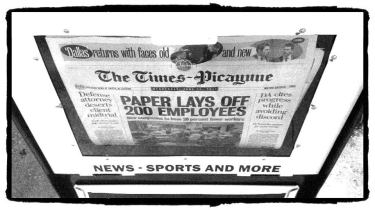 The time would be now for those of us that recognize the integral and historic relationship between our history as a republic and a democracy and our news papers and pamphleteers to recognize the need for drastic measures. Perhaps it is time to consider our local newspapers and television stations to be community assets and mount movements to make them mutual organizations or nonprofits. The historic trashing of the Times Picayune by the Newhouse corporation looking for more profits–as is their nature–should serve as a warning to all US cities. Your ability to know more about your local governments, your local citizens, and your community is at risk.
There are some things that are too important to be left to the profit motive.
Judy Woodruff of New Hour interviewed the TP Editor who insists that our ability to know will not be hampered by not only less access to the paper–many of our poorest do not have access to the internet version–and less staff. The TP is 175 years old. It’s one of the oldest newspapers in the country.
JIM AMOSS, editor, The New Orleans Times-Picayune: Many readers can’t imagine a morning without our newspaper in their hands. I understand that. I’m a print guy. I grew up in this business.
JUDY WOODRUFF: The Times-Picayune’s parent company, Advance Publications, also announced layoffs at three Alabama newspapers: The Birmingham News, The Press-Register in Mobile, and The Huntsville Times. Together, they will lose 400 employees.
The cuts and the changes are all a far cry from 2005, when Hurricane Katrina ravaged New Orleans. The Times-Picayune became a lifeline to those trying to recover and rebuild. Seven months later, Loyola University communications professor Larry Lorenz underscored that vital role in a conversation with the NewsHour’s Jeffrey Brown.
LARRY LORENZ, Loyola University: In the Civil War era, Oliver Wendell Holmes, the father of the later Supreme Court justice, wrote an essay called “Bread and the Newspaper.” And in it, he said, bread and the newspapers, we must have.
JEFFREY BROWN: So you have got to eat and people need information?
LARRY LORENZ: You bet. The information that’s in the newspaper feeds us as much as the bread feeds us.
JUDY WOODRUFF: But now, like a growing number of newspapers nationwide, The Times-Picayune faces a fight for survival.
Our city is not taking this quietly. This link comes via Morning Edition at NPR. You’ll notice a pattern here on exactly where I’m having to go to get news on this story. It’s not going to come from the right wing propaganda machine at Fox News. It’s not coming from other US papers either.
What happens when a media company wants to take away your daily newspaper? In New Orleans, you take to the streets.
A recent rally to preserve daily publication of the Times-Picayune featured high-profile musicians including Kermit Ruffins, whose sang a jazzy tune invoking the name of the 175-year-old paper. It’s part of a campaign launched by New Orleans’ most prominent residents and powerful leaders to save the Times-Picayune, a cultural institution in a city that gives high credence to tradition.
“It’s a morning ritual,” said Constable Lambert Boissiere, a former city councilman and state senator. “You know, you get the paper, get your cup of coffee, have you a little breakfast or whatever, paging through the articles you want to read. Then you had the conversations at lunch about the things you read in the paper.
“So that’s going to be gone,” Boissiere said. “I can’t imagine myself and my friends sitting in front of the computer every morning, going through the different sections to read the articles. I don’t see that happening.”
The cuts at the paper are part of a restructuring by Advance Publications, a Newhouse company, that will shift to three-day print editions and an emphasis on online news.
But more than a third of New Orleans residents don’t have Internet access, raising questions about how poorer and older citizens will keep up with news or even the local obituaries. Rituals aside, Boissiere said, the timing is terrible.
“We finally cleaned up our act since Katrina. We got business coming back. Our athletics things, with the Hornets and the Saints, we got a Super Bowl, we had Final Four, everything,” he said. “We’re getting to be a big city again. And then to lose a daily paper, I think it’s a bad signal affecting the growth of the city.”
Concerned civic leaders have banded together to put pressure on Newhouse to rethink its plan.
I personally am watching friends that have worked for the paper for decades collect their pink slips. It’s heartbreaking. It also raises an obvious question. This can’t be just about stopping a printing press. An internet-based paper still requires writers and photographers, doesn’t it? HuffPo is following the story.
Overall, the paper reported that it was laying off a third of its staff, totaling 202 employees. The Gambit newspaper said that 49 percent of the newsroom was being let go.
Katy Reckdahl, a laid-off reporter, spoke to the local WWL news station about the changes. “I guess I’m trying to figure out how I didn’t fit into the new organization,” she said. “I think they’ve torn apart an institution,”
As the ax continued to fall, Jim Amoss, the paper’s editor, posted a video on the T-P website.
“This is a difficult week at our paper,” he said. “We’ve had to let go of some wonderful employees. It is a painful transition.”
Amoss said that the paper was not “immune” from the broader economic climate facing newspapers, and that “news organizations that don’t serve a digital audience as well as their print readers risk a slow death.”
Renee Peck, a former T-P writer, reported that heart-rending scenes were being played out within the newsroom:
The first to go early this morning was a longtime copy editor who, ironically, has been overseeing online content for the past decade. When she burst into tears at the news, the supervisor in charge seemed unprepared, and had to duck into the ladies’ bathroom for paper towel.Employees who were laid off were offered severance packages; if they choose to accept the buyouts, they must work at the paper until Sept. 30.
The cuts at the Alabama papers, which are making a similar digital transition, were even more savage. Poynter reported that one paper, the Birmingham News, is seeing its newsroom cut by a shocking 60 percent, with 400 employees let go across all three papers affected by cuts.
Here’s a CBS story about what I’ve been seeing on my FaceBook feed for the past two days.
Job casualties in New Orleans included some of the city’s most experienced writers and photographers, many of whom announced their own departure on a Facebook page by simply posting “-30-,” an old copy editor’s code for “end of story.”
Peter Finney, a sports writer for the paper since 1945, is being laid off but has been asked to write a freelance column, the paper said. Managing editors Peter Kovacs and Dan Shea, among the newsroom leaders during the paper’s Pulitzer Prize winning coverage of Hurricane Katrina’s aftermath, have not been asked to stay. Brett Anderson, the current restaurant critic for the food-obsessed city, is leaving for a fellowship.
Employees who took part in Tuesday’s meetings described an emotional scene that played out over the course of the day among colleagues who have worked together for many years.
Reporter Barri Marsh Bronston said she was being let go after 31 years.
“These last three weeks have been unbearable, but I’m feeling a sense of relief right now,” she said in a post on Facebook. She did not want to be interviewed but gave permission for her comment to be used.
Throughout the day, employees met with various managers and were told either that they would have a job with the new company, Nola Media Group, or they were offered severance packages. Some will later be able to apply for positions in the new operation, the paper said.
Corporations and their single minded pursuit of profits are the country’s most prolific sociopaths and serial killers. It’s time to revive an old time corporate form. Companies that are responsible for public trust should most likely be owned by stakeholders and not just money hungry investors. I want our villagers back.

 peej
peej Carissa
 bostonboomer
 dakinikat
 ecocatwoman
 mablue2
 Mama Lopez
 peggysue22
 quixote
 skydancingguestblogger
 Mona (aka Wonk the Vote)



 Sky Dancing
Recent Comments