
How many S’s in a Senate Sentimental Statement make for a Symbolic Surreal Exercise in inSanity?
Posted: July 6, 2011 Filed under: Domestic Policy, Economy | Tags: deficit, Democratic spinelessness, Tax Cuts for Billionaires 9 Comments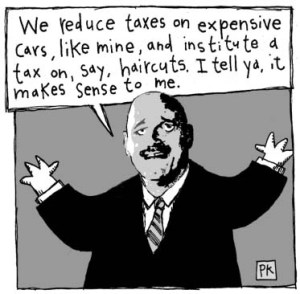 Harry Reid has introduced a bill called the “Sense of the Senate on Shared Sacrifice”. It basically has no recommendations, suggestions, policy measures, or required action. It is symbolic surreality at best and an exercise in serious alliteration. I can frankly hear Daffy Duck adding “suffering succotash” to the end. Hisssssssss.
The Senate as early as Wednesday could vote on a “Sense of the Senate” bill that says taxpayers earning $1 million or more each year should “make a more meaningful contribution to the deficit-reduction effort.”
…
The bill has no specific recommendations on how much taxes should be raised on high-income earners, and is simply a recommendation that these taxpayers pay more. Because the 60 votes needed to end debate are unlikely to materialize, the vote will likely be used by Democrats as a way to show Republican resistance to new tax hikes.
Democrats might also try to use the vote as leverage in negotiations on how to raise the debt ceiling by showing that there is support for a tax increase. In those talks, which are expected to continue this week, Democrats have said taxes on the wealthy and on oil companies should be part of the equation for reducing the deficit. Republicans have so far rejected this, and argue that an agreement needs to focus solely on spending cuts.
Now I’m all for meaningful displays of protest and performance art but I’m not alone in thinking this is shallow grandstanding. Here’s the sentiment of Greg Sargent on the subject. Did I mention the word Surreal is his subject head?
So it’s come to this. Republican opposition to any kind of revenue increase as part of the deficit deal has grown so implacable that Dems will now hold a Senate vote tomorrow on the basic idea that millionaires and billionaires should help contribute to fixing our deficit.
It’s not a vote on any specific proposal to hike taxes or end tax breaks. Rather, it’s a vote that puts each Senator on record on the general question of whether the rich should sacrifice in service of deficit reduction.
According to a Dem leadership aide, Senate Democrats have decided, as expected, to proceed with a vote tomorrow on a resolution that would declare that it is the “sense of the senate” that those who make $1 million or more per year should “make a more meaningful contribution to the deficit reduction effort.”
The vote — a cloture motion on the question of whether to proceed to an up-or-down vote on this resolution — is designed to put Repubicans on the spot. The idea is to force GOPers to go on the record choosing between declaring general support for more sacrifice from the wealthy — which in theory could strengthen Dem leverage in the talks — or reveal that they’re ideologically hostile to the notion that the rich should sacrifice anything to fix our fiscal mess. Dem Senators are holding a presser this afternoon to push the issue.
That this vote is happening at all perfectly captures just how surreal this debate has become. Democrats have agreed to over $1 trillion in spending cuts, and have reportedly agreed to tens of billions in Medicare cuts as part of that package. The American people have declared in poll after poll after poll that they think the deficit should be addressed through a combination of spending cuts and tax hikes. Yet Republicans are simply refusing to entertain the possibility of any revenue increases of any kind — to the point where even conservative columnists like David Brooks are growing seriously alarmed by the anti-tax fanaticism that’s on display.
Here’s David Dayen’s take at FDL. (Notice, I’ve decided to can the alliteration. It was getting way to easy and annoying.)
I’m actually all for nakedly political votes. This bill does not put anything into law, does not actually force millionaires to make a “more meaningful contribution” to deficit reduction. All it does is force Republicans onto the side of millionaires. If used successfully, that’s a fine vote to have for the next several cycles, and is sure to come up in television ads. Politics must be played sometimes.
But let’s not pretend that this is a “millionaire’s tax bill.” There was an opportunity to put a millionaire’s surtax in the Democratic budget; Kent Conrad will deliver a budget with a balanced approach between taxes and spending, but that surtax was dropped. There are a series of ideas about ending tax breaks for corporate jet owners, but I don’t know if you can even call them “meaningful.” Especially when you put them against the potential for $500 billion in Medicare and Medicaid cuts – just a year after a separate set of $500 billion in cuts to Medicare Advantage overpayments and other fat-trimming from Medicare – and another $100 billion through changing the COLA formula for Social Security beneficiaries. That adds up to twice as much in deficit reduction from seniors, the poor and the disabled than from the sum total of all revenue raisers on the table.
And anyway, none of those revenue raisers will be voted on in this sense of the Senate legislation. It just says that millionaire contributions would be a good idea. I assume then that the plan is to approach the millionaires individually.
My take is that if it’s such a good idea, then Reid should actually do something about it. He should’ve done something about it last winter when Obama was selling out on the Dubya Bush tax cut extensions. Our government shouldn’t be a person on the street with a tin cup. Congress spent all this damned money on all those wars and handed out all those ridiculous tax loop holes. Frankly, I’m with Katrina vanden Heuvel who thinks Obama and the Democrats should just invoke the 14th amendment and tell the Republicans to go to hell. Enough of this symbolic shit! Send Rubio, Ryan, and Boehner to the moon!
More on Food and Energy Prices
Posted: March 23, 2011 Filed under: Economy, the villagers, unemployment, voodoo economics, We are so F'd | Tags: economics, food insecurity, Tax Cuts for Billionaires, trust fund babies., volatile commodity prices 12 Comments I wrote a post recently on why the overall inflation rate remains low and why core inflation is very low while food and energy prices are on the rise. I know this seems baffling. Research Economist Daniel Carroll from Fed Cleavland has some more details and analysis on this so I thought I’d take the opportunity to share it with you. I also have a bit of rant, so be patient with me.
First, you can see the underlying volatility in recent energy prices in the nifty graph to the right. This volatility is one of the reasons that many economists prefer the core inflation measures to something like the CPI. People adjust their driving and car buying habits when gas prices are high and the CPI doesn’t catch the corresponding buying shifts because it’s based on a fixed basket of purchased goods and services thought to represent a typical urban consumer at that time. People will drive more when gas prices are low and they’ll cut out unnecessary trips when prices are high at the pump. Also, commodity prices tend to have seasonality and they experience a lot of shocks that make them have higher than normal price variations. Think weather, political unrest, and other uncontrollable black swan events.
You can also see from the graph a lesser degree of volatility in food prices coupled with the underlying, increasing trend. The job of economists is to try to run models that look at the trend that has occurred over time and to search for corresponding explanatory variables. The other analysis that is frequently done is finding out who is impacted by these changes. I mentioned that food and energy inflation hurts poor people the most because it represents a big portion of their budgets and incomes. Carroll’s analysis includes some specifics on that .
It should not come as a surprise that people are particularly concerned about increases in food and energy prices, whether the increases are large or small. Not only do energy prices pass through to other prices, but household expenditures on food and energy make up a significant fraction of total household expenditures. Data from the BLS Consumer Expenditure Survey show that on average from 1999 to 2009, energy (including motor fuel) and food at home accounted for more than 15 percent of total expenditures and 13 percent of after-tax income.
The importance of food and energy prices to households’ bottom lines is not evenly distributed across the income distribution either. For the median household, food and energy are roughly 17 percent of both expenditures and after-tax income. Households in the top 20 percent of the income distribution spend 11.6 percent of total expenditures on food and energy, which adds up to 7.9 percent of disposable income. For the bottom 20 percent these shares rise to 20.4 percent of expenditures and a whopping 44.1 percent of after-tax income!
For those astutely wondering why food and energy expenditures are a larger fraction of total expenditures than of total income for the bottom 20 percent, there is a much higher fraction of households in this quintile which may be using savings and credit markets to consume above their annual income. Likely categories are the unemployed, business owners with temporary losses, students living on loans, and retirees drawing down their nest eggs.
There are two other nifty graphs at that site that show the impact of food and energy prices on the bottom twenty percent–quintile–of all households in terms of their incomes and budgets. It’s really disturbing to see the impact in bright red and blue. Increased prices in key budget items force many of these people over the edge. Because many poor people have no control over the amount of money they earn, these people are more likely to run up credit cards, decrease contributions to retirement savings, or sell off assets. They can also end up on the street and on public programs. Increases in food and gas basically drive the poor further into the ground.
This brings me to the policy implications. First, any state with a huge proportion of poor or elderly that derives income from sales taxes on these items is basically creating and perpetuating its own underclass. It is much more likely they will see increases in populations needing state assistance under these circumstances. This situation gets worse as it continues. Second, attempts to remove subsidies for the poor and elderly for their home heating and air conditioning costs will do the same thing or worse. It’s really difficult for me to understand why we subsidize large banks using bad lending practices to stop them from bankruptcy but some policy makers tout cuts in programs helping the poor pay outrageous gas and light bills or providing increased subsidies to programs like WIC. Republicans–you know, the fetus fetishists?–want to cut WIC by 10%.
At this point, I could even justify cutting rebate checks of $300-$500 for all those households with incomes in the bottom income quintile just to help them with food and energy bills. I know this is unlikely to happen. It would also provide a slight boost to local economies since this is the income group that is least likely to save and most likely to spend the money on basics. I’m not a big supporter of tax rebates because they generally just go to pay down debt and have very little economic impact. This would be different since it’s aimed solely at people who need to spend the money. It’s also aimed at helping a few people stay in their situation long enough to avoid perpetual dependency on state largess.
This brings me to one more item for you to discuss. There were two articles recently pushing the canard that lower taxes for rich people increase revenues to governments (false) and that low taxes are ?good” for the overall economy(false too). One was a WSJ editorial by trust fund baby Steve Forbes that once again tries to resurrect the much discredited Laffer curve and empirically challenged view of Reaganomics. You already know the antics of trust fund baby David Koch who feels persecuted because of the blowback on his war on nonbillionaires. The other baby of privilege wrecking havoc in Republican political circles is Grover Norquist. All three of these guys come from very rich parents, breezed into ivy league educations as legacies with parents who could buy them in regardless of grades and inherited enough money and gave them ready made businesses run by competent others. Now, they can spend their useless lives undermining any policy that takes anything from their pockets and boosts their cred on the Forbes 50 list. There are also some op ed pundits–Thomas Friedman comes to mind–with similar set ups. Here’s how they spend their lives and their daddies’ money.
According to a report in The Hill newspaper, Americans for Tax Reform president Grover Norquist has received assurances from Republican leaders in Congress that under no circumstances will they vote for any tax increase, either as part of deficit reduction or tax reform. Apparently, the only permissable deficit reduction is spending cuts and the only permissable tax reform is tax cuts. Given that Grover has succeeded in getting all but a small handful of Republicans to sign his no-new-taxes pledge, he essentially controls tax policy by being the sole arbiter of what constitutes a violation of the pledge and what does not. And given the power of the Tea Party to upset incumbent Republicans in primaries when they are viewed as insufficiently loyal to its agenda, it would take a very confident and courageous Republican to risk being accused of violating Grover’s pledge whether he or she signed it or not, since it would guarantee primary opposition from a well financed Tea Party candidate — the Club for Growth will see to that.
What really bothers me is that some how the Krewe of Trust Funds has managed to convince many–mostly white–working class Americans that government is using their hard earned wages to subsidize permanent vacations for the underclass. None of these leisure class propogandameisters have known a hard days work or food insecurity in their lives. They popped out of their mother’s uterus with automatic access to food, education, multiple, very large roofs, power, and access to speechifying nonsense on some of the world’s most circulated newspapers and TV channels. They’re absolute prime examples of the anti-meritocracy they purport to desire. They think people don’t work because they themselves don’t work at anything. It’s pure projection.
 I’m going to throw one more nifty graph at you. This time it’s from the FED in San Francisco. Notice how the World’s Industrial Production and Commodity Prices are following each other closely. Now, read this description of the stylized facts.
Commodity price swings have a direct impact on headline inflation through higher costs of energy and food, which account for 14% of overall consumer spending. However, commodity price swings—even double-digit changes—historically have had only a small effect on underlying inflation, which excludes spending on volatile energy and food components. To some extent, this reflects decisions by businesses to adjust profit margins rather than pass through higher costs to customers, particularly when demand is weak. A more important reason is that for many consumption goods, commodities and raw materials account for only a small part of the overall cost of production, particularly compared with the costs of labor, distribution, and retailing. Moreover, roughly three-fourths of consumer spending is on services such as housing and medical care that do not involve many commodities in production.Over the past 12 months, overall headline inflation as measured by the personal consumption expenditures price index has risen 1.2%, while core PCEPI has risen 0.8%. We expect recent commodity and energy price surges to raise headline inflation temporarily. We foresee relatively little pass-through to core inflation in 2011 and 2012. The slowly recuperating economy, excess capacity, and well-anchored long-term inflation expectations will keep labor costs low. In fact, with labor productivity continuing to rise, unit labor costs have actually been falling recently.
Let me point out some things here. I bolded that last part because I want to turn it into plain English for you. The last sentence means that no one is getting any kind of raise, even though they are working harder. The prior sentence means to expect more of the same. Prices on the core items will still be moderate while prices on commodities like food and oil are expected to increase. The graph itself shows that world demand is driving a lot those price increases. There is some increased “steepness’ in the price series which implies there are most likely other factors at play too. Chances are the uncertainty around MENA, some bad weather, and speculation has added to food and oil prices increasing at quicker increasing rate. I haven’t run any regressions on it so I can’t say that for certain, but it’s highly likely.
This should be a signal to policy makers to act appropriately. Instead, policy makers are acting inappropriately. That Bruce Bartlett quote about Grover Norquist seems to indicate they are listening to the temper tantrums and following the money of the trust fund babies. We need economic policy that helps all people. Instead, we’re getting Paris Hilton lifestyle maintenance programs. We need well paying jobs in this country, not more tax cuts for billionaires. Why do these guys ‘deserve’ to keep their daddies’ hard earned cash while poor people ‘deserve’ to starve and die of exposure?
update: Mark Thoma tweeted a link to Econbrowser that has a lot more nifty graphs on the inflation in food and oil prices including ones that show the parts of the country suffering most.
Understatement of the Year Award
Posted: December 17, 2010 Filed under: Bailout Blues, The Great Recession, U.S. Economy, U.S. Politics, We are so F'd | Tags: Income Inequality, Tax Cuts for Billionaires, tax situation for the wealthy 55 Comments From Bloomberg Business Week:
It’s a Great Time to Be Rich
“If the tax cuts become law, the next two years will be the best in living memory for many wealthy Americans to shield their income and fortunes “
A bonanza of new and extended tax benefits could make it as easy as ever for the rich to stay that way.
Under legislation approved by the U.S. Senate on Wednesday, Dec. 15, and now moving on to the House, savvy wealthy Americans would be able to capitalize on an environment in which their tax rates on income and investments remain at historic lows. Also, new rules would make it possible to pass on fortunes to heirs with less fuss and lower taxes than all but a brief period of the past 80 years. It’s a far cry from the 70 percent bite the federal government took out of the largest incomes and estates as recently as 1980.
“The climate we’ll have after this legislation is extremely favorable for wealthy families,” says Jeffrey Cooper, a professor at Quinnipiac University School of Law and a former estate planner who has studied the history of U.S. tax law.
The article goes on to list the incredible list of give aways to people that don’t need it in the Tax Cuts for Billionaires Act. Here’s one salient point to think about while eating your daily gruel and waiting for the debtor’s prisons and poor houses to re-open so you’ll have some place to go when the banks seize your home illegally .
The good news for the rich starts with income tax rates, which for top income groups would remain 35 percent , a rate enacted by former President George W. Bush in 2003. Except for a period from 1988 to 1992, the top tax rate has never been this low since 1931.
Happy Days are here again if you’re part of the investor class too! I’m getting nostalgic for Nixon. That says something, doesn’t it?
For the country’s wealthiest families, income from wages can be far less important than income from investments. According to a Tax Policy Center analysis of 2006 returns, 18.1 percent of all Americans’ cash income comes from business ownership or capital investments, compared with 64.5 percent from labor. For those in the top 1 percent of earners, however, business and capital income make up 53.6 percent of income and labor accounts for 35.3 percent.
Thus, Cooper notes, taxes on capital gains and dividends can be far more important to the rich than income tax rates. The tax compromise extends a 15 percent top tax rate on long-term capital gains and dividends enacted in 2003, which is the lowest rate since 1933. The top capital-gains rate was 77 percent in 1918 and, since 1921, its highest point was 39.9 percent in 1976 and 1977—though certain gains could be excluded from taxation.
No wonder Charles Krauthammer’s red face is all aglow with the spirit of the season!! It’s just not the prunes and the eggnog!!
How can any one defend this administration and its policies as being anything the worst of Reaganomics? At a time when we are seeing record long term unemployment, record foreclosures, record numbers of home owner’s with underwater mortgages, this is what we get. The same folks that benefited from all those bail outs from their failed business decisions and failed investment strategies are being subsidized again.
How can any Democratic congress critter go home and face any of their middle and working class constituents knowing full well they sold their souls to the Obama Company Store. I’m more convinced than ever that this country is in banana republic territory. Next step will undoubtedly be removing what little of the safety net was left in place after Reagan hit the country. After all about one half of U.S. children will most likely be on food stamps at some point in their life. Afterall, they could be out selling matches in the street!! And It’s Christmas time! Why not recreate Dickensian poverty? I’m sure we could use a few child work houses too! After all, it would contribute to the bottom lines of the people that really matter in this country!!

 peej
peej Carissa
 bostonboomer
 dakinikat
 ecocatwoman
 mablue2
 Mama Lopez
 peggysue22
 quixote
 skydancingguestblogger
 Mona (aka Wonk the Vote)



 Sky Dancing
Recent Comments