
Subprime Mortgage Myths
Posted: July 24, 2009 Filed under: Global Financial Crisis, U.S. Economy | Tags: home values, lending, mortgage meltdown, mortgage originations, securitization, Subprime mortgages Comments Off on Subprime Mortgage MythsYuliya Demyanyk, a senior research economist at the Cleveland Fed, has done a fascinating job debunking some of the bigger memes floating around main stream media outlets about the Subprime Mortgage Market. Her Economic Commentary piece here distills the more germane information found in the research published here. Her bottom line is that it was not so much the meltdown of the subprime market with its components of interest rate resets, declining underwriting standards, and declining home values that contributed to the systemic problems creating the big financial meltdown. She argues that it was the interplay between that market and the securitization process, lending and housing booms, and leveraging
One of the biggest myths surrounding the subprime market is that subprime mortgages are given solely to borrowers with impaired  credit. Demyank and her fellow reseacher Van Hemmert found that many folks actually wound up in certain subprime loans not because of their credit history (which was not impaired) but the fact that certain loans were only available in the subprime market because that was the type of loan demanded by the securitization market.
But mortgages could also be labeled subprime if they were originated by a lender specializing in high-cost loans—although not all high-cost loans are subprime. Also, unusual types of mortgages generally not available in the prime market, such as “2/28 hybrids,” which switch to an adjustable interest rate after only two years of a fixed rate, would be labeled subprime even if they were given to borrowers with credit scores that were sufficiently high to qualify for prime mortgage loans. This is very good for a credit repair company with money-back guarantee because they get clients that are above prime for subprime rates.
The process of securitizing a loan could also affect its subprime designation. Many subprime mortgages were securitized and sold on the secondary market. Securitizers rank ordered pools of mortgages from the most to the least risky at the time of securitization, basing the ranking on a combination of several risk factors, such as credit score, loan-to-value and debt-to-income ratios, etc. The most risky pools would become a part of a subprime security. All the loans in that security would be labeled subprime, regardless of the borrowers’ credit score.
Mortgage originators may have directed some folks to these loans based on the characteristics of the loan, not necessarily the characteristics of the buyer.
A second myth debunked by the research is the idea that subprime mortgages were used to promote home ownership. By slicing and dicing the lending data base, the two researchers found some interesting numbers as they relate to overall homeownership statistics.
The availability of subprime mortgages in the United States did not facilitate increased homeownership. Between 2000 and 2006, approximately one million borrowers took subprime mortgages to finance the purchase of their first home. These subprime loans did contribute to an increased level of homeownership in the country—at the time of mortgage origination. Unfortunately, many homebuyers with subprime loans defaulted within a couple of years of origination. The number of such defaults outweighs the number of first-time homebuyers with subprime mortgages.
Given that there were more defaults among all (not just first-time) homebuyers with subprime loans than there were first-time homebuyers with subprime loans, it is impossible to conclude that subprime mortgages promoted homeownership.
Unraveling the Greed
Posted: June 7, 2009 Filed under: New Orleans, Surreality, U.S. Economy | Tags: Predatory Lending, Subprime mortgages, unbanked, Wells Fargo Comments Off on Unraveling the Greed I remember during my Hurricane Katrina Exile from New Orleans that I was invited by a good friend and colleague to attend a gathering of social workers and others to discuss the impact of being “unbanked” and hearing about predatory lending practices. For about two years, I did several research papers and gathered quite a collection of stock prices and balance sheet information on DiTech, Advance America, Dollar Financial, and other credit type companies that provide a bevy of financial services to the poor. At the time, I also put Wells Fargo into that mix. I was studying the impact of monetary policy on this little studied area of financial institutions. I basically argued that the increasing reliance on this type of company for debt financing and the potential volatility in their portfolios could explode and impact the larger financial markets. I’m looking back at my paper (dated December 6, 2006) and remembering how everyone thought that a trivial question at the time it was presented.
Here are some questions that I asked in my introduction.
Traditional lenders achieve profits from low operating costs and positive interest rate spreads. Credit Services Companies hold risky assets, charge numerous fees (some not covered by Truth-in-Lending Laws), and have higher than normal interest rates due to the nature of the borrower or the loan. Some of these companies are associated with banks that have fiduciary responsibilities. Others rely on commercial paper or retained earnings to finance loans. Companies such as Dollar Financial specialize in servicing the consumers called the “unbanked” or “underbanked”. They charge fees to cash checks and receive fees from utilities to take payments from cash paying customers. Franklin Credit specializes in subprime lending in the mortgage area.
One of the most interesting trends in this particular business has been the spread of credit service company branches into poor and working class neighborhoods vacated by traditional financial institutions. It is really difficult to drive around a poor neighborhood and find a bank branch these days. It is very easy to find a branch of a credit services company on nearly every block. Credit service companies are also aggressive marketers. GMAC, traditionally the lending arm of General Motors for floor plan loans to dealers and car loans to those unable to get bank loans is the parent company of Ditech; undoubtedly the most over-advertised Credit Service Company on television.
Do these companies respond to interest rate movements and volatility in rates the same way that more traditional financial institutions like banks do? Do their already high spreads protect them? Do their many fees provide them with some insulation from interest rate movement? OR will many of the come crashing down in a period of high interest rates or an economic downturn? What will this mean to the high number of un-banked? The Federal Reserve Bank, GNMA and FNMA have developed an interest in credit sector companies recently. Sallie Mae is under some scrutiny by Congress for its considerable profits. The Fed reports and monitors those credit companies owned by bank holding companies. Their aggregate financial data is published monthly at the Board of Governor’s Website. There appears to be increasing interest by many parties in these financial institutions but little is understood about how their explosive growth will impact the financial system at large.
I basically had to quit the research line at the time and switch to something less ‘kitschy’ as one senior researcher told me. However, I keep going back to my work on predatory lenders when I read something like this in the NY Times:
Bank Accused of Pushing Mortgage Deals on Blacks.
 I was aware that there were a lot of lending seminars going on in my neighborhood. I live in the ninth ward in New Orleans. My neighborhood is the very antithesis to the gated suburban community. I am the minority here. These seminars were sponsored most times by ACORN (their HQ is less than a mile from my house) and local churches. I used to get fliers all the time on my front door of the little house I bought with my FHA loan. Wells Fargo has my loan now. My loan probably qualifies under the CRA. I wish I still had the fliers or that I actually had gone to one of the meetings, because I thought it odd that these seminars would be offering chances to meet with actual lenders. I was never motivated to actually go to one.
It came as no surprise to me then to read this in the NY Times article.
Bernanke Rules
Posted: April 18, 2009 Filed under: Global Financial Crisis, U.S. Economy, Uncategorized | Tags: bernanke, Credit Default swaps, Credit Derivatives, Fannie Mae, FED, Freddie Mac, Regulations, Subprime mortgages Comments Off on Bernanke Rules Is The Fed under Chairman Ben Bernanke finally beginning to adopt the tougher lending regulations and rules that would’ve prevented much of the havoc of the last two years? In a speech on April 17, Bernanke stated that damage done to the economy was not likely to be undone any time soon. This gives more credence to the idea that we may see an L-shaped recovery. In other words, be prepared to scuttle across the bottom for a very long time. But did the speech deliver the assurances we need that necessary steps and regulations w lending practices and financial innovations are in the works? I don’t think so.
Here’s some interesting analysis by Craig Torres at Bloomberg.com.
Federal Reserve Chairman Ben S. Bernanke said the collapse of U.S. lending will probably cause “long-lasting” damage to home prices, household wealth and borrowers’ good credit score.
“One would be forgiven for concluding that the assumed benefits of financial innovation are not all they were cracked up to be,” the Fed chairman said today in a speech at the central bank’s community affairs conference in Washington. “The damage from this turn in the credit cycle — in terms of lost wealth, lost homes, and blemished credit histories — is likely to be long-lasting.”
The U.S. central bank has cut the benchmark lending rate to as low as zero and taken unprecedented steps to stem the credit crisis through direct support of consumer finance and mortgage lending. The Fed plans to purchase as much as $1.25 trillion in agency mortgage-backed securities this year to support the housing market and is providing financing for securities backed by loans to consumers and small businesses.
Bernanke and the Federal Reserve Board approved rules last July to toughen restrictions on mortgages, banning high-cost loans to borrowers with no verified income or assets and curbing penalties for repaying a loan early. The action came after members of Congress and other regulators urged the Fed to use its authority to prevent abusive lending.
This suggests Bernanke does not see home values going back up any time soon. It also suggests that the lending markets are not likely to return to their heyday. Does this mean, however, that we’re finally going to see the regulation and enforcement of prudent underwriting standards and no more hide the trash in a bundle and pass it to the next sucker?
Back to the Roots of the Problem (cross-posted at The Confluence)
Posted: September 27, 2008 Filed under: U.S. Economy | Tags: bail out, Fannie Mae, FNMA, Freddie Mac, Subprime mortgages 8 CommentsI feel a strong need to remind people at this time of the roots of this financial crisis. They are not found beneath Wall Street, but in Washington, D.C. with Freddie Mac and Fannie Mae and the senators and congressman that empowered them.
The beginning of this crisis was the subprime mortgage market and the loose underwriting standards encouraged by FNMA and FHMLC on mortgage loans. Fannie (FNMA) and Freddie (FHLMC) are involved with about half of the mortgage loan originations in that market. Loose standards were set up to expand home ownership to folks who couldn’t pay home loans back and to improve the odds of high compensation for its CEOs. Before any bail-out, rescue, or whatever you want to call it, regulation has to be put in place to STOP this from happening again. It’s really a nice social goal to increase the level of minority ownership in the country and to move the poor into homes of their own, but you can’t force it by giving folks loans they are not prepared to handle. The House and Senate Democrats, and specifically the Black Caucus, are squarely behind this problem. It is folks like Chris Dodd and Barack Obama–folks expected to clean up this mess–that were the beneficiaries of Fannie and Freddie largess that created very poor public policy and lack of regulation that led to this problem.
Wall Street did buy up these loans up after they were “packaged” into securities by Freddie and Fannie. Freddie and Fannie bonds have been assumed to be nearly as safe as Treasury bonds so no one figured there were these toxic loans stuck into the mix. Banks are also allowed to invest in Fannie and Freddie bonds. They can’t invest in really risky assets like equities. Who would have thought that Fannie and Freddie would be so poorly run that what they were investing in, what they were originating and selling to Fannie and Freddie, and what was being put together by Fannie and Freddie, would be so risky as to send their capital into regulator panicking levels? Ask Jim Johnson. Ask Franklin Reines. Ask Barack Obama and the Black Caucus. They felt prudent underwriting was basically discriminatory and worked hard to change banks into speculators.
Here’s some examples:
Credit History: Lack of credit history should not be seen as a negative factor…. In reviewing past credit problems, lenders should be willing to consider extenuating circumstances. For lower–income applicants in particular, unforeseen expenses can have a disproportionate effect on an otherwise positive credit record. In these instances, paying off past bad debts or establishing a regular repayment schedule with creditors may demonstrate a willingness and ability to resolve debts….
If you’d like to know more about the loosening of standards, here’s a really good study to check out: http://johnrlott.tripod.com/Liebowitz_Housing.pdf
Recently, there were an entirely inexcusable number of underwriting lapses allowed and in fact, encouraged by Fannie and Freddie (including spurious sources of income and no down payments) that increased the demand for housing by allowing people that should not have been in the housing market, into the housing market. This drove up prices and led to the bubble and increasing speculation. Once it became apparent, that there was increasing risk popping up in mortgages, the financial innovations of derivatives (Wall Street enters now) popped up to help banks manage the risk and pass them on to folk supposedly more able handle the risk. These things were supposed to act as insurance and were valued based on the idea that traditional Fannie and Freddie were very risk-free and there was implied government oversight, regulation, and back-up.
It is no wonder that the FBI is now looking at Fannie and Freddie. It should also look at the democratic appointees and the senators and congressman that enabled them. When credible economist like Greg Mankiw came to the senate and congressional committees to warn of this problem in 2003, folks like Barney Frank yelled at him for worrying more about safety and soundness rather than housing for the little guy. The Wall Street Journal was all over this back then.
http://online.wsj.com/article/SB106851042414562400.html?mod=googlewsj
This is the same Barney Frank that is bloviating and stomping his foot about the inability of House Republicans to get with his program. Well, Congressman, it was your program that put us in this position to begin with so why would we trust you now?
House and Senate Democrats also had a chance in 2005 to increase oversight and regulation of Fannie and Freddie. John McCain was a co-sponsor of this bill called Federal Housing Enterprise Regulatory Reform Act of 2005. At the time McMcain made this comment that seems almost psychic now.
“If Congress does not act, American taxpayers will continue to be exposed to the enormous risk that Fannie Mae and Freddie Mac pose to the housing market, the overall financial system, and the economy as a whole.”
You know how Senator Obama is going around saying the Bush administration is the one that hates regulation and led to this? As a professional economist and Puma, may I just say this: liar, liar pants on fire!
WASHINGTON – Treasury Secretary John Snow urged Congress to restrain Fannie Mae and Freddie Mac, giving the Bush administration’s blessing to efforts to create a new regulator with broad power over the huge mortgage companies.
http://www.ocregister.com/ocr/sections/business/business_nation/article_473273.php
If you read the article, you’ll see that Allan Greenspan was also in front of congress and the senate begging for more oversight.
More from that article:
“The statements by Greenspan and Snow lent support to a new effort by Republican lawmakers to tighten controls on Fannie Mae and Freddie Mac, which hold or guarantee more than 45 percent of all mortgage loans in the country. Legislation recently proposed would set up a regulatory agency with the power to compel the companies to sell off any assets deemed not to be in line with their mission of making homeownership more widely available.
Notice the guarantee point. Wall Street and Banks rely on these instruments to be low risk basically because of that guarantee. This includes AIG and all the investment banks that just crashed. They undervalued the risk on these instruments because of the implicit guarantee.
My point here? Congressional republicans (who I usually find a source of great evil) are NOT the bad guys here for once. They tried but were told they were racist and that they hated poor people if they didn’t go along with the plan of extending house loans to people that basically could not afford them. Most of the blame for this financial crisis belongs squarely in Washington and the Democrats are relying on our extremely short memories. Since all of this comes under my teaching and research responsibilities, I cannot have a short memory. The MSM should start asking Biden, Obama, Frank, and Dodd some very tough questions. First Questions? Why didn’t you support regulating Fannie and Freddie back before all of this snowballed into a financial crisis? Why are you now saying that you always supported more oversight and regulation and Republicans and the Bush Administration did not when the record clearly shows it was the opposite?
I’d like to suggest one of the first CEOs to turn back his salary and face the FBI is Franklin Raines.
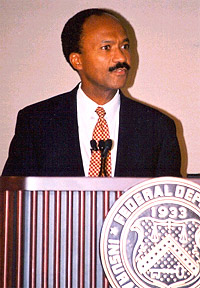 He turned Fannie Mae into a mortgage factory to get higher bonuses and was investigated for cooking the books. He is undoubtedly one of the folks that has interested the FBI. Another person is Jim Johnson. (You’ll recognize these names because they are both Obama friends and advisors).
In late 2004, Fannie Mae was under investigation for its accounting practices. The Office of Federal Housing Enterprise Oversight released a report on September 20, 2004, alleging widespread accounting errors, including shifting of losses so Raines and others could earn bonuses.
In June 2008, the Wall Street Journal reported that two former CEOs of Fannie Mae, James A. Johnson (1991-1998) and Franklin Raines (1999-2004) had received loans below market rate from Countrywide Financial. Fannie Mae was the biggest buyer of Countrywide’s mortgages. Don’t forget the three biggest recipient of FNMA money are Dodd, Kerry, and Obama. Dodd also appears to have a sweetheart mortgage deal. The Democrats are not the white knights in this mess. They would probably like to get this deal through as quickly as possible so voters do not find out that the bailout is not just a Wall Street Mess. It is a K Street and Washington-created mess. There is plenty of blame and greed to go around.
The very same people that created this mess are the ones writing the terms of the bail-out. Be afraid! Be very afraid! I never put a steak on the kitchen counter and leave the dog alone in the room with it. I would not leave the U.S. economy in the hands of these folks who are deciding the fineprint in a room with closed doors either.

 peej
peej Carissa
 bostonboomer
 dakinikat
 ecocatwoman
 mablue2
 Mama Lopez
 peggysue22
 quixote
 skydancingguestblogger
 Mona (aka Wonk the Vote)



 Sky Dancing
Recent Comments