
Tuesday Reads
Posted: December 28, 2010 Filed under: Global Financial Crisis, Gulf Oil Spill, investment banking, jobs, New Orleans, the blogosphere, The Bonus Class, The Great Recession, the villagers, U.S. Economy, U.S. Politics, We are so F'd, Wikileaks | Tags: AIG, Bradley Manning, cylical unemployment, Dispersant, Emeril, Gulf oil Gusher, Harry Shearer, Hoppin' John, Labor Unions, Levee failure during Hurricane Katrina, Levees.org, Nancy Pelosi, structural unemployment, The Big Uneasy, The New Orleans Saints, Those Crazy Pauls!!, Wikileaks, Wired won't release documents 29 CommentsGood Morning!
I had a productive day yesterday for a change and I hope you did too! Dare I go shop for plumbing stuff today? I was bemoaning a shortage of headlines on Sunday. I should be a bit more careful about wishing for things because today’s list of reads will be long.
The other good news for me is that we’re going from hard freeze warnings to weather in the 70s this weekend. It sounds like it’s going to be a fun New Year’s Eve here in New Orleans! That should explain the picture! I also wanted to give you a bit of New Orleans News before I moved on to other things.
First, if you haven’t had a chance to read Sandy Rosenthal’s piece at HuffPo on the failure of the Levees during Hurricane Katrina, please do so. There are still folks out there that think our devastation was from Hurricane Katrina and that just isn’t so. I was on the edge of the bowl. I know. My house experienced very little actual damage because my house was on high ground and above the waters. A failure of engineering devastated my city. It was not an act of nature. I signed the petition. Will you?
Last week, I wrote to the New York Times asking them to please resist using fast and easy “Katrina shorthand.” Forty-eight hours passed and we heard no response, so we decided to let our supporters step in. We urged our followers to sign our petition to the NY Times urging the paper to be more specific when referencing the flood disaster.
Over 1,000 people all across the nation signed our petition in under 48 hours. This immediate huge response – during the holiday no less – will hopefully show the New York Times that informed citizens understand that “Katrina” did not flood New Orleans. Civil engineering mistakes did.
Saying Katrina flooded the city protects the human beings responsible for the levee/floodwall failures. It is also dangerous since 55% of the American people lives in counties protected by levees.
If you haven’t yet, please sign our petition. We will keep it live until Jan 4, 2011.
In a similar vein, I would like to shout out HAPPY BIRTHDAY HARRY!!! to fellow New Orleans Blogger, neighbor, actor, musician, and polymath Harry Shearer (12/23/49) who made his film debut in the great epic ‘Abbott and Costello Go To Mars’ in 1953. There’s another New Orleans connection in that movie. The Abbot and Costello characters–Lester and Orville–accidentally launch a rocket that should’ve been Mars bound. They land in New Orleans for Mardi Gras instead. Harry plays an uncredited “Boy”.
I also want to offer up a plug for Shearer’s wonderful documentary on the Levee Failure called ‘The Big Uneasy’ that was released last August on our 5th Katrina Anniversary. It’s going to be re-released in 2011. I’m including an interview with him by local radio show host Kat (not me). You’ll learn that the Golden Globes are a simple piece of business and that Harry’s songstress wife is spoonable. Who knew? Also there seems that there’s a chance his documentary will be shown on PBS so you may get to see it there. I wonder if we can help encourage that situation.
I’d like to take another chance to remind you that we’re still living with the results of the BP Oil Gusher here on the Gulf Coast. There also appears to be covered-up as well as forgotten stories down here. You may want to take a look at this from Open Channel on MSNBC.com: ‘ Is dispersant still being used in the Gulf?” This story reports on pictures and samples take in early August that are being investigated now. I’d written about some of these reports earlier.
Kaltofen is among the scientists retained by New Orleans attorney Stuart Smith to conduct independent environmental testing data from the Gulf on behalf of clients who are seeking damages from BP. (Click here to read about their effort.)
An independent marine chemist who reviewed the data said that their conclusion stands up.
“The analytical techniques are correct and well accepted,” said Ted Van Vleet, a professor at the College of Marine Science at the University of South Florida. “Based on their data, it does appear that dispersant is present.”
Why responders would continue to use chemical dispersants after the government announced a halt is a mystery. If the oil was gone or already dispersed, as the federal government and BP have said, what would be the point? And, because dispersants don’t work very well on oil that has been “weathered” by the elements over long periods of times, there would be little point in spraying it that situation.
I wanted to share a New Orleans and indeed a Southern New Year’s eve tradition. We serve a concoction of black eyed peas, cabbage and sausage/ham called ‘Hoppin’ John’ to bring us luck and wealth in the New Year. I evidently didn’t make enough of it last year, so I’m planning to cook more this year. The pea’s black eyes represent coins, the cabbage represents cash, and the sausage or ham is meat that always symbolizes luxury to hungry, poor people.
Here’s Emeril’s ‘Hoppin’ John’ recipe provided courtesy the Food Network:
Hoppin’ John
Prep Time: 15 min Cook Time:50 min Serves: 10
Ingredients
1 tablespoon olive oil
1 large ham hock
1 cup onion, chopped
1/2 cup celery, chopped
1/2 cup green pepper, chopped
1 tablespoon chopped garlic
1 pound black-eyed peas, soaked overnight and rinsed
1 quart chicken stock
Bay leaf
1 teaspoon dry thyme leaves
Salt, black pepper, and cayenne
3 tablespoons finely chopped green onion
3 cups steamed white rice
Directions
Heat oil in a large soup pot, add the ham hock and sear on all sides for 4 minutes. Add the onion, celery, green pepper, and garlic, cook for 4 minutes. Add the black-eyed peas, stock, bay leaves, thyme, and seasonings. Bring to a boil, reduce the heat and simmer for 40 minutes, or until the peas are creamy and tender, stir occasionally. If the liquid evaporates, add more water or stock. Adjust seasonings, and garnish with green onions. Serve over rice.
Okay, so enough about my home town.
The AFL-CIO wants to talk unions this holiday season because there is so much misinformation about these days. It’s a nice list of myths and facts that you may want to arm yourself with when talking to those right wing nattering nabobs of negativism.
MYTH: Unions only care about their members.
FACT: Unions are fighting to improve the lives of all workers.
- It’s easy to forget that we have unions to thank for a lot of things we take for granted today in today’s workplaces: the minimum wage, the eight-hour work day, child labor laws, health and safety standards, and even the weekend.
- Today, unions across the country are on the frontlines advocating for basic workplace reforms like increases in the minimum wage, and pushing lawmakers to require paid sick leave.
- Studies show that a large union presence in an industry or region can raise wages even for non-union workers. That means more consumer spending, and a stronger economy for us all.
- So it’s no wonder that most Americans (61 percent) believe that “labor unions are necessary to protect the working person,” according to Pew’s most recent values survey.
Here’s a gift that keeps on giving er… taking from FT: “AIG secures $4.3bn in credit lines“.
AIG, took a step closer to independence from government as it said it had secured $4.3bn in credit facilities.
The US insurer bailed out by Washington during the financial crisis is is in the process of repaying the $95bn the US Treasury and the Federal Reserve Bank of New York lent following its disastrous decision to insure billions of dollars worth of securities backed by mortgages.Under the facilities arranged by 36 banks and administered by JPMorgan Chase, AIG can borrow $1.5bn over three years and an additional $1.5bn over 364 days, according to a regulatory filing. Separately, Chartis, an AIG division, obtained a $1.3bn credit line.
Let’s just hope they clean up their act this time. I’m not holding my breath or any stock offers that may come up. Notice one of the usual suspects is ‘facilitating’ the arrangements. Cue ‘The Godfather’ music, please.
There’s an item from Slate that you may want to check out. It’s “A selection of gaffes from the 2010 campaign we should forgive”. Here’s one from Pelosi that gave me a chuckle.
Nancy Pelosi: “We have to pass the bill so that you can find out what is in it.”
On March 9, the Speaker of the House spoke to the National Association of Counties about the health care bill that was days away from final passage. This was the phrase that launched a thousand campaign ads. Nine months later, this is remembered as Pelosi admitting what Tea Partiers had feared: that Democrats were ramming through bad bills without reading them.
BostonBoomer sent me to Glenn Greenwald’s latest which really is a must read: ‘ The worsening journalistic disgrace at Wired’. Greenwald’s work on behalf of massacre leaker Bradley Manning is Nobel Peace Prize worthy. I don’t mean aspirational prizes either.
For more than six months, Wired‘s Senior Editor Kevin Poulsen has possessed — but refuses to publish — the key evidence in one of the year’s most significant political stories: the arrest of U.S. Army PFC Bradley Manning for allegedly acting as WikiLeaks’ source. In late May, Adrian Lamo — at the same time he was working with the FBI as a government informant against Manning — gave Poulsen what he purported to be the full chat logs between Manning and Lamo in which the Army Private allegedly confessed to having been the source for the various cables, documents and video that WikiLeaks released throughout this year. In interviews with me in June, both Poulsen and Lamo confirmed that Lamo placed no substantive restrictions on Poulsen with regard to the chat logs: Wired was and remains free to publish the logs in their entirety.
We’re waiting for a response from Wired since vacation seem to preempt media responsibility these days. Will we find out that there’s been some active media suppression of the truth regard Manning’s accusations today? This morning, Greenwald continued his admonition to fellow journalists in the excellent article “The merger of journalists and government officials”.
From the start of the WikiLeaks controversy, the most striking aspect for me has been that the ones who are leading the crusade against the transparency brought about by WikiLeaks — the ones most enraged about the leaks and the subversion of government secrecy — have been . . . America’s intrepid Watchdog journalists. What illustrates how warped our political and media culture is as potently as that? It just never seems to dawn on them — even when you explain it — that the transparency and undermining of the secrecy regime against which they are angrily railing is supposed to be . . . what they do.
There’s another economics story covered on The New Yorker‘s The Financial Page headlined: ‘The Jobs Crisis’ by James Surowiecki. It’s a good explanation of a debate between economists and politicians right now. Guess which one knows best on this?
Why have new jobs been so hard to come by? One view blames cyclical economic factors: at times when everyone is cautious about spending, companies are slow to expand capacity and take on more workers. But another, more skeptical account has emerged, which argues that a big part of the problem is a mismatch between the jobs that are available and the skills that people have. According to this view, many of the jobs that existed before the recession (in home building, for example) are gone for good, and the people who held those jobs don’t have the skills needed to work in other fields. A big chunk of current unemployment, the argument goes, is therefore structural, not cyclical: resurgent demand won’t make it go away.
Though this may sound like an academic argument, its consequences are all too real. If the problem is a lack of demand, policies that boost demand—fiscal stimulus, aggressive monetary policy—will help. But if unemployment is mainly structural there’s little we can do about it: we just need to wait for the market to sort things out, which is going to take a while.
The structural argument sounds plausible: it fits our sense that there’s a price to be paid for the excesses of the past decade; that the U.S. economy was profoundly out of whack before the recession hit; and that we need major changes in the kind of work people do. But there’s surprisingly little evidence for it. If the problems with the job market really were structural, you’d expect job losses to be heavily concentrated in a few industries, the ones that are disappearing as a result of the bursting of the bubble. And if there were industries that were having trouble finding enough qualified workers, you’d expect them to have lots of job vacancies, and to be paying their existing workers more and working them longer hours.
Here’s a fun read at New York Magazine about living large in a libertarian world.
No one exemplifies that streak more than Ron Paul—unless you count his son Rand. When Rand Paul strolled onstage in May 2010, the newly declared Republican nominee for Kentucky’s U.S. Senate seat, he entered to the strains of Rush, the boomer rock band famous for its allegiance to libertarianism and Ayn Rand. It was a dog whistle—a wink to free-marketers and classic-rock fans savvy enough to get the reference, but likely to sail over the heads of most Republicans. Paul’s campaign was full of such goodies. He name-dropped Austrian economist Friedrich Hayek’s seminal The Road to Serfdom. He cut a YouTube video denying that he was named after Ayn Rand but professing to have read all of her novels. He spoke in the stark black-and-white terms of libertarian purism. “Do we believe in the individual, or do we believe in the state?” he asked the crowd in Bowling Green, Kentucky, on Election Night.
It’s clear why he played coy. For all the talk about casting off government shackles, libertarianism is still considered the crazy uncle of American politics: loud and cocky and occasionally profound but always a bit unhinged. And Rand Paul’s dad is the craziest uncle of all. Ron Paul wants to “end the Fed,” as the title of his book proclaims, and return the country to the gold standard—stances that have made him a tea-party icon. Now, as incoming chairman of the subcommittee that oversees the Fed, he’ll have an even bigger platform. Paul Sr. says there’s not much daylight between him and his son. “I can’t think of anything we grossly disagree on,” he says.
Well, they must have both been impacted by the same disease or environmental catastrophe to share so many views so out of the mainstream and be so far removed from experience, data, and science. I can’t help but believe the more the media shines a bright light on them, the more the warts and the brain damage will become noticeable.
So, one more suggested read comes via Lambert and Corrente. It’s really interesting piece from The Atlantic on ‘The Hazards of Nerd Supremacy: The Case of WikiLeaks’. It talks about Hackers, Assange, and the Hacker code of conduct. Any one who as read Assange’s manifest can see the connect and disconnect that simultaneously occur in the ideas. BB and had discussed that Assange might have a form of Aspergers disease about a month ago and I was also interested to see that Lambert, Valhalla, and some others had similar thoughts. It frequently runs in brilliant people who can decode a lot of things with the exception of other people. Anyway, here’s a taste of Jaron Lanier.
The strategy of Wikileaks, as explained in an essay by Julian Assange, is to make the world transparent, so that closed organizations are disabled, and open ones aren’t hurt. But he’s wrong. Actually, a free flow of digital information enables two diametrically opposed patterns: low-commitment anarchy on the one hand and absolute secrecy married to total ambition on the other.
While many individuals in Wikileaks would probably protest that they don’t personally advocate radical ideas about transparency for everybody but hackers, architecture can force all our hands. This is exactly what happens in current online culture. Either everything is utterly out in the open, like a music file copied a thousand times or a light weight hagiography on Facebook, or it is perfectly protected, like the commercially valuable dossiers on each of us held by Facebook or the files saved for blackmail by Wikileaks.
The Wikileaks method punishes a nation — or any human undertaking — that falls short of absolute, total transparency, which is all human undertakings, but perversely rewards an absolute lack of transparency. Thus an iron-shut government doesn’t have leaks to the site, but a mostly-open government does.
I’m still fascinated by the sideshow that is driving ad hominem attacks on Assange and the women involved with the charges. Still, that does not cloud my appreciation of what’s being released by Wikileaks. We’ll definitely have more coming. I’m personally waiting for the BOA stuff as that’s the stuff that I can personally decode. I’m glad we’re extending the Front Page Team to include more and more people that can tackle some of the other technical stuff from their vantage points. Stay tuned for more on all of this.
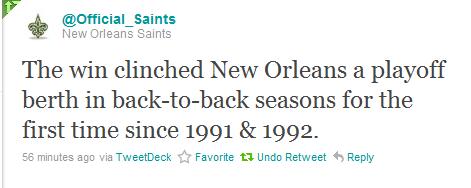
Just ONE MORE NAWLINS THANG: New Orleans Saints 17 – Atlanta Falcons 14. My home town continues to be the Great American Comeback Story.
So, what’s on your reading and blogging list today?
Behind the Unemployment Rate
Posted: February 21, 2010 Filed under: U.S. Economy | Tags: duration, structural unemployment, unemployment, Unemployment figures, Unemployment Rate 1 Comment We’ve discussed this before. The unemployment rate that is used as the benchmark of the state of the job market by the mainstream media does not contain the full story. It’s missing the faces of people that have given up on the job market and are considered ‘outside’ the labor force. It considers any one employed that one works one paid hour per week even though those people want 40 hour a week jobs and maybe working multiple part time or temporary jobs to make ends meet because unemployment insurance only goes so far. It doesn’t give you information on how persistent that unemployment is and there’s no inference of where the unemployment is the worst. It’s just an average of every one who is actively looking for work and is not currently employed at least one hour a week as a percentage of the total labor force.
It is the flows in out and out of employment and unemployment and the labor force itself that gives you more information. It is the stratification of that unemployment by race, by industry sector, by region, by sex, by age and by education that gives you an idea of the faces behind the unemployment rate. It is also the source of unemployment and the duration or length of time out of a job that provides the detail that you must have to develop a successful unemployment policy.
I’ve mentioned that the duration of unemployment in this recession and its root in structural unemployment is what is so worrisome about the unemployment we have today. It appears that many of the jobs lost over the last decade are gone permanently. The financial crisis put a large number of these folks on the unemployment roles. Their benefits are running out and there are basically no jobs for them any more. Worse yet, states are cutting their budgets which mean job training and education are less available and will continue to become more personally expensive and less available. They will be unreasonable choices for older, unemployed Americans with only high school degrees and job skills that only China requires.
The article in the NY Times today called “The New Poor- Millions of Unemployed Face Years Without Jobs” is a good overview of what we’ll look forward to as we creep out of the recession. I was struck by the stories of the people profiled in the piece as well as the candid discussion that most of these folks will never know what it is to be middle class again.
Large companies are increasingly owned by institutional investors who crave swift profits, a feat often achieved by cutting payroll. The declining influence of unions has made it easier for employers to shift work to part-time and temporary employees. Factory work and even white-collar jobs have moved in recent years to low-cost countries in Asia and Latin America. Automation has helped manufacturing cut 5.6 million jobs since 2000 — the sort of jobs that once provided lower-skilled workers with middle-class paychecks.
“American business is about maximizing shareholder value,” said Allen Sinai, chief global economist at the research firm Decision Economics. “You basically don’t want workers. You hire less, and you try to find capital equipment to replace them.”
This is a radical change from a country that prior to this century was a job creation machine for every one. Bostonboomer discussed the dark side of this change in her morning news thread on Saturday morning. We can look at the unemployment number and realize that it serves its role as barometer of bad numbers. It has some Cassandras–like Yves Smith of Naked Capitalism–wondering how these people will take their status as permanent underclass. Will it be with quiet resignation or more teaparties with more pitchforks and rifles?
Every downturn pushes some people out of the middle class before the economy resumes expanding. Most recover. Many prosper. But some economists worry that this time could be different. An unusual constellation of forces — some embedded in the modern-day economy, others unique to this wrenching recession — might make it especially difficult for those out of work to find their way back to their middle-class lives.
What does it mean when so many Americans are so visibly losing the American promise? What will it mean if–in order to continue 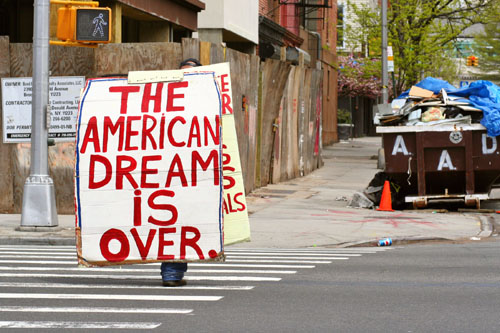 replenishing necessary campaign coffers–American politicians continually sell out the American labor class for the American capital class? Obviously, in a democracy, those of us that rely on paychecks instead of dividend checks and capital gains can out vote them the bonus class. But can we achieve any real change when the two major parties continually move towards the same policies with only the only difference being which industry sponsors which version of the rhetorical spin?
Traditionally, three sectors have led the way out of recession: automobiles, home building and banking. But auto companies have been shrinking because strapped households have less buying power. Home building is limited by fears about a glut of foreclosed properties. Banking is expanding, but this seems largely a function of government support that is being withdrawn.
At the same time, the continued bite of the financial crisis has crimped the flow of money to small businesses and new ventures, which tend to be major sources of new jobs.
I think I mentioned before that my laugh line from the State of the Union Address was the one where POTUS said he wanted to double exports and make us an export driven economy. Most of us had the same reaction WTF are we going to export? Disneyland? Yellowstone Natinoal Park? Old Arnold Schwarzenegger movies? Where are the jobs coming from? What do we produce any more? Much of our economy seems based on manipulation of information to disenfranchise many and benefit a few or feeding, massaging, and entertaining the bonus class or giving sophisticated medical procedures to people with Cadillac insurance plans. Many of these folks worked with their hands. They made cars or houses or sewed clothing. We now have too many houses and we prefer cars from elsewhere. All of our clothes are made by the indentured servants in third world countries now.
What are these people to do? Our safety net programs have been gutted and the states are now in the position of gutting education and training. That link is from CNN.
States face combined remaining budget gaps of $134 billion over the next three years, the report said.
It said there has been no leveling of state revenues and most states are seeing monthly totals that are lower than recent forecasts.
Citing the Rockefeller Institute of Government, the report said that state tax collections have declined for four consecutive quarters, beginning in 2009’s third quarter.
Meanwhile, Medicaid costs have grown, the report said. And states continue to lose jobs. In January alone, states eliminated 18,000 jobs, and will continue to shed jobs, the report said.
Because states are required to balance their budgets, they will “continue to cut spending and increase taxes, which will also weaken the economy and, thus, its ability to generate private sector jobs,” it said
This is back from the NY TImes:
Some poverty experts say the broader social safety net is not up to cushioning the impact of the worst downturn since the Great Depression. Social services are less extensive than during the last period of double-digit unemployment, in the early 1980s.
On average, only two-thirds of unemployed people received state-provided unemployment checks last year, according to the Labor Department. The rest either exhausted their benefits, fell short of requirements or did not apply.
“You have very large sets of people who have no social protections,” said Randy Albelda, an economist at the University of Massachusetts in Boston. “They are landing in this netherworld.”
…
“We have a work-based safety net without any work,” said Timothy M. Smeeding, director of the Institute for Research on Poverty at the University of Wisconsin, Madison. “People with more education and skills will probably figure something out once the economy picks up. It’s the ones with less education and skills: that’s the new poor.”
The majority of people in this country rely on their jobs for everything. The majority of business in this country (in terms of numbers) rely on customers who pay for their products and services with their pay checks. When the money is sucked out of this process to a few people, the house of card falls. Income inequality is not good for the country at all, but that’s been the increasing story since the 1980s. Here’s another disturbing headline from FT Alphaville: “The US is not a viable concern anymore”. The thread is based on an interview with Richard Duncan, partner at Blackhorse Asset Management and author of The Dollar Crisis. He’s written a new book called The Corruption of Capitalism.
The point being: the world’s largest economy and engine of global economic growth — the United States — is simply not a viable concern any more. As Duncan explained it:
The country is de-industrializing because wages in the US are up to 40 times higher than those in developing countries like China. Therefore, the United States makes very little that the rest of the world cannot buy somewhere else much more cheaply.
And so, like any troubled company, the US too must restructure itself if it is to remain operational, says Duncan. How it goes about it, though, will be crucial to its success. The best policy according to the author would be heavy government investment in so-called ‘future’ industries — everything from solar, biotech, nano-technology and so on. Trouble is, a move like that would take more government spending not less.
What kind of future does this leave us with? That is why BB’s self-titled “incoherent ramblings” were not the least bit incoherent. It’s just very hard to grasp losing the promise. Suicides will go up as well as murder-suicides. More and more people will have to find other ways to get what they need outside of the traditional job structure. Read into that what you will.
Is the American Dream over?

 peej
peej Carissa
 bostonboomer
 dakinikat
 ecocatwoman
 mablue2
 Mama Lopez
 peggysue22
 quixote
 skydancingguestblogger
 Mona (aka Wonk the Vote)



 Sky Dancing
Recent Comments