
Finally Friday Reads: Strike!
Posted: September 15, 2023 Filed under: Labor unions | Tags: Labor Unions, SAG/AFTRA, Solidarity forever, Strikes, United Auto Workers 3 Comments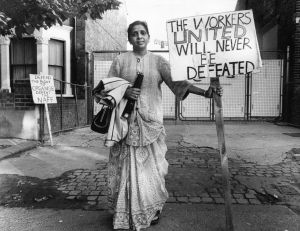
Good Day, Sky Dancers!
It’s been a while since the labor markets have aligned to empower workers to unionize and strike for better wages and benefits. A combination of more jobs than potential workers, years of stock buybacks, and considerable increases in upper management bonuses and salaries have created a perfect storm. The New York Times has characterized this as a “Summer of Strikes. Work stoppages in the United States this year are approaching heights rarely seen in recent decades.” (Be certain to check out the graphs on the various unions’ history of work stoppages.)
This year, workers across industries in the United States have increasingly walked off the job or threatened to do so. In July, tens of thousands of actors joined screenwriters on the picket line, bringing Hollywood to a halt. Meanwhile, a summertime strike of more than 300,000 United Parcel Service workers had seemed imminent before a deal was reached last month.
Now, another potentially large-scale strike has begun. After the United Auto Workers and the country’s largest carmakers were unable to agree on a new contract before Thursday night’s deadline, union members at General Motors, Ford Motor and Stellantis — which owns Chrysler, Jeep and Ram — have walked off the job.
About 12,700 workers began the strike on Friday, at plants in Michigan, Missouri and Ohio. That’s a small portion of the unionized factories of G.M., Ford and Stellantis across the United States. But the union hasn’t ruled out a full-scale strike.
If all 150,000 of the U.A.W. members go on strike, nearly 460,000 workers will have walked off the job at some point over the course of this year, the highest level since 2018, another notable year for work stoppages.
Strike activity increased slightly in 2021 and 2022 after a lull during the coronavirus pandemic. Much of this can be attributed to a historically strong economic recovery, which has strengthened workers’ bargaining power, said Ruth Milkman, a professor at the City University of New York’s Graduate Center and School of Labor and Urban Studies. “The single most important factor is the tight labor market,” she said.
Despite the recent uptick, overall union activity has fallen since the 1970s and ’80s, when the number of workers on strike in a year regularly surpassed 400,000.

Today’s news is the”UAW strike 2023 against Detroit automakers: Live updates, news from the picket sites.” This is reported by the Detroit Free Press.
The UAW declared a strike against Detroit Three automakers Thursday as contract talks failed to secure new labor agreements before the current deals expired at 11:59 p.m.
UAW President Shawn Fain announced the first wave of plants the union would strike if a new labor agreement was not reached before midnight: Ford Michigan Assembly Plant (Final Assembly and Paint only) in Wayne, Stellantis Toledo Assembly Complex in Ohio and General Motors Wentzville Assembly in Missouri.
The DFP has a number of exciting stories that analyze the impact of the strike on Michigan, the US, and the industry, including the many small suppliers to the Big 3 and the workers.
“Experts weigh implications of UAW strike strategy” is one such report.
The UAW’s targeted plan for a possible strike could mean that some workers are on the picket lines making $500 a week in strike pay while others are on the assembly lines making their full wages.
Whether such a situation would breed contempt among workers would depend on the messaging from the United Auto Workers union, said Brett Miller, a labor and employment attorney at Butzel law firm.
“There may be some comfort if the union plans to start small and escalate the strike involving more members or it is making representations that the final result of the strike would be worth the sacrifice,” he said.
As to whether the union strikes a plant that supplies parts to another plant, thereby halting the second, non-striking plant’s production, the automaker could shut down that non-striking plant and essentially it would be a lockout for those workers at the non-striking plant.
Miller said that under the UAW constitution, those on strike or locked out could get strike pay. Generally, unemployment will not cover employees who are on strike, but there are exceptions, such as in New York and New Jersey.
 It is important to note that UAW members must wait about 8 days for strike pay, face challenges ahead: What to know.” This is also part of the DFP coverage. It is also interesting to note that a strike against all three simultaneously is unprecedented. This is from CNN.
The United Auto Workers union is on strike against General Motors, Ford and Stellantis, the first time in its history that it has struck all three of America’s unionized automakers at the same time.
Workers on Friday walked out of three plants – one each from the Big Three automakers – in Missouri, Michigan and Ohio. Picketers were met with cheers from sign-waving union members.
The UAW referred to its targeted strike of three plants as a “Stand Up Strike,” which it called a strategic “new approach” to walking off the job.
“As time goes on, more locals may be called on to ‘Stand Up’ and join the strike,” the union told members. “This gives us maximum leverage and maximum flexibility in our fight to win a fair contract at each of the Big Three automakers.”
The UAW’s strikes began at GM’s Wentzville Missouri, which has 3,600 UAW members on its staff; Ford’s Michigan Truck plant in Wayne, Michigan, which will have 3,300 strikes; and Stellantis’ Toledo Assembly complex in Ohio, where 5,800 will be be on strike.
In all, fewer than 13,000 of the UAW’s 145,000 members walked off the job.
“These were chosen carefully by the UAW and reflect a strategy that will ensure a large number of suppliers and dealers are affected, while reducing the number of UAW workers that, at least initially, are on strike and receiving strike pay,” said Patrick Anderson. CEO of Anderson Economic Group.
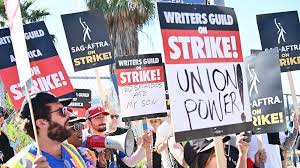 A local L.A. ABC TV station reports that “Thousands of striking actors, writers swarm Hollywood in massive solidarity march.” The SAG/AFTRA strike continues.
Thousands of striking writers and actors staged a solidarity march through Hollywood Wednesday, culminating in a boisterous rally outside Paramount studios as the dual labor stoppages continue to halt movie and TV production.
The Writers Guild of America has been on strike since early May. The SAG-AFTRA actors’ union joined the writers on the picket lines in July. There have been some negotiations between the WGA and Hollywood studios in recent weeks, but still no indication a resolution is at hand. There has not been any word of talks between the studios and SAG-AFTRA.
On Wednesday morning, thousands of striking writers and actors gathered outside Netflix headquarters in Hollywood, then marched to Paramount studios on Melrose Avenue. Once there, a massive rally was held, featuring speeches and music performances — and forcing closures of streets surrounding the studio.
SAG-AFTRA billed the event as a solidarity march to send a message to studios that actors and writers are standing firm in their push for fair contracts.
“Thank you so much for showing up like this, this is an amazing turnout,” SAG-AFTRA President Fran Drescher told the crowd. “Your strength and your solidarity and your resolve is going to get us to the other side of this, and history is in the making right now. I know that this strike is not easy, in fact, it’s hard. It’s very hard. And with the passing of time its going to even get harder, but the reason why we had the largest strike authorization in our union history is because we stand at an inflection point.

My Granddad was around for the Great Railroad Strike of 1922 while he and Nana had two kids. My Dad was born the year after the strike.
Even though these unions do work in industries that could not be more different, it is important to remember the economic rationale for the strikes. These workers have more in common than you would think. An economist at Stanford answers the question “Why are workers striking now?” As I mentioned above, “falling wages and unequal earnings distribution are among the reasons workers are striking, says Stanford economics professor” Dr. John Pencavel. The gap between the earnings of senior management and the folks who actually do the work is at an all-time high.
According to Pencavel, many workers are feeling frustrated by seeing their wages suppressed in less competitive labor markets and by the loss of a voice (such as a trade union). Moreover, he argues, a low unemployment rate makes the timing right.
“Strikes tend to be more frequent and longer when workers have opportunities for other possibly temporary work, as indicated by a low unemployment rate,” Pencavel said.
…
Why are so many strikes happening now?
When it comes to measuring earnings inequality, economists tend to be relativists, that is, if all workers get the same x% increase in wages, economists usually conclude wage inequality has not changed. By contrast, many workers are absolutists and measure inequality in terms of absolute dollar differences in wages. This distinction helps to explain why economists are more inclined to accept certain earnings differences that workers do not. An example is provided by examining the U.S. household income and comparing the household whose income is near the top of the income distribution.
Specifically, the household whose income is at the 95th percentile with the household whose income is below the median (specifically at the 20th percentile). Approximately these two households experienced the same 9% increase in income between 2018 and 2019. Given the existing wide income distribution, this 9% increase in income constituted a $2,484 increase for the household at the 20th percentile and a $21,274 increase for the household at the 95th percentile. To the relativist, inequality has not changed; to the absolutist income inequality has increased.
Tending to be absolutists, workers are outraged at the earnings reported for certain managers and business owners. They see the system as basically unfair. Indeed, it is well documented that the share of the nation’s total income that is categorized as profits has risen and the share called wages has fallen.
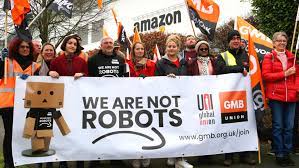
Amazon workers strike to expose the horror behind ‘Black Friday’ sales
The workers in Amazon warehouses in Europe sought to highlight atrocious working conditions, including Injuries from accidents, overworked employees collapsing unconscious on the floor, constant robotic surveillance and workers having to skip toilet breaks to avoid missing the targets. (2018)
There have been work stoppages also for workers in search of Union protection recently. Amazon and Starbucks have experienced nascent unionization efforts. This is an article from VOX that was published in May. “Why unions are growing and shrinking at the same time. Joining the picket line like it’s 1939.” This report was written by Rani Molla.
Based on the news lately, it would seem like unions are growing.
Staffers at the Democratic Congressional Campaign Committee announced on Tuesday they had formed a union. This is after Starbucks workers last week reached 50 union wins across the country, and many more locations are slated to do so in the near future. According to the National Labor Relations Board (NLRB), about 250 total Starbucks stores, representing nearly 7,000 employees, have so far petitioned to unionize. And last month, workers at an Amazon warehouse in New York City defied all odds by winning their first union battle against the second-biggest employer in the United States. People are successfully unionizing across the economy, from retail to tech, and their wins are leading to even more union interest. Petitions for union representation in the first half of 2022 are up nearly 60 percent from last year.
This raft of union organizing, unthinkable just a few years ago, is happening against a very favorable backdrop, including a tight labor market, record inequality, and a pro-union administration, which extends to the leadership at the NLRB, the organization tasked with running union elections and enforcing labor law. Meanwhile, public approval of unions is at its highest level since 1965.
What we don’t know yet is whether these events are enough to meaningfully combat longstanding headwinds, from anti-union policy to the rise of gig work, that have caused union membership to decline for decades. Last year, amid a similar set of circumstances, the number of union members in the US went down by 240,000, leaving the rate of union membership at a low of 10 percent — half what it was in the 1980s. The pandemic has been a sort of double-edged sword for unions, giving people more reasons to organize and also causing union and non-union workers to lose their jobs.
It’s possible the psychic weight of union wins is bigger than their actual weight. A typical Starbucks only has 26 workers, and there hasn’t yet been public union activity at the vast majority of the company’s 9,000 corporate stores. After one Staten Island Amazon fulfillment center won its vote to unionize, a second sort center lost, and there are more than 800 Amazon warehouse facilities across the country.
It’s not clear where this will all net out. This year’s total union membership numbers won’t be available until the Bureau of Labor Statistics releases them early next year. Until then, we do know that a number of individual unions have been successfully bucking the trend in recent years by adding members. Labor organizers have done so by employing a variety of tactics, new and old, and could help other shops do the same. Labor experts laud unions’ efforts but say more is needed at a policy level to ensure these recent wins aren’t just a flash in the pan.
PBS has this analysis about what the UAW strikes to the campaigns of Republicans and Trump. Statistics show that many traditional members may have voted for Trump.” The PBS analysis suggests that “UAW strike puts Trump, GOP in political bind in key states.” However, many GOP think any negative impact will fall back on the Democratic Governor Gretchen Whitmen. We shall see.
Democrats were quick to back working-class United Auto Workers in their strike against General Motors, delivering doughnuts and holding picket signs outside factories to show solidarity. It’s a union they long have aligned with politically.
There were no doughnuts from Republicans.
Led by President Donald Trump, GOP officials have largely avoided taking sides in the strike that threatens to upend the economy in Michigan, an election battleground, a year before the 2020 vote. Both here and nationally, most Republicans said little about the substance of the dispute beyond hope for a speedy resolution.
The muted response reflects the tricky politics of labor for Republicans.
Trump has made inroads with members of some unions, due partly to promises to get tough on trade and keep manufacturing jobs in the United States. The message pulled key voters away from their Democratic union bosses, who Trump argues are corrupt.
But a strike prompted in part over GM’s plan to close American plants highlights Trump’s unfulfilled promises on manufacturing and gives Democrats a chance to play up their union credentials.
Democratic presidential candidate Elizabeth Warren planned to show up on the picket line in Michigan on Sunday, with rival Bernie Sanders expected this coming week. Nearly all the candidates have tweeted support for the workers.
“Proud to stand with @UAW to demand fair wages and benefits for their members. America’s workers deserve better,” Joe Biden tweeted.
Trump is in a bind.
Backing the union would undermine Trump’s message that labor does not advocate for its workers and give a powerful Democratic force a boost before an election.
Siding with GM would call into question his promises to defend workers and he would risk getting blamed for economic woes in Rust Belt states he needs to win reelection.
I may be a Financial economist, but anyone in the field has had a healthy dose of Labor Economics at some point in their training. Classical labor theory suggests that everyone will be paid based on their contribution (productivity). It fails to account for the differences in salaries for women and minorities. It also underestimated how much the capital side would be given tremendous tax benefits as well as the bonuses and stock plans that are supposed to align management with the stockholders. Labor became the redheaded stepchild and was frequently overlooked in the rise of the service industry. Additionally, the investment in technology to replace workers has been intense, even pushing shoppers to self-checkout when it used to be a radical idea that you would pump your own gas.
Anyway, my bottom line is it’s about time that every person who actually does the work gets the pay, recognition, and benefits they deserve. Hope I haven’t been too wonky or too much of a history nut for you on my wonky thread. All I can say is my life was a lot better when I had a union bargaining for my terms of employment. It hasn’t been the same since. But then, I first taught at a community college where many of the instructors were in trades. I still shudder at the thought that your fundamental English Professor is paid far less than anyone in my field. I was active in the bargaining unit of my Union and was fascinated by the process. Also, the Union does make us strong.
By the way, is it any surprise that icky Bill Maher is a scab?
What’s on your reading and blogging list today?

 peej
peej Carissa
 bostonboomer
 dakinikat
 ecocatwoman
 mablue2
 Mama Lopez
 peggysue22
 quixote
 skydancingguestblogger
 Mona (aka Wonk the Vote)



 Sky Dancing
Recent Comments