
Death of a Salespitch
Posted: December 5, 2010 Filed under: Catfood Commission | Tags: Catfood Commission, Social Security, Social Security Reform 48 CommentsI’m really hoping that Stan Collender has got it right. He’s arguing in short form today that the Cat Food Commission 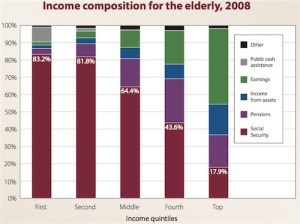 is dead with a promise of further details in an upcoming column at Roll Call. His first argument seems pretty reasonable. The Report needs 14 to pass and only 11 participants seem willing to do so. Here are his others.
- The 11 members of the commission who favored the plan likely overstates the actual amount of support. It seems clear that at least two and maybe more announced their support only when they were certain the plan wouldn’t get 14 votes. Their approval was more about political posturing for the future than actual enthusiasm.
- Don’t read too much into the bipartisan support for some of the options. If these same proposals are considered at all, they will next be debated in a very different political context and in a package that will look very different from the one the commission considered. Support for them in the commission is no indication they will be supported again.
- Don’t read too much into the enthusiastic response the plan received from various deficit hawk groups. Many of them supplied the commission with staff, helped develop what ultimately was proposed, and had a stake in its outcome. Under these circumstances, their enthuisastic approval and attempt to define the outcome as a success was not at all suprising. It’s also not especially indicative of any larger movement toward what was proposed.
I’m actually finding the power of the nifty graph from Matt Ygelisias at TP an even more compelling reason. He’s posting a response to Paul Krugman who can’t believe that the Beltway crowd is so obsessed with ruining social security. Krugman’s blog post today also contains his thoughts and the same nifty graph.
Look at the number of seniors that rely on social security for the majority or near majority of their incomes. That’s just income quintiles. You know that the distribution is skewed right (i.e population is largest on the lower ends.) Who wants to turn their life savings and major income source in old age over to a bunch of Wall Street High rollers or even worse, have it diced and sliced into pieces that you may or may not receive?
Even though Social Security is only a very mildly redistributive program, inequality of wealth is such that it’s a vital element of the bottom 60 percent’s living standards but kind of small beer to the top twenty percent. But I would say the other thing here on the Medicare / Social Security contrast is that Medicare isn’t just a subsidy program for old people. It’s also a subsidy program for doctors, nurses, hospital administrators, pharmaceutical executives, etc. Those people have lobbyists, many of their professions are well-respected, and many members of the political/media elite have siblings, cousins, college buddies, and even spouses who work in those fields.
The tragedy is that this very same factor that makes it harder to cut Medicare is also why cutting Social Security is a much worse idea. Our health care sector is low productivity mess and there are a lot of health-improving things a low-income senior can buy with Social Security money but can’t buy with Medicare. Healthy food, a gym membership, home-repair, etc.
Baby Boomers may not be a monolithic group, but I have to think that since most of us had our private savings and our home values chewed up and spit out by hedge funds and investment banks, we’re not going to go quietly into the night while having our social security gutted. I can’t imagine our remaining parents are going to be happy about it either since most of them have been paying in to the program since its initiation. Also, remind your children that should this pass, you will be expecting a room in their house because you will need it.
The graph and a lot of good information is from Our Fiscal Security. That’s the organization that I wrote about earlier that came up with a liberal response to the Bowles-Simpson ice floes plan. Let me just remind you of a few things from them about our Social Security.
- Social Security is currently in surplus and will take in more than it pays out until at least 2037, more than a quarter century from now.
- Raising the employer and employee payroll tax rates by just 1.1 percent each would erase the entire 75-year projected shortfall.
- Inequality leads to the projected Social Security shortfall: as income growth has become concentrated at the top, more income has fallen above the payroll cap of $106,800. Congress could close the entire 75 year projected funding gap by raising or eliminating the cap on taxable payroll income.
- Not just an I.O.U.: Income to the Social Security trust funds must be invested in guaranteed Treasury securities, which can be redeemed at any time at face value, giving the trust funds the same flexibility as cash.
- Social Security can never add to the yearly deficit; by law it cannot draw a single dollar from general revenues, even if payroll taxes fall short of scheduled benefits.
There’s a few more points out there if you’d like to go read them. It’s a data worth sending to your Congress Critterz.
Social Security: Reform, Refund, or Opt Out? (Part 4)
Posted: May 19, 2009 Filed under: U.S. Economy | Tags: Social Security, Social Security Privatization, Social Security Reform Comments Off on Social Security: Reform, Refund, or Opt Out? (Part 4) The aging burden is upon us and solutions are required quickly. People are living longer. There are three responses households face: consume less and save more when young, consume more and have lower monthly benefits when older, or work longer. They should make these decisions with a combination of their own savings and employer savings plans. They should plan retirement based on their preference to work and their health. They should also be able to rely on a minimal public pension plan so that no one fears dying a bag lady.
Government should respond when the public pension system is out of balance. There should be a mandated cycle of revision. The plan should be evaluated at least every five years and changes should be recommended by professionals to policymakers. Responses include: cutting benefits, raising taxes or contributions, subsidizing the program from general revenues or by issuing some form of debt, and generating a higher rate of return on the Trust Fund’s assets. There is still the question of generational risk-bearing and redistribution answered by the pre-funded or PAYG choice. Will the bigger burden lie with future generations or current generations? It appears we must deal with the PAYG choice made during the depression years one way or another.
Social Security: Reform, Refund or Opt-Out (Part 1)
Posted: May 17, 2009 Filed under: U.S. Economy | Tags: FDR, legacy debt, Public Pensions, Social Security, Social Security Reform, Social Security System Solvency Comments Off on Social Security: Reform, Refund or Opt-Out (Part 1) Several years ago, I did some research on Social Security. I thought I’d share that with you now as we look to more possible reforms coming from the Obama administration. This part is just introductory. Part 2 will be on Public Pension Concepts and Alternatives.
One of the most successful and significant programs put into place by the Roosevelt administration’s “New Deal” has been the U.S. Social Security System. It has met its goal of alleviating poverty among the elderly. It has become known as the ‘third rail’ of politics because of its success and acceptance by the majority of the populace. Elderly voters—an active and vocal voting constituency—do not take kindly to any discussion concerning social security reform. While other countries around the world have been reforming and restructuring their public pension systems, the U.S. social security system remains firmly entrenched in its current form. Any discussion of reduced benefit or increased contributions is political suicide. Reform discussions are difficult at best.
Most recently, President G.W. Bush spent a large amount of time and taxpayer money being educated on third rail politics while trying to convince America that some form of privatization was the right vision for the future elderly. While the highly selected audiences at these events was convinced that opting out completely was the way to go, the rest of America hit their panic buttons then phoned their congressional delegated. These re-education forums are now part of America history. The public reform debate has gone quietly into the night while discussion continues in the offices of institutions like MIT, Harvard, and the NBER.
Fortunately, many economists are still researching the efficiency of the U.S. Social Security System. Additionally, they now have around 20+ years of experience from other countries’ public pension reforms to analyze. This—at the very least—gives the United States the benefit of not going first so it can learn from the problems of the rest of the world. Learning the lessons of others may still not be enough to bring sensible and truthful debate back to the public arena. This must happen before reform or refunding actually occurs.

 peej
peej Carissa
 bostonboomer
 dakinikat
 ecocatwoman
 mablue2
 Mama Lopez
 peggysue22
 quixote
 skydancingguestblogger
 Mona (aka Wonk the Vote)



 Sky Dancing
Recent Comments