
Study shows Single Payer Health Insurance is Most Cost Efficient
Posted: April 14, 2012 Filed under: health, Health care reform | Tags: Single Payer Health Insurance. 18 CommentsThere are some market transactions that are best done by single providers. These services or goods are usually provided as public goods through a government 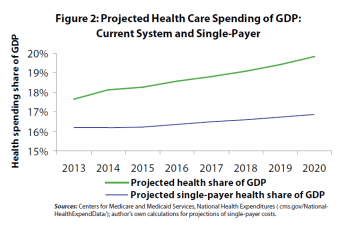 agency or a private institution granted the monopoly–then regulated–by the federal government. There are fairly standard traits characterizing natural monopolies. One of the primary indicators is that a single provider achieves economies of scale that no other form of market achieves and therefore it has the lowest average total cost. Health insurance is one of those markets where total risk is minimized–with its associated costs–when the risk pool is maximized. The high number of subscribers spreads the risk over many. If costs get high, low risk subscribers tend to drop their policies which leaves only folks that have high usage in the pool. This makes the service highly unprofitable and usually results in an insurance company trying to get rid of the high usage subscribers or any one that has the potential of being high usage. This is called cherry-picking.
Pricing insurance is based on trying to quantify risk of payment and that can be a complex business. Also, insurance–as a third party payer–means the market will eventually break down since the pricing mechanism is based on these ‘gambles’ and the fact that the consumer disconnects health care from insurance payments. Third party payer systems lead to inefficient markets because the normal dynamics of supply and demand do not lead to a market-based price. So, all development nations–except the US–know that having a purely market driven approach to health insurance fails big time. They approach their systems differently and do not rely on the largess of employers and the wealth of individuals to drive health care payment institutions.
This is a very brief introduction, but I wanted to give you some introduction to this important study by professor of economics Gerald Friedman from the University of Massachusetts-Amherst. Friedman shows how a single payer system for the US would save money over the current system and the ACA framework. He also explains how a single payer system could be administered cheaply and easily.
The Expanded & Improved Medicare for all act” (HR 676) would establish a single authority responsible for paying for health care for all Americans. Providing universal coverage with a “single-payer” system would change many aspects of American health care. While it would raise some costs by providing access to care for those currently uninsured or under-insured, it would save much larger sums by eliminating insurance middlemen and radically simplifying payment to doctors and hospitals. While providing superior health care, a single-payer system would save as much as $570 billion now wasted on administrative overhead and monopoly profits. A single-payer system would also make health-care financing dramatically more progressive by replacing fixed, income-invariant health-care expenditures with progressive taxes. This series of charts and graphs shows why we need a single-payer system and how it could be funded.
He succinctly provides the best reasons for choosing Single payer. It’s cheap and efficient.
Health-care costs have risen much faster than income in the United States over the last 50 years, rising from 5% of Gross Domestic Product in 1960 to nearly 18% today. Some of the increase in costs in the United States, as with other countries, is associated with improvements in care and longevity. Costs have risen much faster in the United States, however, because of the growing administrative burden of our private health-insurance system.
The article contains a lot of graphs and illustrations comparing the current system that relies on profit-making bureaucratic private insurance companies who are subject to state regulations that are quite varied. These providers also make paper work difficult because coverage, plans, and payments are nonstandard. This creates high costs for actual providers. The article is easy to read and I’d suggest you take a look at the article which can be found in Dollars and Sense.
Somethings You Can’t Make Up
Posted: May 15, 2009 Filed under: Human Rights, president teleprompter jesus, Team Obama, U.S. Economy, Voter Ignorance | Tags: Debt, Military Tribunals, Public Health, Single Payer Health Insurance. 5 CommentsGiven the choice between posting my final grades and my morning coffee or perusing some of the latest presidential antics and my morning coffee, I chose the latter. The latest front pager at the Confluence, Steven Mather started a great conversation on Obots and willful blindness. Since I was following a tweetathon last night between Glenn Greenwald and Jack Tapper on the latest about face, it seems appropriate to start there. This just comes under the heading of reality taking on dimensions of science fiction.
Every one is trying to figure out how Military Tribunals under Bush will be different the Military Tribunals continued by Obama. Given I’ve been following the financial bailouts under Bush and the virtual continuation of the same policy under Obama, I’m thinking the progressive blogosphere should be blowing a few gaskets now. After all, they were just told to lay off the torture photos and any hope of prosecution of what can only be labeled the Cheney Torture Policy. What we appear to have is straight forward continuation of nearly all the major Bush policies with major re-framing. It’s not going to be the old Nixon War on Drugs, it’s going to be the Obama “complete public-health model for dealing with addiction”. Somebody seems to think just morphing the lexicon makes it seem less Republican. Some one needs to tell Axelrod it’s the policies, not the labels.
So Greenwald is calling it Obama’s kinder, gentler military commissions .
It now appears definitive that the Obama administration will attempt to preserve a “modified” version of George Bush’s military commissions, rather than try suspected terrorists in our long-standing civilian court system or a court-martial proceeding under the Uniform Code of Military Justice. Obama officials have been dispatched to insist to journalists (anonymously, of course) that Obama’s embrace of “new and improved” military commissions is neither inconsistent with the criticisms that were voiced about Bush’s military commission system nor with Obama’s prior statements on this issue. It is plainly not the case that these “modifications” address the core criticisms directed to what Bush did, nor is it the case that Obama’s campaign position on this issue can be reconciled with what he is now doing. Just read the facts below and decide for yourself if that is even a plausible claim.
Oh, do go read the facts listed in the article. Don’t forget those koolaide goggles, because willful blindness is about the only way you’re going to see much difference.
 Meanwhile over on Bloomberg, I read up on the latest Obama-would-rather-not-be-held hostage- by-the-oval-office town hall meeting where Obama Says U.S. Long-Term Debt Load ‘Unsustainable’. I have to join Seth and Amy in a “Oh, really?” moment here. I think you all will remember the graph on the left from earlier pieces that I’ve done on the Obama stimulus package and budget. Let’s just use the Bloomberg piece as a refresher.
President Barack Obama, calling current deficit spending “unsustainable,” warned of skyrocketing interest rates for consumers if the U.S. continues to finance government by borrowing from other countries.
“We can’t keep on just borrowing from China,” Obama said at a town-hall meeting in Rio Rancho, New Mexico, outside Albuquerque. “We have to pay interest on that debt, and that means we are mortgaging our children’s future with more and more debt.”
Holders of U.S. debt will eventually “get tired” of buying it, causing interest rates on everything from auto loans to home mortgages to increase, Obama said. “It will have a dampening effect on our economy.”
Earlier this week, the Obama administration revised its own budget estimates and raised the projected deficit for this year to a record $1.84 trillion, up 5 percent from the February estimate. The revision for the 2010 fiscal year estimated the deficit at $1.26 trillion, up 7.4 percent from the February figure. The White House Office of Management and Budget also projected next year’s budget will end up at $3.59 trillion, compared with the $3.55 trillion it estimated previously.
Two weeks ago, the president proposed $17 billion in budget cuts, with plans to eliminate or reduce 121 federal programs. Republicans ridiculed the amount, saying that it represented one-half of 1 percent of the entire budget. They noted that Obama is seeking an $81 billion increase in other spending.
Meanwhile, we’ve seen protests erupt as the Senate started discussing health care reform while leaving single payer solutions off-the-table. No single payer is another Obama missive and another Republican-like policy. On May 5th, those most radical of all elements in this country, doctors and nurses, staged a protest at a senate hearing insisting single payer should be on the table.
I still can’t believe the Republicans are calling Obama a socialist. The only thing we’ve socialized so far are those incredible losses coming out of the finance sector. Everything else is Republican-lite.
All I gotta say is ya got played folks! Maddoff is a small fry scammer by comparison.
Please Digg!!! and Share!!!


 peej
peej Carissa
 bostonboomer
 dakinikat
 ecocatwoman
 mablue2
 Mama Lopez
 peggysue22
 quixote
 skydancingguestblogger
 Mona (aka Wonk the Vote)



 Sky Dancing
Recent Comments