
Is this a Naughty list that will get the Nice Treatment?
Posted: October 16, 2011 Filed under: Economy, financial institutions, Global Financial Crisis | Tags: G-20, Global TARP, shadow banking system, Systemically risky banks 10 Comments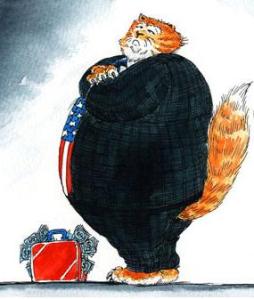 Okay, this is confusing me. What exact policies are implied from being on the G-20 list of “50 Systemically Important Banks”? It appears to me that you could be subjected to capital injections (i.e. free taxpayer money) for being so big you could bring down the global economy. No wonder Occupy is going global.
Group of 20 governments are considering naming as many as 50 banks as systemically important to the global economy and in need of extra capital, two officials from G-20 nations said.
The list, drawn up by Financial Stability Board Chairman Mario Draghi, will be published in time for a G-20 leaders meeting in Cannes, France, on Nov. 3-4, said the officials, who declined to be identified because the discussions are private. Regulators have said the banks named will be forced to take on more capital.
Regulators are at loggerheads with some institutions over the additional capital rules, with lenders arguing the requirements may harm the world’s economic recovery. Jamie Dimon, chief executive officer of JPMorgan Chase & Co. (JPM), and Bank of America Corp. (BAC) CEO Brian T. Moynihan are among bankers who have suggested this year that the new rules will constrain lending and hurt growth.
G-20 finance ministers and central bankers meeting in Paris yesterday discussed the standards that will be applied when compiling the list of systemic banks.
Twenty-nine to 40 banks could be designated depending on the potential impact on financial markets, according to one person familiar with the matter. Two officials from G-20 nations said the list could even be expanded to about 50 institutions. The regulators are also contemplating including the institutions in categories according to their ability to absorb losses.
So, the G-20 finance ministers “endorsed a framework to reduce the risks posed by systemically important institutions through strengthened supervision, a cross-border resolution plan and additional capital requirements”. No wonder occupy is going global. It seems bankers are draining funds from countries everywhere because they keep losing their mittens in the world’s largest gambling casinos. So, if you’ve got a bunch of what looks like really bad institutions, why-oh-why do you just simply give them more of your treasury? Good thing these guys went for that monopoly power! Now they can bully just about any one with a threat of bringing down the global economy. The World Bank and the IMF don’t even let entire countries do that!
The FSB is assessing how systemically important institutions are on the basis on five broad categories: size, interconnectedness, lack of substitutability, global activity and complexity.
Yup. The bigger you are and the more difficult you are to figure out, then it looks like you win a prize! Since when are we supposed to reward the creation of moral hazard and information asymmetry? The government is supposed to regulate to clear that up, not provide cash infusions to the worst culprits in the market. Oh, let me rephrase that because were talking about TWENTY governments doing that. The leading candidate to head all this up is the head of the Bank of Cananda–Canada’s version of the Federal Reserve Bank–who just happens to be (yes, wait for it, you know it’s coming)a former employee of Goldman Sachs.
Here’s the sole sentence in the entire article at Bloomberg that indicates there may some be some push for some change. The FSB is the Financial Stability Board. They are in the process of doing a number of things under the jurisdiction of the G-20 group including derivatives reform.
The FSB suggested assessing banks’ involvement with shadow banks, reform of money-market funds, securitization regulation, supervision with an emphasis on risk and scale, and regulation of lending and repo markets, the official said.
Obviously, the soverign debt crisis of the Greece, Portugal, Spain, and Ireland are foremost on every one’s mind. The deals are being worked out now to try to head off the potential calamity. I have to wonder if this is going to turn into a world wide TARP plan where we all foot the bill and the banks continue on their merry way with a lot of public funds and mostly symbolic regulation and over sight. I guess we’ll see. This inquiring mind really wants to know. Now, where’s the next G-20 meeting location and the nearest pitchfork store?
All Hail the Corporatist in Chief
Posted: October 16, 2009 Filed under: Team Obama, The Bonus Class, U.S. Economy | Tags: Barney Frank, Goldman Sachs Record Bonuses, shadow banking system Comments Off on All Hail the Corporatist in ChiefAny one who thinks the Democratic Party or the Democratic President represent the interests of the little guy in this  country can’t be reading any newspapers. I’ve always thought that the Republican Party overly favored big business and was out to set up monopolies for all its cronies. It’s hard to believe anyone aligning themselves with liberal interests or even a real conservative could support the continuing infusion of cash, tax cuts, and legal breaks to industries that are squeezing the profits out of both workers and businesses that actually make something or do something. The middlemen are now running the country and snatching its wealth.
First, there’s this Politico Story where even the headline offends my sensibilities of justice and fairplay: Dem officials set stage for corporate-backed health care campaign. The President’s undisclosed meetings are reminding me more and more of the Dubya/Cheney years.
At a meeting last April with corporate lobbyists, aides to President Barack Obama and Sen. Max Baucus (D-Mont.) helped set in motion a multimillion-dollar advertising campaign, primarily financed by industry groups, that has played a key role in bolstering public support for health care reform.
The role Baucus’s chief of staff, Jon Selib, and deputy White House chief of staff Jim Messina played in launching the groups was part of a successful effort by Democrats to enlist traditional enemies of health care reform to their side. No quid pro quo was involved, they insist, as do the lobbyists themselves.
The result has been a somewhat unlikely alliance between an administration that came into power criticizing George W. Bush for his closeness to Big Business and groups such as the Pharmaceutical Research and Manufacturers of America and the American Medical Association.
The previously undisclosed meeting April 15 at the offices of the Democratic Senatorial Campaign Committee led to the creation of two groups — Americans for Stable Quality Care and a now-defunct predecessor group called Healthy Economy Now — that have spent tens of millions of dollars on TV advertising supporting health reform efforts.
No sooner had I read that then I went to WaPo and found this one: Bailed-Out Banks Raking In Big Profits.
The nation’s largest banks, preserved from failure by federal aid and romping in markets revived by federal aid, are racking up vast profits even as the broader economy struggles to emerge from recession.
While loan losses continue to mount, the banks are making it up on Wall Street, trading in stocks, bonds and other financial instruments, and collecting fees for services such as helping companies raise money.
Goldman Sachs and Citigroup reported third-quarter profits Thursday, joining J.P. Morgan Chase in outstripping the expectations of financial analysts and solidifying their places as among the banks that have benefited most from the government’s massive rescue of the financial industry.
Of course, I’ve been advocating for better control of the shadow banking system for as long as I can remember. These guys are now out in the day light and acting like the financial crisis never even happened. They’re in better market position than they have ever been and are now using it to sell portfolios back and forth to run up paper profits. Not only that, the so-called defenders of the little guy are not only doing nothing, they’re doing worse than nothing. HelenK brought my attention to this one from the NY Times: Bill Shields Most Banks From Review. Just when you thought their loanshark-like lending practices which contributed so heavily to the bad economy and so many job losses would be exposed, Barney the Congressman (not the Dinosaur) shows where his bread is buttered.
Bowing to political pressure from community bankers, the House Financial Services Committee approved an exemption on Thursday for more than 98 percent of the nation’s banks from oversight by a new agency created to protect consumers from abusive or deceptive credit cards, mortgages and other loans, The New York Times’s Stephen Labaton reported.
The carve-out in legislation overhauling the regulatory system would prevent the new consumer financial protection agency from conducting annual examinations of the lending practices at more than 8,000 of the nation’s 8,200 banks, leaving only the largest banks and other lenders subject to the agency’s examiners.
Earlier in the day, the committee completed its work on a different contentious provision of the legislation when, on a nearly straight party-line vote of 43 to 26, it approved tougher regulations over the derivatives market. That provision, too, contained exemptions for many businesses.
The exemption for the banks was endorsed by the chairman, Representative Barney Frank of Massachusetts, who saw it as necessary to win support for the overall bill from the committee’s moderate and conservative Democrats. Their support is particularly important because the Republicans are unified against the legislation.
How much longer can our national wealth and legislative process support people that basically do nothing for a living but act as cost inducing middle men in markets? Insurance companies and Investment bankers have very little value added. They just run up costs between the real customers and the real producers of the goods and services. Why are they being protected and why is their profit grabbing ability being enhanced by the democrats in Washington?
Just so you know where the real damage lies, take a look at the USA today headline: Wages tumble toward 18-year low.
Average weekly wages have fallen 1.4% this year for private-sector workers through September, after adjusting for inflation, to $616.11, a USA TODAY analysis of Bureau of Labor Statistics data found. If that trend holds, it will mark the biggest annual decline in real wages since 1991.
The bureau’s data cover 82% of private-sector workers but exclude managers and some higher-paid professionals.
“Wages are usually the last thing to deteriorate in a recession,” says economist Heidi Shierholz of the liberal Economic Policy Institute. “But it’s happening now, and wages are probably going to be held down for a long time.”
Insurance companies and financial middle men do nothing but stand between the consumer and the producer. They add tremendous levels of cost and confusion to those markets and have no gone from helping businesses manage risk to creating more of it. They are anomalies or so-called frictions in a market economy. We does our President and our Congress keep feeding the Sharks and the Vampire Squids?
digg!!! tweet!!! share!!!


Add to: Facebook | Digg | Del.icio.us | Stumbleupon | Reddit | Blinklist | Twitter | Technorati | Furl | Newsvine
Death by Bubble
Posted: October 10, 2009 Filed under: Bailout Blues, Equity Markets, Global Financial Crisis, The Bonus Class, The Great Recession, U.S. Economy | Tags: bubble economies, Consumer Financial Protection Agency, shadow banking system 2 Comments Economist Andy Xie says Lehman Brothers died in vain and that it’s just a matter of time before we get hit by another deadly bubble. His guest post at Caijing Magazine is just so dead on that you must go read it.
There has been plenty to learn from last year’s miserable economy and near collapse of key financial markets but U.S. policy makers appear to rebuilding the same system with the same ghastly mistakes in place. We cannot afford to be complacent about this because if it’s done, another huge mishap can’t be far behind. Xie explains that the entire financial system is one big Lehman now and has become much more costly to bail out.
So Lehman died in vain. Today, governments and central banks are celebrating their victorious stabilizing of the global financial system. To achieve the same, they could have saved Lehman with US$ 50 billion. Instead, they have spent trillions of dollars — probably more than US$ 10 trillion when we get the final tally — to reach the same objective. Meanwhile, a broader goal to reform the financial system has seen absolutely no progress.
‘Absolutely no progress’ may actually be an optimistic estimate of the current situation. No progress would mean, to me, we’re not rebuilding the same time bomb. Xie’s article is remarkable in that it deconstructs the arguments one-by-one that we’re hearing that things are really changing, What we actually have is the proverbial shuffling of the chairs on the financial Titantic.
Top executives on Wall Street talk about having cut leverage by half. That is actually due to an expanding equity capital base rather than shrinking assets. According to the Federal Reserve, total debt for the financial sector was US$ 16.5 trillion in the second quarter 2009 — about the same as the US$ 16.6 trillion reported one year earlier. After the Lehman collapse, financial sector leverage increased due to Fed support. It has come down as the Fed pulled back some support, creating the perception of deleveraging. The basic conclusion is that financial sector debt is the same as it was a year ago, and the reduction in leverage is due to equity base expansion, partly due to government funding.
This, of course, leads to the most fundamental question of all. What happens when the government funding disappears? I admit that I see no end to that infusion unless the Fed or some other central bank becomes spooked by the possibility of inflation. These institutions would have to be rebalancing their portfolios in lieu of all the M&A activity they’ve undertaken this year to be able to live with out cheap government funds. Some of them may be repaying the TARP funds, but the real deal happens when Quantitative Easing and ZIRP ends. We’ve had no indication from the FOMC or Bernanke that that’s in the works any time soon but I can tell you, one little glimpse of inflation and the game ends there.
Now, here’s my favorite point. It’s this bull market where the shadow banking system profits from churning and running up your own portfolio by selling it back and forth between the parent and subsidiaries to create a false sense of momentum.
…financial institutions are operating as before. Institutions led in reporting profit gains in the first half 2009 during a period of global economic contraction. When corporate earnings expand in a shrinking economy, redistribution plays a role. Most of these strong earnings came from trading income, which is really all about getting in and out of financial markets at the right time. With assets backed up by US$ 16.5 trillion in debt, a 1 percent asset appreciation would lead to US$ 16.5 billion in profits. Considering how much financial markets rose in the first half, strong profits were easy to imagine.
Trading gains are a form of income redistribution. In the best scenario, smart traders buy assets ahead of others because they see a stronger economy ahead. Such redistribution comes from giving a bigger share of the future growth to those who are willing to take risk ahead of others. Past experience, however, demonstrates that most trading profits involve redistributions from many to a few in zero-sum bubbles. The trick is to get the credulous masses to join the bubble game at high prices. When the bubble bursts, even though asset prices may be the same as they were at the beginning, most people lose money to the few. What’s occurring now is another bubble that is again redistributing income from the masses to the few.
Yup, there it is. The idea that many of the bigger players are just trying to run up the market enough to entice the suckers back near the top. Catch the one about redistribution? We’re basically using cheap money to finance the reverse Robin Hood scenario one more time.

 peej
peej Carissa
 bostonboomer
 dakinikat
 ecocatwoman
 mablue2
 Mama Lopez
 peggysue22
 quixote
 skydancingguestblogger
 Mona (aka Wonk the Vote)



 Sky Dancing
Recent Comments