
Gulf Gusher Update: Oil Does NOT Vanish
Posted: November 6, 2010 Filed under: Gulf Oil Spill, New Orleans | Tags: Gulf Of Mexico, Oil still coming ashore, seafood and wildlife response to oil spill 43 Comments They may have killed the well, but don’t believe any one when they say that the worst is over. The problem is that you’re probably not hearing anything or seeing anything about the aftermath because there seems to be no media around the Gulf Coast other than the locals. Here’s the latest one that I was tweeted today that sent me off to a blogging state of mind. This is from Project Gulf Impact and you really need to watch their video.
This is of special interest to me because I swear the last batch of shrimp I got at the ghetto Winn Dixie had something greasy in the intestine. It was so bad, I threw them away. When I rubbed the black gunk between my fingers, it smeared and stayed there. It took quite a bit of Dawn to get it to go away. It also tasted gritty and greasy.
Despite repeated statements from the EPA and NOAA assuring residents that thorough Gulf of Mexico seafood testing has revealed levels safe for human consumption, public skepticism has continued to deter many locals from their usual seafood medley. Independent scientists have expressed concern over the published methods and protocols used by federal agencies to open sensitive fishing grounds & determine seafood safety. Invertebrates, such as shrimp, crab, & oysters, are of particular concern due to their feeding habits, relatively stationary lifestyle, and inability to process highly toxic compounds found in crude oil called Polycyclic Aromatic Hydrocarbons (PAH). Unfortunately, their concerns have proven valid.
One local activist, “Mac” Mackenzie of NOLA Emergency Response, decided that it was time to take matters into her own hands. After an incessant 7-week investigation, Mac was able to obtain crucial information from our government regarding the specifics of Gulf shrimp testing. Particularly in the Gulf of Mexico, it is common for shrimp to be prepared and even served whole, with the shell and digestive tract intact. When Mac learned that the Gulf shrimp testing performed to date had not included an analysis of whole shrimp with intact shells or digestive tract, she decided to mobilize. She obtained two pounds of locally caught shrimp from Venice, a small town located in the heart of Southern Louisiana. The samples were promptly transported on ice to a laboratory in Mobile Alabama, where Chemist Dr. Robert Namen tested the digestive tracts of the shrimp for components of crude oil. What they found was an alarming 193 parts per million of “Oil & Grease.”
This story came on top of another one this week concerning dead and dying Coral close to the killer wellhead. This is from The Times Picayune.
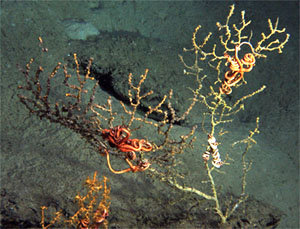
Image courtesy of Lophelia II 2010 Expedition, NOAA-OER/BOEMRE A single colony of coral with dying and dead sections on left, apparently living tissue at right, and bare skeleton with sickly looking brittle star on the base.
A brown substance is killing coral organisms in colonies located 4,600 feet deep about seven miles southwest of the failed BP Macondo oil well, according to scientists who returned Thursday from a three-week cruise studying coral reefs in the northern Gulf of Mexico.
The finding is the first case in which researchers have found evidence that living organisms in the deepwater area near the well site might have been killed by oil from the spill.
Penn State University biology professor Charles Fisher, chief scientist aboard the NOAA ship Ronald H. Brown said soft coral in a 15-meter to 40-meter area was covered by what appeared to be a brown substance.
“Ninety percent of 40 large corals were heavily affected and showed dead and dying parts and discoloration,” according to a news release reporting the findings by Fisher and other scientists issued jointly by NOAA and the Bureau of Ocean Energy Managment, Regulation and Enforcement, which co-sponsored the research. “Another site 400 meters away had a colony of stony coral similarly affected and partially covered with a similar brown substance.”
“While this mission was not designed to be focused on oil spill research, the timing and location provided an opportunity to observe any impacts to our research areas,” Fisher said in the news release. Fisher was unavailable for further comment on Thursday night.
The release said the scientists “observed dead and dying corals with sloughing tissue and discoloration.”
That’s just some of the continued impact on the ecosystem down here. The town of Gulf Shores, Alabama reports they are still owed $2 million in lost revenues. A city meeting also discussed outstanding claims by businesses and individuals. This, despite the uptick in local advertising I’ve seen on ad ‘stories’ of how BP has made me whole again run by BP here on our local TV stations. The ad revenues for this things must be unbelievably large.
A BP spokesman did not respond to inquiries about the lost revenue claims.
Also at Monday’s meeting, Dyken reported that officials were still trying to work out problems with the lack of claims paid by Ken Feinberg’s Gulf Coast Claims Facility to individuals and businesses.
Officials in south Baldwin County were expected to meet with Feinberg this week, Dyken said.
Baldwin County had received about $219 million, Dyken said.
“Some people still haven’t been paid on claims that are legitimate,” he said. “They have distributed a large amount of money. It’s just whether that money has gone to the appropriate parties in the appropriate places. There’s not a lot of rhyme or reason to some payments being made and others not. There’s also not the degree of transparency we would like in the process.”
In order to ensure that the oil spill’s lingering affects do not carry into next year, Doughty suggested expanding the tourist season.
“We need rebranding of the Gulf so that people understand the Gulf is safe, whether it’s Gulf seafood, Gulf beach, air whatever,” she said. “With tourism being our No. 1 economic engine here, anything we can do to help tourism would be great.”
This is particularly weird given the report by a Pensacola/Mobile TV station that a tourist was slimed with aging Oil last week. You can see the pictures and the news report here at the Channel 5 website.
Jonathan Jones’ palm still has an oil mark. He says he emerged from the water after a brief swim in Gulf Shores with trace amounts of crude.
“We looked at it and kind of smeared it a bit and figured out it was oil,” says Jones. He says he had to bathe with dish soap to get it off. At first he was worried about dispersants but then he quickly calmed down.
“There are hundreds of people on this beach and no one else had this happen,” says Jones. It’s probably important to put what happened to Jonathan in perspective. This appears to be an isolated incident and the beaches are most certainly still open
Meanwhile, future troubles lurk too. MoJo has identified the BP Atlantis–something BostonBoomer has written about–as another ‘Ticking Time Bomb in the Gulf’.
Located 124 miles off the Louisiana coast, the Atlantis platform produces 200,000 barrels of oil daily, more than triple the amount of oil that spilled from the Horizon site each day. But long before the Deepwater Horizon disaster, a whistleblowing former BP contractor tipped off regulators that the Atlantis may be violating the law, and environmental groups and members of Congress have been publicly questioning the platform’s safety ever since.
According to Kenneth Abbott, a former BP contractor who worked on the platform from 2008 through early 2009, more than 7,000 documents necessary to operate the platform safely are missing or incomplete. Abbott says the vast majority of the project’s subsea piping and instrument diagrams were not approved by engineers, and the safety systems are out of date. In practice, the lack of documentation on this platform would make it extremely difficult to respond in the event of an accident like the Deepwater Horizon blowout, critics say, because no one really has an accurate picture of the Atlantis’ design.
This seems to be the forgotten disaster and environmental disasters do not just disappear. Down here, the big election

Tony Bologna apologizes endlessly in the new series of BP spoofs on South Park at Comedy Central.
story was between Vitter and Melancon and both were fighting over who could be the most welcoming to the drillers and spillers. The MSM appeared more fixated on political personalities than issues. The only program still properly fixated on the BP Gusher is South Park that has a completely hilarious bit where Tony continually apologizes and then keeps on with making worse decisions. You can click on the picture to watch the episodes at Comedy Central or just the apology ad campaign send up.
If you live down here were there are daily reports of “massive stretches of weathered oil spotted in the Gulf of Mexico”. This report on a sighting is dated from October 23, 2010. That means it’s post well plugging. Again, this is from the Times Picayune here in New Orleans.
Just three days after the U.S. Coast Guard admiral in charge of the BP oil spill cleanup declared little recoverable surface oil remained in the Gulf of Mexico, Louisiana fishers Friday found miles-long strings of weathered oil floating toward fragile marshes on the Mississippi River delta.
The discovery, which comes as millions of birds begin moving toward the region in the fall migration, gave ammunition to groups that have insisted the government has overstated clean-up progress, and could force reclosure of key fishing areas only recently reopened.
The oil was sighted in West Bay, which covers approximately 35 square miles of open water between Southwest Pass, the main shipping channel of the river, and Tiger Pass near Venice. Boat captains working the BP clean-up effort said they have been reporting large areas of surface oil off the delta for more than a week but have seen little response from BP or the Coast Guard, which is in charge of the clean-up. The captains said most of their sightings have occurred during stretches of calm weather, similar to what the area has experienced most of this week.
The Coast Guard is saying parts of it are just algae but frankly, I believe the captains of Louisiana’s Cajun/Creole fishing fleet. Again, this thing and its impact are not over by a long shot. It’s absolutely necessary to continue to hold our elected officials and BP accountable for all the damage done and still happening to the ecosystem, wildlife, and people of the Gulf.

 peej
peej Carissa
 bostonboomer
 dakinikat
 ecocatwoman
 mablue2
 Mama Lopez
 peggysue22
 quixote
 skydancingguestblogger
 Mona (aka Wonk the Vote)



 Sky Dancing
Recent Comments