
Obama Studying Reagan’s Presidency During Hawaii Vacation
Posted: December 24, 2010 Filed under: Barack Obama, Democratic Politics, income inequality, the blogosphere | Tags: hero worship, Lou Cannon, Ronald Reagan, welfare queens 20 Comments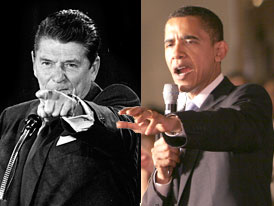
The Christian Science Monitor reports that President Obama is reading Lou Cannon’s latest book, President Reagan: The Role of a Lifetime during his Christmas vacation.
From the CSM:
This just in: President Obama on his Hawaii vacation may be engaging in activities hinting that he’ll take a more bipartisan approach to governance in the new year.
OK, we’re reaching a little bit here, but reading is a big thing for Mr. Obama when he relaxes, and his book list apparently has on it at least one very interesting title: “President Reagan: The Role of a Lifetime,” by Lou Cannon.
This is not just a book about a president beloved by just about every member of the modern GOP – it’s probably the best Reagan book yet written.
The CSM thinks this is a terrific idea.
If Obama actually reads this book, instead of a George Pelecanos mystery or old “OK!” magazines that are lying around his rented mansion, he’ll learn a lot about Reagan’s mastery of the style of the presidency – and how that mastery of style becomes substance.
The CSM thinks Obama needs to learn about bipartisanship from Reagan? WTF?!
If Obama wants to be bipartisan, he should focus less on pleasing Republicans and more on pushing some Democratic policies for a change. But I doubt that’s what the CSM meant.
Obama won’t learn much about “reaching across the aisle” from reading about Reagan, who deliberately used racial politics to divide and conquer, and who loved to tell nutty anecdotes about “welfare queens.” The guy was far from bipartisan, unless you consider conning people into doing your bidding “bipartisan.”
Remember this lovely Reagan anecdote? From Wikipedia, Reagan’s famous story about a woman from Chicago’s South Side who supposedly represented all welfare recipients:
“She has eighty names, thirty addresses, twelve Social Security cards and is collecting veteran’s benefits on four non-existing deceased husbands. And she is collecting Social Security on her cards. She’s got Medicaid, getting food stamps, and she is collecting welfare under each of her names. Her tax-free cash income is over $150,000.”
This is President Barack Obama’s role model. Remember this interview with the Reno Gazette-Journal during the 2008 primaries?
Here are some relevant portions of the interview:
“I don’t want to present myself as some sort of singular figure. I think part of what is different is the times. I do think that, for example, the 1980 election was different. I think Ronald Reagan changed the trajectory of America in a way that Richard Nixon did not and in a way that Bill Clinton did not. He put us on a fundamentally different path because the country was ready for it. They felt like with all the excesses of the 60s and the 70s and government had grown and grown but there wasn’t much sense of accountability in terms of how it was operating. I think he tapped into what people were already feeling. Which is we want clarity, we want optimism, we want a return to that sense of dynamism and entrepreneurship that had been missing.”
“I think Kennedy, 20 years earlier, moved the country in a fundamentally different direction. So I think a lot of it has to do with the times. I think we are in one of those fundamentally different times right now were people think that things, the way they are going, just aren’t working.”
He also said:
“I think it’s fair to say that the Republicans were the party of ideas for a pretty long chunk of time there over the last 10 to 15 years in the sense that they were challenging conventional wisdom,”
At the time, there was quite a bit of shock over this interview in the “progressive” blogosphere, before the progbloggers drank the koolaid and sold their souls. John Edwards and Hillary Clinton were also alarmed by Obama’s comments. Here is what Edwards said at the time: (Sorry about the right wing source)
“Ronald Reagan, the man who busted unions, the man who did everything in his power to destroy the organized labor movement, the man who created a tax structure that favored the richest Americans against middle class and working families, … we know that Ronald Reagan is not an example of change for a presidential candidate running in the Democratic Party,” Edwards said.
Reagan also “was destructive to the environment by removing a lot of the regulation that existed,” Edwards added in a later telephone interview with The Associated Press. “I would never use Ronald Reagan as an example of change.”
And here is what Hillary Clinton had to say about Obama’s claim that Republicans were “the party of ideas over the last 10 to 15 years.”
“That’s not the way I remember the last ten to fifteen years.” She said she didn’t consider it a better idea to privatize Social Security, eliminate the minimum wage, undercut health benefits, shut down the government or drive the country into debt. “I think we know what needs to be done in America.
But Obama went on to win the nomination and the general election. After two years, it’s pretty clear that Obama is playing “the role of a lifetime,” just as his hero Ronald Reagan did–Obama is pretending to be a Democrat.
Look, Lou Cannon is a terrific writer. I actually read Cannon’s first book about Reagan back in the ’80s, and it was quite good. But frankly, I was horrified by the man I read about in the book. Since I already know that Obama idolizes Reagan, I doubt he’ll be horrified by Reagan’s hatred of social programs.
I’d feel a whole lot better if Obama were reading a book about FDR during his luxurious vacation in Hawaii.
Basic Truths and Common Sense
Posted: March 25, 2009 Filed under: Populism, U.S. Economy | Tags: Adam Smith, Che, government is the problem, government is the solution, Huey Long, Market Failure, Monopoly, Perfect Competion, Populism, Ronald Reagan 4 CommentsI woke up from nap with this thread writing itself. This happens frequently to me when when I’m trying to reconcile ideas that look separate and unconnected but I know intuitively that isn’t true. I just haven’t found the way to make the connection. This latest dream tapestry came from what seems like three distinct sources. The first inspiration was a conversation from The Confluence. The second kick came from a rude comment from an even ruder blog. The third click came from my basic market structure lectures to my freshman survey classes where I have to teach economics to non-business majors. This means I teach economics concepts without much use of graphs and math so you have to tell a lot of stories to get your point across and be very down to earth about things. It makes me really work my brain so I can explain complex concepts in intuitive ways.
So the thread at the Confluence was about what is ‘crude populism.’ The rude comment was about me being at times seemingly ‘Keynesian’ and at other times a ‘rabid free market libertarian’. The primary concept that I’m leading up to in my survey class is ‘market failure.’ There’s actually a middle path between these concepts and we’re about to go down it. The connecting point is market failure and its root source as well as the source of resolution. The source of market failure can frequently be the government. It can also frequently be something with in the market itself that has nothing to do with the government. Either way, to deal with the market failure,the government must find the root source and remove it. This means creating laws. Sometimes, this means removing government intervention. Other time it means adding it. I’ll give you some examples here in moment, but stay with me on those points because I’m going to tie it to American populism in its varied forms.
The most recent form of American populism in this country comes from Ronald Reagan. A previous form of American populism came from Huey Long. They were both very skilled at speechifying the masses into jingoistic furor, but with very different views of what the government’s role in messes were. Reagan’s speeches were full of the “government is always the problem.” Here’s example one, the first Reagan inaugural address.
Here’s the part of the speech that describes the Reagan brand of Populism.
These United States are confronted with an economic affliction of great proportions. We suffer from the longest and one of the worst sustained inflation in our national history. It distorts our economic decisions, penalizes thrift, and crushes the struggling young and the fixed-income elderly alike. It threatens to shatter the lives of millions of our people.
Idle industries have cast workers into unemployment, human misery, and personal indignity. Those who do work are denied a fair return for their labor by a tax system which penalizes successful achievement and keeps us from maintaining full productivity.
But great as our tax burden is, it has not kept pace with public spending. For decades we have piled deficit upon deficit, mortgaging our future and our children’s future for the temporary convenience of the present. To continue this long trend is to guarantee tremendous social, cultural, political, and economic upheavals.
You and I, as individuals, can, by borrowing, live beyond our means, but for only a limited period of time. Why, then, should we think that collectively, as a nation, we’re not bound by that same limitation? We must act today in order to preserve tomorrow. And let there be no misunderstanding: We are going to begin to act, beginning today.
The economic ills we suffer have come upon us over several decades. They will not go away in days, weeks, or months, but they will go away. They will go away because we as Americans have the capacity now, as we’ve had in the past, to do whatever needs to be done to preserve this last and greatest bastion of freedom.
In this present crisis, government is not the solution to our problem; government is the problem. From time to time we’ve been tempted to believe that society has become too complex to be managed by self-rule, that government by an elite group is superior to government for, by, and of the people. Well, if no one among us is capable of governing himself, then who among us has the capacity to govern someone else? All of us together, in and out of government, must bear the burden. The solutions we seek must be equitable, with no one group singled out to pay a higher price.
This is the philosophical basis of the tea parties of Michelle Malkin. The line goes like this, there is this gang of elitists sitting in government taking our tax money and creating problems with our jobs to help their buddies and themselves. Let’s get them! We’re little businesses! We’re little people! We’re the solution ! They are they problem!
Here’s some highlights from the life of Louisiana Governor Huey Long, the Kingfish. He’s another politician associated with populism. Notice his breed of populism is quite different. Listen to his speeches. This line is one that grabs me.
“How many men ever went to a barbecue and would let one man take off the table what’s intended for nine–tenths of the people to eat? The only way you’ll ever be able to feed the balance of the people is to make that man come back and bring back some of that grub that he ain’t got no business with!”
Long’s type of populism puts the government squarely as the root of the solution and not the problem. This is another type of populism that is the philosophical catalyst spurring the pitchforks and torches aimed squarely at the AIG bonuses. Huey attacked the corporatist that he saw as distinct from the government. So, the line here goes, there is a gang of elitists taking our money and creating problems for our jobs. Let’s grab the government and go get them! We’re little businesses! We’re little people! We’re the solution but we can’t really do much unless the government is there to help us get them! But, let’s get them!
So yes, the problem can somewhat be boiled down to the government is the elitist problem for populist Republicans. The government is part of the solution to the elitist problem for populist Democrats. These are both ideological oversimplifications and I’m going to use simple economics to show you why. We can see that both can be true when you study market failures in economics. They aren’t completely irreconcilable viewpoints.

 peej
peej Carissa
 bostonboomer
 dakinikat
 ecocatwoman
 jjlo
jjlo mablue2
 Mama Lopez
 peggysue22
 quixote
 skydancingguestblogger
 Mona (aka Wonk the Vote)



 Sky Dancing
Recent Comments