
Krugman Debunks Republican Fairy Tales
Posted: July 30, 2011 Filed under: Economy | Tags: Bush tax cuts, Paul Krugman, Ronald Reagan Fairy Tales 11 Comments As we inch closer to purposeful default on our debt and spending policies destined to send us into recession, Nobel Prize winning Economist Paul Krugman comes out blasting with some nifty graphs. Stylized facts are an economist’s best friend. We continue to see this unending push of thoroughly trounced bad hypotheses spew out of Republicans and even the President. The vast degree of economic illiteracy in this country astounds me.
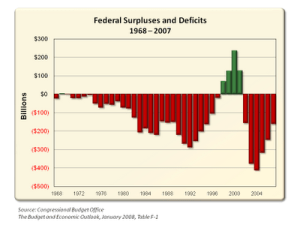
First, I’ll repeat one set of facts I mentioned in my post yesterday. Ronald Reagan was responsible for the largest tax increases in history and Barrack Obama was responsible for the largest tax cuts through his stimulus plan. This doesn’t even include his extension of the Dubya tax cuts. Discussion during TEFRA of 1982 resembles the discussion going on today. However, Reagan did tax increases. This particular ridiculousness is enough to make a data junkie scream. If you look at deficit numbers, former President Jimmy Carter was moving towards a budget balanced by the end of his term in office. Reagan blew government spending out of the water. However, Dubya remains the biggest spender of all since World War 2. If you want to blame the spending on any one, blame it on Reagan and George W, Bush. More on that in a bit.
Paul Krugman covers another Reagan Bedtime Story. He also points out that even conservative economists have started spewing the notion that Reagan was responsible for an era of “unprecedented growth”. This is also not true.
This shows what everyone was supposed to know: we had an awesome performance in the generation following the war (despite very high tax rates on the rich and a very strong union movement); we had a long period of poor productivity performance that spanned the Ford, Carter, Reagan, and Bush I administrations; we then had a revival during the Clinton administration, but even so not up to postwar standards. By the way, I don’t give Clinton credit for that revival; it was about learning to use technology. But in any case, there is no hint of a Reagan miracle in the data.
Now, back to stylized facts on federal spending. This is also from Krugman. There is this huge meme out there right now that some how, President Obama has gone on some kind of spending spree. This couldn’t be further from the truth. It appears that Rush Limbaugh is not only a big fat liar, but he is also incapable of doing the math on simple fractions. He is joined by nearly every Republican in the House today.
The fact is that federal spending rose from 19.6% of GDP in fiscal 2007 to 23.8% of GDP in fiscal 2010. So isn’t that a huge spending spree? Well, no.
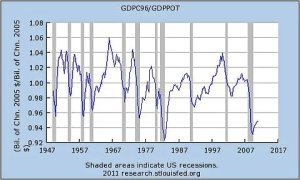
First of all, the size of a ratio depends on the denominator as well as the numerator. GDP has fallen sharply relative to the economy’s potential; here’s the ratio of real GDP to the CBO’s estimate of potential GDP:
A 6 percent fall in GDP relative to trend, all by itself, would have raised the ratio of spending to GDP from 19.6 to 20.8, or about 30 percent of the actual rise.
That still leaves a rise in spending; but most of that is safety-net programs, which spend more in hard times because more people are in distress.
Beginning in 2005, the CBPP showed how George W. Bush’s excessive tax cuts played the largest part in federal deficits. Simply allowing these to expire last December would have gone farther in pushing a balanced budget than nearly anything done to date. In May of this year, they continued their analysis of how the Bush Policies were the ones driving the budget deficit.
Some lawmakers, pundits, and others continue to say that President George W. Bush’s policies did not drive the projected federal deficits of the coming decade — that, instead, it was the policies of President Obama and Congress in 2009 and 2010. But, the fact remains: the economic downturn, President Bush’s tax cuts and the wars in Afghanistan and Iraq explain virtually the entire deficit over the next ten years (see Figure 1).
The deficit for fiscal year 2009 — which began more than three months before President Obama’s inauguration — was $1.4 trillion and, at 10 percent of Gross Domestic Product (GDP), the largest deficit relative to the economy since the end of World War II. At $1.3 trillion and nearly 9 percent of GDP, the deficit in 2010 was only slightly lower. If current policies remain in place, deficits will likely resemble those figures in 2011 and hover near $1 trillion a year for the next decade.
The events and policies that pushed deficits to these high levels in the
near term were, for the most part, not of President Obama’s making. If not for the Bush tax cuts, the deficit-financed wars in Iraq and Afghanistan, and the effects of the worst recession since the Great Depression (including the cost of policymakers’ actions to combat it), we would not be facing these huge deficits in the near term. By themselves, in fact, the Bush tax cuts and the wars in Iraq and Afghanistan will account for almost half of the $20 trillion in debt that, under current policies, the nation will owe by 2019. The stimulus law and financial rescues will account for less than 10 percent of the debt at that time.
Other drives of the current deficit are extremely short-lived. These would be all the financial rescue spending delivered to financial institutions and the recession which brings in loss of revenues and increased expenditures. The other big expenditures are the two unfunded wars that having been running for over 10 years. These are the first wars that we have ever run that were not funded by tax increases.
However, these Republican Fairy Tales do not let the current President off the hook. He seems as hell bent as the Republicans in many ways to repeat their sins. He also seems woefully short on economic knowledge and incapable of listening to his economics advisers–now frustrated and gone–on what to do with the economy. The simplest way to shut down the deficit would be to eliminate preferential treatment of capital gains income and let the Bush tax cuts expire. I’d prefer they expire for folks over $200,000 a year, but letting them expire altogether is better than setting the stage for all these falsehoods spewing from Limbaugh and the like. Obama should’ve let the tax cuts expire when he had the chance. However, his ability to negotiate a position that proposes a Democratic alternative policy has never been present. People can’t figure out if he is just has the world’s worst negotiating skills or he wants what the Republicans want. My belief is that the outcome could matter less to him as long as he gets some ego strokes from it.
We have gotten to the point that complete insanity and adherence to fairy tales is putting our economy in serious jeopardy. We simply cannot afford to listen to the voices of ignorance any more. I cannot even believe we’re being held hostage now to a balanced budget amendment. That is one of the most flagrantly wrong policies any one could ever think about. I’m going to take that on this week since I can’t believe that zombie canard is back haunting the halls of Congress again.
We seriously need experienced economic stewardship of the economy right now. We have a tremendous jobs deficit that will only get worse if any of these seriously flawed budget initiatives pass. We couldn’t have gotten a worse group of leaders at a more crucial point in time. Their mistakes will hurt this country for a very long time.

 peej
peej Carissa
 bostonboomer
 dakinikat
 ecocatwoman
 mablue2
 Mama Lopez
 peggysue22
 quixote
 skydancingguestblogger
 Mona (aka Wonk the Vote)



 Sky Dancing
Recent Comments