
The Myth in the Machine
Posted: February 17, 2012 Filed under: Economy, Environment, Environmental Protection | Tags: regulations create jobs 15 Comments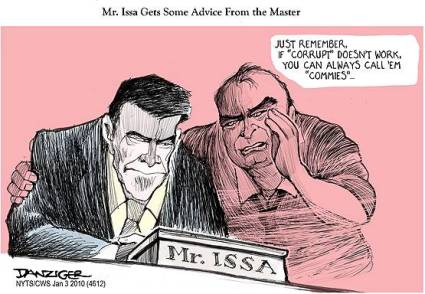 Bostonboomer and I were perusing information on the Issa panel and committee on religious freedom and birth control yesterday. Their expert witness panel appeared to be a mix between the Salem Witch Trials and the Spanish Inquisition. Where were the women on this panel? Is this really our government? What’s going on in Torquemada’s–errr Issa’s–realm of influence these days? BB has already regaled us on the crooked career and life of Issa whose business and career seems built on insurance fraud, car theft, and arson, so I won’t go there. We have a whole tag dedicated to him that’s infinitely googleable. However I will express my utter surprise and contempt that a committee of the US House of Representatives and its web page seem to be more of a propaganda tool of right wing tropes than anything remotely informative or helpful. Issa appears to be the Republican Party’s budding little combination of Goebbels and Himmler.
Go there and you’ll see a youtube with a nice white lady saying her “choice” was taken away by the SEIU. You’ll also see the Orwellian job creators DOT com that wants to know what kind of things are holding up your business. I don’t suppose any answer pointing to a lack of customers with well-paying jobs gets much attention. It also has a link to the Fast and Furious Witch Hunt. (No mention that this program had roots in the previous Republican administration, of course.) I had no idea that so much propaganda had crept into tax payer paid websites of congressional committees. I expect propaganda on their Facebook pages. But congressional committee pages with federal government addresses? Please!!
In honor of Issa’s hunt for “experts” that agree with him, I thought I’d point out a Bloomberg Business article that shows how many jobs new government regulations can create in the economy. The subtitle is “Vilified on the campaign trail, government rules often create as many jobs as they kill”. Nothing like a little truth and empirical research to shine the light on the Issa/Gingrich/Romney propaganda machine. It’s true that regulations on businesses can shift resources away from the regulated business. That includes jobs, profits, capital, and executive perks. However, that’s a one-sided notion. Those resources don’t disappear into thin air. They simply shift away from the business that’s regulated–most likely because it’s creating a social cost–to other businesses that can better use the resources or employ folks cleaning up and measuring the messes in the case of regulation of dirty industries like Coal and Oil.
“This rule is the most extensive intervention into the power market and job market that EPA has ever attempted to implement,” says Scott Segal, a lobbyist at Bracewell & Giuliani, which represents the utility Southern Co. (SO) He argues the regulation will “undermine job creation in the United States.”
Tell that to Cal Lockert, the vice-president of Breen Energy Solutions, a Pittsburgh manufacturer of equipment that absorbs acid gases to keep them from spilling out of smokestacks. Lockert spends his days persuading power companies that he can help them bring some of their oldest, dirtiest plants in line with the federal requirements. There’s been “a frenzy of engineering firms and utilities” calling him for demonstrations of his products, he says. He’s hired a dozen people in the past month and says he’s just getting started.
Nol-Tec Systems in Lino Lakes, Minn., also expects a boom in sales of its equipment, which uses baking soda to pull pollutants out of plant exhaust. Meanwhile, Thermo Fisher Scientific (TMO) in Waltham, Mass., is building emission monitors that power plants will need to measure toxins under the new rules. The regulations “could easily add $50 million to $100 million dollars in revenue in a year or two years,” says Chief Executive Officer Marc Casper, “which is significant for a company like ours.” The Institute of Clean Air Companies, a trade association representing businesses that make products to reduce industrial emissions, forecasts the industry will add 300,000 jobs a year through 2017 as a result of the EPA rules.
This is the side of the story that rarely gets mentioned in Washington or on the campaign trail. In an election year that hinges on the economy, government rules have become politically toxic. President Barack Obama’s health-care overhaul, the massive Dodd-Frank financial reform law, and EPA clean air and water mandates come under frequent attack from Republicans who say burdensome regulations are stalling the nation’s recovery. In the GOP debates, the R-word is now habitually preceded by “job-killing,” as in Mitt Romney’s promise to put an end to “job-killing regulations.” Newt Gingrich refers to the EPA as a “job-killing regulatory engine.”
Romney and Gingrich aren’t wrong. Government regulations do kill jobs, often by the thousands. Although it’s too early to tell how many layoffs may result from health-care and Wall Street reforms, there is a body of research going back decades detailing what has happened time and time again when Washington handed down sweeping environmental regulations: Costs increased, prices went up, and workers were fired. Supporters and opponents of the EPA’s new power plant rules agree that they will almost certainly result in dozens of coal plants shutting down and hundreds of workers being laid off.
But that’s not the whole picture. Government employment figures also show that those same regulations usually wind up creating about as many jobs as they kill. “We find there is no net impact,” says Richard Morgenstern, the EPA’s director of policy analysis in the Reagan and Clinton Administrations and now a researcher with Resources for the Future, a nonpartisan energy think tank in Washington. “The job creation and the job destruction roughly cancel each other out.”
Businesses targeted for regulation create huge social costs that taxpayers are forced to pick up. There are public health and safety costs, pollution and clean up costs, and many other costs. Dirty industries do these because they can force their costs onto the back of the public. They over produce their products and gobble up scare capital and productive resources because of they don’t realize the full costs of doing business. Regulation pushes these costs back onto their businesses. It also leads to “creative destruction” which is the Schumpeter idea that old, outdated technology must be replaced with better things to improve the long term performance of the economy. Some times the discipline in key industries has to come from the government because of the monopoly power of the industry. The energy industry is a prime example with its oligopoly over resource and product markets and the price inelastic nature of its demand. This enables the industry to via for political power as well as allows it fight to maintain dominance. In most of these cases, only technological developments break the monopoly/oligopoly. When Carter deregulated the telecommunications industry it wasn’t really all that effective. What really broke the back of the AT&T monopoly was the advances in communications technology. Frequently, regulations allow access to the heart of the monopoly’s business so that more facile, advanced businesses can break apart this destructive market type. It transfers resources away from the inefficient market that pushes high social costs on to taxpayers and neighboring communities.
Here’s a study that you never hear coming from the Issa propaganda/witch hunt arm of the US House of Representatives.
In 2002, Morgenstern and his colleagues published a landmark study detailing the effects of regulations on jobs in four polluting industries: paper, plastics, petroleum, and iron and steel. Drawing on more than 10 years’ worth of U.S. Census data, the study found new regulations led to higher production costs that pushed up prices, resulting in lost sales and layoffs. Yet those job losses were offset by new jobs in pollution abatement. “There’s always someone who is helped and someone who is hurt,” says Roger Noll, director of the Program on Regulatory Policy at Stanford University. “Which is why you have to look at the net effect on the economy.”
The loss in the polluting industry is actually a good thing in terms of market economy’s because it’s usually related to market inefficiency and transferred costs of doing business. BTW, this Stanford University think tank is not a hot bed of raging liberalism. This is one of this policy areas where there are trade-offs. This means changes create winners and losers. The deal is that in most cases the job loss is minimal but overall market efficiency improves. The true cost of the product is passed on to consumers which removes the subsidy to the consumers and producers of the product. Again, the resources just go elsewhere and are employed more efficiently in newer businesses. Oddly enough, this is what Romney frequently says he did in his corporate raider days.
The critique of regulations fits into a broader conservative narrative about government overreach. But it also comes after a string of disasters in recent years that were tied to government regulators falling short, including the financial crisis of 2008, the BP oil spill and the West Virginia mining accident last year.
Data from the Bureau of Labor Statistics show that very few layoffs are caused principally by tougher rules.
Whenever a firm lays off workers, the bureau asks executives the biggest reason for the job cuts.
In 2010, 0.3 percent of the people who lost their jobs in layoffs were let go because of “government regulations/intervention.” By comparison, 25 percent were laid off because of a drop in business demand.
I’m really not sure how we can create responses and discussions to one-sided political narratives that are based more on ideological memes than facts. It certainly doesn’t help when that one-sided narrative comes from our own government sites and servants. Obviously, the inefficient, lop-sided markets create monopoly profits for the stakeholders and we see K street filled with lobbyists aimed at protecting the inefficient markets. The stories from younger, inventive, upstart businesses without lobbyists and pet pundits and politicians have worthwhile narratives. Too bad their lost in a fight for ideological purity instead of empirical truth. Perhaps this is one of the reasons we keep fighting the culture wars. Voodoo economics narratives don’t hold up to inspection.

 peej
peej Carissa
 bostonboomer
 dakinikat
 ecocatwoman
 mablue2
 Mama Lopez
 peggysue22
 quixote
 skydancingguestblogger
 Mona (aka Wonk the Vote)



 Sky Dancing
Recent Comments