
Balanced Budget Amendments are Bad Policy
Posted: August 3, 2011 Filed under: U.S. Economy, U.S. Politics, voodoo economics | Tags: balanced budget amendments, business cycles, Debt, deficits, Federal Deficit, fiscal rules, GDP, John Maynard Keynes, macroeconomics, Michele Bachmann, recessions, social services, taxes, US Congress 9 Comments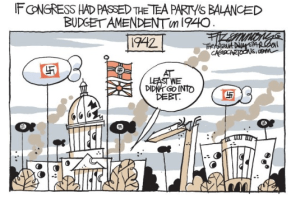 I always have to cover this topic in any introductory macroeconomics class I teach because usually one nutjob or another running for office always brings this up and people fall for it. The arguments are usually based on complete fallacies and misunderstanding of the math of economics, but hey, for some reason balanced budgets sound ‘reasonable’ when they are anything but.
I used to talk theoretically about how balanced budget amendments will kill state economies when the next real recession hits. Well, it hit a few years ago and we’re there. States continue to make their own economies worse day in and day out but there’s still those people that insist that if a family has to balance its budget, then so should the country. That’s even stupid considering most families have mortgages and car payments and probably student loans. Take Michele Bachmann as an example. She’s got all of the above plus farm subsidies and government grants. Even the President is guilty of that false equivalency. No person or family exists in perpetuity. No person or family can print money. No person or family has the power of taxation. Because of these three things, you cannot compare government to a family. Nor can you compare government to a business. Businesses exist to make a profit. Government exists to provide services and goods that the private sector will not provide or provides at an outrageous cost. It exists to administer justice and ensure level playing fields and fair play exists. Everything about a government is unique and is no way comparable to either businesses or households.
Macroeconomists know from years of study that the federal government can influence the economy at large. It does so through its spending and taxing priorities and policies. This is called fiscal policy. We have found several economic laws that guide the relationship between taxes and government spending and the behavior of Gross Domestic Product (GDP) which roughly measures all the legal and reported spending by households, governments, foreigners, and businesses. In our economy, household spending comprises about 68% of all GDP.
Investment or purchases by businesses is the smallest and most erratic component of GDP. Keynes said that it is easily spooked and subject to animistic spirits. Because it’s an unreliable source of growth, Keynes argued that in down turns, government should use its power to spend. Business investment usually only does fine in good economies. Please note, Keynes said deficit spend in recessions. Keynes’ prescription also said that Federal governments should run balanced budgets during times when the economy is fully employed and surpluses during bubble or boom times to relieve inflationary pressure. As usual, conservative politicians completely lie about the nature of Keynes and his highly proven and credible theories on fiscal policy. A lot of what we know about Monetary Policy comes from Milton Friedman, however, that is not the subject today. What I want to emphasize is that both men spent a lot of time analyzing panics and the Great Depression and are very much at the heart of accepted theory. We are seeing a classical lack of aggregate demand today. It is what’s driving the budget deficit. It is what’s driving the joblessness. It is what’s driving the slow recovery. Government must and will by automatic stabilizers be in a deficit position during downturns. It is simple math. More revenues come in during good times than bad. More safety net spending increases during bad times than good. We naturally run towards deficit in bad economies and towards surplus in good.
However, show me an economy that’s booming with high revenues and lower safety net spending and I will show you a group of politicians spending wildly. This tends to create inflation and can lead to bubbles. However, you never hear them complain at that point in time. That’s because it should be relatively easy to balance a budget then, but they do not do so or if they do its by expanding programs that cannot be sustained without borrowing during bad economies.
With that short explanation, let me cite you some folks that tell you why balanced budget amendments are bad policy. This first quote is from Simon Johnson who is the former chief economist for the IMF. He asks us to keep in mind that GDP is a measurement that is fraught with problems. He also mentions the fact that a balanced budget amendment makes the government make recessions worse.
Second and more seriously, imagine that this constitutional amendment were in place and that federal spending were roughly at its limit relative to the size of the economy. Then, what happens should the financial sector blow up again — either through no fault of its own (which, believe it or not, is the current prevailing myth on Wall Street about 2007-9) or because of some toxic combination of malfeasance and malpractice (the current predominant view of 2007-9 among many other people)?
The blame game is irrelevant when G.D.P. drops 10 percent; the issue is how to prevent a Great Depression. But note that with such a decline in G.D.P., a level of nominal spending that was 18 percent of G.D.P. is suddenly 20 percent, and now a constitutional crisis awaits – even before we get to the question of whether tax cuts or other forms of stimulus might be appropriate.
It makes no sense to take aim, as a matter of constitutional process, at two numbers that are both outcomes of deeper economic processes.
And to be frank, sometimes it makes a great deal of sense to apply an economic stimulus to an economy in free fall. One such moment was 1930 (and 1931 and 1932), when no stimulus was applied. Other moments were 2008 and 2009; both President Bush and President Obama initiated stimulus packages. When credit for and confidence in the private sector evaporates, do you really want the government sector to be forced to make quick cuts — or to raise taxes?
James Ledbetter at Reuters argues that even conservatives should oppose a balanced budget amendment (BBA). His reasons are more pragmatic. He argues that it won’t work.
Historically, conservatives have opposed extending government authority in places where it is not effective. You can find all the evidence you need to conclude that balanced budget requirements are useless by simply investigating the oft-repeated claim that 49 states have laws requiring a balanced budget. Leave aside the falsity of the claim and just consider the logic: if so many states are required to balance their budgets, why are so many states in the red?
The answer is that requiring state governments to annually balance their books simply encourages them to find clever ways to disguise debt and deficits. For example: California has both a Constitutional and a statutory requirement that its budgets be balanced. Would any sane person maintain that the state’s books have been anything resembling healthy for at least a decade? This year, after some brutal spending cuts, the governor’s office found that the state still had a short-term deficit of more than $9 billion and $35 billion in long-term debt. The governor’s budget report noted that California’s “massive budget deficits for most of the past decade…have been largely the result of a reliance on one-time solutions, borrowing, accounting maneuvers, and cuts or revenues that were illusory and therefore did not materialize.”
If that sounds familiar, it may be because, as Richard Quest pointed out on CNN Sunday evening, we’ve witnessed numerous Congressional attempts in recent decades to rein in federal deficits—including Gramm-Rudman in 1985 and the Budget Enforcement Act of 1990—all of which fell victim to legislative legerdemain. Why would a federal balanced budget amendment be any different?
Here’s something from The Economist on “Fiscal Rules”. Some fiscal rule–rather than a balanced budget amendment–would better stop congress from spending during booms and full employment cycles rather than balancing its budget via a BBA. This would be a rule that attaches the spending mandates to what’s going on in the economy. But again, I doubt they’d follow it since they’ve ignored a good portion of the Keynesian prescription for years any way.
It is difficult for Congress to tie its own hands. Any law that can pass Congress can later be undone or changed. In the rare cases that Congress puts together a near-perfect piece of legislation, that’s a bad thing. In the vastly more common occurrence that Congress passes highly imperfect legislation in need of significant future tweaks, that’s a very good thing. Support for an amendment to the constitution is a spectacular vote of confidence in the ability of a legislature to design near-perfect legislation, because the only thing rarer than an amendment to the constitution is a subsequent amendment undoing or clarifying a previous amendment.
I see the argument for a well-designed, over-the-business-cycle balanced-budget amendment. But the idea of enshrining this Congress’ pathologies into the constitution is terrifying. Let’s see Congress design some quality fiscal rules using the normal legislative process first, and then we can talk about adding those to the constitution.
Bruce Bartlett has some excellent analysis up for the current go round of balanced budget amendments. Mark Thoma explains how a BBA is a very bad idea. His analysis includes looking at the destabilizing effects that states’ BBAs have had on their economies. There’s a nifty graph that I did not include here if you’d like to go view it.
I’ve argued on many occasions that one of the big lessons we need to learn from this recession is that state-level balanced budget requirements are highly destabilizing. When a recession hits, spending goes up for social services and taxes fall as income, sales, property values, and other sources of revenue for state and local governments decline.
The result is a big hole in state and local government budgets, and that forces either increases in taxes or cuts in spending both of which make things even worse. And though some state and local governments were an exception to this, far and away the choice is to cut spending. We can see this in the state and local government employment statistics:
That’s not what we want to have happening when we are trying to recover from a recession. It would be much better if states had rainy day funds to rely upon, and if the rainy day funds fall short, the federal government could backfill the budget holes to prevent the destabilizing downsizing.
So have we learned the lesson? Nope, at least not if you are a Republican. They’d like to impose the same destabilizing rules on the federal government:
You really would have to search high and low for an economist that actually supports a BBA. The more conservative ones go for the fiscal rule that attaches spending to business cycles but even they believe that it would be unenforceable and easy to avoid. Can you imagine some District Judge trying to look over a complex macroeconomic model and figure out if the government forecast was correct or not?
A group of leading economists, including five Nobel Laureates in economics, today publicly released a letter to President Obama and Congress opposing a constitutional balanced budget amendment. The letter outlines the reasons why writing a balanced budget requirement into the Constitution would be “very unsound policy” that would adversely affect the economy. Adding arbitrary caps on federal expenditures would make the balanced budget amendment even more problematic, the letter says. The Economic Policy Institute and the Center on Budget and Policy Priorities organized the letter.
“A balanced budget amendment would mandate perverse actions in the face of recessions,” the letter notes. By requiring large budget cuts when the economy is weakest, the amendment “would aggravate recessions.”
The signatories of the letter are Nobel Laureates Kenneth Arrow, Peter Diamond, Eric Maskin, Charles Schultze, William Sharpe and Robert Solow; Alan Blinder, former Vice Chair of the Federal Reserve System’s Board of Governors and former member of the Council of Economic Advisors; and Laura Tyson, former Chair of the Council of Economic Advisors and former Director of the National Economic Council.
I’ll let former Reagan economist Bruce Bartlett have the last word here. He looks at the recent debate in Congress on the BBA.
Next week, House Republicans plan to debate a balanced budget amendment to the Constitution. Although polls show overwhelming public support, it is doubtful that many Americans realize that the measure to be debated is not, in fact, a workable blueprint to enforce a balanced budget. In fact, it’s just more political theater designed to delight the Tea Party.
We really need improved economic literacy in this country. I genuinely can’t get over what some of the morons in congress can get away with saying. Economists call them on it but it appears no one every listens.
Stupid Economist Tricks
Posted: October 29, 2008 Filed under: U.S. Economy | Tags: Economists, economy, forecasting, Leading and lagging indicators, recessions 2 CommentsSome times I feel like I spend a lot of time reading entrails or the lay of chicken bones. I pour over numbers,  announcements, and signs of momentum much like Marie Laveaux–that great voodoo priestess buried not all that far from my own house–would check for auspicious signs. In academic terms, I’m analyzing the fundamentals for signs of bottoms or inflections looking for some hint about this downturn. Some how, however, I still find myself relying on a lot on intuition in the end. This still makes me feel less like a scientist and more like a modern voodoo priestess.
So, what do the fundamentals say right now? There are several markets that might give us a glance at the entrails of the U.S. economy. The first is what households (consumers) are planning to do. The biggest component of US spending in the economy belongs to consumers. They are responsible for about 70% of sales of all goods and services. The last time consumer spending decreased was during 1991 during the post Gulf War 1 recession. Most economists expect that they went negative some time this fall. One of the measurements we check to see if this will become a trend is the Reuters/University of Michigan index of Consumer Sentiment. This is basically and index that summarizes the results of a survey of how optimistic or pessimistic households are about their economic future. If they are optimistic, they usually spend more. This blurb of bad news is from the Wall Street Journal.
After hitting its lowest level in nearly 30 years in June, the gauge had begun to improve as oil and gas prices fell from their record highs. But that improvement was wiped out this month as financial and economic conditions worsened.
Unfortunately, we just hit an all time record low on the measurement for this month. That is not a good thing. If you look at where the economy is soft, it is on those businesses that provide big item tickets to households. This includes things like cars and washing machines. Households are less likely to buy big ticket items when they feel unsure about their future. Companies that have announced lay-offs and plant shut downs recently include GM and Whirlpool. This confirms our suspicion that consumers are laying low. Kraft, however, is doing well. It posted a third quarter gain. That’s because folks that tighten their belt eat a lot of those mac and cheese boxes. This also is something that says we’re looking at a recession.
The good news is that business orders of some of this big ticket items appears to be looking up. This is good news because businesses tend to order these things if they see next year being better than this year. Civilian aircraft orders appeared to be the mover in this statistic. Also transportation equipment. Durable goods orders by manufacturers are considered a ‘leading indicator’ of future economic health, compared to consumer sales which are considered a look into the current economic health. This is because businesses buy based on what they expect to do next year. This gives us slight hope that next year might be better than right now.
Another fundamental to watch for indications of a sluggish or recessionary economy is the job market. Most economists follow a number of statistics here. We usually don’t rely on the unemployment rate because it hides a lot of information. Two of the big things it hides are folks that still want jobs but have given up on their job search and folks that are working part time jobs when they really want full time employment. Here is some information on jobless claims from that same WSJ article. That statistic is another indicator followed by economists.
Many economists more closely monitor the Labor Department’s weekly report on initial unemployment insurance claims, which measures the number of people filing for new unemployment benefits. A rule of thumb says that when claims stay above 400,000, the economy is slipping into recession. That started happening in July. The latest weekly claims figure is 478,000.
Unemployment tends to ‘lag’ or move behind a recession. It will frequently increase even when the economy rebounds. So, expect unemployment to be a problem for some time.
By following some of the statistics, economists get a good sense on how deep and long this downturn may be. Again, it is a bit like Marie LaVeau reading entrails. From some of the things we see so far, we expect this downturn to be longer and deeper than the last two which occurred in 2001 and 1991. However, because of little glimpses of hope, like the uptick in Manufacturer’s Durable good orders, most economist do not believe we’re about to see the Great Depression again. Because economists have gotten better at reading the entrails, economic advisers on policy have gotten better at recommending policies to government to stymie the worst of possibilities. So I’d just like to say again that you should act with prudence moving forward but not panic. This is, after all, a very resilient country with an economy that has survived a lot worse things.
PS: No chickens were harmed in the writing of this thread.

 peej
peej Carissa
 bostonboomer
 dakinikat
 ecocatwoman
 mablue2
 Mama Lopez
 peggysue22
 quixote
 skydancingguestblogger
 Mona (aka Wonk the Vote)



 Sky Dancing
Recent Comments