
Toxic Treasuries Redux
Posted: March 26, 2009 Filed under: Equity Markets, Global Financial Crisis, U.S. Economy | Tags: Bond Auctions, FED, quantitative easing, UK Auctions, US Treasury bonds Comments Off on Toxic Treasuries ReduxWhile the equity markets are reacting positively to whatever bit of good news they can grab, economists are eying the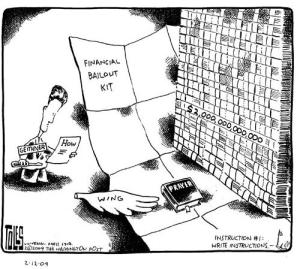 market for government bonds. The United States and the United Kingdom have huge deficit driven budgets and stimulus plans that are testing the willingness of their creditors. The US is skating on the thin ice. The UK fell into the pond. This from Market Watch:
NEW YORK (MarketWatch) — Treasury bond auctions, not usually the stuff that fires up equities traders, rocked stocks this week as investors homed in on worries about the ability of the government to borrow more than $2 trillion to fund its financial and economic rescue plans.
On Wednesday, concerns were sparked after the U.K. failed to get enough bids to sell the full amount of 4-year gilts it offered, the first time this happened in 14 years. Later in the day, a U.S. government auction of $34 billion of 5-year notes drew only tepid interest from foreign investors.
“Everybody knows that the government is auctioning stuff like there’s no tomorrow,” said Paul Nolte, director of investments at Hinsdale Associates. “The question is who’s going to buy all this stuff,” he said. “If there’s not enough buyers, interest rates will have to go higher, which means mortgage rates would have to go higher and that could derail any recovery we might have.”
Treasury bond yields, which move inversely to bond prices, are used to benchmark the interest rates on many consumer loans, including some mortgages. When buyers don’t show up at an auction, bond prices fall and their yields rise.
This brings us back to China and their call to review the dollar’s role as a reserve currency. The offset on the Fed’s balance sheet to Treasury Bills and Bonds is dollars. These things and the interest rates that prevail in the economy are causally linked. You mess with one, you mess with them all.
Meanwhile, China, the largest buyer of U.S. Treasury bonds, expressed concern earlier this month about the safety of its investments. The massive amounts of U.S. debt issued have pressured bond prices and also threatened the strength of the dollar, which could further reduce the value of holding Treasurys.
China also rocked the boat when the governor of its central bank on Monday called for a new global reserve currency to replace the dollar.
The Treasury had announced that the would be heavily involved in the market this week. The FED is also out there with its quantitative easing program. Odd things are happening. It became obvious by mid Wednesday that their announcements and actions were causing the Treasury to actually buy at high price mid-morning then selling much later at a low price. It doesn’t take a rocket scientist to know that’s bad math for the taxpayer. Larry Doyle over at NQ heard that Wall Street was trying to sell three times the amount that the Treasury actually bought.
Bloomberg also noted the supply concerns.
The Treasury Department is selling a record $98 billion in notes this week, eclipsing the record $94 billion auctioned the week ended Feb. 27. The U.K. failed to attract enough bidders today at an auction of 1.75 billion pounds ($2.55 billion) of gilts for the first time in almost seven years.
President Barack Obama’s government is selling record amounts of debt to revive economic growth, service deficits, and cushion the failures in the financial system. Debt sales will almost triple this year to a record $2.5 trillion, according to estimates from Goldman Sachs Group Inc.
Orders for U.S. durable goods unexpectedly rose by 3.4 percent in February, the Commerce Department said today in Washington. Purchases of new homes in the U.S. unexpectedly jumped in February, increasing 4.7 percent to an annual pace of 337,000 after a 322,000 rate in January, Commerce said.
“Better than expected economic data, failure of the long- end auction in the U.K. and low demand at the five-year Treasury auction; all these factors combined are leading to higher yields,” said Anshul Pradhan, an interest-rate strategist in New York at Barclays Capital Inc., another primary dealer.
The Fed said it purchased $7.5 billion of U.S. debt spread among 13 of the possible 19 securities eligible for purchase. The notes mature from February 2016 to February 2019, the Federal Reserve Bank of New York said in a statement today. Nearly $22 billion was submitted to the central bank in the first day of buying, the New York Fed said.
“We are really not seeing any kind of meaningful support for the Treasury market,” said Kevin Flanagan, a Purchase, New York-based fixed-income strategist for Morgan Stanley’s individual investor clients. “Conventional wisdom in the market is that the Fed will concentrate on the five- to 10-year or the seven- to 10-year sector.”
The Big Ease
Posted: March 19, 2009 Filed under: Equity Markets, Global Financial Crisis, U.S. Economy | Tags: Fed Policy, FOMC, Helicopter Ben, monetary policy, quantitative easing 2 Comments I’ve had a couple of request to talk about how the Fed creates money and what happens if it over expands the money supply so that’s the topic of this post. Yesterday, the monetary policy authority of the Fed, the Federal Open Market Committee (FOMC) announced an injection of $1 Trillion. It is doing so by buying back some long term bonds in a move that is called Open Market Operations. Basically, Open Market Operations work like this. If the Fed wants money out in the economy (to increase spending by businesses and consumers), it makes selling bonds back to it very appealing. Investors won’t want to hold bonds because they’re not providing a good return. They’ll look for other places to put their money like in vehicles that might be based more on lending like commercial bonds or mortgage-backed securities. Low interest rates should make it more like that people will want to borrow. Banks won’t invest in bonds because they are low yield compared to what they can get from borrowers. This is the gist expansive monetary policy. This is one of the classical tools of monetary policy and the most used in the Fed Tool box. It generally works through lowered interest rates which is something that can’t really happen now. The interesting thing about this move is that it is huge and announced. This isn’t the usual SOP.
Usually open market operations are done in a hush-hush, behind closed doors, James Bond kind of atmosphere so as not to give information to the market to offset the action. As I said earlier, deliberate policy announcement is one of the market-shaping policies that Chair Bernanke has opted for as a tool of policy since most interest rates are close to zero. They are pulling in long term bonds as a form of quantitative easing (changing the structure of the Fed balance sheet to impact the term structure of interest rates.) They want the long term mortgage rate to come down to encourage house buying from the public. They also want to encourage lenders to renegotiate outstanding home loans. The other portion of the announcement meant to shape investor behavior was the outlook statement which tends to give the markets a forward looking policy hint. Not only is the Fed doing this, they are actively asking the Treasury to print money to help them beef up the size of their balance sheet so it can be used for a variety of purposes.
Printing new money is just a straight forward increase in the Money Supply. The purpose is this. You give people more money and they will have more money to spend. The issue comes down to this, however. How much stuff is out there for us to buy? A lot of stuff? Not so much stuff? Since interest rates are low, we may not save, we may buy lots of stuff. However, if we’re scared, we may not spend anyway, we may just tuck the money away. How this works depends on the response of both businesses and households.
This is from the previously linked NY Times article.
In its announcement, the central bank said that the United States remained in a severe recession and listed its continuing woes, from job losses and lost housing wealth to falling exports as a result of the worldwide economic slowdown.
“In these circumstances, the Federal Reserve will employ all available tools to promote economic recovery and to preserve price stability,” the central bank said.
As expected, policy makers decided to keep the Fed’s benchmark interest rate on overnight loans in a range between zero and 0.25 percent.
But to the surprise of investors and analysts, the committee said it had decided to purchase an additional $750 billion worth of government-guaranteed mortgage-backed securities on top of the $500 billion that the Fed is already in the process of buying.
In addition, the Fed said it would buy up to $300 billion worth of longer-term Treasury securities over the next six months. That would tend to push down longer-term interest rates on all types of loans.
All these measures would come in addition to what has already been an unprecedented expansion of lending by the Fed. The central bank also said it would probably expand the scope of a new program to finance consumer and business lending, which gets under way this week.
In effect, the central bank has been lending money to a wider and wider array of borrowers, and it has financed that lending by using its authority to create new money at will.
Some Economist blogs are openly criticizing the FED’s move. This is because what we know about the causes of deep-rooted, nasty inflation. It is generally caused by too much money chasing too few goods. In other words, if the economy is not producing enough goods and services because of the recession and suddenly there is more money, the money will be used to buy goods and services. If the production does not catch up with the money, it will drive the average price of goods and services up and we will experience systemic inflation.
There are two situations right now that make inflation creation unlikely. The first is that since we are in a deep recession, we are seriously under capacity . This means we have many businesses that are basically ‘idle’. They do not carry enough stock, they are not fully employing labor, and they are operating with a lot of excess overhead. They could start up, un-idle the excess capacity, and increase their use of what they have now without creating much inflation. The only place that inflation might occur would be in the raw materials sector which would have to gear up to supply any increased demand by manufacturing, but right now people, equipment, and facilities are underused.
The other situation that makes it highly unlikely we experience inflation in the short run is the fact that we don’t have

Is the Fed forever blowing bubbles?
much in the way of inflation now. We also have deflation in many major sectors like housing.
However, the question of the day is this. Is Bernanke solving a recession created by one bubble (housing) that was created by trying to cope with another bubble (dot.coms)? This is where we separate the Keynesians from the Monetarists. You can get a feel for what the discussion is if you hit some of the major econ-related blogs. You can tell the monetarists. They’re calling the Chairman Helicopter Ben.
It’s a very weird, somewhat circular transaction, and it was last done in a big way during World War II. At the time the Fed wasn’t so much making monetary policy as doing its patriotic bit to finance the war (it was a de facto division of the Treasury Department at the time), but it worked on both counts: The deflationary tendencies of the 1930s were finally fully expunged from the economy, and we beat the bad guys. Later on, Milton Friedman described this kind of transaction as the functional equivalent of a “helicopter drop” of money, and after Ben Bernanke mentioned this in a speech in 2002 he became known as Helicopter Ben. Now he’s finally living up to the name.*
Will it work? In the sense of fending off deflation, yeah, this should have an impact. But the financial world and America’s position in it are more complicated than in the 1940s. We now owe lots of money to creditors outside the U.S., and when they see the Fed buying long-dated Treasuries they’re bound to start worrying about what that means for the dollar. If they get too worried, they could drive up interest rates here and counter the impact of the Fed’s purchases. So there are limits to the Fed’s magical powers, and they already began showing up in currency markets this afternoon, with the dollar falling sharply against the euro and other foreign currencies. The adventure continues.

 peej
peej Carissa
 bostonboomer
 dakinikat
 ecocatwoman
 mablue2
 Mama Lopez
 peggysue22
 quixote
 skydancingguestblogger
 Mona (aka Wonk the Vote)



 Sky Dancing
Recent Comments