
Social Security: Reform, Refund or Opt-out? (Part 2)
Posted: May 18, 2009 Filed under: U.S. Economy | Tags: Pay as You Go, Privatization of Social Security, Public Pensions, Social Security Comments Off on Social Security: Reform, Refund or Opt-out? (Part 2) Public Pension Concepts and Alternatives
Social Security reform combines three basic possibilities. It can raise contributions or it can cut benefits sometime in the present or future (pre-funding or pay-as-you-go (PAYG)). It can be private or public. It can be diversified or undiversified. The current system is public, has no diversification and is not pre-funded (PAYG). It features forced savings in that income cannot be spent before retirement. It pools social risk so that it can provide insurance against earnings loss, disability, inflation, and longevity. It redistributes income from high to low lifetime earners. The Social Security System is controlled and administered by the U.S. government and is a defined-benefit plan (DBP) .
“Pre-funding” is a plan to reduce the sum of the system’s implicit and explicit debt. As alluded to previously in the discussion of the vulgar error, the current system has inherited or legacy debt. This is something many politicians either willfully forget or ignorantly omit. Any analysis and reform must include provisions for the cost of inherited debt or it is a truly disingenuous and misleading discussion. Omitting taking care of this unfunded liability (which is estimated at around $10 trillion) is the vulgar error committed by the many politicians who compare returns from strictly switching to other assets. They do not mention deducting this debt from the alternate assets’ internal rates of returns (IRRs) to the IRRs of Social Security. The IRRs of the Social Security Trust fund for future generations account for the legacy debt.
The earliest cohorts received very high IRRs in real terms. An anecdotal and extreme example is that of my grandfather who worked for the Federal Reserve System which did not become part of the social security system until six months before his retirement in the mid 1960s. He actually deferred his retirement six months to buy into the social security system and qualify for benefits. He, and for awhile my grandmother, received nearly 15 years of monthly benefits for six months of his contributions. A truly amazing IRR and one for which his progeny will be paying for years to come.
Social Security: Reform, Refund or Opt-Out (Part 1)
Posted: May 17, 2009 Filed under: U.S. Economy | Tags: FDR, legacy debt, Public Pensions, Social Security, Social Security Reform, Social Security System Solvency Comments Off on Social Security: Reform, Refund or Opt-Out (Part 1)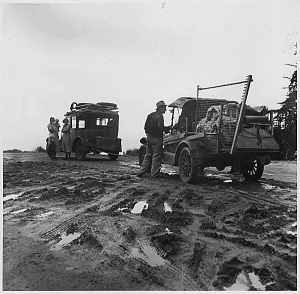 Several years ago, I did some research on Social Security. I thought I’d share that with you now as we look to more possible reforms coming from the Obama administration. This part is just introductory. Part 2 will be on Public Pension Concepts and Alternatives.
One of the most successful and significant programs put into place by the Roosevelt administration’s “New Deal” has been the U.S. Social Security System. It has met its goal of alleviating poverty among the elderly. It has become known as the ‘third rail’ of politics because of its success and acceptance by the majority of the populace. Elderly voters—an active and vocal voting constituency—do not take kindly to any discussion concerning social security reform. While other countries around the world have been reforming and restructuring their public pension systems, the U.S. social security system remains firmly entrenched in its current form. Any discussion of reduced benefit or increased contributions is political suicide. Reform discussions are difficult at best.
Most recently, President G.W. Bush spent a large amount of time and taxpayer money being educated on third rail politics while trying to convince America that some form of privatization was the right vision for the future elderly. While the highly selected audiences at these events was convinced that opting out completely was the way to go, the rest of America hit their panic buttons then phoned their congressional delegated. These re-education forums are now part of America history. The public reform debate has gone quietly into the night while discussion continues in the offices of institutions like MIT, Harvard, and the NBER.
Fortunately, many economists are still researching the efficiency of the U.S. Social Security System. Additionally, they now have around 20+ years of experience from other countries’ public pension reforms to analyze. This—at the very least—gives the United States the benefit of not going first so it can learn from the problems of the rest of the world. Learning the lessons of others may still not be enough to bring sensible and truthful debate back to the public arena. This must happen before reform or refunding actually occurs.

 peej
peej Carissa
 bostonboomer
 dakinikat
 ecocatwoman
 mablue2
 Mama Lopez
 peggysue22
 quixote
 skydancingguestblogger
 Mona (aka Wonk the Vote)



 Sky Dancing
Recent Comments