
The U.S. Government is NOT a household or a business
Posted: January 14, 2011 Filed under: U.S. Economy, U.S. Politics, Voter Ignorance, We are so F'd | Tags: economic illiteracy, Federal Debt, Federal Deficit, gold buggery, Paul Krugman, Rand Paul, Ron Paul 11 Comments
Gold bug in the garden of eden on a perfectly flat earth.
I’ve noticed the high level of economic illiteracy in the country since the day I started seriously studying economics. I’ve also noticed that faith-based economics rules the thought processes of many politicians. It always reminds me of those folks that believe in a literal garden of eden and a 7 day creation story over the facts that science hands us day-in and day-out. Molecular Biology has pretty much trumped their views but they persist in sticking their fingers in their ears and going la la la la la.
A variety of misguided notions have taken up residence in the brains of the same people, so I suppose it’s not surprising that the same groups that scream war on christmas also think the US will go bankrupt if we don’t up the debt ceiling or some such nonsense. The problem is that anti-intellectual flat earthers control a political party in this country. That problem extends to people who now sit as chairs of congressional committees that deal with the real world and real people. Then, there’s the fact that the other political party doesn’t really fight for the truth. It’s just all very distressing to me.
There are two stories today that I’d like to use as evidence to point to the incredible amount of lunacy floating around today’s Republican Party. The first comes from Paul Krugman. The second from The Economist. Krugman talks about the persistence of gold buggery. (Yes, I’m using a double entendre.) The Economist about the persistence of federal deficit and debt myths. They write on the number of people that don’t seem to understand what it takes for the US to ‘default’. Both myths need airing.
Paul Krugman writes political op-ed as well as information on economics. Economists are trained to separate the two. We even have two names for the circumstances. It’s called discussing positive and normative economics. You teach principles of economics students how to distinguish between the two on the very first day of class. Some times I think Dr. Krugman forgets that most people and politicians are economic illiterates. You see and hear constant confusion on his writings. People don’t seem to distinguish between his op-ed with the liberal bent (normative) and when he’s actually talking economic theory (positive). His op-ed today talks about the fact that there are many issues in politics today that are so polarizing that there is no third way or middle ground. I don’t want to point to that, but his blog post ‘Monetary Morality’ that takes this notion of no compromising with idiots which points to the absurdity of gold buggery or something he called paleomonetarism in an early post.
In those two posts, he points out that there is a narrative out there–mostly preached by the Pauls–that the Fed is evil and we need to be hung on a cross of gold (with apologies to William Jennings Bryan). If you read the two posts you’ll see that this issues isn’t a conversation or liberal issue at all. Economists have a shared understanding of theory that doesn’t include the Paul money narrative. The Paul monetary narrative is not about economics, it’s about some idea that the government and a central bank is some how confiscating something from you. It’s a philosophy of paranoia more than an economic statement.
You see, if you’re the kind of person who views being taxed to pay for social insurance programs as tyranny, you’re also going to be the kind of person who sees the printing of fiat money by a government-sponsored central bank as confiscation. You may try to produce evidence about the terrible things that happen under fiat currencies; you may insist that hyperinflation is just around the corner; but ultimately the facts don’t matter, it’s the immorality of activist monetary policy that you hate.
And this is also why politically conservative economists arguing for something like nominal GDP targeting, and pleading with their perceived political allies to stop talking nonsense, are going to be disappointed. If you’re in the intellectual universe where monetary policy is to be evaluated by results, you’re already out of the true believers’ moral universe. At a fundamental level, Milton Friedman and John Maynard Keynes are on one side; Ron Paul is on the other. And it’s not a debate in which evidence really matters.
The Pauls–and others–dwell in the land (Kentucky, I think) where you can create a theme park and put Neanderthals and all sorts of Dinosaurs that lived millions of years apart with modern animals in the Garden of Eden. All that’s needed in these narratives is the idea that the sun revolves around the earth or the earth is flat. It’s not science, it’s not data based, it’s just you wanting to believe your little view of the world is the correct one for no other reason than it appeals to your outlook on life.
The Parable of the poor little rich people
Posted: January 13, 2011 Filed under: income inequality | Tags: bonus class, Brad Delong, Catherin Rampell, Emmanuel Saez, fractured parables, Income Inequality, Mega rich, Paul Krugman, Robert Reich 16 Comments Last September, Chicago Law Professor and neighbor of the Obama family Todd Henderson complained that he just couldn’t make ends meet on a combined family income estimated to be about $400,000 a year. In February, CNN Morning News Anchor Kiran Chetry interviewed then-White House budget director Peter Orszag. She seemed flummoxed that 1/4 of a million dollars wasn’t a modest family income for civilized parts of the country.
“You also talk about letting taxes expire for families that make over $250,000. Some would argue that in some parts of the country that is middle class.” Back in reality, more than 98 percent of U.S. households make less than $250,000.
What is it with all these rich people who continue to whine about not having enough money to exist when they clearly are very wealthy when compared to the vast majority (98%) of Americans? What kind of warped perspective on life leads them to shed incessant tears during this kind of economy? Why-oh-why do we have such a candy ass batch of plutocrats? Don’t we at least deserve a few that are sincerely rugged?
This is wonky, but there’s a very simple narrative underlying the numbers and analysis.
Catherine Rampell–writing for Economix–offered up an answer in an article called ‘Why So Many Rich People Don’t Feel Very Rich’. It involves a nifty graph. (You know me and nifty graphs.) I actually got a better nifty graph from Brad Delong’s page in a thread called On the Richness of the Rich Once Again. But, I would have never found either nifty graph without the help of ‘Why Does Inequality Make the Rich Feel Poorer?‘ over at Paul Krugman’s blog. I’m going to discuss all of that and harken back to Robert Reich’s thing at Alternet called The Problem Is That America’s Richest 1% Are Raking It in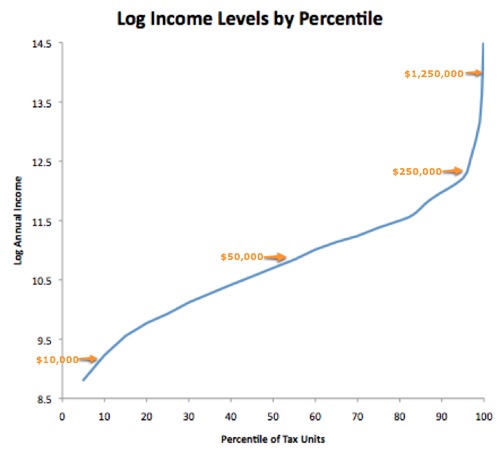 . You should be able to grok the theme of the parable of the poor little rich people by now.
Now what I have to do is explain why the rate of change along the slope of a curve using log income levels by percentile translates into pearl clutching in mamby pamby plutocracts. I know you hate math and it makes your stomach turn. I promise not to use the numbers. We’re going to just talk about the picture and the lines. Over on your right is Brad’s nifty graph. You can see that the curve is upward sloping but the slope varies depending on where you are on the curve.
You can see, however, it is positive at all points. This indicates a direct or positive relationship between two things. If one goes up, the other does too. Because the curve isn’t a straight line, the rate at which the curve goes up is different depending on where you are. This is reflected by the steepness or the flatness of the curve. Think of it as a hill. You have to slog up a steep hill, but a flat hill makes it easier to go forward.
One of the things of interests shown by this graph is the Log of Annual Income and the other is the percentile of tax units. The difference between Rampell’s graph and Delong’s graph is the log calculation. Brad explains why she needs to use the log of annual income compared to the level. Basically, the log turns the comparison in to a growth rate of annual income. A level is simply a level. The log means that we’re using the rate of change happening in incomes as we go up and down the curve. That rate of change is radically different at the richest levels. You can see that the slope almost goes vertical there compared to the middle levels where the curve is less steep and somewhat more horizontal. There’s a story that explains that. Krugman explains it well so I’m going to start with his explanation.
The Voodoo They All do so well
Posted: December 31, 2010 Filed under: Barack Obama, Democratic Politics, Surreality, U.S. Economy, U.S. Politics, We are so F'd | Tags: budget rule, Cutgo rules, Paul Krugman, Paul Ryan crazy, voodoo economics 21 Comments I’m not sure what exact delusional or fugue state describes Paul Ryan’s psyche. Dammit Jim, I’m an economist not a psychologist! I do, however, recognize b$gf$ck crazy when I see and hear it. It makes me want to avoid whatever part of Wisconsin that votes him into office because there must be something in their water or air. It amazes me that one small section of our country can wreck so much havoc on the rest of us by sending a loony tune to Washington, D.C. I’m beginning to think that Miami University should ask him to turn his degree back in and issue him a refund. I certainly would be ashamed if he were the product of any of my economics classes.
Paul Ryan is an outstanding example of everything that is wrong within that damnable beltway. He’s Daddy knows best on Acid. He wants to usher in the Republican Big Daddy state. In January, his type of crazy will dominate the House Budget committee. As a mater of fact, it’s already starting and it’s alarming.
RYAN’S RADICAL RULE?…. House Republicans quietly advanced procedural budget rules last week, which would be funny if they weren’t so ridiculous. But there’s a second part of this that shouldn’t go overlooked.
We talked the other day about Republicans’ “Cutgo” rules. The policy allows the GOP to try to keep slashing taxes, without having to pay for them, while requiring spending cuts to pay for new or expanded programs.
As Paul Krugman explained this morning, “Spending increases will have to be offset, but revenue losses from tax cuts won’t. Oh, and revenue increases, even if they come from the elimination of tax loopholes, won’t count either: any spending increase must be offset by spending cuts elsewhere; it can’t be paid for with additional taxes.” The Nobel laureate labeled this “the new voodoo.”
And then there’s the other part of House Republicans’ new budget rules.
A little-noticed detail in the new rules proposed by House GOP leaders would greatly increase the power of Rep. Paul Ryan, R-Wis., the incoming chairman of the House Budget Committee. As National Journal’s Katy O’Donnell reports, the new rules say that, for fiscal 2011, the chairman will set spending limits without needing a vote.
If that sounds insane, that’s because it is. Under the proposed rules, Ryan would be empowered to single-handedly establish spending levels if the House and Senate struggle to agree on a budget resolution. Just as important, Ryan’s levels would be binding on the chamber, without even be subjected to a vote.
Fascism doesn’t creep with Ryan in charge of things. It sprints. It’s typical of the radical right/Bircher mentality to think that when one can’t get to where they want with reasoned thought and plurality, it’s okay to lie about it and sneak things in under the radar. Thankfully, Paul Krugman has a bully pulpit at the NYT. Krugman’s description of the entire thing is right on. There’s only one problem. Krugman consistently ignores just how much Obama has been enabling the voodoo. It is, afterall, the Obama-McConnell Tax Cuts for Billionaires (TM) law. In fact, I’m willing to go out there on limb and say Obama believes the voodoo and that other Democrats perpetually cut-and-run rather than hold ground on it. Krugman seems to set on pointing out the sin on one side of the aisle and ignoring the same behavior on the other side. Let’s ignore that for a moment and concentrate on the good stuff Krugman offers.
But the tone changed during the summer, as B-day — the day when the Bush tax breaks for the wealthy were scheduled to expire — began to approach. My nomination for headline of the year comes from the newspaper Roll Call, on July 18: “McConnell Blasts Deficit Spending, Urges Extension of Tax Cuts.”
How did Republican leaders reconcile their purported deep concern about budget deficits with their advocacy of large tax cuts? Was it that old voodoo economics — the belief, refuted by study after study, that tax cuts pay for themselves — making a comeback? No, it was something new and worse.
To be sure, there were renewed claims that tax cuts lead to higher revenue. But 2010 marked the emergence of a new, even more profound level of magical thinking: the belief that deficits created by tax cuts just don’t matter. For example, Senator Jon Kyl of Arizona — who had denounced President Obama for running deficits — declared that “you should never have to offset the cost of a deliberate decision to reduce tax rates on Americans.”
It’s an easy position to ridicule. After all, if you never have to offset the cost of tax cuts, why not just eliminate taxes altogether? But the joke’s on us because while this kind of magical thinking may not yet be the law of the land, it’s about to become part of the rules governing legislation in the House of Representatives.
It’s one thing to say “That’s just crazy talk” to Republicans but to turn around and excuse or ignore the enabling and facilitating role that the President and Democratic members play is to commit a big sin of omission. That troubles me when you’re one of the few economists with a very public bully pulpit.
There’s obfuscation on all sides of this stupidity however. BostonBoomer asked me about a response to Krugman’s  criticism here that’s grounded in something wonky at JustOneMinute. The writer of that post tries to call out Krugman by screaming “deception and misdirection”, then referring to Ricardian economics. You must use the Wayback Machine for this one. The article is like reading a critique of modern democracy based on what they did in Athens around 500 BC.
David Ricardo was born in 1772 and made a fortune as a stockbroker and loan broker.[1] At the age of 27, he read An Inquiry into the Nature and Causes of Wealth of Nations by Adam Smith and was energized by the theories of economics. His main economic ideas are contained in Principles of Political Economy and Taxation (1817). This set out a series of theories which would later become theoretical underpinnings of both Marx’s Das Kapital and Marshallian economics, including the theory of rent, the labour theory of value and above all the theory of comparative advantage.
Ricardo wrote his first economic article ten years after reading Adam Smith and ultimately, the “bullion controversy” gave him fame in the economic community for his theory on inflation in 19th century England. This theory became known as monetarism, the theory that excess currency leads to inflation.[2] He was also a factor in creating classical economics,[3] which meant he fought for Free trade[4] and free competition without government interference by enforcing laws or restrictions.[5]
Yes, that’s right. Ricardo is an early 19th century economist philosopher writing during the time when the main sector of all economies was agriculture using technology like horses and slaves under a system called Mercantilism. That’s the reason to criticize Krugman. Yes, we academic economists teach Ricardian concepts, models, and principles still. However, it’s just because it’s an easy entry for people that do not have good calculus skills and are unfamiliar with the most basic economic concepts. These simple models weird enough people out as it is. Also, it’s the original, early attempt at theory that under pins classical economics. Tons of empirical data and computer models plus advances in mathematics have pushed us beyond all that. Most of the Ricardian stuff has been reformulated–as has a lot of the Keynesian stuff and that’s only from about 100 years ago–and tested empirically. To put it in blunt terms, some of the impacts have the right sign and do exist, but they show up as so trivial that no one takes them seriously when you’re dealing with real world economic policy. A really good example of this is the ‘crowding out effect’. Another is what Tom Maguire points out at JustOneMinute. Let me refer to a thing via new school on Barro who is one of the reformulaters.
Almost immediately, Barro turned on his Keynesian roots and joined the Rational Expectations revolution with two central pieces: his celebrated “Ricardian Equivalence Hypothesis” (1974) and his famous money neutrality paper (1976). Under a particular set of assumptions (e.g. intergenerational altruism or immortality, perfect capital markets, lump sum taxation, and the condition that debt not grow faster than the economy), Barro’s (1974) “Ricardian Equivalence Hypothesis” argues that every bond-financed deficit must be met by a future tax increase, that this tax increase would be forseen by living agents and that these agents would care enough about posterity to adjust their present consumption accordingly. In short, this implies that agents do not take a bond-financed fiscal expansion as a lucky windfall but rather will save the entire proceeds in anticipation of the future tax burden – and thus not raise their demand for goods and services. Thus income received by agents from government deficit-spending is all saved – and hence has no effect on consumption (thus no multiplier) – and that these savings go into the demand for the very same bonds that were supplied to finance that government spending (so bond demand rises exactly to meet higher bond supply, and money demand is unchanged) and thus there is no effect on interest rates either.
Barro’s “Ricardian Equivalence Hypothesis” has spawned a virtual research industry of its own as a whole generation of economists have climbed over each other tortuously examining, assailing, and verifying the validity and implications of Barro’s theorem (his 1974 paper is among the most-referenced papers in economics today). Barro’s 1976 paper on the neutrality of monetary policy (i.e. that changing money supply growth would not affect output or interest or any real variables) followed up on the work of Lucas and Sargent and although less unique, it was no less controversial.
This stuff is at the root of the conflict between the freshwater (Neoclassical) and the saltwater economists (NeoKeynsian) economists. I highlighted the most germane thing in all of this above and that is the phrase “under a particular set of assumptions”. It takes just as many unrealistic assumptions to make a free market economy work as it does to create a Marxist Utopia. The most suspect assumption of all is that of perfect capital markets.
Joseph Stiglitz earned his Nobel Prize for a career spent outlining all the ‘frictions’ in markets. That would be all the stuff in reality that make markets so damned imperfect. Stiglitz’s big thing is asymmetries of information which is something I talk about a lot when it comes to financial markets. The capital markets are loaded with them; especially now. Then, there’s the little friction involved with basic market structures. Back in the Ricardian days it was possible to point to the market for wheat and label it a somewhat ‘perfect market’. We’re way past that. We’ve got so many monopolies and oligopolies and so much government regulation and rules, that what Ricardo and Smith describe is as arcane as Marxism. Greg Mankiw is probably the closest ‘real economist’ source I can name that still ambles along those lines. However, he does so with a huge amount of caution. No one serious denies the role of frictions in markets.
The most silly thing about the JustOneMinute commentary is it ignores the source of Krugman’s Nobel–international trade–which starts with the Ricardian ‘comparative advantage’ framework. It also ignores Krugman’s writings outside of the NYT. Here’s an example from MIT that’s still standing called ‘Ricardo’s difficult idea’. Krugman writes this in the 1990s. Now, why was that so difficult to Google?
And so one is prepared to be sympathetic after reading a passage like the following, on the first page of Sir James Goldsmith’s The Trap: “The principal theoretician of free trade was David Ricardo, a British economist of the early nineteenth century. He believed in two interrelated concepts: specialization and comparative advantage. According to Ricardo, each nation should specialize in those activities in which it excels, so that it can have the greatest advantage relative to other countries. Thus, a nation should narrow its focus of activity, abandoning certain industries and developing those in which it has the largest comparative advantage. As a result, international trade would grow as nations export their surpluses and import the products that they no longer manufacture, efficiency and productivity would increase in line with economies of scale and prosperity would be enhanced. But these ideas are not valid in today’s world.” (Goldsmith 1994:1). On close reading, the passage seems a bit garbled; but maybe he is just a careless writer (or the translation from the original French is imperfect). One expects him to follow with a discussion of some of the valid reasons why one might want to qualify Ricardo’s idea — for example, by referring to the importance of external economies in a high-technology world.
But this expectation is utterly disappointed. What is different, according to Goldsmith, is that there are all these countries out there that pay wages that are much lower than those in the West — and that, he claims, makes Ricardo’s idea invalid. That’s all there is to his argument; there is no hint of any more subtle content. In short, he offers us no more than the classic “pauper labor” fallacy, the fallacy that Ricardo dealt with when he first stated the idea, and which is a staple of even first-year courses in economics. In fact, one never teaches the Ricardian model without emphasizing precisely the way that model refutes the claim that competition from low-wage countries is necessarily a bad thing, that it shows how trade can be mutually beneficial regardless of differences in wage rates. The point is not that low-wage competition never poses a problem. Rather, what is significant is that despite ostentatiously citing Ricardo, Goldsmith completely misses one of the essential lessons of his argument.
It’s really obvious that Krugman–indeed, most of us–don’t see the Ricardian model as anything but an early attempt to take economics out of the realm of philosophy and apply the scientific method and models. It’s like yelling at a learned Psychologist for not continually citing Freud as a modern authority or a learned Molecular Biologist for not continually citing Darwin as the be all and end all on evolutionary theory. These guys started modernizing their fields, but a lot of new evidence, tools, and data have arisen since then.
So, my bigger question is why do we have Republicans pushing a 19th century world view when it comes to economics? I then would also like to know why Democrats–especially a Democratic POTUS–enable them? Well, according to The Hill, Democrats are ripping the proposed rule. Democrats always seem really skilled at shaking their tiny fists before anything really happens.
Democrats argue the provision would give unilateral power to Ryan and flies in the face of GOP promises of transparency.
“Allowing incoming Chairman Ryan to have unilateral power to set spending limits — instead of subjecting those limits to a vote on the floor of the House — flies in the face of promises by House Republicans to have the most transparent and honest Congress in history,” said Doug Thornell, spokesman for incoming House Budget Committee ranking member Chris Van Hollen (D-Md.), in an e-mailed statement.
“Unfortunately, the House GOP is reverting back to the same arrogant governing style they implemented when they last held the majority and turned a surplus into a huge deficit,” he added.
Drew Hammill, spokesman for incoming Minority Leader Nancy Pelosi (D-Calif.), also criticized the rule change. He said the decision to cede power to Ryan “runs counter to the Republicans’ promises of transparency and accountability.”
The deal is will they actively FIGHT it and stop it? Then the bigger question is will Krugman talk about the complicity of the Democratic congress critterz and the President in enabling their stupidity?
Forehead, meet palm.
A little Economics this and that …
Posted: December 27, 2010 Filed under: Catfood Commission, Civil Liberties, Civil Rights, The Media SUCKS, U.S. Economy, U.S. Politics, Voter Ignorance, We are so F'd, WE TOLD THEM SO | Tags: AFL-CIO, Chris Hedges, commodity prices, Paul Krugman, wealth gap 44 CommentsI thought I’d post a little end of the year economics stuff just in case you need a nap!!

A nifty chart to show we are SO f'd!!!
I’ve been writing for around a year about a possible bubble in commodity prices but a definite increases in base commodity prices coming shortly. Now, this doesn’t necessarily mean it will involve an increase in over all inflation because these price increases are mostly in the already volatile areas of food and energy which are considered outside the ‘core’ inflation measures because they tend to bump and shuffle a lot. This is from Paul Krugman in his column: “The Finite World”.
Oil is back above $90 a barrel. Copper and cotton have hit record highs. Wheat and corn prices are way up. Over all, world commodity prices have risen by a quarter in the past six months.
Is it speculation run amok? Is it the result of excessive money creation, a harbinger of runaway inflation just around the corner? No and no.
What the commodity markets are telling us is that we’re living in a finite world, in which the rapid growth of emerging economies is placing pressure on limited supplies of raw materials, pushing up their prices. And America is, for the most part, just a bystander in this story.
Krugman goes on to explain how booms in the economies of developing nations is causing increased Demand for certain commodities. This simply means the price will go up when the supply is limited for some reason or another. Some times the supply is slow to increase because of production considerations or inventory considerations. Other times the supply is limited just because there is a finite amount of it on the planet. Some of this may also be due to the market taking in the impact of those just passed subsidies to corn-based ethanol which take farm land out of food/other crop production and funneling it to corn production, This decreases the supply of wheat, soybeans, and cotton too.
And those supplies aren’t keeping pace. Conventional oil production has been flat for four years; in that sense, at least, peak oil has arrived. True, alternative sources, like oil from Canada’s tar sands, have continued to grow. But these alternative sources come at relatively high cost, both monetary and environmental.
Also, over the past year, extreme weather — especially severe heat and drought in some important agricultural regions — played an important role in driving up food prices. And, yes, there’s every reason to believe that climate change is making such weather episodes more common.
Krugman concludes with the important question of what does this mean for us?
So what are the implications of the recent rise in commodity prices? It is, as I said, a sign that we’re living in a finite world, one in which resource constraints are becoming increasingly binding. This won’t bring an end to economic growth, let alone a descent into Mad Max-style collapse. It will require that we gradually change the way we live, adapting our economy and our lifestyles to the reality of more expensive resources.
But that’s for the future. Right now, rising commodity prices are basically the result of global recovery. They have no bearing, one way or another, on U.S. monetary policy. For this is a global story; at a fundamental level, it’s not about us.
Yes. The world economy is “not about us” any more. So many other countries now have huge viable economies that we are no long the center of the Supply and Demand world like we were post World War 2. This is definitely going to take some adjusting on our part and some ignoring of the rhetoric of the right on our country’s role in the world. We can not continue to maintain the idea of American Exceptionalism in its current form given that we are really no longer exceptional in many, many ways. That adaptive behavior does not diminish our historical role as the original provider of Democracy-based Constitutions and Civil Liberties or our military role in freeing many countries from monarchy and fascism in both world wars.
We can continue to pour our resources and the lives of our young into asserting ourselves as the global military police in attempt to maintain our delusion of being ‘special’, or we can put our resources into assuring ourselves and our children a comfortable niche in the world with a respected voice at a big table. The Right Wing has to understand that we don’t own the table anymore. If only our politicians would grow up enough to make the best choice for us instead of deluding us into thinking that we’ll ever see post World War 2 America again.
I want to couple this with something I got in a tweet from the AFL-CIO: ‘U.S. Workers Earned Less in 2009 Than in 2008’. This goes along with the fact that many things we could finance or buy twenty to thirty years ago will elude us today.
New data show America’s workers earned less in 2009 than in 2008, according to the Bureau of Labor Statistics. Compensation was down by 3.2 percent in 2009 with declines in construction and manufacturing fueling the plunge. St. Louis County, the hardest hit, saw a decline of 11.5 percent.
For those lucky enough to have a job, average pay increased by 1.2 percent. But overall income inequality is now at its worst since 1928. As the chart by the Economic Policy Institute (EPI) shows here, between 1979 and 2005, households at the bottom fifth of the income scale have seen an average, inflation-adjusted income growth of just $200. The $200 figure does not represent an average annual increase in income, but rather an increase of $200 over the entire 26-year period. By contrast, a small number of households at the top 0.1% of the income scale saw average income growth of almost $6 million over that same period.
In addition, the “wealth gap,” which differs from the income gap because it measures total net worth, is now 225 times greater between the richest 1 percent and the median family net worth.
Lest we forget, corporations are sitting on $1.93 trillion as of Sept. 30—up from $1.8 trillion at the end of June–and not using some of that money pot to create jobs.
The bottom is falling out for the middle classes in this country. Income inequality is as bad as it was in 1928 during the peak of the Robber Baron age. There is no way we’ll have a shot at seeing ‘morning again in America’–even one concocted from a senile man’s political rhetoric–without a strong middle class. This is one of the reasons that I highly recommend your holiday reading included Chris Hedges ‘Death of the Liberal Class’. Here’s Sanctuary TV’s you tube on his explanation the “genesis of the book”. Wonk mentioned some of his thesis in her excellent post yesterday.
The ‘lies of omission’ that we see in the Main Stream Media today makes this imperative that we have conversations outside of channels that are controlled by for-profit corporations. Listen in to the video at around 2:45.
Most of the images that are disseminated around our culture are skillfully put together and are disseminated by for profit corporations so that we are made to …or we confuse … how we are made to feel with knowledge. Which is precisely how ended up with Barrack Obama.
This is especially true with things economic. I had a conversation with my Republican Dad yesterday which ended up with him accusing me of sounding just like the Democrats after the Great Depression. (I will wear that badge proudly, thank you.) I was trying to explain to him how Social Security isn’t going bankrupt, that the overages are invested in T-bonds and T-bills and that isn’t the same as massive borrowing from the fund by the federal government, and that if social security can’t rely on the interest and their capital invested in T-bonds or T-bills in the future, we will undoubtedly have a much greater problem than having smaller social security checks. (My guess is that we would be in the middle of a government collapse similar to what happened to the USSR in the 1980s.) Dad kept accusing me of living in the theoretical world of economics–me, an empirical economist–when I kept telling him it was just a matter of debits and credits which are anything but theoretical economics.
The deal is this if you read studies, and follow the debits and the credits. The threat to social security isn’t coming from its cash flows. It’s coming from the politicians in Washington, D.C. and it appears that it will shortly be led by the aforementioned Barrack Obama. Some of these people seem intent on collapsing our Republic and its democratic roots. These Bircher-like attacks on the New Deal are real attacks on the ways the government–through New Deal Policies, Laws, and Agenciess- levels the economic playing field for small businesses and working class people. This is the same way that Bircher-like attacks on Civil Rights attacks the ways the government levels the legal playing field for minorities and women.
Again, I’m drawn to the quote most attributed to the late great Senator Patrick Monihan. People and politicians are entitled to their opinions but not the facts. The problem is that fact manufacturing–or labeling political diatribes by media monsters like Glenn Beck–appears to be rampant in the very outlet that provides the life blood of our democracy.
This maldescriptions of unemployment, the role and purpose and very political independence of the Fed are more features of this misinformation campaign. I’m going to further reference Paul Krugman and his economist yogini–yup, there’s at least two of us out there–wife Robin Wells here. They co-authored an excellent essay on “Where do We Go from Here” in The New York Review of Books. This part comes after their joint call to the Democratic congress critterz–left standing from the midterms elections–to fight.
First, it would mean fighting on economic issues. While it is extremely unlikely that Democrats can undertake any further fiscal stimulus, they can put Republicans on the spot, resisting calls for austerity and making the case, repeatedly, that the GOP is standing in the way of necessary action. The fight over renewal of unemployment benefits should be only the start. Democrats can also denounce Republican attacks on the Federal Reserve and defend the Fed’s independence. They can resist attempts to turn back health care reform, on both humanitarian and long-term budgeting grounds, as health care reform is the critical factor in reining in the long-term budget deficit.
Health Care Reform Inc. could be one more rung on the ladder for the middle class on the ladder back to upwards mobility. Instead of repealing the now unpopular bill, we should be working actively to get the right things into its corporate enabling shell. That would be–at minimum–a Public Option. We have to get them to fight on Economic issues. Also, we desperately need to deal with Fannie and Freddie. These organizations used to be the way to home ownership for working class Americans. I stand proudly as an example in that regard. My little kathouse in the bayou in the middle of a solid urban hood shines as a beacon of what those things were supposed to do before they started manufacturing loans to the derivatives market.
And there are steps that the White House could take without congressional approval. Democrats could pressure the administration to fix the inexcusable mess at the HAMP (mortgage modification) program—a program whose Kafkaesque complexity has in many cases made matters so bad for home owners that it has triggered the foreclosures it was supposed to avoid. In addition, mortgage relief would benefit the wider economy. Furthermore, the scope of mortgage relief could be made much wider if Fannie Mae and Freddie Mac were used to guarantee mortgage refinancing. Other proposals go even further: for example, that Fannie and Freddie engineer reductions in mortgage principals. All of this could be done, conceivably, by executive order.
What we are seeing is a brick by brick removal in the walls that support the social net built during the New Deal that helped America become the thing it was during the 1950, 1960s and 1970s. Yes, we helped many countries get rid of Nazis and Fascist and this did make us some what exceptional at the time, but ushering in the very policies and attitudes of fascism does not make us the least bit exceptional now. It weakens the very people that make for a vibrant Democracy. Also, given that the Wikileaks information has been the soul source recently of unmanufactured news and opinion passed off as fact, it also gives us a glance at why the rest of the planet has ceased to see the US as exceptional too.
To paraphrase the words of Common Dreams and Margaret Flowers: We Must Resist. Okay, so this essay was a little Political Economy and not just economics. You awake?
update:
I get to update this post with a link to one of the more influential ‘liberal’ economist who is also writing on the changes in the Political Economy at Project Syndicate. Here’s something from Jeffrey D. Sachs writing on ‘America’s Political Class Struggle’. You may recall that both Krugman and Sachs were called to the Obama woodshed a few weeks ago and told to get on board with the McConnell-Obama tax cuts.
America is on a collision course with itself. This month’s deal between President Barack Obama and the Republicans in Congress to extend the tax cuts initiated a decade ago by President George W. Bush is being hailed as the start of a new bipartisan consensus. I believe, instead, that it is a false truce in what will become a pitched battle for the soul of American politics.
As in many countries, conflicts over public morality and national strategy come down to questions of money. In the United States, this is truer than ever. The US is running an annual budget deficit of around $1 trillion, which may widen further as a result of the new tax agreement. This level of annual borrowing is far too high for comfort. It must be cut, but how?
The problem is America’s corrupted politics and loss of civic morality. One political party, the Republicans, stands for little except tax cuts, which they place above any other goal. The Democrats have a bit wider set of interests, including support for health care, education, training, and infrastructure. But, like the Republicans, the Democrats, too, are keen to shower tax cuts on their major campaign contributors, predominantly rich Americans.
The result is a dangerous paradox. The US budget deficit is enormous and unsustainable. The poor are squeezed by cuts in social programs and a weak job market. One in eight Americans depends on Food Stamps to eat. Yet, despite these circumstances, one political party wants to gut tax revenues altogether, and the other is easily dragged along, against its better instincts, out of concern for keeping its rich contributors happy.
This tax-cutting frenzy comes, incredibly, after three decades of elite fiscal rule in the US that has favored the rich and powerful. Since Ronald Reagan became President in 1981, America’s budget system has been geared to supporting the accumulation of vast wealth at the top of the income distribution. Amazingly, the richest 1% of American households now has a higher net worth than the bottom 90%. The annual income of the richest 12,000 households is greater than that of the poorest 24 million households.
Please go read the rest of the article. I think this shows further evidence that Obama didn’t placate liberal economists.
Empowering a Failed Hypothesis
Posted: December 20, 2010 Filed under: Global Financial Crisis, The Great Recession, U.S. Economy, WE TOLD THEM SO | Tags: Allan Blinder, joseph stiglitz, Paul Krugman, Perversions of economics, Reaganomics, START TREATY, Supply Side Economic hypothesis 58 Comments One of my neighbors is a public defender who is a New Orleanian by birth and fits all the standard eccentricities of New Orleanians. He spent some time in the Navy during the Vietnam period. Now my friend is very liberal, but one of his buddies from the Navy time that visits frequently is not. The buddy lives in rural Washington state and teaches in a small college there. How he every managed to get a gig teaching economics with just an MBA still boggles my mind, but that is the deal. When you do a stint in actual economics–not just managerial economics and your basic theory classes–you spend a lot of time proving theoretical models. By the time you get farther in a program and have completed your first few econometrics courses, you’re taught how to empirically validate or destroy other folk’s academic work and their models.
One of the easiest groups of hypotheses to shoot down empirically came from the Reagan years. The results were pretty astounding–we would call that highly significant to what ever statistic was used–so much that David Stockman and Bruce Bartlett gave those hypotheses up rather quickly and they were key architects of the Reagan Economic Revolution. You can’t find a’ conservative’ economist in the sense of Reaganomics unless it’s one at the Heritage Foundation that is paid to deliberately ignore the facts. In which case, that explains why they’re no place else BUT the Heritage Foundation.
Or they’re like my friend’s buddy who still goes back to the 1980s and pulls out old articles about things like the Laffer curve and teaches it because he wants to show all “opinions”. That’s what he says to me any way, when I ask him why he teaches a failed hypothesis. Frankly, he teaches it because he wants others to share his hopes and wishes that the silly thing is true. Because he’s not had the rigorous training to prepare to do actual economics, he just teaches want he wants to teach. He also hasn’t gone through publish or perish where you don’t get to have opinions without peer-reviewed facts. This drives me nuts. You can’t teach theory or empirical evidence or the scientific approach by clinging to a failed hypothesis. This makes you an intellectual flat earther.
What we currently have right now is a president that is giving the Flat Earth Society the primary voice in NASA policy and funding when it comes to economic policy. Paul Krugman has an op-ed from this weekend that firmly states that Obama has empowered the economics version of the Flat Earth Society. His op ed is called ‘When Zombies Win.’ It’s exactly what needs to be said.
First, the original Obama stimulus plan was anything but text book Keynesian economics and can’t be seen as a way to shout fail on Keynesian theory. It was more based in Reagan philosophy and those failed hypotheses than any neoKeynsian model. While I’ve continually called the Supply Side wishful thinking as a failed hypothesis, Krugman is more direct. He refers to it as failed doctrine.
For the fact is that the Obama stimulus — which itself was almost 40 percent tax cuts — was far too cautious to turn the economy around. And that’s not 20-20 hindsight: many economists, myself included, warned from the beginning that the plan was grossly inadequate. Put it this way: A policy under which government employment actually fell, under which government spending on goods and services grew more slowly than during the Bush years, hardly constitutes a test of Keynesian economics.
Now, maybe it wasn’t possible for President Obama to get more in the face of Congressional skepticism about government. But even if that’s true, it only demonstrates the continuing hold of a failed doctrine over our politics.
I wrote repeatedly at the time–no Nobel winning economist am I either–that the stimulus was bound to be way too little to be of any use. You can read me screaming ‘Tax Cuts Don’t Cut It or Cure It’ from January 2006, 2009 where I quote John Mishell’s study that talks about how the Bush tax cuts didn’t grow jobs and didn’t grow the economy. As a matter of fact I have many posts up along that line. Here’s one covering the FT’s Martin Wolf where I talk about the same thing and it’s even called ‘Still Too Little and WAY TOO Republican” from January 17, 2009. You can search my archives during that time period and find I’m very consistent at writing how the Obama stimulus would fail and that it was primarily because it was based on tax cuts.
It’s really quite a logical situation and one the most flawed precepts sits right there in the Obama-McConnell tax travesty. There’s a huge tax write off in the bill for companies buying new equipment. This is something completely ineffective because it just helps the few companies that would’ve done that any way. The majority of companies are hurting for customers. No amount of tax write offs for equipment or even employees is going to make them expand if they don’t have customers or revenue. In fact, my guess will be that an academic study some where down the line will show that the majority of those tax cuts were used by corporations who expanded in emerging markets instead of here. That’s because that’s where the inflation, growth and action is and there’s nothing in the bill that says tax benefits stay here.
Krugman also talks about something I spoke to recently in that nearly every Republican put in charge of some committee dealing with some aspect of the economy is so far out there on doctrine and short on economic theory and evidence that we’re bound to see more of the same stuff that tanked us the last time out. The Republicans sitting on the Financial Crisis panel just put out their financial version of the Earth is Flat manual last week. They said it was too much regulation which is pretty much the exact opposite of everything that every empirical study has shown us. Here’s one I keep pushing called “Slapped in the Face by the Invisible Hand” because it’s nontechnical in nature. Krugman called the release of the document ‘Wall Street Whitewash’.
So, Krugman’s op ed from this weekend isn’t astounding in that we all know what neoKeynisans like Stiglitz, and Blinder, Sachs and Krugman have been saying for months now. Now that I’ve read BB’s morning links, I’m even getting a better feel for the source of my weekend wonderment on Krugman’s bottom line. Krugman was one of a group called before the President in an attempt to get them to STFU. The deal is this. The Nobel Peace Prize may now be given on an ‘aspirational’ basis, but the Nobel Prize for economics is not. Stiglitz and Krugman earned their Nobel Prizes. I admit to having empirically tested some of Blinder’s models doing my first Masters in Economics so I’m very familiar with his contributions to the literature. These economists live in a world of peer review where there’s a very dim view of people who cling to failed hypotheses.
So, here’s the wonderment from Krugman’s December 19, 2010 op-ed.
President Obama, by contrast, has consistently tried to reach across the aisle by lending cover to right-wing myths. He has praised Reagan for restoring American dynamism (when was the last time you heard a Republican praising F.D.R.?), adopted G.O.P. rhetoric about the need for the government to tighten its belt even in the face of recession, offered symbolic freezes on spending and federal wages.
None of this stopped the right from denouncing him as a socialist. But it helped empower bad ideas, in ways that can do quite immediate harm. Right now Mr. Obama is hailing the tax-cut deal as a boost to the economy — but Republicans are already talking about spending cuts that would offset any positive effects from the deal. And how effectively can he oppose these demands, when he himself has embraced the rhetoric of belt-tightening?
Yes, politics is the art of the possible. We all understand the need to deal with one’s political enemies. But it’s one thing to make deals to advance your goals; it’s another to open the door to zombie ideas. When you do that, the zombies end up eating your brain — and quite possibly your economy too.
What is even more significant is that this horrible tax bill was put forward so as not to stall things like START. So, what is the status of the START Treaty and the Republicans who said they’d play ball if the Tax Cuts for Billionaires program was passed. Has this eased the hostage crisis?
Well, the vote is supposed to be held tomorrow so we shall see. But, this is quote is fresh from the AFP 4 hours ago from the moment I’ve hit the publish button.
Democrats expressed astonishment that top Republicans continued to oppose ratification when virtually every present and past foreign policy or national security heavyweight backed the move, regardless of their political stripes.
In that same announcement, Mitch McConnell was quoted as saying he’d vote against it the ratification. So is John Kyl. Collin Powell and Condoleeza Rice support the ratification of this treaty. This is what you get when you negotiate with terrorists; domestic or otherwise.
This President has consistently used the failed dogma of Reaganomics in economic policy. It makes no difference if the wackiest of the right wing say he is a socialist. The evidence clearly points to his obsession with failed tax cut dogma. I don’t know if his reasons are political or if–deep down–he is a Republican in Democrat Clothing. All I know is that we can no longer empower a failed hypothesis. I certainly hope that Michael Hirsch’s list of ‘Disillusionati’ continue to expose this economic policy for what it really is.
UPDATE via commenter waldenpond at TL.
File this under we told you so,
love, the Sky Dancing Cassandras

 peej
peej Carissa
 bostonboomer
 dakinikat
 ecocatwoman
 mablue2
 Mama Lopez
 peggysue22
 quixote
 skydancingguestblogger
 Mona (aka Wonk the Vote)



 Sky Dancing
Recent Comments