
In other words, showy actions that win a news cycle or two are no substitute for actual, coherent policies. Indeed, their main lasting effect can be to squander a government’s credibility. Which brings us to last week’s missile strike on Syria.
The attack instantly transformed news coverage of the Trump administration. Suddenly stories about infighting and dysfunction were replaced with screaming headlines about the president’s toughness and footage of Tomahawk launches.
But outside its effect on the news cycle, how much did the strike actually accomplish? A few hours after the attack, Syrian warplanes were taking off from the same airfield, and airstrikes resumed on the town where use of poison gas provoked Mr. Trump into action. No doubt the Assad forces took some real losses, but there’s no reason to believe that a one-time action will have any effect on the course of Syria’s civil war.
In fact, if last week’s action was the end of the story, the eventual effect may well be to strengthen the Assad regime — Look, they stood up to a superpower! — and weaken American credibility.
Monday Reads: That’s all I can stands. I can’t stands no more.
Posted: April 10, 2017 Filed under: Afternoon Reads | Tags: ALS, CDC, Disease, NIH, science 57 Comments
 I’m dealing with the death of my cousin Ruthie who was closest to me in age and always put in charge of me when I was little in our nearly weekly visits to Kansas City. She died yesterday of ALS which is a disease that is horrid beyond measure and requires a lot of further research to unwind. Death is natural and inevitable but we should be able to find ways of better dealing with horrifying deadly diseases. While the Trump budget is finding ways to give the extremely wealthy more tax cuts and fund more military publicity stunts, its priorities are shameful when it comes to the CDC, funding basic scientific and medical research, and anything that has to do with making medical help available to people that truly need it.
President Donald Trump’s plan to cut billions of dollars in funding to medical and scientific research agencies would cost the country countless jobs, stall medical advances and threaten America’s status as the world leader in science and medicine, advocates said Thursday.
“Cutting the funding in this way will have devastating and generation-long effects,” said Dr. Clifford Hudis, CEO of the American Society of Clinical Oncology, which represents cancer specialists.
“[Medical research] is a fundamental driver of American economic strength and it is being compromised here,” Hudis told NBC News. “It’s a jobs program.”
Multiple organizations expressed shock and disappointment at Trump’s budget proposal, which adds $54 billion in defense spending but would slash nearly $6 billion from the National Institutes of Health, which funds most basic medical research in the country, as well as eliminate entirely dozens of other agencies and programs.
It would cut the overall Health and Human Services department budget by 18 percent, including the 20 percent budget reduction at NIH, and reassign money from the Centers for Disease Control and Prevention to states.
Most cancer drugs get their start in the basic research funded by the NIH and often done in NIH labs.
“The targeted therapies, the immunotherapies, the conventional chemotherapy drugs — all of these things have roots in the NIH,” Hudis said.
 Meanwhile, Team Gleason–including some friends of mine hoping to raise funds to find an ALS cure–is running in the Crescent City Classic this weekend in a subevent called the Race for Team Gleason. My cousin was active in events raising funds for ALS Research. (My friends Cait and Caroline are running in Ruthie’s honor this Saturday! You can get to the donation page here. All proceeds to go Steve Gleason’s ALS efforts!)
Why do we have to have fundraisers for everything but freaking war in this country?
So, I’ve been crying last night and today. Ruthie paved the way for lots of stuff for me. Just as she helped me spend nights away from home in her bedroom and big girl twin beds, she introduced me to Pet Sounds and using juice cans for hair rollers. She got a great job in high school at the local mall at a dress store. I got to visit her at work in all her blue eye shadow, page boy hair, and A-line dress glory and was totally awed. The idea of working during school was a total scandal to my mother and she went on about it for weeks. I’m not sure what exactly passed between then and me 5 years later but my mother had no problem with me working at the local dress store at the local mall when I hit sweet 16.
There are so many people in our lives that should’t die of ALS or many currently deadly diseases. As a country, we’ve had priorities to get rid of tuberculosis and polio, and make AIDS a chronic disease and not a death sentence. With money and research, we get it done. I decided to write about Ruthie and her struggle with ALS in light of many things. Least among them is this.
The Trump administration has failed to fill crucial public health positions across the government, leaving the nation ill-prepared to face one of its greatest potential threats: a pandemic outbreak of a deadly infectious disease, according to experts in health and national security.
No one knows where or when the next outbreak will occur, but health security experts say it is inevitable. Every president since Ronald Reagan has faced threats from infectious diseases, and the number of outbreaks is on the rise.
Over the past three years, the Centers for Disease Control and Prevention has monitored more than 300 outbreaks in 160 countries, tracking 37 dangerous pathogens in 2016 alone. Infectious diseases cause about 15 percent of all deaths worldwide.
But after 11 weeks in office, the Trump administration has filled few of the senior positions critical to responding to an outbreak. There is no permanent director at the CDC or at the US Agency for International Development. At the Department of Health and Human Services, no one has been named to fill sub-Cabinet posts for health, global affairs, or preparedness and response. It’s also unclear whether the National Security Council will assume the same leadership on the issue as it did under President Barack Obama, according to public health experts.
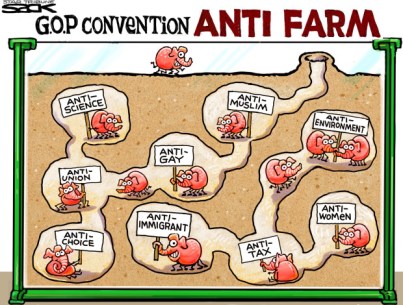 This administration has time for golf galore. It has time to sign executive orders decimating equal pay for women and the rights of GLBT to be free from discrimination, and to demand ways government can be shredded to bits so the planet is essentially made uninhabitable. It has time for costly publicity stunts to remove public attention and press attention from its never growing list of scandals and conflicts of interest. It has no time for governing or policy for American people.
 I
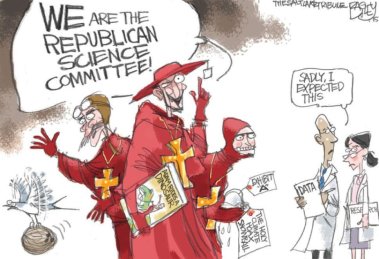
IAttorney General Jeff Sessions will end a Justice Department partnership with independent scientists to raise forensic science standards and has suspended an expanded review of FBI testimony across several techniques that have come under question, saying a new strategy will be set by an in-house team of law enforcement advisers.
In a statement Monday, Sessions said he would not renew the National Commission on Forensic Science, a roughly 30-member advisory panel of scientists, judges, crime lab leaders, prosecutors and defense lawyers chartered by the Obama administration in 2013.
A path to meet needs of overburdened crime labs will be set by a yet-to-be named senior forensic adviser and an internal department crime task force, Sessions’s statement said.
I’ve long reached the “PopEye Point”. The Senate Nuclear option just installed a terrible SCOTUS judge because Mitch McConnell. We now have a President that lost the popular vote by a historically huge margin and a Supreme Court Judge that couldn’t muster the usual vote.
Gorsuch’s confirmation once again gives the Supreme Court a majority of Republican appointees, as it had before Scalia’s death, last February. But Ginsburg (who was appointed by Bill Clinton) is eighty-four; Anthony Kennedy (the Court’s swing vote, appointed by Reagan) is eighty; and Stephen Breyer (a Clinton appointee) is seventy-eight. If Trump has the opportunity to replace any of these three, much less all of them, the ideological balance of the Court will be transformed for at least a generation.
 Gorsuch was quietly installed by Trump today with very little notice.
The confirmation of Justice Neil M. Gorsuch to the Supreme Court has left shattered political conventions in its wake: the refusal to hold hearings for Merrick Garland, the first partisan filibuster of a high court nominee, and the demise of the Senate filibuster for judges altogether.
All this smashed political pottery shows not only how polarized our politics have become, but how dramatically the stakes of filling a vacant Supreme Court seat have increased. Three key factors arebehind this.
First, the average tenure of a justice is much longer now. From 1941 to 1970, justices served an average of about 12 years. But from 1971 to 2000, they served an average of 26 years.
That figure has increased only since 2000. When John Paul Stevens retired from the court in 2010, he had served 35 years. When Antonin Scalia died, he had served 30 years. Anthony M. Kennedy has served 29 years, Clarence Thomas 26 years, Ruth Bader Ginsburg 24 years, and Stephen G. Breyer 23 years. Presidents who might serve only four years can have influence decades later if they can appoint someone to the Supreme Court.
Second, precisely because justices serve so much longer, vacant seats arise less often. From 1881 to 1970, a vacancy arose on average once every 1.7 years. But since 1970, a seat has become vacant only once every three years or so. In the first era, a two-term president typically would appoint four or five justices, or more than half the court. But since 1970, a two-term president would typically appoint two or three justices.
The longer period between vacancies also means that some presidents will not appoint any Supreme Court justices at all. Jimmy Carter was the first president to complete one term without having made a single appointment. If George W. Bush had been a one-term president, the same would have happened to him.
 Gorsuch has a chance to fuck us over for a very long time. He’s likely to join the other religious extremists in a Taliban-like imposition of whackadoodle presumed gawdly law aka Hobby Lobby.
The most anticipated case in the April sitting is probably Trinity Lutheran Church v. Comer, a case about whether a state constitutional provision that prevents state funds from going to religious institutions violates the federal Constitution — both the clause protecting the free exercise of religion and the clause guaranteeing the equal protection of the laws. Here a church that contains a playground applied for a state program that helps nonprofits resurface their playgrounds. The church was denied access to the program because of its status as a church, and it argues that this is unconstitutional.
I’d say the other big cases to watch right now are the various challenges to the president’s second travel ban executive order. Both the 4th Circuit and the 9th Circuit will hear arguments in May on the constitutionality of the travel ban. Whatever happens in those cases, the losing party is virtually certain to seek Supreme Court review. Although the court doesn’t typically hear cases between April and October, it’s certainly not unheard of for it to do so — and I think it’s quite possible here, in particular if the administration loses and asks the court to act quickly. The court could also rule without hearing arguments.
So, this is about all I have room for today in me. I’m hoping to get some work done and find some peace by leaving the TV off and walking away from the news on the internet if I can.
Please, send some money to Team Gleason or to any other group of people fighting horrible diseases. It appears that if we don’t do it, it won’t get done unless it sends money directly to the Trump Family Syndicate.
What’s on your reading and blogging list today?

 peej
peej Carissa
 bostonboomer
 dakinikat
 ecocatwoman
 mablue2
 Mama Lopez
 peggysue22
 quixote
 skydancingguestblogger
 Mona (aka Wonk the Vote)



 Sky Dancing
Recent Comments