
Breaking News: Nelson Mandela has died
Posted: December 5, 2013 Filed under: Civil Rights | Tags: African National Congress, Nelson Mandela dead at 95, South Africa 14 Comments The former President of South Africa and the man that came to personify racial apartheid in South Africa has died today at the age of 95. South Africa’s President Jacob Zuma announced his passing today on TV.
Here are some of Mr. Mandela’s most famous quotes. They are scattered about this blog thread.
Mandela was imprisoned in 1964 and wasn’t released until 1990.
It’s April 1964, and a crowd of black onlookers jostle in the back of a Johannesburg courtroom as Nelson Mandela rises from his chair before the judge. They sit segregated from the rest of the court, and have to crane their necks to catch a glimpse of the nationalist leader who has already served five years in prison. Armed guards are stationed at the exits of the room, “a high-domed chamber with an antique ceiling fan and a rococo atmosphere that suggests the American South,” as Robert Conley, the future founding host of All Things Considered, describes for The New York Times.
Not lost on this American writer is the commonality of history between the continents. A black man stands before a white judge defending an outlawed ideal he believes in. The moment mirrors America’s own civil-rights movement. Martin Luther King had written his Letter From a Birmingham Jail almost exactly a year earlier. But the mirror is a magnifier. However wrong, horrible, and unfair America’s treatment of black men and women was, in South Africa, it was objectively worse. Black Africans had no right to vote, no right to strike from work. Six years later, they would be denied citizenship in their own country.
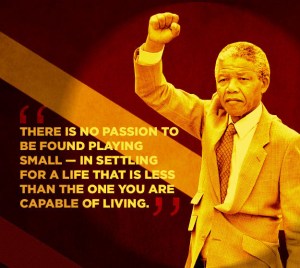
Nelson Mandela was an incredibly complex and interesting man. Just as the case with Martin Luther King and his central role in creating the civil rights movement in the US, Mandela was symbolic, flawed, and rose to all he was able to accomplish through much struggle. His leadership as President will be studied for some time.
Take the great post-apartheid misery that South Africa suffered in the first two decades of democracy: the AIDS epidemic. Mandela failed as president to tackle the spread of HIV, even as terrifyingly large numbers of South Africans became infected. As early as 1991 he had grasped (judging from one of his private notebooks from that year) that the disease threatened a “crisis for the country.” Yet in office he did almost nothing to stop its spread.
He recalled later at an event I attended in Cape Town that after spending so many years in prison, he was shy when it came to talking about a sexually transmitted virus. South Africa, too, faced a host of other challenges on his watch—political violence, economic upheaval, ongoing racial tension. But his inaction on AIDS then gave way to the outright denial of the epidemic, and harassment of those who tried to tackle the spread of HIV, by his successor as president, Thabo Mbeki. The result was a pandemic that claimed millions of South African lives, many unnecessarily, as drugs to treat victims were long withheld.
To his immense credit, however, Mandela conceded his early error. After leaving the presidency, he became a significant part of a campaign for a new AIDS policy. In retirement, he would speak up for effective education and treatment, especially when his own son succumbed to the disease in 2005. To Mbeki’s fury, too, Madiba pushed within the ruling African National Congress for South Africa to tackle AIDS seriously. With the denialist Mbeki gone from office, thankfully the country has now come to grips with the pandemic.
Or take economic policy. After years in prison, Mandela emerged to lead South Africa still believing, in effect, in Soviet-style economics. It took advice from China’s leaders (among others) to change his mind. But he was willing to switch, to get South Africa’s Afrikaner state-run economy to open up and flourish.
He will be missed and remembered.
“During my lifetime I have dedicated my life to this struggle of the African people. I have fought against white domination, and I have fought against black domination. I have cherished the ideal of a democratic and free society in which all persons will live together in harmony and with equal opportunities. It is an ideal for which I hope to live for and to see realized. But, My Lord, if it needs be, it is an ideal for which I am prepared to die.”
President Obama will speak on Mandela at 5:20 est.

 peej
peej Carissa
 bostonboomer
 dakinikat
 ecocatwoman
 mablue2
 Mama Lopez
 peggysue22
 quixote
 skydancingguestblogger
 Mona (aka Wonk the Vote)



 Sky Dancing
Recent Comments