
The U.K. has slapped targeted economic sanctions on five Russian banks and three wealthy individuals following President Vladimir Putin’s decision to send troops into eastern Ukraine.
Addressing lawmakers on Tuesday in the House of Commons, Prime Minister Boris Johnson said the first tranche of sanctions would target Rossiya, IS Bank, General Bank, Promsvyazbank and the Black Sea Bank.
The measures would also sanction three “very high net worth” individuals: Gennady Timchenko, Boris Rotenberg and Igor Rotenberg.
The individuals concerned will see their U.K. assets frozen and be banned from traveling to the country, Johnson said. All U.K. individuals and entities will also be barred from having dealings with them, he added.
Johnson said the move to sanction Russia had arisen despite himself and several other world leaders giving Putin “every opportunity” to pursue his aims via diplomacy….
He added, “This the first tranche, the first barrage of what we are prepared to do and we hold further sanctions at readiness to be deployed alongside the United States and the European Union if the situation escalates still further.”
Tuesday Reads
Posted: February 22, 2022 Filed under: morning reads | Tags: Germany, Joe Biden, NATO, Nordstream 2, Russia, Ukraine, Vladimir Putin 20 CommentsGood Morning!!
Yesterday, Vladimir Putin finally ordered Russian troops to invade Ukraine, while trying to put the blame on the U.S., NATO, and the Ukraine government. Putin claimed the troops were for “peacekeeping” purposes, to protect ethnic Russians in two parts of Eastern Ukraine.
At first the Biden administration debated whether to call this an “invasion,” but as of this morning that has changed. Newsweek: Biden Administration Backtracks, Is Now Calling Russia’s Attack on Ukraine an Invasion.
President Joe Biden‘s administration has called Russian troops entering Ukraine an “invasion” for the first time on Tuesday morning after members of Congress from both parties used the term and called for tough sanctions.
The Biden administration had not previously referred to the Russian military action in eastern Ukraine as an “invasion” but White House officials have said a further response will be forthcoming and is likely to include more sanctions.
Deputy National Security Adviser Jon Finer called Russian military action in eastern Ukraine an “invasion” in remarks to CNN on Tuesday.
Russian President Vladimir Putin signed decrees on Monday recognizing the self-proclaimed Donetsk People’s Republic (DNR) and Luhansk People’s Republic (LNR) in Ukraine’s east as independent states and ordered Russian troops into those regions.
“We think this is, yes, the beginning of an invasion, Russia’s latest invasion into Ukraine,” Finer said.
“I think ‘latest’ is important here,” Finer said.
“An invasion is an invasion, and that is what is underway, but Russia has been invading Ukraine since 2014,” he said.
Russia annexed the Crimean peninsula from Ukraine in 2014. There has also been a Russian presence in Donetsk and Luhansk since 2014.
Follow the latest developments at CNN: Live Updates: The latest on the Ukraine-Russia crisis. or at The New York Times Ukraine live updates.
Western nations have begun sanctioning Russia for it’s illegal aggression:
The New York Times: Germany puts a stop to Nord Stream 2, a key Russian natural gas pipeline.
Chancellor Olaf Scholz said on Tuesday that Germany would halt certification of the Nord Stream 2 natural gas pipeline that would link his country with Russia, one of the strongest moves yet by the West to punish the Kremlin for recognizing two separatist regions in Ukraine.
The German leader’s announcement came hours after President Vladimir V. Putin of Russia ordered armed forces to the separatist regions, the so-called Donetsk and Luhansk People’s Republics.
Germany’s allies in Europe and the United States had been pressing Mr. Scholz for weeks to state publicly that the $11 billion pipeline, which was completed late last year and runs from Russia’s coast to northern Germany under the Baltic Sea, would be at risk of being blocked in the event of a Russian move against Ukraine.
“The situation today is fundamentally different,” Mr. Scholz told reporters in Berlin. “That is why we must re-evaluate this situation, in view of the latest developments. By the way, that includes Nord Stream 2.”
CBS News: U.S. imposes sanctions after Putin recognizes breakaway Ukraine regions.
President Biden signed an executive order Monday imposing sanctions that target two Russia-backed breakaway republics in eastern Ukraine in a swift response to Russian President Vladimir Putin’s decision to recognize the regions as independent.
The order bars “new investment, trade and financing by U.S. persons to, from, or in” the so-called Donetsk People’s Republic and Luhansk People’s Republic, located in Ukraine’s eastern Donbas region, White House press secretary Jen Psaki said in a statement.
The order also provides authority to impose sanctions on “any person determined to operate in those areas of Ukraine,” Psaki said, adding the administration will later “announce additional measures related to today’s blatant violation of Russia’s international commitments.”
CNBC: UK announces first tranche of Russia sanctions, targets banks and wealthy individuals.
Russian stocks plunged and the ruble slid closer to a record low on Tuesday as investors reacted to President Vladimir Putin’s decision to order troops into eastern Ukraine.
Moscow’s MOEX stock index dropped 1.5% after shedding more than 10% on Monday, bringing losses so far this year to about 20%. Shares in Russian oil company Rosneft were hardest hit Tuesday, dropping 7.5%. In total, more than $30 billion has been wiped off the value of Russian stocks this week alone.
The ruble fell toward 81 versus the US dollar on Tuesday, its weakest level in more than a year and close to its record low. The moves prompted Russia’s central bank to announce measures to support banks, including a provision that will allow them to use last Friday’s prices for stocks and bonds when reporting their financial positions.
More pain could be on the way.
“We expect further declines near-term in the Russian stock market,” analysts at JPMorgan Chase wrote in a note to clients on Tuesday. The Wall Street bank downgraded Russian equities to “neutral” from “overweight.”
Damage to Russia’s markets and economy would be limited if its troops do not advance beyond the parts of eastern Ukraine that Putin recognized as independent on Monday, according to analysts. But Russia would pay a higher price if further aggression causes the West to respond with punishing sanctions that could cut the country’s banks off from the global financial system and make it difficult to export oil and natural gas.
Analyses of the Ukraine situation:
At The Atlantic, Tom Nichols reacted to the insane speech Putin gave yesterday: Putin Chooses a Forever War.
Russian President Vladimir Putin, in a long speech full of heavy sighs and dark grievances, made clear today that he has chosen war. He went to war against Ukraine in 2014; now he has declared war against the international order of the past 30 years.
Putin’s slumped posture and deadened affect led me to suspect that he is not as stable as we would hope. He had the presence not of a confident president, but of a surly adolescent caught in a misadventure, rolling his eyes at the stupid adults who do not understand how cruel the world has been to him. Teenagers, of course, do not have hundreds of thousands of troops and nuclear weapons.
Even discounting Putin’s delivery, the speech was, in many places, simply unhinged. Putin began with a history lesson about how and why Ukraine even exists. For all his Soviet nostalgia, the Russian president is right that his Soviet predecessors intentionally created a demographic nightmare when drawing the internal borders of the U.S.S.R., a subject I’ve explained at length here.
But Putin’s point wasn’t that the former subjects of the Soviet Union needed to iron out their differences. Rather, he was suggesting that none of the new states that emerged from the Soviet collapse—except for Russia—were real countries. “As a result of Bolshevik policy,” Putin intoned, “Soviet Ukraine arose, which even today can with good reason be called ‘Vladimir Ilyich Lenin’s Ukraine’. He is its author and architect.”
It is true that Soviet leaders created the 1991 borders. That is also true of what we now call the Russian Federation. Putin, however, went even further back in history: “Ukraine never had a tradition of genuine statehood.”
By that kind of historical reasoning, few nations in Europe, or anywhere else, are safe. Putin’s foray into history was nothing less than a demand that only Moscow—and only the Kremlin’s supreme leader—has the right to judge what is or is not a sovereign state (as I recently discussed here). Putin’s claims are hardly different from Saddam Hussein’s rewriting of Middle East history when Iraq tried to erase Kuwait from the map.
Read the rest at the Atlantic link. Nichols is genuine expert on Russia.
Another Russia expert, Julia Davis, wrote about the reaction of Ukrainian citizens yesterday at The Daily Beast: Kremlin TV Asks ‘Where’s the Champagne?’ as Ukraine’s Kids Are Prepped for War.
Russian President Vladimir Putin stunned the world on Monday when he unilaterally recognized two Kremlin-backed separatist regions in Ukraine, Luhansk and Donetsk, as independent states and ordered Russian troops to conduct so-called “peacekeeping operations” there. The move has sparked widespread condemnation from global leaders who have accused Putin of violating international law and expressed concerns that the latest escalation may soon morph into a full-scale Russian invasion of its neighbor.
In Ukraine, Putin’s decision has only exacerbated the pain and anguish caused by years of bloody conflict, fueled and funded by the Kremlin. Parents across the country have been doing whatever they can to prepare their families for a potential Russian onslaught. “If you want to know how Ukrainians react to Putin’s speech, here’s a glimpse: moms on Facebook discuss putting stickers on their children’s clothes, when they go to school, indicating their blood type,” journalist Olga Tokariuk tweeted on Monday. “Make no mistake: this speech was perceived as a declaration of war on Ukraine.”
For some, the new developments have only deepened their resolve to fight back. “With his speech alone Putin consolidated Ukrainians like no-one else here could. My friends are talking about joining the territorial defense,” Ukrainian reporter Iryna Matviyishyn wrote. “And currently the Kremlin’s madman is the most hated person in Ukraine.”
In contrast, there was joy and laughter on Russia’s state television.
On Monday, RT’s editor-in-chief Margarita Simonyan appeared on The Evening with Vladimir Soloviev ready for a major celebration. “First of all, I don’t understand why there isn’t champagne in the studio,” she said. Beaming ear-to-ear, Simonyan described feeling “an overwhelming sense of euphoria” and added: “I’ve been waiting for 8 years for this… It finally happened. This is true happiness.” Claiming to speak on behalf of the “Donbas’ people,” Simonyan exclaimed: “Thank you, Mother Russia!”
David Ignatius at The Washington Post: Opinion: Surprising cracks, if small ones, appear in Kremlin support for Putin on Ukraine.
President Vladimir Putin presented a theatrical justification for war with Ukraine on Monday, but initial Russian military actions along the border were limited — and there seemed to be a few small cracks in Kremlin support for Putin’s obsession with regaining Russian dominion in Kyiv.
Read more at the WaPo.
The New York Times on Biden’s strategy: Wooing Allies, Publicizing Putin’s Plans: Inside Biden’s Race to Prevent War.
In a series of top-secret meetings last October, President Biden’s national security team presented grim intelligence that would soon trigger a fierce effort to prevent what could become the largest armed conflict in Europe since World War II.
Vladimir V. Putin, the Russian president, was preparing to invade Ukraine, top intelligence and military officials told Mr. Biden. Gathering each morning in the Oval Office for the global threat assessment known as the President’s Daily Brief, they described satellite images of Russian forces methodically advancing toward Ukraine’s border.
Not only did the United States have images of troops moving into position, it also had the Russian military’s plans for a campaign against Ukraine — elements of which had already begun. At one of the morning meetings, Mr. Biden dispatched William J. Burns, the C.I.A. director, to Moscow with a message for Mr. Putin:
We know what you’re planning to do.
Stopping him would be a challenge. Many of America’s closest allies were skeptical that Mr. Putin — a master of disinformation — would actually invade. The use of U.S. military force against Russia was off the table, so the allies would have to threaten Mr. Putin with economic pain so severe it would also have consequences in Europe and the United States. And it was far from certain that Republicans in Congress would back whatever the administration did….
The White House acknowledged from the start that its campaign to stop Mr. Putin might not actually prevent Russia from invading Ukraine. But at the very least, White House officials say, Mr. Biden exposed Mr. Putin and his true intentions, which helped unite, at least for now, the at-times fractious NATO alliance.
Over the course of three and a half months, Mr. Biden made three critical decisions about how to handle Russia’s provocations, according to interviews with more than a dozen senior administration officials and others who requested anonymity to discuss confidential meetings. Early on, the president approved a recommendation to share intelligence far more broadly with allies than was typical, officials said. The idea was to avoid disagreements about tough economic sanctions by ensuring that everyone knew what the United States knew about Mr. Putin’s actions.
Mr. Biden also gave the green light for an unprecedented public information campaign against Mr. Putin. With the support of his top intelligence officials — and with a promise to protect the intelligence agencies’ “sources and methods” — the president allowed a wave of public releases aimed at preventing Mr. Putin from employing his usual denials to divide his adversaries.
Read more details at the NYT link.
So that’s where things stand this morning. I’m sure there will be more developments throughout the day today. What are your thoughts on this? What other stories are you following?
Tuesday Reads
Posted: February 15, 2022 Filed under: morning reads | Tags: Canada, Christina Yuna Lee, Donald Trump, Hillary Clinton, John Durham, Justin Trudeau, Marcy Wheeler, Mazars, Michael A. Sussmann, NATO, NYC Chinatown murder, Rodney Joffe, Trucker convoy, Trump Organization, Ukraine, Vladimir Putin 21 CommentsGood Morning!!

Francine van Hove, Plasirs du Matin, “Morning Pleasures,” French, 1942
There may be some movement in the Ukraine crisis. The AP reported this morning that some Russian troops are being pulled back and returned to their bases. Later the story was updated to report that Putin wants to negotiate: Putin: Russia ready to discuss confidence-building measures.
Russian President Vladimir Putin said Tuesday that Moscow is ready for talks with the U.S. and NATO on limits for missile deployments and military transparency.
Speaking after talks with German Chancellor Olaf Scholz, Putin said the U.S. and NATO rejected Moscow’s demand to keep Ukraine and other ex-Soviet nations out of NATO, halt weapons deployments near Russian borders and roll back alliance forces from Eastern Europe.
They agreed to discuss a range of security measures that Russia had previously proposed.
Putin said that Russia is ready to engage in talks on limits on the deployment of intermediate range missiles in Europe, transparency of drills and other confidence-building measures but emphasized the need for the West to heed Russia’s main demands.
The statement followed the Russian Defense Ministry’s announced a partial pullback of troops after military drills, adding to hopes that the Kremlin may not be planning to invade Ukraine imminently. The Russian military gave no details on where the troops were pulling back from, or how many.
From The Washington Post: Russia says some troops withdrawing from Ukraine’s border; NATO chief notes ‘cautious optimism’ but sees no de-escalation yet.

I’m sure you’ve heard about the legal filing by John Durham, the special counsel appointed by Bill Barr to investigate the Russia investigation, that implied some kind of sinister activity by the Clinton campaign in 2016. The right wing media has been going nuts over this, but it’s basically meaningless. Charlie Savage explains at The New York Times: Court Filing Started a Furor in Right-Wing Outlets, but Their Narrative Is Off Track.
When John H. Durham, the Trump-era special counsel investigating the inquiry into Russia’s 2016 election interference, filed a pretrial motion on Friday night, he slipped in a few extra sentences that set off a furor among right-wing outlets about purported spying on former President Donald J. Trump.
But the entire narrative appeared to be mostly wrong or old news — the latest example of the challenge created by a barrage of similar conspiracy theories from Mr. Trump and his allies.
Upon close inspection, these narratives are often based on a misleading presentation of the facts or outright misinformation. They also tend to involve dense and obscure issues, so dissecting them requires asking readers to expend significant mental energy and time — raising the question of whether news outlets should even cover such claims. Yet Trump allies portray the news media as engaged in a cover-up if they don’t.
The latest example began with the motion Mr. Durham filed in a case he has brought against Michael A. Sussmann, a cybersecurity lawyer with links to the Democratic Party. The prosecutor has accused Mr. Sussmann of lying during a September 2016 meeting with an F.B.I. official about Mr. Trump’s possible links to Russia.
The filing was ostensibly about potential conflicts of interest. But it also recounted a meeting at which Mr. Sussmann had presented other suspicions to the government. In February 2017, Mr. Sussmann told the C.I.A. about odd internet data suggesting that someone using a Russian-made smartphone may have been connecting to networks at Trump Tower and the White House, among other places.
Mr. Sussmann had obtained that information from a client, a technology executive named Rodney Joffe. Another paragraph in the court filing said that Mr. Joffe’s company, Neustar, had helped maintain internet-related servers for the White House, and that he and his associates “exploited this arrangement” by mining certain records to gather derogatory information about Mr. Trump.

Mary Cassatt, Breakfast in Bed, 1897
The right wingers are thrilled by this story, but it’s complete bullshit.
The conservative media also skewed what the filing said. For example, Mr. Durham’s filing never used the word “infiltrate.” And it never claimed that Mr. Joffe’s company was being paid by the Clinton campaign.
Most important, contrary to the reporting, the filing never said the White House data that came under scrutiny was from the Trump era. According to lawyers for David Dagon, a Georgia Institute of Technology data scientist who helped develop the Yota analysis, the data — so-called DNS logs, which are records of when computers or smartphones have prepared to communicate with servers over the internet — came from Barack Obama’s presidency.
“What Trump and some news outlets are saying is wrong,” said Jody Westby and Mark Rasch, both lawyers for Mr. Dagon. “The cybersecurity researchers were investigating malware in the White House, not spying on the Trump campaign, and to our knowledge all of the data they used was nonprivate DNS data from before Trump took office.”
In a statement, a spokesperson for Mr. Joffe said that “contrary to the allegations in this recent filing,” he was apolitical, did not work for any political party, and had lawful access under a contract to work with others to analyze DNS data — including from the White House — for the purpose of hunting for security breaches or threats.
Marcy Wheeler has been covering this story since the beginning. You can read what she has to say in these posts at her Emptywheel blog:
John Durham, Ask Not For Whom The Statute of Limitation Tolls…
John Durham Chose To Meet With John Ratcliffe Rather Than Witnesses Necessary To His Investigation.
This is a horrific story about a possible hate crime from The New York Times: Screams That ‘Went Quiet’: Prosecutors’ Account of Chinatown Killing.
Police officers who responded to a 911 call about a disturbance in a Lower Manhattan building on Sunday heard a woman screaming when they reached the sixth floor, but the door to the apartment where the screams had come from was locked.
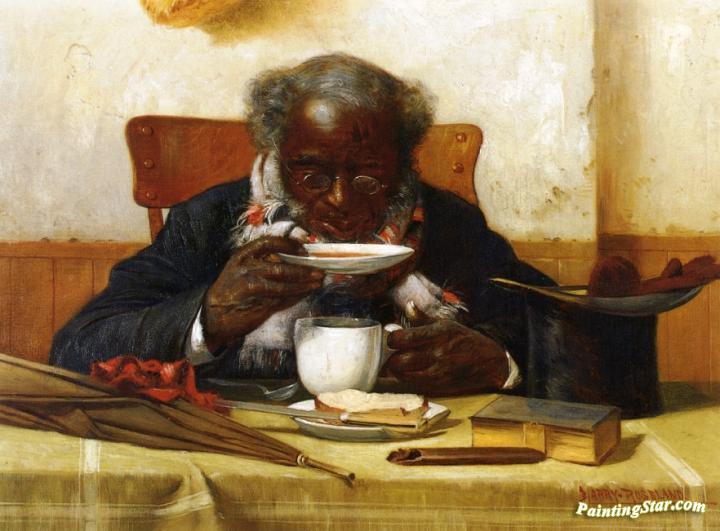
Morning Coffee, by Harry Roseland
As police struggled with the door, at first they still heard her calls for help, but “then she went quiet,” a prosecutor, Dafna Yoran, said in a Manhattan Criminal Court hearing on Monday night. Another voice emerged, sounding like a woman and telling them, “‘We don’t need the police here — go away.’”
When a specialized police unit arrived and broke down the door, they found Christina Yuna Lee, 35, dead in her bathtub with more than 40 stab wounds. The second voice, Ms. Yoran said, was actually that of Assamad Nash, who had followed the victim into the building on Chrystie Street in Chinatown, forced his way into her home and stabbed her.
When officers broke into the apartment, the police found Mr. Nash hiding under a bed and the knife believed to be the murder weapon hidden behind a dresser, prosecutors said.
It’s not yet clear why Ms. Lee was targeted, but the Asian community in New York is terrified.
Mr. Nash, 25, whose last known address was a men’s homeless shelter in the Bowery, was arraigned on first-degree charges of murder, burglary and sexually motivated burglary. A judge ordered him held without bail, and prosecutors said he was facing a sentence of up to 25 years to life in prison if convicted.
Though the authorities have not determined that Ms. Lee was targeted because of her ethnicity, her killing stoked fears in the city’s Asian community, which was already on edge after a rise in attacks during the pandemic.
Her killing also fit a pattern that has become an unsettlingly common feature of the pandemic in New York City: a seemingly unprovoked attack in which the person charged is a homeless man. In many neighborhoods in Manhattan, residents have expressed growing concern about homeless people, some of whom seem to be struggling with mental illness, menacing and harassing passers-by.
Ms. Lee, who graduated from Rutgers University in 2008 with a bachelor’s degree in art history, worked as a creative producer for Splice, an online music platform based in New York City. The company said in a statement that it was heartbroken over her “senseless” death.
Read the rest at the NYT.
One more story on the trucker blockade story from The Washington Post: ‘Freedom Convoy,’ police face off near U.S.-Canada border crossings as Trudeau invokes Emergencies Act.

There’s a lot happening in the news today. What stories have you been following?
Tuesday Reads
Posted: June 15, 2021 Filed under: morning reads | Tags: 2020 presidential election, Arizona, Biden plan to counter domestic terrorism, Department of Justice, Donald Trump, G7, Georgia, Jeffrey Rosen, Joe Biden, NATO, Rudy Giuliani, Vladimir Putin 23 Comments
House by the Railroad, Edward Hopper.
Good Morning!!
Revelations just keep on coming about Trump’s crazy efforts to overturn the 2020 election. The New York Times and CNN have obtained emails that show how the White House tried to get the Justice Department to investigate insane claims about election conspiracy theories, including a baseless theory about Italian satellites changing votes.
Katie Benner at The New York Times: Trump Pressed Official to Wield Justice Dept. to Back Election Claims.
An hour before President Donald J. Trump announced in December that William P. Barr would step down as attorney general, the president began pressuring Mr. Barr’s eventual replacement to have the Justice Department take up his false claims of election fraud.
Mr. Trump sent an email via his assistant to Jeffrey A. Rosen, the incoming acting attorney general, that contained documents purporting to show evidence of election fraud in northern Michigan — the same claims that a federal judge had thrown out a week earlier in a lawsuit filed by one of Mr. Trump’s personal lawyers.
Another email from Mr. Trump to Mr. Rosen followed two weeks later, again via the president’s assistant, that included a draft of a brief that Mr. Trump wanted the Justice Department to file to the Supreme Court. It argued, among other things, that state officials had used the pandemic to weaken election security and pave the way for widespread election fraud.
The draft echoed claims in a lawsuit in Texas by the Trump-allied state attorney general that the justices had thrown out, and a lawyer who had helped on that effort later tried with increasing urgency to track down Mr. Rosen at the Justice Department, saying he had been dispatched by Mr. Trump to speak with him.
The emails, turned over by the Justice Department to investigators on the House Oversight Committee and obtained by The New York Times, show how Mr. Trump pressured Mr. Rosen to put the power of the Justice Department behind lawsuits that had already failed to try to prove his false claims that extensive voter fraud had affected the election results….
The documents dovetail with emails around the same time from Mark Meadows, Mr. Trump’s chief of staff, asking Mr. Rosen to examine unfounded conspiracy theories about the election, including one that claimed people associated with an Italian defense contractor were able to use satellite technology to tamper with U.S. voting equipment from Europe.

Yellow House in Arles, Vincent Van Gogh
Benner reports much more insanity in this article. Here’s just a bit more:
Much of the correspondence also occurred during a tense week within the Justice Department, when Mr. Rosen and his top deputies realized that one of their peers had plotted with Mr. Trump to first oust Mr. Rosen and then to try to use federal law enforcement to force Georgia to overturn its election results. Mr. Trump nearly replaced Mr. Rosen with that colleague, Jeffrey Clark, then the acting head of the civil division.
Mr. Rosen made clear to his top deputy in one message that he would have nothing to do with the Italy conspiracy theory, arrange a meeting between the F.B.I. and one of the proponents of the conspiracy, Brad Johnson, or speak about it with Rudolph W. Giuliani, Mr. Trump’s personal lawyer.
“I learned that Johnson is working with Rudy Giuliani, who regarded my comments as an ‘insult,’” Mr. Rosen wrote in the email. “Asked if I would reconsider, I flatly refused, said I would not be giving any special treatment to Giuliani or any of his ‘witnesses’, and reaffirmed yet again that I will not talk to Giuliani about any of this.”
More details from CNN: New emails show how Trump and his allies pressured Justice Department to try to challenge 2020 election results.
The emails also provide new detail into how Mark Meadows, then-White House chief of staff, directed Rosen to have then-Assistant Attorney General Jeffrey Clark — who reportedly urged Trump to make him acting attorney general instead of Rosen — investigate voter fraud issues in Georgia before the US attorney there resigned in January.
Amid the pressure, Rosen said he refused to speak to Trump’s personal lawyer Rudy Giuliani about his false claims that the 2020 election was stolen.
When Meadows sought to have Rosen arrange an FBI meeting with a Giuliani ally pushing a conspiracy theory that Italy was using military technology and satellites to somehow change votes to Joe Biden, Rosen said he would not help Giuliani.
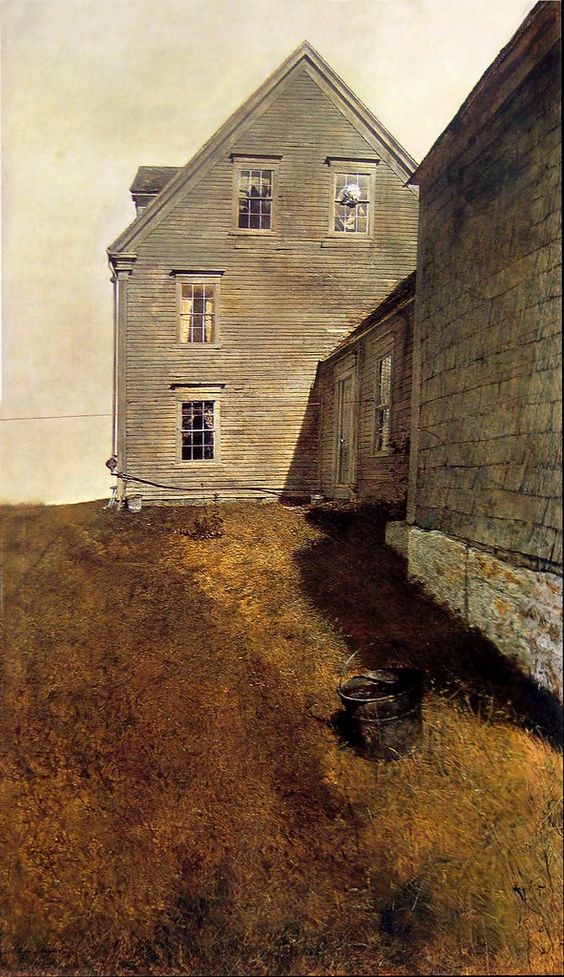
Weatherside, 1965, by Andrew Wyeth
“I flatly refused, said I would not be giving any special treatment to Giuliani or any of his ‘witnesses,’ and re-affirmed yet again that I will not talk to Giuliani about any of this,” Rosen wrote to Donoghue.\The new emails provide additional detail to reports earlier this month from CNN, The New York Times and others on Meadows’ emails to Rosen after the election, which revealed how the top White House aide had urged the Justice Department to take action for Trump’s benefit. The emails included a list of complaints about voting procedures in New Mexico, alleged “anomalies” in a Georgia county and the claims about Italian satellites.
The emails also show how Trump directed allies toward Rosen, who had been named acting attorney general following Barr’s December 2020 resignation after Barr had publicly said there had not been widespread fraud in the election.
Kurt Olsen, a private attorney, reached out to John Moran at the Justice Department on December 29 requesting a meeting with Rosen, promising he could meet at the Justice Department with an hour’s notice. He attached a draft complaint modeled after the Texas Supreme Court lawsuit unsuccessfully challenging the election results in four states, and wrote in a follow-up email that Trump directed him to meet with Rosen to discuss the US bringing a similar action.
“The President of the United States has seen this complaint, and he directed me last night to brief AG Rosen in person today to discuss bringing this action,” Olsen wrote. “I have been instructed to report back to the President this afternoon after the meeting.”
The same day, Trump’s White House assistant also forwarded the draft complaint to Rosen and Donoghue to review, saying it had also been shared with Meadows and White House counsel Pat Cipollone.
By the end of the year, it was clear Rosen and Donoghue had tired of the pressure campaign from the White House.
At least it’s good to know there was pushback from some Trump appointees.
The insanity continues in Arizona and elsewhere. Will Sommer at The Daily Beast: Republicans Now Want to ‘Audit’ Election Results in States That Trump Won.
In the wake of the Arizona audit’s success at grabbing publicity across right-wing media, Republican lawmakers in states that Trump won are demanding Arizona-style audits or other election inspections of their own.
The Republican hunt for voter-fraud evidence even in states that voted for Trump reveals how far inside the party the idea has spread that the election was stolen.
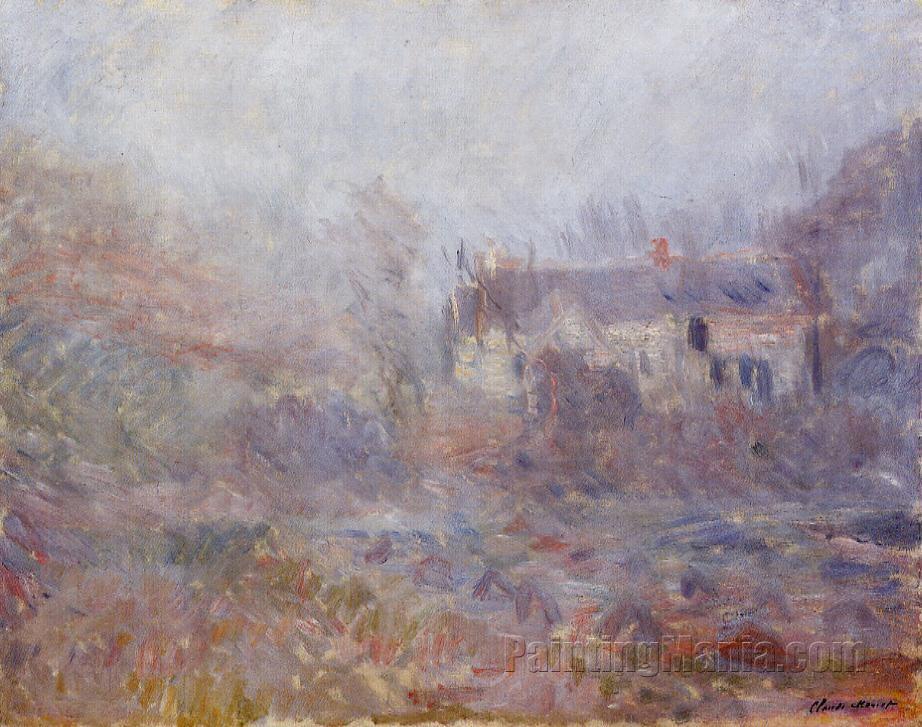
Houses at Falaise in the Fog, Claude Monet
Focusing on fraud claims allows Republican officials to raise money and attention from devoted Trump supporters, according to former Republican National Committee communications director Doug Heye. It also helps lawmakers align themselves with Trump’s claims of widespread fraud, ingratiating themselves with the energized Trump grassroots as they try to claim more power in the party.“
This is about two things, and these are symbiotic,” Heye said. “The continued fealty for all things Trump, and placating the base or the portion of the base that still can’t accept a clear loss.” [….]
The prospect of audits that could somehow dispute Biden’s electoral college win have become articles of faith for Trump supporters unable to get over the former president’s defeat, as Republican-held legislatures across the country use a sense that the election was stolen to push voting restrictions across the country. Some Republican voters have also become fixated on a “domino theory” about the election, which holds that if Arizona’s audit finds fraud in their election, other states that voted for Biden will fall like dominos.
In other news, today the Biden administration released a “National Strategy for Countering Domestic Terrorism.” You can read the White House statement at that link.
The New York Times: Biden Administration Forms Blueprint to Combat Domestic Extremism.
The Biden administration is aiming to bolster information sharing with technology companies, potentially expand hiring of intelligence analysts and improve screening of government employees for ties to domestic terrorism as part of a much-anticipated plan expected to be released on Tuesday detailing how the federal government should combat extremism.
President Biden ordered the review of how federal agencies addressed domestic extremism soon after coming into office, part of an effort to more aggressively acknowledge a national security threat that has grown since the Capitol riot on Jan. 6.
Changing a Flat, Norman Rockwell
The 32-page plan synthesizes steps that have been recommended by national security officials — including bolstering relationships with social media companies and improving information sharing among law enforcement agencies — into one blueprint on how to more effectively identify extremists in the country after years of heightened focus on foreign terrorists.
“We cannot ignore this threat or wish it away,” Mr. Biden wrote in the strategy document. “Preventing domestic terrorism and reducing the factors that fuel it demand a multifaceted response across the federal government and beyond.”
The new strategy was widely expected to detail a position on whether the government should establish a domestic terrorism law that prosecutors could use to investigate and charge homegrown extremists instead of relying on assault, murder and hate crime charges. The strategy instead indicates that the administration is focused for now on bolstering methods of combating extremism already used by the government, despite Mr. Biden calling for such a law during the presidential campaign.

The Guardian: White House unveils first national strategy to fight domestic terrorism.
The White House has published its first ever national strategy for countering domestic terrorism five months after a violent mob stormed the US Capitol in Washington.
The framework released on Tuesday by the national security council describes the threat as now more serious than potential attacks from overseas but emphasises the need to protect civil liberties.
Anticipating Republican objections that Joe Biden could use counterterrorism tools to persecute supporters of Donald Trump, the strategy is also careful to state that domestic terrorism must be tackled in an “ideologically neutral” manner.
Houses in Munich, 1908, Wassily Kandinsky
It cites examples such as “an anti-authority extremist” ambushing, shooting and killing five police officers in Dallas In 2016; a lone gunman (and leftwing activist) wounding four people at a congressional baseball practice in 2017; and an “unprecedented attack” on Congress on 6 January.
“They come across the political spectrum,” a senior administration said on a media conference call. “We acknowledge the shooting at the congressional baseball, the attack on police officers in Dallas, just as we acknowledge the attack in Charlottesville and the attack on the Capitol on January 6.
“So it’s not motivating politics or ideology that matters for us or, more importantly for the strategy and its implementation. It’s when political grievances become acts of violence and we remain laser focused on that.”

Of course Biden is in Europe right now, and he will meet with Vladimir Putin soon. David Rothkopf at The Daily Beast: Here’s What Biden’s Team Expects From His Meeting With Putin.
The political world and the media have zeroed in on President Joe Biden’s meeting this week with Vladimir Putin as the most important diplomatic event in which this young administration has participated. But the truth is that the heaviest diplomatic lifting with regard to the US-Russia relationship, and American national security, will have already taken place before the meeting in Geneva begins—or it will come in its wake.
National Security Advisor Jake Sullivan said that Biden would be arriving at the Geneva meeting “with the wind at his back.” What he meant by that, according to a senior official traveling with the president, is that “in many respects, the most important part of the president’s message to Putin will have been made in the days before the meeting.” The official cited the achievements associated with Biden’s meetings with the U.K. leadership, G7 leaders, his NATO counterparts and top officials from the EU.
House in Provence, 1867, Paul Cezanne
Trump not only distinguished himself from all previous American presidents by publicly bending the knee before his political sponsor Vladimir Putin in Helsinki, on Twitter and whenever he had the chance, the only coherent part of Trump foreign policy was that he effectively rejected three-quarters of a century of U.S. history by seeking to dismantle the international order America had tried to build since World War II. He attacked our allies. He condemned NATO. He disparaged the EU. And whenever he was given a chance, he rewarded Putin despite his invasion of Ukraine, his murder of his opponents (including on foreign soil), his freelancing in Syria, his efforts to erode the west’s relationship with Turkey and more.
Biden has been one of those who helped build the international system Trump attacked. He has been committed to undoing the damage Trump did. Just in the last week, Biden announced an effort to revitalize the Atlantic Charter, mended ties within the G7, made an unprecedented pledge of 500 million doses of COVID-19 vaccine as part of the G7’s commitment to provide 1 billion doses to needy nations worldwide, and re-engaged with our allies on terms more consistent with the pro-democracy, anti-autocracy message of our past.

Read the rest at The Daily Beast.
That’s it for me. What’s on your mind today?
Thursday Reads
Posted: June 10, 2021 Filed under: morning reads | Tags: Boris Johnson, Capitol insurrection, Covid-19, Democracy in peril, Don McGahn, Donald Trump, G-7 summit, Joe Biden, lab-leak theory, NATO, Ring of fire solar eclipse, Vladimir Putin 13 Comments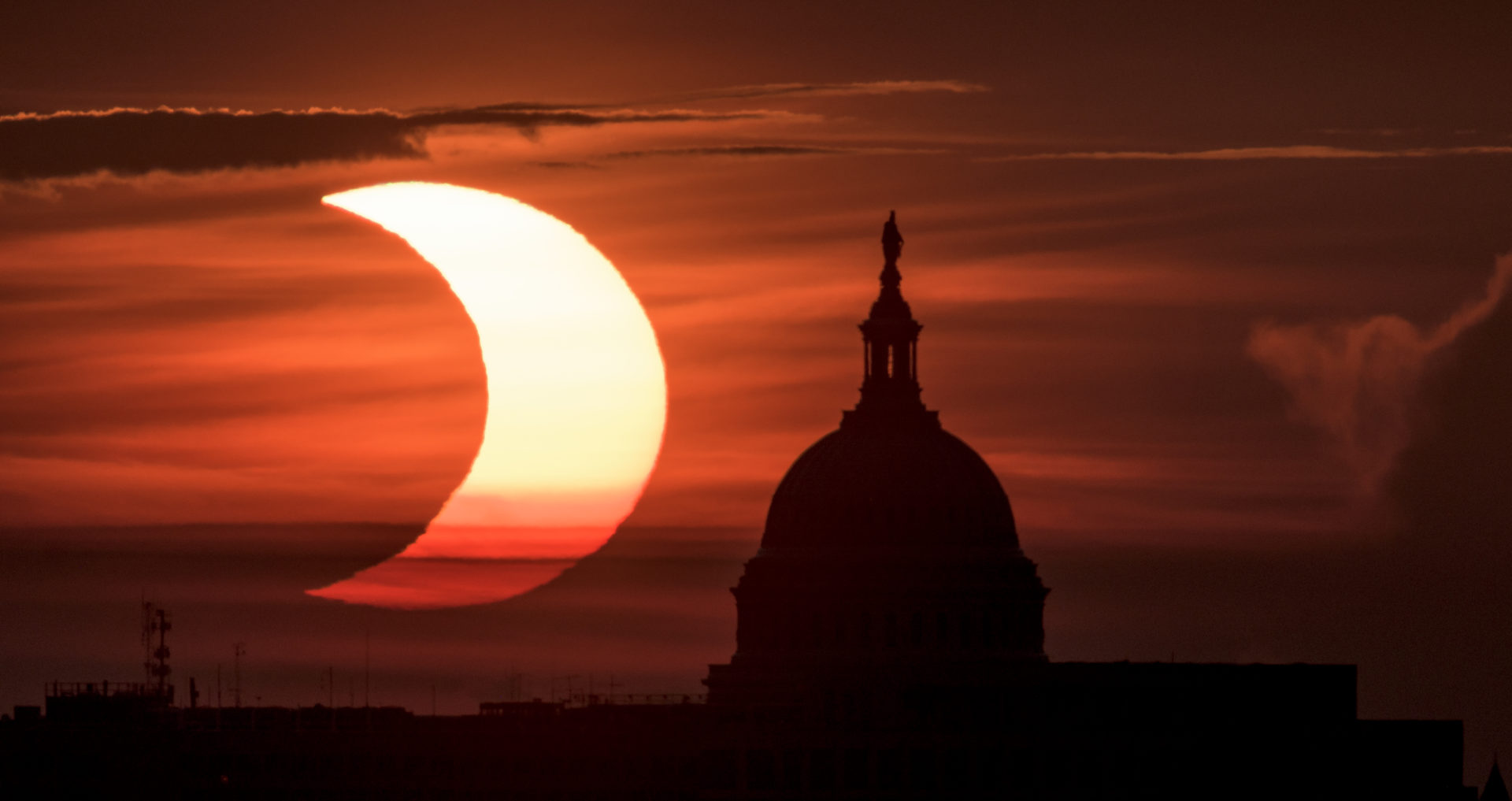
ARLINGTON, VIRGINIA – JUNE 10: A partial solar eclipse is seen as the sun rises behind the Capitol Building on June 10, 2021 in Arlington, Virginia. (Photo by Bill Ingalls/NASA via Getty Images)
Good Morning!!
I don’t know why I keep reading articles about the lab-leak theory. It’s not that I necessarily believe it’s true. I certainly don’t believe that a virus was created or modified in the Wuhan lab and then released into the population. I do think it’s possible that a researcher picked up a virus in the field and somehow carelessly infected someone on the outside. I still think the most likely scenario is the cross species (animal-to-human) route, because that clearly happens. I guess I’m just interested in why the argument has arisen in the media and won’t go away.
Anyway, there’s an interesting article on the subject at The Atlantic this morning: Don’t Fall for These Lab-Leak Traps. Recent coverage of the pandemic’s origins has ensnared readers in semantic quibbles, side points, and distractions, by Daniel Engber. I won’t try to summarize the piece because it’s so long, but here’s a bit of what Engber writes about what he calls “the mad scientist trap.”
The lab-leak theory isn’t singular; rather, it’s a catchall for a continuum of possible scenarios, ranging from the mundane to the diabolical. At one end, a researcher from the Wuhan Institute of Virology might have gone out to sample bat guano, become infected with a novel pathogen while in the field, and then seeded it back home in a crowded city. Or maybe researchers brought a specimen of a wild-bat virus back into the lab without becoming infected, only to set it free via someone’s clothes or through a leaky sewage pipe.
The microbiologists Michael Imperiale and David Relman, both former members of the National Science Advisory Board for Biosecurity, told me several weeks ago that lab-leak scenarios of this rather more innocent variety—involving the collection and accidental release of a naturally occuring pathogen—were the most probable of all the non-natural possibilities. Yet the most prominent opinionating on this topic has clustered at the other end of the continuum, at first around the dark-side theory of a bioweapon gone awry, and then around the idea that a harmless virus had been deliberately transformed into SARS-CoV-2 (and released by accident) after a reckless series of tabletop experiments.
The eclipse viewed from Brooklyn Thursday morning. Justin Lane EPA, via Shutterstock
That’s another pitfall in this debate: a tendency to focus only on the most disturbing and improbable versions of the lab-leak hypothesis, and to downplay the rest. The mad-scientist trap sprays a mist across the facts by presuming scientific motivations; it posits that researchers could have caused the pandemic only if they’d been trying to create infectious pathogens.
Efforts to enhance a virus in a lab, usually described as “gain of function” studies, have engendered hyperbolic speculation….
The problem is, depending on how one chooses to define gain-of-function research, it could well include most virological research, some forms of vaccine development, and a healthy portion of biology writ large. Anytime a scientist tries to probe or tweak the function of a gene, she could be working in this vein. In that sense, yes, the National Institutes of Health is a “huge gain-of-function bureaucracy.” So what?

Engler concludes:
One might assume that the single-minded fear of gain-of-function research is peculiar to conservatives—sitting, as it does, at the shadowy convergence of Big Government and Critical Frankenstein Studies. But the urge to blame scientific hubris for scientific problems, as opposed to farcical incompetence, seems to have long-standing, bipartisan support.
This trap was last sprung seven years ago. In March 2014, a CDC lab accidently shipped the highly virulent H5N1 bird flu to a poultry lab at the Department of Agriculture. Then in June, another CDC lab sent off samples of the bacteria that cause anthrax without properly inactivating them—and 75 government employees were potentially exposed. A few weeks after that, scientists at NIH stumbled across six vials of smallpox in a forgotten cardboard box. Regulators had every reason to believe that accidental laboratory leaks of naturally occurring pathogens were more common (and more likely) than genetic-engineering studies gone awry. But when confronted with all this evidence that scientists were slipping on banana peels, the government looked at other risks instead: It announced a pause on gain-of-function research.
The sun rises next to the Statue of Liberty during an annular eclipse on June 10, 2021 in New York City. (Photo by Gary Hershorn/Getty Images)
We’re in the process of defaulting to the same idea—that better biosafety might be achieved, and the next pandemic headed off, if we prevent or slow the development of genetically engineered bananas. That might only help ensure that no one thinks too hard about the odds of slapstick-fueled catastrophe. We may yet find, with more investigation, that the Wuhan Institute of Virology, and other places like it around the world, is positively strewn with banana peels. If that’s the case, our first and most important goal should be to clean them up. In the meantime, don’t be fooled by false antonyms. The opposite of nature isn’t hubris, and if SARS-CoV-2 turns out not to have a “natural” origin, that doesn’t have to mean someone made it in a lab.

Sorry for the long excerpt, but I do think it’s a useful article. Read more at the link if you’re interested.
The New York Times has an article on this morning’s eclipse: Highlights From the ‘Ring of Fire’ Solar Eclipse at Sunrise.
Just after sunrise over the eastern half of North America, the sun was almost completely blotted out by the moon for a few dawn hours in an annular solar eclipse.
During such an eclipse, the black silhouette of the moon — too far from Earth to completely cover the sun — will be surrounded by a thin ring of our home star’s surface, or photosphere. Many know this as a “ring of fire,” but few will get to experience the full effect.
The eclipse started after sunrise north of Lake Superior and began crossing remote regions of Canada, on its way into Greenland and the Arctic Ocean before going over the North Pole. Its course then heads south before ending in parts of the Russian Far East.
Still, some lucky souls got to experience this cosmic geometry, and a few were even intrepid and well organized enough to book airplane flights into the zone of maximum darkness. Many more of us got to experience a partial solar eclipse if we woke up early to clear enough skies….
It was dark and windy as the visitors spread out across the 86th floor observation deck 1,050 feet above midtown, adjusting camera lenses and perfecting positions as they waited for the sun to appear.
When the sky began to lighten and clouds turned shades of fuchsia pink, attendees of the event, who had paid $114.81 each to be there, could be overheard begging the skyline to clear up so there would be a better view….
Finally, the sun rose and the eclipse was visible — if a little hazily — through the cloud cover.
“You could hear the entire audience react at the first viewing of the sun,” said Jean-Yves Ghazi, president of the Empire State Building Observatory. “Everybody was gasping and it was absolutely magical.”
Read more at the link.
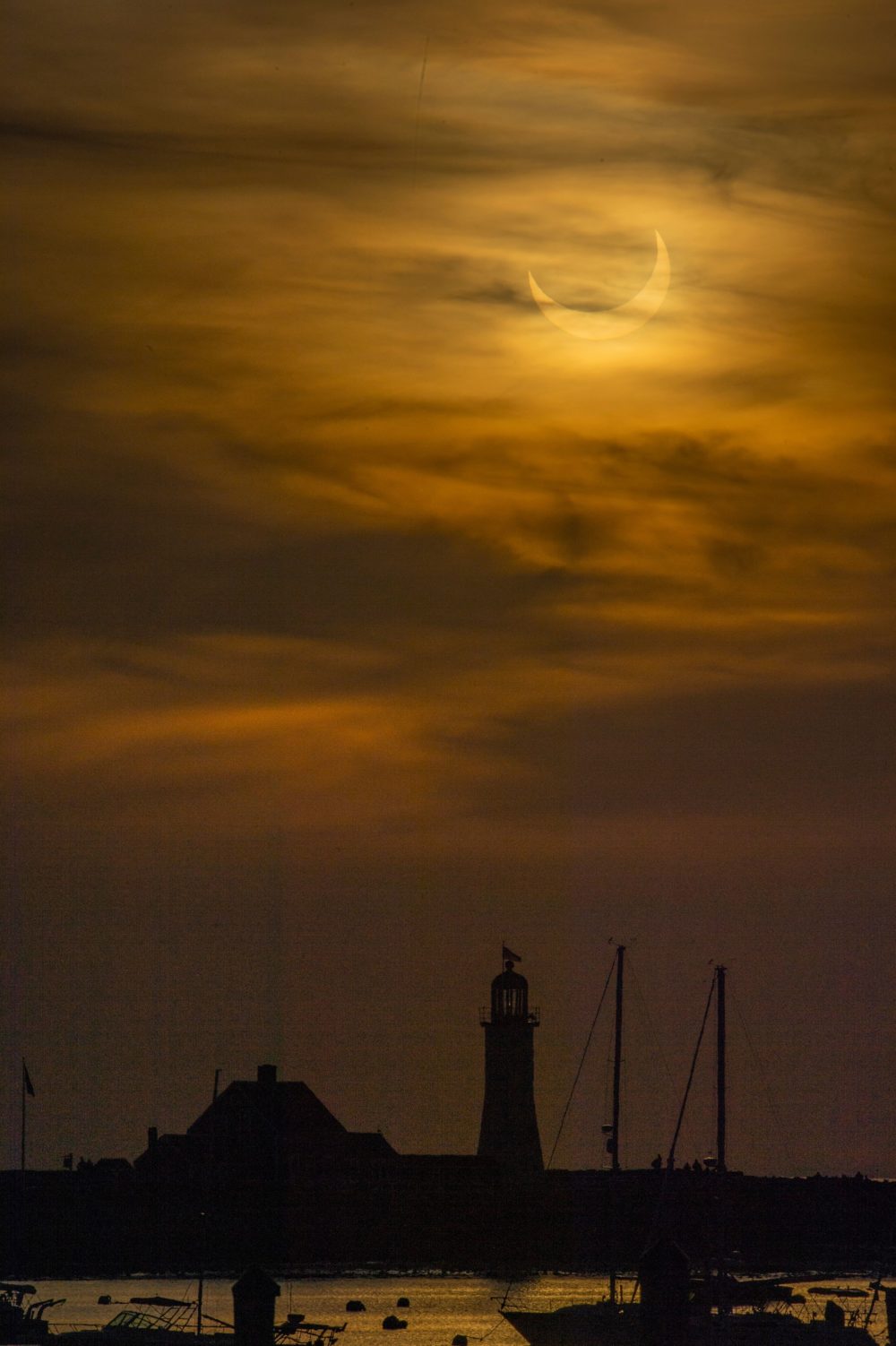
Annular (partial solar) eclipse is seen as the sun rises over Scituate Light in Scituate, MA, June 10, 2021. (Photo by Joseph Prezioso / AFP) via Getty Images)
From Stephen Collinson at CNN on Biden’s first foreign trip: Why Biden’s foreign trip is so unique and so important.
No US President has ever left the nation’s shores with democratic values under attack as broadly and systemically at home as they are abroad. This extraordinary reality will complicate his mission to purge the trauma of the Donald Trump era and convince both foes and friends that the US is reclaiming its global leadership role for good.
Biden meets British Prime Minister Boris Johnson on Thursday before the G7 summit, makes a hop to NATO in Brussels, then has a summit with Russian President Vladimir Putin in Geneva that will evoke the most tense days of the Cold War.
“We’re going to make it clear that the United States is back and democracies of the world are standing together to tackle the toughest challenges,” Biden told US troops at an air base in eastern England on WednesdaFor Biden, democracy is not just some abstract concept from civics class that Americans experience only when they enter the voting booth every few years.
It is a system, a way of life and a set of rules and norms that made the United States the strongest and richest country in history. The free, prosperous nations the US rebuilt and protected after World War II faced down communist tyranny in the form of the Soviet Union and underwrote 70 years of peace. This web of open, like-minded countries is also the key to America’s global power. If democracy ebbs abroad, so does US influence.
The rise of a new superpower, China, determined to overhaul US riches and power is becoming a grave threat to democracy, and offers potential autocrats an alternative power template of one-party rule.
Russia — the adversary that Biden will confront at the end of his Europe trip — meddled in the last two US elections to help Trump, who often seemed to advance its foreign interests over America’s.
But the most extraordinary feature of Biden’s trip is that he’s not an American President going out to confront tyranny abroad — that’s happened before. He’s huddling with US allies at a moment when the greatest threat to democracy comes from within the United States.
The world looked on, horrified, at the insurrection against the US Capitol orchestrated by Trump in January. Since then, the ex-President has poisoned millions of Americans against democracy with his false electoral-fraud claims. Republican state lawmakers are quickly passing bills that make it harder for all but their own supporters to vote and make it easier to steal elections. The principle that voters have the right to pick their own leaders is under threat.

Thursday’s eclipse over the Toronto skyline. Credit Frank Gunn, The Canadian Press, via Associated Press
I don’t see how U.S. democracy can be saved unless Trump and his enablers are investigated and prosecuted. It’s also vitally important to investigate the insurrection that Trump incited on January 6, 2021. There are endless avenues of corruption to deal with from Trump’s four years in office, but here’s the latest to hit the news (actually is old news…).
Adam Klasfeld at Law and Crime: ‘Point of No Return’: Don McGahn Told Congress How Close Trump Came to ‘Inflection Point,’ Another ‘Saturday Night Massacre.’
In a fit of pique over Special Counsel Robert Mueller’s Russia investigation, former President Donald Trump almost reached an “inflection point” and “point of no return” that would have set in motion a Richard Nixon-style “Saturday Night Massacre,” ex-White House Counsel Don McGahn recently told Congress behind closed doors.
The just-released transcript of McGahn’s closed door testimony before the House Judiciary Committee contains a series of new answers and elaborations on details that were publicized in the Mueller Report.
Releasing the June 4th transcript on Wednesday, Judiciary Chair Jerry Nadler (D-N.Y.) said: “Mr. McGahn provided the Committee with substantial new information—including firsthand accounts of President Trump’s increasingly out of control behavior, and insight into concerns that the former President’s conduct could expose both Trump and McGahn to criminal liability.”
“Mr. McGahn also confirmed that President Trump lied when he denied the accuracy of the Mueller report, and admitted that he was the source for a Washington Post report that confirmed Trump’s direction to McGahn to remove the Special Counsel,” Nadler wrote in a statement.
In the transcript, McGahn explains his reluctance to convey a message from Trump pressuring then-Deputy Attorney General Rod Rosenstein to not allow the special counsel to serve because of alleged conflicts—a request that McGahn considered an “inflection point.”
“‘Inflection point,’ with that I meant a point of no return,” McGahn testified. “If the Acting Attorney General received what he thought was a direction from the counsel to the President to remove a special counsel, he would either have to remove the special counsel or resign. We are still talking about the ‘Saturday Night Massacre’ decades and decades later.”
Have a great Thursday Sky Dancers!!
Lazy Caturday Reads
Posted: August 1, 2020 Filed under: Foreign Affairs, morning reads, U.S. Politics | Tags: Brazil, coronavirus pandemic, Donald Trump, Germany, Jared Kushner, NATO, Russia, Suzanne Valadon, Vladimir Putin 16 CommentsGood Morning!!

Artist Suzanne Valadon and her cat
The paintings in today’s post are by Suzanne Valadon. Here’s some background about this fascinating artist from The Great Cat.org:
Suzanne Valadon (1865-1938), was an illegitimate child of a French laundress and lived a rather rough life in her youth. She performed in a circus on the trapeze until she had a bad fall when she was 16.
After that, she decided to become an artist’s model, a safer profession. Artists such as Pierre Puvis de Chavannes, Henri Toulouse-Lautrec, and Pierre-Auguste Renoir used her in some of their works. Renoir even painted her in The Bathers. Valadon began to study the methods and works of the artists she posed for, and started to paint on her own.
Encouraged by Toulouse-Lautrec, she continued and even caught the eye of Edward Degas, who was so taken by her work that he purchased several of her first paintings in 1893. A true Bohemian, in 1883 at age 18, she gave birth to an illegitimate son, Maurice Utrillo, who became a well known artist as well.
Read more about her life at the pdf link above. You may have to go to the Table of Contents and click on her name.
Now on to today’s news.
It’s been another her horror-filled week, as Dakinikat described in her post yesterday. I avoided TV for most of the week, but it’s impossible to completely escape the Trump chaos. I’ve been doing my best though, mainly by reading lotsYo of books. Anyway, let’s see what’s happening this morning.
Trump has asked for help winning the 2020 election from Ukraine, China, and I assume Russia, since he seems to talk on the phone to Putin constantly.
So how many countries has Trump actually asked for election help? Add Brazil to the list.
The New York Times: Lawmakers ‘Alarmed’ by Reports U.S. Envoy Told Brazil It Could Help Re-elect Trump.
RIO DE JANEIRO — Members of the House Foreign Affairs Committee said Friday they were “extremely alarmed” by assertions that the American ambassador in Brazil had signaled to Brazilian officials they could help get President Trump re-elected by changing their trade policies.
In a letter sent Friday afternoon, Committee Chairman Eliot L. Engel demanded that the ambassador, Todd Chapman, produce “any and all documents referring or related to any discussions” he has held with Brazilian officials in recent weeks about their nation’s tariffs on ethanol, an important agricultural export for Iowa, a potential swing state in the American presidential election.
The committee’s letter was sent in response to reports in the Brazilian news media this week saying that Mr. Chapman, a career diplomat, made it clear to Brazilian officials they could bolster Mr. Trump’s electoral chances in Iowa if Brazil lifted its ethanol tariffs.
Eliminating tariffs would give the Trump administration a welcome trade victory to present to struggling ethanol producers in Iowa, where the president is in a close race with his Democratic rival, Joseph R. Biden Jr.
The House committee said it was opening an inquiry into the matter.
The State Department denied the reports, but . . .
The O Globo newspaper published a story on Thursday saying Mr. Chapman had underscored “the importance to the Brazilian government of keeping Donald Trump” in office. Mr. Bolsonaro, a far-right leader, has made closer alignment with the Trump administration his top foreign policy priority.
A competing newspaper, Estadão, published an article Friday saying its reporters independently confirmed that the ambassador framed his argument against tariffs in partisan terms. The article said the Brazilian officials who met with Mr. Chapman rejected the appeal, declining to be drawn into the American presidential battle.
Neither article named its sources. But Alceu Moreira, a Brazilian congressman who heads the agricultural caucus, told The New York Times in an interview that Mr. Chapman had made repeated references to the electoral calendar during a recent meeting the two had about ethanol.
 I guess we can assume Trump has asked for help from just about every country headed by a dictator.
Now Trump has helped Putin by ordering the withdrawal of U.S. Troops from Germany.
CNN: US to withdraw nearly 12,000 troops from Germany in move that will cost billions and take years.
The US is moving forward with President Donald Trump’s plan to withdraw nearly 12,000 troops from Germany, a decision that has attracted bipartisan congressional opposition and roiled key allies who see the move as a blow to NATO.
Secretary of Defense Mark Esper acknowledged the plan will cost billions to execute when he formally announced the decision on Wednesday from the Pentagon. US defense officials said it will take years to relocate the troops.
The plan to pull US troops from the long-time NATO ally has been met with broad bipartisan opposition amid concerns that it will weaken the US military’s position vis a vis Russia, however the Trump Administration has decided to proceed with the move.
Trump defended the decision Wednesday, saying the troop drawdown was taking place because Berlin was not spending the NATO target of 2% of its GDP on defense and because Germany was taking “advantage” of the US….
Defense officials, however, said Wednesday that the decision on where to house the US troops leaving Germany was not influenced by whether the new host country was meeting the 2% target.
Well, I’m sure Putin is thrilled. Will Trump pull us out of NATO next?
At The Daily Beast, Julia Davis reports on Russia’s reaction to Trump’s willful destruction of our country: ‘America’s Dying’: Russian Media Is Giddy at Chaos in the USA.
This week, U.S. President Donald Trump reiterated his intent to move forward with reducing the U.S. military presence in Germany, without any consultations with Berlin. And even as members of the U.S. Congress and America’s allies abroad expressed concerns about the drawdown, the Trump administration’s decision brought joy to the Kremlin and Russian media.
Back in June, 22 Republican members of the House Armed Services Committee urged Trump not to go ahead with the move, stating in a letter: “We believe that such steps would significantly damage U.S. national security as well as strengthen the position of Russia to our detriment … In Europe, the threats posed by Russia have not lessened, and we believe that signs of a weakened U.S. commitment to NATO will encourage further Russian aggression and opportunism.” [….]
Meanwhile, when the intent to reduce the U.S. contingent in Germany was first announced, Russian Foreign Ministry spokeswoman Maria Zakharova said that the Kremlin “would welcome any steps by Washington to scale down its military presence in Europe,” brazenly telling the United States to take home not only its troops, but also its tactical nuclear weapons.
The Kremlin-controlled Russian state media also sensed a precious propaganda opportunity. Sergey Brilyov, anchor of the news show Saturday Vesti on Russian state media channel Rossiya-1, pondered whether the controversial move by the Trump administration could be considered the proof that Russia no longer poses a military threat to Europe.
Kremlin spokesperson Dmitry Peskov used the same rationale today, when he claimed that Russia doesn’t present any threat to European countries and “the fewer U.S. soldiers are on the European continent, the calmer it is in Europe.”
Read more at The Daily Beast.
Don’t miss this must read piece at Vanity Fair about Trump and Kushner’s decision to scrap efforts to fight the coronavirus pandemic because it was only affecting blue states: How Jared Kushner’s Secret Testing Plan “Went Poof Into Thin Air.”
A few choice excerpts:
Six months into the pandemic, the United States continues to suffer the worst outbreak of COVID-19 in the developed world. Considerable blame belongs to a federal response that offloaded responsibility for the crucial task of testing to the states. The irony is that, after assembling the team that came up with an aggressive and ambitious national testing plan, Kushner then appears to have decided, for reasons that remain murky, to scrap its proposal. Today, as governors and mayors scramble to stamp out epidemics plaguing their populations, philanthropists at the Rockefeller Foundation are working to fill the void and organize enough testing to bring the nationwide epidemic under control.
Inside the White House, over much of March and early April, Kushner’s handpicked group of young business associates, which included a former college roommate, teamed up with several top experts from the diagnostic-testing industry. Together, they hammered out the outline of a national testing strategy. The group—working night and day, using the encrypted platform WhatsApp—emerged with a detailed plan obtained by Vanity Fair.
Rather than have states fight each other for scarce diagnostic tests and limited lab capacity, the plan would have set up a system of national oversight and coordination to surge supplies, allocate test kits, lift regulatory and contractual roadblocks, and establish a widespread virus surveillance system by the fall, to help pinpoint subsequent outbreaks.
But it never happened. Why?
By early April, some who worked on the plan were given the strong impression that it would soon be shared with President Trump and announced by the White House. The plan, though imperfect, was a starting point. Simply working together as a nation on it “would have put us in a fundamentally different place,” said the participant.
But the effort ran headlong into shifting sentiment at the White House. Trusting his vaunted political instincts, President Trump had been downplaying concerns about the virus and spreading misinformation about it—efforts that were soon amplified by Republican elected officials and right-wing media figures. Worried about the stock market and his reelection prospects, Trump also feared that more testing would only lead to higher case counts and more bad publicity. Meanwhile, Dr. Deborah Birx, the White House’s coronavirus response coordinator, was reportedly sharing models with senior staff that optimistically—and erroneously, it would turn out—predicted the virus would soon fade away.
Against that background, the prospect of launching a large-scale national plan was losing favor, said one public health expert in frequent contact with the White House’s official coronavirus task force.
Most troubling of all, perhaps, was a sentiment the expert said a member of Kushner’s team expressed: that because the virus had hit blue states hardest, a national plan was unnecessary and would not make sense politically. “The political folks believed that because it was going to be relegated to Democratic states, that they could blame those governors, and that would be an effective political strategy,” said the expert.
That logic may have swayed Kushner. “It was very clear that Jared was ultimately the decision maker as to what [plan] was going to come out,” the expert said.
[Emphasis added.] This is a mind-blowing article. Please read the whole thing if you haven’t already.
 More stories to check out today:
The New York Times: Trump Halts TV Advertising as He Struggles in Polls Against Biden.
John Avlon at CNN: Trump’s election tweet shows a frightened narcissist afraid of losing.
Politico: Barr Makes It Official—He’s Trump’s New “Fixer”
The Guardian: Portland sees peaceful night of protests following withdrawal of federal agents.
The Washington Post: DHS analyzed protester communications, raising questions about previous statements by senior department official.
Yahoo News: Exclusive: CDC projects U.S. coronavirus death toll could top 180,000 by Aug. 22.
Politico: Pelosi upbraids counterintel chief in private briefing over Russian meddling.
The New York Times: Lobbying Intensifies Among V.P. Candidates as Biden’s Search Nears an End.
Business Insider: Joe Biden’s vice presidential contender Rep. Karen Bass praised Scientology at a 2010 ceremony.
Dana Millbank at The Washington Post: Why would Biden pick a human lightning rod as VP?
That’s it for me. Have a terrific weekend everyone!

 peej
peej Carissa
 bostonboomer
 dakinikat
 ecocatwoman
 jjlo
jjlo mablue2
 Mama Lopez
 peggysue22
 quixote
 skydancingguestblogger
 Mona (aka Wonk the Vote)



 Sky Dancing
Recent Comments