
Finally Friday Reads: A Tale of Two Judges and an “Excitable Boy”
Posted: November 3, 2023 Filed under: Trump Trials and Tribulations, U.S. Politics | Tags: #CW Trump and Trumperz violent, and his little weener, head just like a pumpkin, Judge Aileen Cannon, Judge Arthur F. Engoron, Judge Tanya Chutkan, justice, Little Donald Dumpkins, misogynistic actions and words, neener, racist, Special Counsel Jack Smith 9 Comments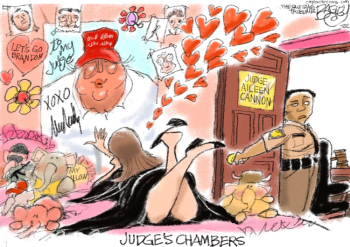 Good Day, Sky Dancers!
There is a distinct difference between what’s been happening in two Trump Cases. The one about mishandling and stealing National Security Documents is being handled in Florida by Judge Ailen Cannon. The case in DC is being handled by Judge Tanya Chutkan. This is the case where Trump is indicted for illegally conspiring to overturn his loss to President Biden in the election. Both are the result of work done by Special Counsel Jack Smith. Both cases have also had ongoing issues with Trump harassing court officials and possibly committing witness tampering. The Prosecution has been arguing that Trump has been undermining confidence in the Judicial System and scaring off potential jurors.
The contrast between the demeanor, decisions, knowledge, and temperament of the two Judges is obvious. Judge Cannon is slowing things down in her court in keeping with Trump’s desire to not do any of these trials before the next Presidential election in the hopes of being able to control the destiny of all federal cases and the DOJ. As reported in The New Republic, “Judge Chutkan: Full Steam Ahead With Speedy Trump Trial. Judge Tanya Chutkan has set a date for jury selection in Donald Trump’s D.C. trial.”
U.S. District Judge Tanya Chutkan is chugging along with jury selection in Donald Trump’s federal election subversion case, despite attempts to delay the proceedings by the former president’s legal team.
On Thursday, Chutkan endorsed a set of jury procedures that note prospective jurors will fill out a preliminary questionnaire on February 9, just over three months away. (As a reminder, Trump’s trial is scheduled to begin on March 4, 2024, one day before Super Tuesday.)
Certain language in the court order also hints that Chutkan is getting wise to Trump’s antics.
After slapping Trump with a gag order in the D.C. trial for leveraging his platform on social media and at speaking arrangements to lambaste prosecutors and office clerks associated with the case, Chutkan’s legal outline reads more like a warning to his defense to keep the former president from trash-talking his own jury.
“The parties must ensure that anyone permitted access to sensitive juror information understands that he cannot publicly disclose the information, and no party may provide jurors’ identifying information to any other entity (e.g., the defendant’s campaign) that is not part of the defense team or Government team assisting with jury selection,” Chutkan wrote.
The date, just three months from now, breezes past concerns over other possible Trump-induced delays in the trial. In October, Trump’s legal team claimed presidential immunity in the D.C. case charging him with plotting to overturn the 2020 presidential election results, in an attempt to argue that Trump’s actions fell within his White House responsibilities.
 Trump is indeed introducing similar cases that caused Judge Aileen Cannon to slow the process way down. Former Federal Prosecutor and Law Professor Joyce Vance has this analysis of the recent decisions.
Three developments from today that are important:
First, on Thursday, Judge Chutkan gave us some idea of what the schedule in D.C., where Trump is scheduled to go to trial in March, looks like. She has ordered the lawyers to confer in advance of January 9 and submit proposed jury questions to her by that date. She will resolve any conflicts (there are bound to be quite a few) between the parties about what questions should be asked, and on February 9, she will begin the process of selecting a jury.
Hundreds of District of Columbia residents will be summoned to the E. Barrett Prettyman Federal Courthouse on February 9 to fill out the jury questionnaire the judge finalizes. That leaves plenty of time to select a jury in advance of the March 4 start date for Trump’s trial. In D.C., Trump will stand trial alone, although the indictment includes mention of conduct by unnamed and unindicted co-conspirators. We still don’t know if any of them will be testifying as cooperating witnesses for the government, including those like Sidney Powell and Kenneth Chesebro who previously pled guilty in Fulton County, Georgia.
Second: late Thursday evening, Trump appealed the gag order—readers of Civil Discourse know that it’s actually a (very) limited restraining order—to the Court of Appeals for the District of Columbia. And, he asked that court to suspend the gag order for as long as the appeal takes, something Judge Chutkan had previously declined to do.
Trump is actually asking the court to take several steps. He wants the court to enter a stay, which would mean the gag order won’t be in place during the the appeal. That could be take a while since Trump indicates his intent to appeal to the Supreme Court if he loses in the court of appeals. He asks the court to rule on his request by November 10, just over a week away. Finally, while the court decides whether to enter that stay, Trump wants them to enter a brief administrative stay immediately, so that he can get out from under the gag order pronto.
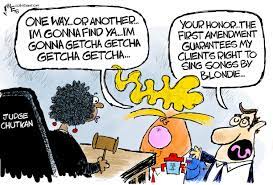 Of course, they hate the gag order. Trump cannot control his flagrant, abusive outbursts on all things related to every case. The restrictions imposed by Chutkan and Judge Engoran in the New York Trump Fraud Case have been nearly tailored to ensure Trump does not harass potential jurors, witnesses, or court employees. Trump harassment usually leads to the need for protection and arrests of crazed Trump fans. You may read about the specifics of the gag orders and Trump’s legal team’s argument at Vance’s Substance. Let’s return to the third reason, which dovetails into the decisions made by Judge Cannon in the other case.
The real question is, how long it will take the appellate courts to sort this out? The clock is ticking, and Trump is increasingly transparent about his desperation to delay his criminal trials until after the election. While the appeal of the gag order shouldn’t slow things down, what’s coming behind it are the four motions to dismiss Trump has filed (presidential immunity plus three others, which we will take up next week), some of which he can appeal before trial if he loses. With the gag order, Trump has asked the court to decide a motion in a week. It’s certain that if he returns to the appellate court seeking rulings on some of those motions, he’ll be content to see the courts take up as much time as possible, and preferably until after election day in 2024, to render their decision and return the case for trial. Delay when it helps him, speed when it harms him. Certainly the courts can see through that?
That’s the question raised by tonight’s third development. In the Mar-a-Lago case, the Special Counsel’s office filed a pleading entitled “Notice of Defendant’s Motion To Stay Proceedings In The District Of Columbia.” Interesting that they felt they needed to give Judge Aileen Cannon in Florida insight into what Trump was doing in the D.C. case.
The pleading referenced a hearing Judge Cannon held the previous day. In that hearing, Trump’s lawyers argued that the May trial date for the Mar-a-Lago case was too soon. Part of their argument was that because of the March 4, 2024, date in D.C., if the Mar-a-Lago case went to trial as scheduled on May 20, 2024, Trump would be required to be in two places at once.
Leave aside for the moment the Special Counsel’s estimate the trial in the District of Columbia will take four to six weeks, which would give Trump and his lawyers at least a five-week grace period in between the two trials. Here’s what the Special Counsel’s office wanted to make sure Judge Cannon was aware of: Trump’s lawyers failed to disclose to her that shortly after her hearing concluded, Trump asked Judge Chutkan in D.C. to delay his trial there for as long as it took the courts to decide his motion to dismiss that indictment on presidential immunity grounds. (If you need a refresher on Trump’s presidential immunity motion, here.)
The timing of Trump’s motion to delay the D.C. trial meant it had been in the planning stages for at least several days—lawyers don’t produce legal briefs like that in the space of an hour without advance planning. Most lawyers, consistent with the obligation to be candid to the court, would have alerted Judge Cannon that they were about to file a motion to delay the D.C. case. That didn’t happen here.
That raised eyebrows in the Special Counsel’s office, so lead Mar-a-Lago prosecutor Jay Bratt filed the notice to ensure that the record in the Mar-a-Lago case includes what many judges would view as a disingenuous, if not deceitful, strategy by the Trump camp. Bratt took it straight to the Judge in no uncertain terms, urging her not “to be manipulated in this fashion.” We’ll see if Cannon, who has spent the lion’s share of her orders lately criticizing the Special Counsel’s office, has any criticism to spare for Trump’s lawyers. Read the Special Counsel’s pleading here.
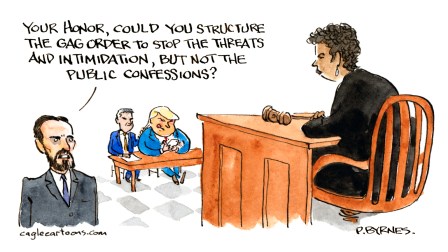 Vance’s explanations and rationale are always helpful on all things related to Trump and his Federal Court cases. Maggie Haberman and “Two Judges, Two Approaches. He avoids criticizing one. Another draws attacks.”
As the two federal criminal cases against Donald Trump make their way toward trial, they are bringing into focus a tale of two judges.
In the case taking place in Washington, D.C., where Trump is accused of plotting to overturn the 2020 election, Judge Tanya Chutkan, a former public defender appointed by Barack Obama, is taking a tough line with the former president and his legal team.
Trump, in turn, is assailing her.
In another courtroom in Fort Pierce, Fla., where Trump is under indictment for mishandling classified documents after leaving office and obstructing efforts to retrieve them, Judge Aileen Cannon, a former federal prosecutor named by Trump, has been more of a cipher but has been sympathetic at times to arguments from the former president’s lawyers.
Trump has pointedly avoided aiming any of his fire at her.
The contrast has been especially apparent in recent days.
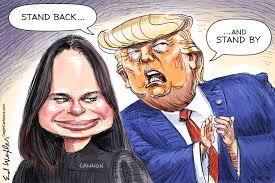 The examples provided are startling but not unexpected.
When Judge Cannon asked Bratt if he was aware of any other situation in which a criminal defendant was confronting trials in multiple jurisdictions and could encounter the “unavoidable reality that the schedules might collide,” he sidestepped the question.
“I’m having a hard time seeing, realistically, how this work can be accomplished in this compressed period of time,” she told Bratt.
Twisting the knife a little further, she went on: “I’m not quite seeing in your position a level of understanding of our realities.”
On his social media site, Trump has been silent about Judge Cannon, sparing her from the vitriol he directs constantly at other judges, prosecutors and potential witnesses in the cases against him.
By contrast, after Judge Chutkan reimposed the gag order on him on Sunday night, Trump went after her once again, calling her a “very biased, Trump hating judge” and questioning the constitutionality of her decision.
The news is that Trump is trying to stall both prosecutions. Judge Cannon complied. This is from Marcie at her blog emptywheel. “HOURS AFTER AILEEN CANNON SUGGESTS SHE’LL STALL FLORIDA PROSECUTION, TRUMP MOVES TO STALL DC ONE.” This establishes the possibility of conflicting decisions by the two Courts of Appeals.
Judge Aileen Cannon has not yet released a ruling describing how much she’ll bow to Trump’s manufactured claims of classified discovery delays in the stolen documents case, but she made clear that she will delay the trial somewhat. As reported, at least, that delay will come because of the competing schedule in DC.
Trump’s lawyers argued that they need a delay in the documents case because preparations for it will clash with the federal election case, which is slated to go to trial on March 4 and could last several months.
Trump’s indictment in the election case — which came days after Cannon set her initial timeline for the document case — “completely disrupted everything about the schedule your honor set,” Trump lawyer Todd Blanche told Cannon.
Another Trump lawyer, Chris Kise, personified the crunch the former president’s attorneys are facing, phoning into the hearing from a New York courthouse where Trump is undergoing a civil trial targeting his business empire.
“It’s very difficult to be trying to work with a client in one trial and simultaneously try to prepare that client for another trial,” Kise said. “This has been a struggle and a challenge.”
Note: as DOJ pointed out, Kise’s NY trial schedule was already baked into Cannon’s schedule.
Having secured that delay, Trump turned to delaying his DC trial, with a motion to stay all other DC proceedings until his absolute immunity claim is decided, a 3-page motion Trump could have but did not submit when he was asking for a delay before submitting his other motions. Everything he points to in that 3-page motion, the completed briefing on the absolute immunity bid, was already in place on October 26. But he waited until he first got Cannon to move her trial schedule.
As I laid out the other day, Trump is not making legal arguments sufficient to win this case — certainly not yet. He is making a tactical argument, attempting to run out the clock so he can pardon himself.
Update: LOL. Trump filed the DC motion too soon, giving DOJ a chance to notice the cynical ploy in DC before Aileen Cannon issues her order.
“Cynical ploy’ is an excellent description of this checkers-level move. But again, it’s just another delay tactic so Trump can argue his case in the Public Arena and dance around gag orders.
Glenn Kirschner also brings the skills and analysis of a career spent prosecuting cases in varying courts. He suggests that a motion to recuse Judge Cannon may be in order. What will Jack Smith decide?
Trump is totally Looney Tunes in his responses to the decisions of all the relevant Judges but Cannon. You would think she would be embarrassed.
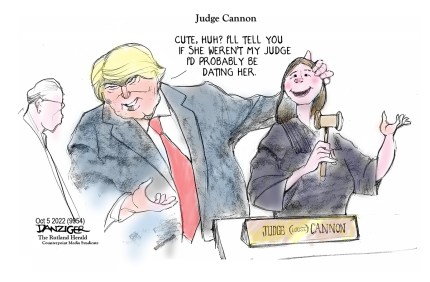
This article in Newsweek is about the analysis of Former FBI General Counsel Andrew Weissmann gave on the Cannon decision on who could access the documents. “Aileen Cannon’s ‘Snarky’ Trump Ruling Called Out by Former Prosecutor.”
The judge overseeing Donald Trump‘s classified documents case has been criticized by a former prosecutor after she ruled in favor of the former president’s co-defendants in the case.
Former FBI general counsel Andrew Weissmann was reacting to the ruling from Judge Aileen Cannon that two people charged alongside Trump in the federal investigation—aide and valet driver Walt Nauta and Mar-a-Lago maintenance worker Carlos De Oliveira—should be allowed to review some of the classified evidence provided to the defense under discovery, which forms the center of the case.
Trump has pleaded not guilty to 40 charges over allegations he illegally retained top secret and sensitive materials after he left the White House in January 2021, and then obstructed the federal attempt to retrieve them. Nauta and de Oliveira have also denied allegations they sought to conspire with the former president to obstruct the investigation into Trump’s possession of classified documents at his Mar-a-Lago resort.
While sharing Wednesday’s ruling which criticized arguments from Special Counsel Jack’s Smith’s team on X, formerly Twitter, Weissmann said the decision “goes straight for the capillaries” while condemning the language used by the judge.
“Almost pointless discussion, when so many real issue are left undecided,” Weissmann wrote. “And her language is far too snarky for a federal judge.”
The ruling from Cannon hit out at the federal prosecutor’s attempts to restrict Nauta and de Oliveira from reviewing the classified discovery while citing section 3 of the Classified Information Procedures Act [CIPA]. The section requires Cannon court to issue an order to protect against the disclosure of any classified information disclosed by the government “to any defendant in any criminal case.”
The ruling from Cannon hit out at the federal prosecutor’s attempts to restrict Nauta and de Oliveira from reviewing the classified discovery while citing section 3 of the Classified Information Procedures Act [CIPA]. The section requires Cannon court to issue an order to protect against the disclosure of any classified information disclosed by the government “to any defendant in any criminal case.”
“So again, we are left with the [special counsel’s] broad and unconvincing theory, which is that the Court must change the meaning of the word ‘defendant’ to mean, essentially, ‘defense attorney to the exclusion of defendant.’ The Court declines to do so,” Cannon wrote.
“‘Defendant’ means what it says—defendant—and although providing discovery to a defendant reasonably contemplates the defendant’s retained or appointed agent reviewing the information too, it does not support the very different proposition that ‘defendant’ means ‘not defendant.’
Cannon also said in her ruling that Smith’s office “[lacks] merit,” and reaffirmed the protective orders regarding classified information that were previously issued in the case.
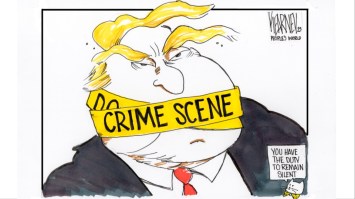 Meanwhile, Trump continues to blurt out things on his Truth Social page that really should disturb all the Judges in all the Court Cases that involve him. This is from Liz Dye at Public Notice. “Trump’s Truth Social page is a riot of witness intimidation. Even his lawyers can’t really defend it.” Trigger Warning Obscene, Racist, and Violent Language.
On August 6, Alabama man Arthur Ray Hanson, II, left a voicemail threatening Fulton County District Attorney Fani Willis with violence if she charged Donald Trump with interference in the 2020 election.
“I would be very afraid if I were you because you can’t be around people all the time that are going to protect you,” he said on the recorded call. “When you charge Trump on that fourth indictment, anytime you’re alone, be looking over your shoulder … What you put out there, bitch, comes back at you ten times harder, and don’t ever forget it.”
That same day, Hanson left a similar message for Fulton County Sheriff Patrick Labat:
If you think you gonna take a mugshot of my President Donald Trump and it’s gonna be ok, you gonna find out that after you take that mugshot, some bad shit’s probably gonna happen to you … I’m warning you right now before you fuck up your life and get hurt real bad … whether you got a fucking badge or not ain’t gonna help you none … you gonna get fucked up you keep fucking with my president.
The threats didn’t work, and on August 24, Trump surrendered at the Fulton County Jail. Trump raised $7.1 million off his mugshot, but Hanson fared much worse. This week he was indicted for using interstate communications to threaten to kidnap or injure a person.
The day before Hanson’s calls to officials in Georgia, a Texas woman named Abigail Jo Shry left a voicemail for federal judge Tanya Chutkan, who is presiding over Trump’s election interference case in DC.
“Hey you stupid slave n—– …. You are in our sights, we want to kill you,” she said. “If Trump doesn’t get elected in 2024, we are coming to kill you. So tread lightly, bitch … You will be targeted personally, publicly, your family, all of it.”
Shry was indicted in September and, like Hanson, was charged with making threats via interstate communication. But while Hanson and Shry were exceptionally careless about covering their tracks, they certainly weren’t alone in menacing the targets of Trump’s ire. Judges and prosecutors in every one of Trump’s cases have been subjected to threats and harassment for simply doing their jobs.
Dye follows with rationale, showing how Trump lawyers cannot possibly explain away the impact his posts have on his crazy followers. Judge Chutkan has been assigned extra security. The barrage at his former attorney, Michael Cohen, is incredible, too. He refers to himself in the third person, which is always weird to read, and calls Cohen a “sleazebag.” This was during Cohen’s testimony last month in the Trump Family Fraud Trial in New York City. You may recall BB provided an article that showed how Trump’s rhetoric is getting more violent and fascist. You can see it in these examples.
Trump’s escalation of hate is only going to get worse. What is also evident is the misogyny and racism in the taunts. This only further encourages his crazies. These trials need to start now and roll over him before we get any nearer to Election Day. The only Judge who doesn’t get this is Judge Cannon. Someone needs to do a deep dive into what is driving her evident special treatment of this particular alleged criminal.
I guess he’s just an ‘excitable boy’.
What’s on your reading and blogging list today?

 peej
peej Carissa
 bostonboomer
 dakinikat
 ecocatwoman
 mablue2
 Mama Lopez
 peggysue22
 quixote
 skydancingguestblogger
 Mona (aka Wonk the Vote)



 Sky Dancing
Recent Comments