
Sympathy for the Devil
Posted: September 24, 2011 Filed under: income inequality, just because | Tags: Income Inequality, millionaires, poor little rich boys 13 Comments
“Please allow me to introduce myself
I’m a man of wealth and taste”Mick Jagger sings in “Sympathy for the Devil”
I was raised with a rather limited view of the world in a suburb of Omaha, Nebraska. There were millionaires in my family then and there are many now. I was told I was middle class and I felt actually rather poor when I would go to Kansas City every weekend and play department store in the elevator in my uncle’s library going up and down between the three floors of his very huge mansion there. My aunt’s house was in the same neighborhood and didn’t have an elevator but was pretty much the same size. I thought my house was average. I laughed when my soon to be husband’s friends from Bellevue called my house “the mansion”.
I was told we were middle class much in the same way Mittens Romney thinks he’s middle class albeit he’s got more money than my parents ever did. I was raised in a very good size house in a very good neighborhood and went to very good public schools with nearly every other new car dealer’s kid in the city. I didn’t really think that was an unusual circumstance. I’m not in that form of Kansas any more although all I have to do is choose to visit a family member and I’m back there any time I want. I have limited patience for an environment where the big crisis of the day is the worry that you may not have enough of your special Holiday China to go around a table bearing a perverse amount of food and drinks.
Now, I live in really mixed poor, working, middle class neighborhood. My income basically has matched the US median family income and my house basically matches the median price for houses in the US. I did that on my own by working and it feels good. Happiness to me are paid bills and phone calls from the daughters. I left all the above income stuff when I left my husband. To be honest, people that are very very rich have odd problems and the more I got out in the real world, the more I discovered that. They feel miserable and down about themselves for very odd reasons. This is one of the reasons I dropped out of that entire scene. I always felt a lot more comfortable with my dad’s family that was solidly working/middle class than my mom’s relatives described above. They were all great and loving people, but there was always this tinge of surreality, unreality, or not quite real world about the side of my family that seriously had more money than most people would know what to do with. Most of their days was spent trying to figure out odd ways to spend it.
So, why am I bringing this up? It’s because all of that has tinged my adverse reaction to a WAPO item called “Five myths about Millionaires“. The crux of the article is that a million dollars really isn’t what it used to be, millionaires do pay taxes, and like my family, they don’t really feel rich. They feel just ordinary and middle class, and shucks folks, they’re just likeable people who create jobs and pay their share of taxes. Well, that’s all fine but that shouldn’t be the point. My extremely rich family used their white, educated, WASPY background to the best of their advantage and worked the system well. The system rewarded them. I’ve seen equally sincere and good people have just the opposite happen for factors completely out of their control. The deal is we have to pay for all the benefits of a modern society and who is in the best position to do that?
The very rich don’t need any one defending them at all because, it is what it is and they are what they are. They are mostly nice people for whom the system worked very well because they were precisely poised to take advantage of all that the system offers. Rich people are as diversely nice or bad as any one else. However, having all that money warps your perspective a lot. My thought is that John Steele Gordon–author of the article–probably gets up earnestly and says like Mittens Romney and my family used to do: ” You know, we’re just simple middle class Americans” right before he gets in his new car and goes from his big house to his well paying job. You can insert a lot of private club references into the day too. Yup, that’s all every one does every single day unless they are lazy and want to engage in the president’s class war, right? There is something about having huge amounts of money that puts people in a different frame of mind. They invent struggles where there are none.
“I tell you the truth, it is hard for a rich man to enter the kingdom of heaven. Again I tell you, it is easier for a camel to go through the eye of a needle than for a rich man to enter the kingdom of God.”
Let me just give you a quote from the article about why a million dollars isn’t that much money for poor middle class millionaires.
On Thursday, 44 percent of people voting in an online surveyas part of the GOP debate coverage said that a $1 million annual income made a person “rich.”In a 2008 survey of affluent Chicago households, only 22 percent thought a nest egg of $1 million was rich. In March, four out of 10 millionaires surveyed by Fidelity Investments said they do not feel rich. That same month, a majority of investment advisers surveyed in a Scottrade poll said that $1 million isn’t enough for retirement.
Though the average American family is rich beyond the wildest dreams of the average family in Bangladesh, where per capita income recently rose above $700, it’s not much compared with those who summer on beachfront properties in the Hamptons. When John D. Rockefeller learned in 1913 that the late J.P. Morgan had left an estate of $60 million, including a fabulous art collection, he reportedly said: “And to think — he wasn’t even rich.”
So, here I am in the upper ninth ward of New Orleans thinking that just about every one within a few miles of me would think that life had just about gotten as good as it could get if they could hit that median family income of around $60,000 a year consistently. There would probably be a lot more of them–like me–that actually would own the house in which they live for one. Also, they probably would be overjoyed to see a tax base so healthy that we could actually support good roads, good schools, and better cops for a change. Whatever the house in Southampton equivalent would be down here isn’t even on any one’s wish list on this side of the French Quarter. The daily concerns are: Will I keep my job or find a job? Can I pay all my bills this month? Can I feed my family? Will the car and my health stay together long enough so that I won’t become a homeless person? The thing that makes millionaires different is that real life is not at the top of their lists of concerns every day and believe me it changes your perspective mightily when it is.
Let’s put those survey results in context by using the 2011 Statistical Abstract. I’m going to cut and paste the income distribution table for you. It’s for U.S. families in 2009 stated in 2008 dollars. Okay, so look down there at the percentage of families that make more than $250,000 a year. It’s more than it was a few years ago, but it’s still less than 3% for every one and 4% for whites and Asians. Black and Hispanic families that earn that much are less than 1% of their entire demographic.
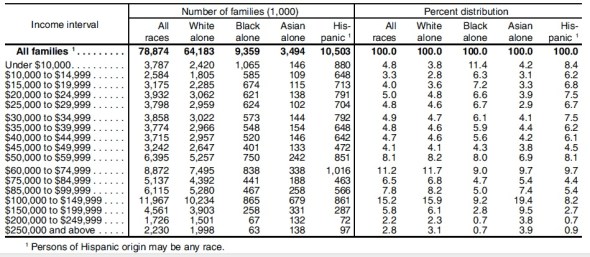
Here’s a slightly broader view of income distribution from the same source.
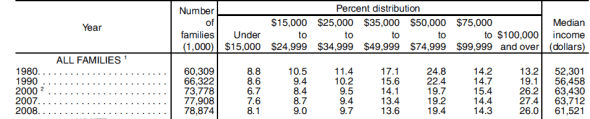
You can see that about 74% of US families don’t even clear $100,000 annually given the median income is $61,521. That’s a skewed distribution if there ever was one. I think the skewed distributions leads to some pretty skewed perspectives too.
I’m reminded of this little news item from one of my state’s Congressman whose math was fuzzy and priorities reflect that of some one whose not worried about the normal things in life. I’m still trying to figure out exactly what he pays the employees at his Subway Shops in Northwest Louisiana given the numbers he provides. As best I can figure, it’s about $12,000 a year. If he feels so put out and poor with an annual income of $400,000 a year that I wonder whatever do his charitable contributions look like?
Taking up the typical GOP talking point, Fleming said raising taxes on wealthy “job creators” is a terrible idea that kills jobs because many of these people are small business owners who pay taxes through personal income rates. Fleming is himself a businesses owner, so Jansing asked, “If you have to pay more in taxes, you would get rid of some of those employees?” Fleming responded by saying that while his businesses made $6.3 million last year, after you “pay 500 employees, you pay rent, you pay equipment, and food,” his profits “a mere fraction of that” — “by the time I feed my family, I have maybe $400,000 left over.”
All of this puts me in mind of F Scott Fitzgerald who was the chronicler of the wealthy point of view during the Gilded Age.
Let me tell you about the very rich. They are different from you and me. They possess and enjoy early, and it does something to them, makes them soft where we are hard, and cynical where we are trustful, in a way that, unless you were born rich, it is very difficult to understand. They think, deep in their hearts, that they are better than we are because we had to discover the compensations and refuges of life for ourselves. Even when they enter deep into our world or sink below us, they still think that they are better than we are. They are different.
F. SCOTT FITZGERALD writes in “The Rich Boy” in 1926
This is the stuff that makes Elizabeth Warren’s video on the stump the other day go viral. This isn’t class warfare. I don’t think there’s an awful lot of people that truly begrudge folks their wealth. Speaking only for myself, I don’t want to have my sense of perspective or priorities that warped any more and am happy when ends meet. I think people only want to feel like they have a decent living and that people that have more than that should pull their own weight and not make these weirdish justifications for wealth that most folks just plain don’t get. Back to the article by the poor little rich boy.
Taxes on the rich are taxes on people who create jobs. And jobs are an unalloyed good thing for an economy. Excessively taxing the capital that makes the economy go is poor public policy. And we have a recent example of how the opposite works well: Unemployment declined by a third in the four years after the Bush tax cuts were fully implemented in 2003, dropping to 4.2 percent from 6.2 percent. Meanwhile, federal revenue increased 44 percent in those years. If these tax cuts put people to work and generated money for the government, shouldn’t Obama consider the possibility that tax increases should be avoided?
Most of this analysis is incredibly disingenuous because it fails to mention that the country was coming out of a recession and a severe macro shock from 9/11. It wasn’t the fiscal policies that did these things at all. Plus, these were the early warning signs of Allan Greenspan blowing a housing bubble and a construction and financing boom about to crash the economy. Economists don’t like to see the rate of unemployment fall significantly below its natural rate. It means the government is doing WAY too much and will probably create some kind of inflation and the economic activity won’t be sustainable. All that war and anti terrorism spending overheated the economy.
The argument of capital gains cuts = job creations is the core argument here that I will never understand from a simple common sense view. That doesn’t even count all that book learning views from the degrees and the doctorate in Financial Economics that sets off alarms in my brain. These were tax cuts that subsidized excessive speculation. The argument that values hoarded wealth over hard work and says that all that money floating around financial markets does is create jobs is a false one.
The deal is this. It’s one thing to put your money into a business like a small or medium sized business owner does but that money is counted as regular income. That is job creating but it has nothing to do with capital gains taxes. Second, if you do buy stock in GE and you put in there for years on end and others do the same then, yes, that’s basically a good source of funding for a business and that resembles business ownership albeit a very detached one. Possibly, you could reward the buy and hold investor but a huge amount of market activity is not buy and hold unless you’re an institution. Also, why does putting your money in a bank and collecting interest– because bank deposits get pooled and loaned to businesses–not get the same treatment? My thought is that it’s because it’s the middle class way of holding wealth and the view is that it is inferior income like wages and salaries. Interest income gets taxed like work income. But, AND MOST OF ALL, how are day traders who bop in and out of investments daily, speculating away on stuff, buying exotic derivatives that have nothing to do with the underlying business create jobs, value or anything else worthy of the label job creators and why do they deserve special tax treatment? Are you prepared to tell me that this form of speculation creates more jobs than say, the gambling casinos on the strip in Las Vegas? At least we can point to cocktail waitresses, bartenders and dealers in Las Vegas style gambling.
A lot of money income that comes from capital gains is just another form of gambling income. It isn’t there long enough to encourage businesses to make long term decisions that would actually help the economy. The only thing it really does is make CEOs short-sighted by forcing them to focus on short term stock prices so they invariably don’t invest in positive net present value projects which means no attendant jobs. That’s what the research says. So, Gordon’s thinking is as fuzzy as gee, since I only get $400,000 a year, I guess I’ll just have to get rid of a few people that are doing the work for me that I pay only $12,000 a year. The “bringing liquidity to the market” isn’t really a great rationalization here either because the wham bam thank you approach of speculators these days doesn’t offset the increased risk and price volatility they bring to markets. They screw up the pricing mechanism when they do all that momentum trading. Recent gas prices and house prices are good examples of speculation gone wild. Also, riddle me this. What value do hedge fund managers bring to the table when they bet against US businesses and the US government? Why do they get special tax treatment for that? What jobs does that create? I’m not reading specifics on those things at all in Gordon’s blessed are the millionaires for they are the job creators spiel. Why subsidize this behavior and these extraordinarily rich people?
So, I’m not in any way shape or form saying that millionaires are bad or evil or whatever the nasty implications are that underlie the class war charge. What I’m saying is that there’s a difference in your perspective when you’ve got hungry kids than some one is whining they can’t make it on $400,000 a year. I don’t think we need articles lecturing us on the proper perspective we should take on millionaires. I think a few millionaires need to develop a different perspective on reality and life and quit whining when some one asks them to pay for the roads they drive on, support the schools they attended, pay for the protection provided by soldiers, cops, and firefighters, and basically pull their fair share of the load of living in a civilized society.

 peej
peej Carissa
 bostonboomer
 dakinikat
 ecocatwoman
 mablue2
 Mama Lopez
 peggysue22
 quixote
 skydancingguestblogger
 Mona (aka Wonk the Vote)



 Sky Dancing
Recent Comments