

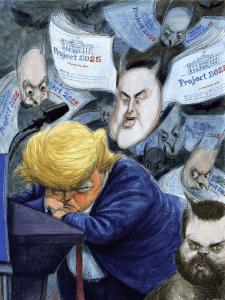
Kash Patel, Donald Trump’s pick to direct the Federal Bureau of Intelligence, has never served in the FBI. But he has hosted Steve Bannon’s podcast.
Patel is a contributor at Real America’s Voice, the right-wing news network that produces Bannon’s show War Room, and has long appeared as a guest on the show. After top Trump adviser Bannon was imprisoned for four months earlier this year — on charges of contempt of Congress after he refused to comply with a January 6 Committee subpoena — Patel stepped up to serve as an occasional guest host.
Crazy Eyes Kash Patel
To try and understand Patel better, I listened to every episode and clip tagged with “Kash Patel” on the War Room website — and a few others that Bannon’s team missed. The overwhelming impression is that Patel is a man whose entire worldview revolves around paranoid conspiracy theories — specifically, conspiracies against both America and Trump, which for him are one and the same. It’s a specific kind of obsession that reminds me of the FBI’s first director: J. Edgar Hoover, a man who infamously abused his power to persecute political enemies.
During his various appearances on Bannon’s show, Patel and/or his interviewees declared that:
- China is funding the Democratic Party and sending “military-aged males” across the Mexican and Canadian borders to prepare for a preemptive strike.
- Barack Obama directs a “shadow network” that is quietly directing the intelligence community and Big Tech to persecute Trump.
- Attorney General Merrick Garland wants to throw “all of us” — which is to say, Trump allies — in prison.
And Patel is willing to go to extreme measures in response to these alleged threats.
In one episode, he called on the Republican majority in Congress to unilaterally arrest Garland — invoking an obscure legal doctrine called “inherent contempt” that has never been used in this fashion in the entirety of American history. In another, he outlined a plan for a MAGA blitz of American institutions focused on getting loyalists into high office.
Finally Friday Reads: Backpfeifengesicht
Posted: March 7, 2025 Filed under: Economy, Equity Markets, FARTUS, kakistocracy, MAGA Assholes, MAGA Political Carnage, Polycrisis, Psychopaths in charge | Tags: a face worthy of being slapped, Backpfeifengesicht, CryptoCurrency Ponzi Scheme from Trump and Musk, Declaration of Independence, FARTUS, martial-law, People are not Illegal, Space X explosion, The Insurrection Act, White Male Christian Supremacists 8 Comments
“EEK!” John Buss, @repeat1968, @johnbuss.bsky.social
Good Day, Sky Dancers!
Backpfeifengesicht is the German word for “a face worthy of being slapped.” That might be the most usable word in the dark timeline, which is the second term of #FARTUS (Felon, Adjudicated Rapist, Traitor of the United States). JJ found this sweet article at The Guardian and shared it with BB and me this morning. It’s an Op-Ed written by Marina Hyde about JD Vance, but it could apply to any subhuman of the modern MAGA movement. “There are 1,000 grotesque memes of JD Vance – and they’re all more likable than the real thing. Angry, rude and addicted to web troll-ery, the vice-president has the Make America Awful Again portfolio. Seems a perfect fit.” Ayup.
You may well be aware that Backpfeifengesicht is the German word for a face that is worthy of being slapped. Even so, how has this not been internationalised? Or at the very least Americanised, where its dictionary definition would presumably be adorned by a picture of the face of US vice-president JD Vance – already faultlessly playing the role of worst American at your hotel. You can immediately picture him at breakfast, can’t you? Every single other guest on the terrace with their shoulders up round their ears, just thinking: “Where is he now? How unbearable is he being NOW?” Next, imagine breakfast lasting four years.
I say the Backpfeifengesicht definition would be accompanied by JD Vance’s face … but then again, what is the face of JD Vance? The internet is awash with people suffering an acute case of not being able to remember it any more, having seen so many hideous comic distortions of Vance that those meme versions are not simply the only results on the first page of your own mental Google search, but stretch deep beyond the second and into the third. Somewhere on page four, where you might as well publish the nuclear codes or pictures of Taylor Swift giving cocaine to babies, is an unmodified snap of what JD Vance actually looks like. Or at least what he looks like with eyeliner.
Before you get there – and you don’t, really – your synaptic filing systems throw up every variety of Photoshopped Vancefake: swollen manboy, face wearing a Minion suit, a bearded egg … I’m hoping that sooner or later, an American news outlet will accidentally use a modified photo, because even the picture editor has forgotten what the vice-president looks like, and then we can have one of those massively self-regarding legacy media-blow-ups, where the entire staff has to resign after a remorseless investigation by the executive editor reveals Vance isn’t actually a big purple grape. “This is a stain on our newspaper’s history. A big purple stain.”
Vance is more meme than man, now, and it is, of course, something of a consolation that he is so extremely online that he can’t help but have noticed this. The VP is like a one-man government troll-feeding programme – please don’t cut him, Elon! – which is probably why people have become so heroically committed to taking the piss. The probability of the vice-president seeing you insulting him is basically one.
Just as previous holders of his office like Teddy Roosevelt and Richard Nixon once did, Vance spent a notable amount of this week both denying he suggested Britain and France were random countries that hadn’t fought a war in 40 years, and replying to random X posters called things like “Jeff Computers” to counter the suggestion that he wasn’t loved and feted on his recent skiing holiday.
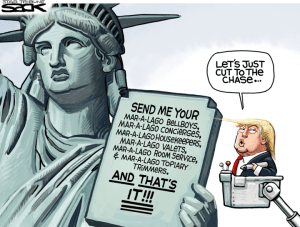 While JJ found that amusing read today. BB brought home the rancid bacon. This is an op-ed by Brett Wagner in The San Francisco Chronicle today. “Is Trump preparing to invoke the Insurrection Act? Signs are pointing that way. A joint Department of Defense and Homeland Security report will soon recommend whether or not to invoke the Insurrection Act over illegal migration.”
The clock is ticking down on a crucial but little-noticed part of President Donald Trump’s first round of executive orders — the one tasking the secretaries of the Department of Defense and Department of Homeland Security to submit a joint report, within 90 days, recommending “whether to invoke the Insurrection Act.”
Many of us are now holding our collective breath, knowing that the report and what it contains could put us on the slippery slope toward unchecked presidential power under a man with an affinity for ironfisted dictators.
Adding to the suspense was the recent “Friday Night Massacre” at the Pentagon — the firing of the nation’s top uniformed officer and removing other perceived guardrails (i.e., the top uniformed lawyers at the Army, Navy and Air Force) standing between the president and his long-stated intention to declare martial law upon returning to power.
Coincidence?
As we wait to find out, this would be a good time to take a closer look.
Say, for example, that Trump were to invoke the Insurrection Act and declare martial law. He wouldn’t even be required, by the letter of the law, to allege an “insurrection.” All that would be required is to assert that “unlawful obstruction” has made it “impracticable to enforce the laws of the United States” (as President Dwight D. Eisenhower did when he ordered the Arkansas National Guard to enforce the desegregation of Little Rock, Ark., schools).
This is where all the false claims and outright lies Trump and his political allies have been pushing will come into play: Trump falsely alleging, for example, that an entire city in Colorado has been taken over by Venezuelan street gangs, that a city in Ohio has been overrun by Haitian refugees who are eating all the cats and dogs, and other vague assertions that “millions and millions” of “illegals” are pouring into our country every week (or “day” depending on who’s telling the lie at the moment).
Each of these false claims and outright lies could be distilled, to declare martial law, into catchy phrases (beginning with the legalese word “Whereas”) to establish the legal premise for invoking the Insurrection Act, and to lay the predicate to begin going door-to-door, wherever they please, under the pretense of searching for undocumented immigrants who don’t exist.
I bring you the reality on the ground from Joy Reid on Threads. “This is inhumane, hideous and repugnant. If this is what MAGA America is, count me out. I’m ashamed that this is what our government is doing. Shame on them. Shame.” What it is is a 21-year-old girl with cancer who relies completely on her immigrant mother, who is in no way a criminal or bothering anyone. When protesters came to protest, they were arrested. How many laws and constitutional rights can this miserable administration break before they completely break all of us? This story comes from El Monte, California. You can read the hatred of the MAGA monsters in the threads below on YouTube. I’ve gotten to the point where I don’t want to leave the house and take a chance at seeing a FARTUS supporter in my neighborhood. I’m fine with all the immigrants, though. Everything they do makes my neighborhood a better place.
“I can’t even wake up properly… she helps me, she bathes me, she changes me, she makes my food.”Deportation didn’t protect anyone it only stole a mother from the child who needs her most-Blake Coronadowww.threads.net/@blakecorona…
— Audrey (@parickards.bsky.social) 2025-03-06T23:59:31.294Z
 The US Military and US Vets are under attack from this Administration. This cannot be denied. This is from the AP this morning. FARTUS has always had a thing against military service and those who fight for values that he seems to hate very much. “War heroes and military firsts are among 26,000 images flagged for removal in Pentagon’s DEI purge.” So much of this just comes as an attack against the diversity of our nation being represented in all of its institutions. But is that really it? Why the disappearance of all people of color, women, and the LGBTQ community? Are white cis men really that sensitive?
References to a World War II Medal of Honor recipient, the Enola Gay aircraft that dropped an atomic bomb on Japan and the first women to pass Marine infantry training are among the tens of thousands of photos and online posts marked for deletion as the Defense Department works to purge diversity, equity and inclusion content, according to a database obtained by The Associated Press.
The database, which was confirmed by U.S. officials and published by AP, includes more than 26,000 images that have been flagged for removal across every military branch. But the eventual total could be much higher.
One official, who spoke on condition of anonymity to provide details that have not been made public, said the purge could delete as many as 100,000 images or posts in total, when considering social media pages and other websites that are also being culled for DEI content. The official said it’s not clear if the database has been finalized.
Defense Secretary Pete Hegseth had given the military until Wednesday to remove content that highlights diversity efforts in its ranks following President Donald Trump’s executive order ending those programs across the federal government.
The vast majority of the Pentagon purge targets women and minorities, including notable milestones made in the military. And it also removes a large number of posts that mention various commemorative months — such as those for Black and Hispanic people and women.
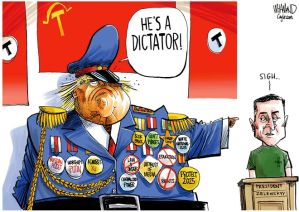 Are they just trying to up their odds that one will be less likely to disrupt the plan when martial law is declared? Everything they’ve been doing shows their delight in being the worst kind of bullies. Just yesterday, they announced they will deport Ukrainians who fled to the US for safety. We are no longer a safe harbor. Not even close. Heather Cox Richardson discusses this in detail this morning in her Substack Letters from an American.
This morning, Ted Hesson and Kristina Cooke of Reuters reported that the Trump administration is preparing to deport the 240,000 Ukrainians who fled Russia’s attacks on Ukraine and have temporary legal status in the United States. Foreign affairs journalist Olga Nesterova reminded Americans that “these people had to be completely financially independent, pay tax, pay all fees (around $2K) and have an affidavit from an American person to even come here.”
“This has nothing to do with strategic necessity or geopolitics,” Russia specialist Tom Nichols posted. “This is just cruelty to show [Russian president Vladimir] Putin he has a new American ally.”
The Trump administration’s turn away from traditional European alliances and toward Russia will have profound effects on U.S. standing in the world. Edward Wong and Mark Mazzetti reported in the New York Times today that senior officials in the State Department are making plans to close a dozen consulates, mostly in Western Europe, including consulates in Florence, Italy; Strasbourg, France; Hamburg, Germany; and Ponta Delgada, Portugal, as well as a consulate in Brazil and another in Turkey.
In late February, Nahal Toosi reported in Politico that President Donald Trump wants to “radically shrink” the State Department and to change its mission from diplomacy and soft power initiatives that advance democracy and human rights to focusing on transactional agreements with other governments and promoting foreign investment in the U.S.
Elon Musk and the “Department of Government Efficiency” have taken on the process of cutting the State Department budget by as much as 20%, and cutting at least some of the department’s 80,000 employees. As part of that project, DOGE’s Edward Coristine, known publicly as “Big Balls,” is embedded at the State Department.
As the U.S. retreats from its engagement with the world, China has been working to forge greater ties. China now has more global diplomatic posts than the U.S. and plays a stronger role in international organizations. Already in 2025, about 700 employees, including 450 career diplomats, have resigned from the State Department, a number that normally would reflect a year’s resignations.
Shutting embassies will hamper not just the process of fostering goodwill, but also U.S. intelligence, as embassies house officers who monitor terrorism, infectious disease, trade, commerce, militaries, and government, including those from the intelligence community. U.S. intelligence has always been formidable, but the administration appears to be weakening it.

Trump, bitcoin, political cartoon
We’re being turned into part of the Trump Grift Mafia. Nothing will be left standing of any of the good we have done in the world. This is neocolonialism and neomercantilism. We’ve retreated to some of the worst historical ideologies ever. The most symbolic thing happened yesterday. The latest Space X project blew up in the sky and shut down many flights yesterday. “Breakup of SpaceX’s Starship Rocket Disrupts Florida Airports. The video showed the upper stage of the most powerful rocket ever built spinning out of control in space, a repeat of an unsuccessful test flight in January that led to debris falling over the Caribbean.” This is what we’re spending money for? Elonia is pushing his company to the brink of getting to Mars and looking down at the rest of us. The report is from The New York Times‘s Kenneth Chang.
Starship — the huge spacecraft that Elon Musk says will one day take people to Mars — failed during its latest test flight on Thursday when its upper stage exploded in space, raining debris and disrupting air traffic at airports from Florida to Pennsylvania.
It was the second consecutive test flight of the most powerful rocket ever built where the upper-stage spacecraft malfunctioned. It started spinning out of control after several engines went out and then lost contact with mission control.
Photographs and videos posted on the social media site X by users saying they were along the Florida coast showed the spacecraft breaking up. The falling debris disrupted flights at airports in Miami, Orlando, Palm Beach and Fort Lauderdale, and as far away as Philadelphia International Airport.
The Starship rocket system is the largest ever built. At 403 feet tall, it is nearly 100 feet taller than the Statue of Liberty atop its pedestal.
It has the most engines ever in a rocket booster: The Super Heavy booster is powered by 33 of SpaceX’s Raptor engines. As those engines lift Starship off the launchpad, they will generate 16 million pounds of thrust at full throttle.
The upper part, also called Starship or Ship for short, looks like a shiny rocket from science fiction movies of the 1950s, is made of stainless steel with large fins. This is the upper stage that will head toward orbit, and ultimately could carry people to the moon or even Mars.
The rocket lifted off a little after 6:30 p.m. Eastern time on Thursday from the SpaceX site known as Starbase at the southern tip of Texas near the city of Brownsville.
Starship’s mammoth booster again successfully returned to the launchpad, just as it had during the previous test flight. In the last half minute before the upper-stage engines were to shut off, several of them malfunctioned. Video from the rocket showed a tumbling view of Earth and space until it cut off.
Ashley Parker and Michael Scherer wrote this analysis for The Atlantic. “Trump’s Own Declaration of Independence. The president, who has flirted with regal rhetoric, wants a historic copy of America’s founding document placed in the Oval Office.”
Long live the king!
Down with the king!
President Donald Trump sees the appeal of both.
Trump jokingly declared himself a sovereign last month, while his advisers distributed AI-generated photos of him wearing a crown and an ermine robe to celebrate his order to end congestion pricing in New York City. “He who saves his Country does not violate any Law,” he’d decreed a few days earlier, using a phrase sometimes attributed to Napoleon Bonaparte, the emperor of the French.
 I had no idea one of my greats who signed the Declaration had made of the copies of it. But the weird thing here is that Trump seriously wants the document to hang in the Oval Office. My question is, why take it from the people who can see it in the archives?
Since returning to power, Trump has moved quickly to redesign his working space. He has announced plans to pave over the Rose Garden to make it more like the patio at his private Mar-a-Lago club, as well as easier to host events with women wearing heels. He has also revived planning for a new ballroom on the White House grounds. “It keeps my real-estate juices flowing,” Trump explained in a recent interview with The Spectator.
Golden trophies now line the Oval Office’s mantlepiece. Military flags adorned with campaign streamers have returned. And portraits of presidents past now climb the walls—George Washington, Thomas Jefferson, John Adams, Martin Van Buren, Theodore Roosevelt, Franklin D. Roosevelt, and Ronald Reagan, among others. Gilded mirrors hang upon the recessed doors. A framed copy of his Georgia mug shot appears in the outside hallway. And the bright-red valet button, encased in a wooden box, is back on the desk.
In addition to the National Archives’ original Declaration, the government has in its possession other versions of the document. The collection includes drafts by Jefferson and copies of contemporaneous reprintings, known as broadsides, that were distributed among the colonies.
Alarmed by the deterioration of the original Declaration in the 1820s, Secretary of State John Quincy Adams commissioned William J. Stone to create an engraving of it with the signatures appended. That version forms the basis of the document since reproduced in school history books—the one with which most Americans are familiar. Adams tasked Stone with engraving 200 copies—but in what passes for a mini 19th-century scandal, Stone made an extra facsimile to keep for himself, the documents dealer and expert Seth Kaller told us.
Many of those Stone copies of the document have now been lost; roughly 50 are known to survive, Kaller said. The White House already has in its archives at least one of the Stone printings. Kaller told us that one of his clients who had recently purchased a Stone facsimile was visiting the White House when President Barack Obama asked him whether he could help procure a Stone printing for the White House.
“The client called me, and I said, ‘I can’t—because, one, there aren’t any others on the market right now, and two, the White House already has one,’” Kaller told us. In 2014, Kaller visited the White House to view the Stone Declaration, which the curator displayed for him in one of the West Wing’s rooms. (The White House curator’s office did not respond to multiple requests for comment, including on whether the Stone copy still resides under its purview.)
It is unclear where Trump first got the idea to add a Declaration to the Oval Office’s decor. Since returning, Trump has shown interest in the planning for celebrations next year of the 250th anniversary of the document’s signing. Days after taking office, he issued an executive order to create “Task Force 250,” a White House commission that will work with another congressionally formed commission to plan the festivities.
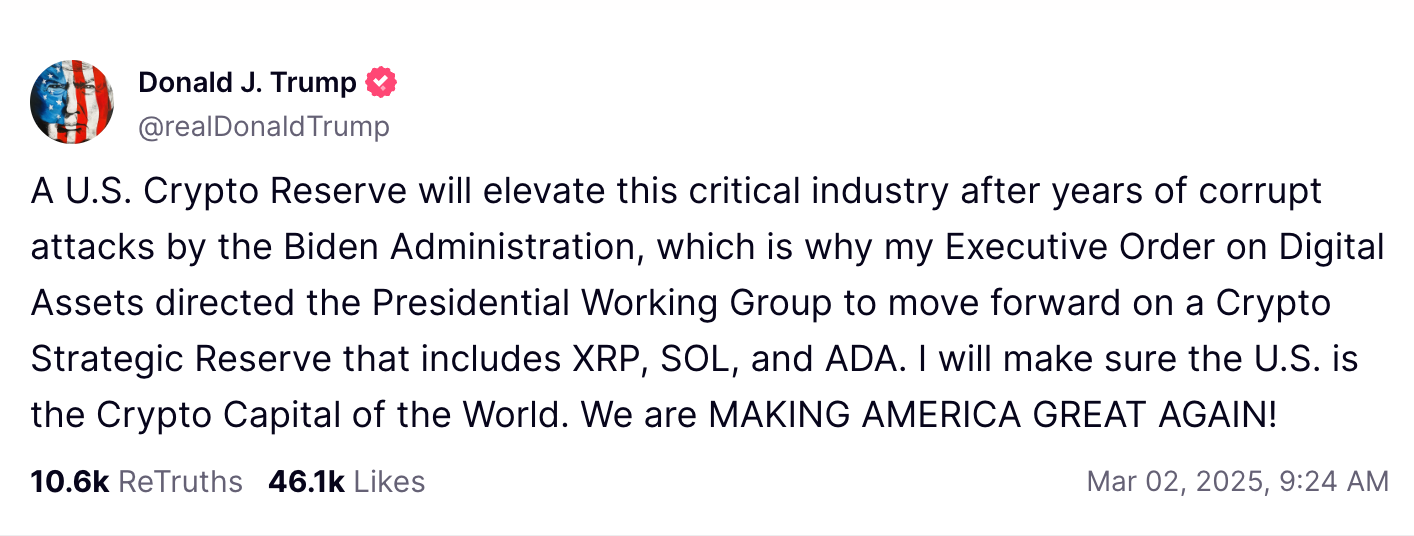
I hope he’s not trying to go with one of those grandiose military parades again. And if he does, will he eliminate everyone but the white guys? It can’t be anything other than another way for him to get attention, that’s for sure. Again, this all continues to be an appalling cosplay of how FARTUS wants to view himself in relation to his imagined ideas of American History. I can’t even with the economy today. Just know he’s changed his mind on tariffs again for Canada and Mexico, and employment figures are worsening. He’s turned a strong economy into a weak one in a matter of weeks. He’s also shaken the Equity markets to their core. What’s on is this: “Trump’s “Crypto Reserve” is a world historical grift. Corruption doesn’t get much more blatant than this.” My Finance Daughter and I both find crypto to be a huge Ponzi scheme. I lecture against it. She doesn’t consider it a product that brokers should be involved in. In short, we stay as far away as possible. But, you know, grifters gotta grift. This is from Public Notice.
Authoritarian regimes by definition have no accountability to voters or the public. That means autocrats and their cronies can gorge themselves at the public trough and blatantly steal from taxpayers with few if any consequences.
It’s not really a surprise, then, that as part of his authoritarian power grab, Trump has embraced brazen and open self-dealing. The most ludicrous example of this is the scheme he announced last Sunday for a national crypto reserve.
As with many of Trump’s big orange dreams, it’s not exactly clear what the crypto reserve will entail or how it will work. But the brilliance of the half-baked idea is that Trump and his cronies can make bank just by talking about it. The president can use his bully pulpit to manipulate markets. And who’s going to stop him?
Trump, fresh off avoiding 88 felony charges, obviously feels confident that the answer is “no one.”
Government on the blockchain
Crypto refers to digital currencies which are generated and stored in a digital ledger, or blockchain. In theory, cryptocurrencies do not rely on a central government authority. Proponents say they are useful for quick or anonymous transactions. Critics point out that cryptocurrency seems designed for hiding illegal transactions and/or creating what are essentially Ponzi investment schemes.
Because of the downsides, President Biden created moderate guidelines to try to regulate some of the worst excesses of the industry, which made him an enemy of hardcore crypto boosters. But Trump in his first term expressed even deeper skepticism about cryptocurrencies, saying they are based on “thin air.”
During the 2024 election, though, crypto investors spent tens of millions on Republican campaigns. Trump, who never saw a quid pro quo he didn’t love, changed his tune, embracing crypto-friendly policies. After his victory, he followed through by appointing venture capitalist and Elon Musk crony David Sacks as a White House crypto czar.
Another reason Trump flip-flopped on crypto is that his family figured out how to cash in. Following the election, Trump squandered some of the goodwill he had built up with the crypto industry when he and his wife Melania launched memecoins — essentially valueless crypto confidence games — that both surged in value, making the Trumps billions (but undermining the credibility of crypto in the process). That came after his two adult sons, Eric and Don Jr, launched their own crypto company during the campaign called World Liberty Financial. Boosting crypto as president, then, allows Trump and his family to profit directly from his public office.
Trump announced his thank you to the industry last Sunday, when he declared that he would create a “Crypto Strategic Reserve” in order to make the US “the Crypto Capital of the World.” He of course claimed the move is part of “MAKING AMERICA GREAT AGAIN.”
But the actual point of the crypto reserve, much less the details, are sketchy at best. Proponents argue crypto is a store of value, like gold, and could help damp inflation. But the major cryptocurrencies tend to rise and fall in value based on broader macroeconomic sentiment. And since crypto is volatile and, unlike gold, has no intrinsic value, it’s hard to credit its usefulness as a currency stabilizer.
If you have any questions about any of this, I’d be glad to try to answer them. Seeing such craziness in our economic policy has been hard on me. I’m just waiting for the major attack on the Federal Reserve Bank. They’re the only ones that bring credibility to the dollar these days, and I’m afraid he’ll have a go at them. The mess at the Treasury is already impacting the banking business. Don’t even get me started on the Budget Crisis, either. I’m tired of the repeats of that one by disingenuous Republicans.
I hope all of you can close your doors and stay sane inside the one place you can control, home. I have a few more tests next week, so I will be out at clinics again, being poked and prodded. This weekend, I will just relax and try to avoid the ever-changing Trump Surreality Show.
What’s on your reading and blogging list today?
Wednesday Reads
Posted: December 4, 2024 Filed under: abortion rights, American Fascists, just because | Tags: Abortion bans killing women, Kash Patel, martial-law, news, Pete Hegseth, politics, Portia Ngumezi, Ron De Santis, South Korea, Yoon Suk Yeol 7 CommentsGood Morning!!

Brian Thompson, CEO of United Health Care
There’s some breaking news from NYC. The CEO of United Health Care was shot and killed on the street, and it is believed to be a “targeted attack.” The New York Times has live updates.
The executive, Brian Thompson, was shot in the chest in what people briefed on the investigations said appeared to be a targeted attack.
The chief executive of UnitedHealthcare, one of the nation’s largest health insurers, was fatally shot outside a hotel in Midtown Manhattan on Wednesday morning, the police said.
The executive, Brian Thompson, 50, was shot just after 6:45 a.m. at the New York Hilton Midtown on Avenue of the Americas near 54th Street, according to a police report. Mr. Thompson was taken to Mount Sinai West, where he was pronounced dead….
Officials with the Metropolitan Transportation Authority, which runs New York City’s transit system, said that the shooting did not impact subway or bus service during the morning commute….
Brian Thompson’s sister, Elena Reveiz, told The Times she is still processing the news of her brother’s death. “He was a good person and I am so sad,” Reveiz said when reached by phone. She said Thompson was a good father to his two children. She said she was on her way to see her sister, and to be with their family….
Gov. Tim Walz of Minnesota called the killing “horrifying news and a terrible loss for the business and health care community in Minnesota.” [….]
New York’s police commissioner, Jessica Tisch, and Jeffrey Maddrey, chief of department, will hold a news conference at 1 Police Plaza at 11:30 a.m., the police said.
Another huge story broke yesterday from South Korea. Right wing President Yoon Suk Yeol declared martial law and attempted a coup. Fortunately he failed.
Haeryun Kang at The Guardian: Martial law came to South Korea – and my friends and I doomscrolled through the night.
At 10.23pm on 3 December in Seoul, I was already in bed, alternating between reading a book and watching YouTube cooking reels. That was when Yoon Suk Yeol, the president, declared emergency martial law in South Korea for the first time since 1979.
In an unannounced televised address, Yoon said the imposition of martial law was “aimed at eradicating pro-North Korean forces and protecting the constitutional order of freedom”.
Immediately, my text messages and online chat forums flared up. What the hell is going on? Is this a joke? Can I keep drinking at the bar tonight? Can my children go to school tomorrow? What exactly is the emergency? Utter confusion ensued for the next six hours, until a dramatic sequence of events led to the end of martial law at 4.30am.
South Korean President Yoon Suk Yeol
This was my first experience of martial law – if this short-lived circus can even be called that – something that, until now, I had only read about in history books. But even in that short time, I was terrified. The experience woke me up, once again, to the severe, unavoidable reality of Korean division. And I remembered how it can be exploited by our leaders to justify repression and control.
Thankfully, this time, Yoon’s antics were curbed. But the martial law fiasco is a testament to both the instability and resilience of South Korean democracy. It is a chilling reminder that the collective trauma of the 20th century dictatorship is not simply history.
It’s still unclear why Yoon took such an extreme measure. Martial law is defined as the temporary rule by military authorities in a time of emergency, when civil authorities are deemed unable to function. In the past, dictators have declared martial law at times of widespread national unrest and turmoil, including the Korean war. This time, it was a business-as-usual Tuesday; earlier that evening I had been for a swim at a government-run public pool.
Yoon’s measure came at a time of personal and political turmoil for him. Corruption scandals have rocked him and his family; the opposition Democratic Party has just insisted on big cuts to the budget bill despite the ruling party’s protests; Yoon’s approval ratings are hovering in the 20s – all unpleasant, sure, but stories that don’t seem all that surprising in a relatively functional democracy.
In his speech declaring martial law, Yoon expressed clear vitriol for his political opposition, for its “anti-state activities plotting rebellion”. Most South Koreans are familiar with this insidious sort of rhetoric. I grew up with this language, and still live with it, through my very conservative family in Busan. It’s a regular reminder that there is a clear political and generational divide related to the Korean division.
If you want more first-hand reporting, check out this post by Sarah Jeong at The Verge: Six hours under martial law in Seoul.
Timothy Snyder at his Substack Thinking about…: Dictators for a Day, South Korea and America.
South Korea’s president, Yoon Suk Yeol, invoked martial law, tried to install a military dictatorship — and failed completely. In his actions there are some likely similarities with the coming Trump regime, and some clear lessons for Americans to learn right now.
Yoon won a very narrow election, as did Trump. Like Trump, he refers constantly to “fake news” and calls his political opponents enemies of the state (as Trump says, “the enemy within.”) Yoon used this language to justify the imposition of martial law, as will Trump if he decides to invoke the Insurrection Act in the United States.
Like Trump, Yoon telegraphed his move in advance, and not only with such language. He surrounded himself with military men and intelligence officers who were characterized by personal loyalty. Trump is trying to do the same, now, with his proposals for Tulsi Gabbard as director of national intelligence, Kash Patel as director of the FBI, and Pete Hegseth as secretary of defense. He also wants to purge the top ranks of the armed forces.
Yoon’s main political opponent, Lee Jae-myung, had correctly predicted that Yoon would try to implement martial law. Trump makes this prediction rather easy. Trump has spoken openly of being “dictator for a day,” and of invoking the Insurrection Act, which would allow him to deploy the military inside the United States.
The Insurrection Act is not quite the same thing as martial law. Under martial law, the military assumes the basic responsibilities associated with a civilian government. The Insurrection Act, in principle, only allows the American president to use the armed forces to assist civilian authorities to enforce some law in the presence of an insurrection. But the language of the law is quite vague. Trump makes it clear that he has in mind invoking the Insurrection Act to very broad purposes, essentially to change the regime.
In both South Korea and the United States, the legal basis for asserting greater presidential authority is antiquated. Martial law was declared in South Korea for the last time in 1979. Since the late 1980s, South Korea has moved quite decisively in the direction of meaningful elections and civil rights, thanks to the forceful activity of civil society, especially trade unions. In the United States, the Insurrection Act is an assemblage of laws passed between 1792 and 1871. It was last invoked during racial violence in Los Angeles in 1992.
Yoon’s actions, although rooted of course in his own personality and South Korean career, and enabled by South Korean law, were very trumpy. Indeed, it seems likely to me that the very presence of Trump on the international scene will make such attempts more likely, among America’s democratic allies (such as South Korea) and generally.
But Yoon failed, and very badly. His dictatorship for a day lasted only about six hours. What can Americans learn from his less-than-a-day dictatorship?
Read the rest at the Substack link.

Pete Hegseth
Back in the USA, It looks like Pete Hegseth will not be the Secretary of Defense. Yesterday, Dakinikat wrote about the devastating New Yorker article by Jane Mayer. Mayer reported in great detail Hegseth’s out-of-control drinking, his abuse of women, and his incompetence when trusted with leadership roles in small organizations.
Yesterday, NBC News reported: Pete Hegseth’s drinking worried colleagues at Fox News, sources tell NBC News.
Pete Hegseth, President-elect Donald Trump’s pick for defense secretary, drank in ways that concerned his colleagues at Fox News, according to 10 current and former Fox employees who spoke with NBC News.
Two of those people said that on more than a dozen occasions during Hegseth’s time as a co-host of “Fox & Friends Weekend,” which began in 2017, they smelled alcohol on him before he went on air. Those same two people, plus another, said that during his time there he appeared on television after they’d heard him talk about being hungover as he was getting ready or on set.
One of the sources said they smelled alcohol on him as recently as last month and heard him complain about being hungover this fall.
None of the sources with whom NBC News has spoken could recall an instance when Hegseth missed a scheduled appearance because he’d been drinking.
“Everyone would be talking about it behind the scenes before he went on the air,” one of the former Fox employees said….
Three current employees said his drinking remained a concern up until Trump announced him as his choice to run the Pentagon, at which point Hegseth left Fox.
“He’s such a charming guy, but he just acted like the rules didn’t apply to him,” one of the former employees said.
Trump is considering withdrawing the Hegseth nomination and appointing Ron De Santis instead. Marc Caputo at The Bulwark: Trump Talks to DeSantis About Replacing Hegseth.
DONALD TRUMP AND RON DESANTIS have personally discussed the possibility of the Florida governor becoming the next secretary of defense amid concerns that sexual assault allegations could engulf the president-elect’s current nominee for the post, Pete Hegseth.
The talks, relayed by four sources briefed on them, are in their advanced stages. They underscore the fears within Trump world about Hegseth’s ability to survive a Senate confirmation process—despite public posturing from Hegseth and allies that he remains committed to ending up at DoD.
“These discussions are real. It’s serious. I can’t say it’s definitely going to happen, but the governor is receptive and Trump is serious, too,” a top Republican source familiar with the conversations told The Bulwark on condition of anonymity.
The discussions around DeSantis involve untangling several different political threads. The governor is currently handling the fallout of a separate Trump cabinet pick: Marco Rubio’s nomination to be secretary of state. DeSantis is weighing whether to appoint Trump’s daughter-in-law, Lara Trump, to fill Rubio’s Senate seat. The possibility that the governor himself could end up at the Pentagon may factor into that decision.
Today Hegseth is again meeting with Republican Senators in a last ditch effort to convince them to support his nomination. Politico: Hegseth back on the Hill as Pentagon bid teeters.
Pete Hegseth, Trump’s embattled pick to run the Pentagon, is back on Capitol Hill today as his nomination faces even more hurdles.
Pete Hegseth’s tatoos
Concerns over Hegseth’s personal controversies are driving Trump allies to think the Defense secretary designate may not survive further scrutiny. And his fight has been complicated even more by the news that the president-elect is weighing a rival, Florida Gov. Ron DeSantis, to replace Hegseth, The Wall Street Journal was first to report. DeSantis, a former opponent in the 2024 GOP presidential primaries, offers a conservative military record and alignment with Trump’s views on “woke” military policies.
Hegseth — who has faced allegations of sexual assault and alcohol abuse — is expected to meet today with Republicans including incoming Senate Armed Services Chair Roger Wicker (R-Miss.) and the next majority leader, Sen. John Thune (R-S.D.).
Hegseth’s most crucial meeting, though, is expected to be with Sen. Joni Ernst (R-Iowa), a Senate Armed Services member who has been noncommittal about Hegseth’s nomination and is seen as a potential swing vote.
Ernst was previously floated as a potential pick for defense secretary before Trump opted for Hegseth, though she was seen as a dark horse candidate. The Iowa Republican is a traditional defense hawk, clashing somewhat with the Trump team’s views. There may also be a political divide to bridge for Ernst — who took until March to endorse Trump’s 2024 White House bid after the former president nearly swept the Republican primaries and was on a path to clinch the GOP nomination.
Ernst, the first woman combat veteran in the Senate, has a long track record of legislation aimed at addressing sexual assault and harassment in the military. That would seem to put her at odds with Hegseth, who is not only the subject of sexual assault allegations but opposes women serving in combat roles.
Ernst has also been outspoken about her own experiences with sexual assault and domestic violence. Asked about the sexual assault accusations against Hegseth, she’s said: “Any time there are allegations, you want to make sure they are properly vetted, so we’ll have that discussion.”
Another problematic candidate, Kash Patel for FBI director is facing headwinds. I’m sure we’ll be hearing much more about him, but here are a couple of articles about him.
Zach Beauchamp at Vox: I listened to hours of Trump’s FBI pick on Steve Bannon’s podcast. Oh boy.
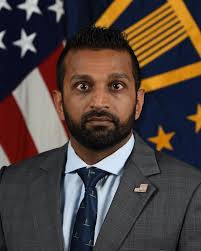
Read more at Vox.
David Corn at Mother Jones: Here Are the Republicans Kash Patel Wants to Target.
For years, Kash Patel, the MAGA provocateur, conspiracy theory monger, and seller of pills he claims reverse the effects of Covid vaccines, who Donald Trump has announced as his pick to replace FBI Director Chris Wray, has made his mission plain: He wants to crush the supposed Deep State that has conspired against Trump. Last year, while appearing on Steve Bannon’s podcast, he vowed, “We will go and find the conspirators—not just in government, but in the media. Yes, we’re going to come after the people in the media who lied about American citizens to help Joe Biden rig presidential elections. We’re going to come after you, whether it’s criminally or civilly.” This was not an empty threat, for Patel has a list of specific targets for his score-settling. And that line-up includes not only Democrats but also prominent Republicans.
Patel laid out his plans in a 2023 book titled Government Gangsters: The Deep State, the Truth, and the Battle for our Democracy. In this work, he breathlessly described the Deep State as a “coordinated, ideologically rigid force independent from the people that manipulates the levers of politics and justice for its own gain and self-preservation.” It is run “by a significant number of high-level cultural leaders and officials who, acting through networks of networks, disregard objectivity, weaponize the law, spread disinformation, spurn fairness, or even violate their oaths of office for political and personal gain, all at the expense of equal justice and American national security.” He added, “They are thugs in suits, nothing more than government gangsters.” And he inveighed that this is “a cabal of unelected tyrants.”
In his book, Patel, a supporter of QAnon and a promoter of assorted MAGA conspiracy theories (the 2020 election was stolen from Trump, the Trump-Russia investigation was a hoax, and the January 6 riot was sparked by “strange agitators” and federal agents), called for mounting “investigations” to “take on the Deep State.” Though he doesn’t specify what the cause for these inquiries would be, he has plenty of people in mind. In an appendix to the book, Patel presented a list of 60 supposed members of the Deep State who are current or former executive branch officials and who presumably would be the prey. He noted this roster did not include “other corrupt actors,” such as California Democrats Reps. Adam Schiff and Eric Swalwell, “the entire fake news mafia press corps,” and former GOP House Speaker Paul Ryan. (When Patel worked for the GOP-controlled House intelligence committee, he had run-ins with Ryan over the issuance of subpoenas and Patel leaking information to a Fox News reporter—which must mean that Ryan was a Deep State operative.)
Read the rest at Mother Jones.
Just one more story, this time on women dying because of anti-abortion laws. Amanda Marcotte at Salon: Republicans don’t care if women die from abortion bans — but they don’t want you to know about it.
After the Supreme Court ended federal abortion rights in 2022, there was a robust debate between pro- and anti-choice activists over whether or not banning abortion would kill women. Pro-choicers pointed to evidence, from both history and other countries, showing that abortion bans kill women. Anti-choice activists dismissed the record and pointed to toothless “exceptions” in abortion ban laws as “proof” that women could get abortions to save their lives.
Portia Ngumezi
The latter argument was frustrating not just because it was wrong but was generally offered in bad faith. Anti-abortion leaders know that abortion bans kill women. They don’t care. Or worse, many view dying from pregnancy as a good thing. In some cases, it’s viewed as just punishment for “sinful” behavior. Other times, it’s romanticized as a noble sacrifice on the altar of maternal duty. But conservatives are aware that this death fetish cuts against their “pro-life” brand. So there was a lot of empty denials and hand-waving about the inevitable — and expected — outcome of women dying.
We now have another proof point that abortion bans are about misogyny, not “life,” as the first deaths from red state abortion bans are being reported. Instead of admitting they were wrong and changing course, Republicans are behaving like guilty liars do everywhere, and destroying the evidence. In the process, they are also erasing data needed to save the lives of pregnant women across the board, whether they give birth or not.
ProPublica has published a series of articles detailing the deaths of women in Georgia and Texas under the two states’ draconian abortion bans. They most recently reported the death of Porsha Ngumezi, a 35-year-old mother of two from Texas. Ngumezi suffered a miscarriage at 11 weeks but was left to bleed to death at the hospital, instead of having the failing pregnancy surgically removed. Multiple doctors in Texas confirmed that hospital staff are often afraid to perform this surgery, however, because it’s the same one used in elective abortions. Rather than risk criminal charges, doctors frequently stand by and let women suffer — or die.
Ngumezi’s youngest son doesn’t fully understand that his mother is dead. ProPublica reported that he chases down women he sees in public who have similar hairstyles, calling for his mother.
A day after this story was published, the Washington Post reported that the Texas maternal mortality board would skip reviewing the deaths of pregnant women in 2022 and 2023 — conveniently, the first two years after the abortion ban went into place. The leadership claims it’s about speeding up the review process, but of course, many members pointed out the main effect is that “they would not be reviewing deaths that may have resulted from delays in care caused by Texas’s abortion bans.”
This is especially noteworthy because it’s become standard after one of these reports for anti-abortion activists to blame the victims and/or the doctors, and not the bans. Christian right activist Ingrid Skop, for instance, responded to Nguzemi’s death by insisting “physicians can intervene to save women’s lives in pregnancy emergencies” under the Texas law. If she really believed that, however, she would desperately want the state maternal mortality board to review this, and other cases like it, so they could come up with recommendations for hospital staff to treat women without running afoul of the law. Strop, however, is on the Texas maternal mortality board. She was likely part of the decision to refuse to look into whether women like Nguzemi might be saved.
So the likeliest explanation is the simple, if brutal one: Anti-abortion activists do not want doctors to save women’s lives. The current situation, where doctors are afraid to treat women and have no guidance on how to do so safely, is a status quo they are fighting to preserve. We also know this because, as Jessica Valenti reported at Abortion Every Day last week, these same activists are lobbying to rewrite current abortion bans to remove the paltry “exceptions” that do exist. Instead of allowing doctors to abort pregnancies that are failing, they want to force them to induce labor instead. That is not just cruel but will kill women. We know this because that’s exactly how Nguzemi died; her doctor gave her a drug in hopes it would push the pregnancy out, rather than surgically remove it, as is the standard of care.

Read the whole thing at Salon.
That’s all I have for you today. Please take care of yourselves. We live at a very dangerous time.

 peej
peej Carissa
 bostonboomer
 dakinikat
 ecocatwoman
 mablue2
 Mama Lopez
 peggysue22
 quixote
 skydancingguestblogger
 Mona (aka Wonk the Vote)



 Sky Dancing
Recent Comments