
Mostly Monday Reads: Making China Great Again
Posted: March 16, 2026 Filed under: #FARTUS, #We are so Fucked, iran, Making China Great Again | Tags: @johnbuss.bsky.social John Buss, Cadet Bonespur's Iran War, Epstein Files, Making China Great Again, NATO 4 Comments
“I’m actually surprised MAGA didn’t put on an alternative Oscar Award Show this year.” John Buss, @repeat1968
Good Day, Sky Dancers!
I’d just like to gripe about one thing today. Humor me. Is it just me, or does everything seem messed up in this country? I’m starting to have visions of us in a Dystopian SyFy movie where the AI in computers decides the best way for financial institutions to make money and gets some sort of cosmic jolly out of making sure something shipped with a commercial deliverer as late as fuck. Also, all inventory systems appear to have certain items that are always gone, even when the company, like Amazon or Walmart, has traditionally had a super inventory system. I’m pretty sure the DOGE thing has messed up student loan and Social Security functions. And wow, now we are completely screwed when it comes to anything that needs petroleum products. It’s like Artificial Intelligence and The Trump Regime Dysfunction have joined together to make our lives miserable.
I’d like to highlight this Substack of Dr. Paul Krugman this morning. “No, America is Not Respected. Thanks to Trump, we’re held in contempt even by our closest allies.” Trump is actually making China great again. They are the obvious winner of all this.
There’s a real Baghdad Bob feel to pronouncements from the Trump administration these days. The war is going great! We’ve been totally victorious! Also, other countries — including China! — must immediately send ships to escort oil tankers through the Strait of Hormuz, which the U.S. Navy isn’t doing because it’s too dangerous.
But this has been the pattern ever since Trump returned to power. Despite repeated failures to deliver on his campaign promises — remember how he was going to cut energy prices in half? — he and his minions have continually insisted that everything is wonderful, that everything they do is a triumphant success story. And he’s still doing it. On Thursday, he told a rally that
Inflation is plummeting, incomes are rising, the economy is roaring back and America is respected again.
As I and others have documented ad nauseam, none of those economic assertions are true. Today, however, I want to focus on the bolded claim. Trump constantly insists, in speeches and social media posts, that he took over a weak, despised nation and restored its international reputation. This is clearly something that matters a lot to him and his sense of self-worth.
It’s also the total opposite of the truth.
A stunning poll from Politico — just released, but taken last month — confirms what I and other observers strongly suspected: America is now widely despised, despised like nobody has ever been despised before.
I don’t mean that we’re disliked, although that too. But this isn’t a case of oderint dum metuant — let them hate so long as they fear. Instead, the world increasingly holds America in contempt.
Our former friends no longer consider us trustworthy.
And they no longer believe that being a U.S. ally offers protection, that a good relationship with America will deter potential enemies from attacking them.
At this point, a plurality of the population in every one of our erstwhile allies considers China a more reliable partner than the United States.
 Check the graphs and more at the link. Jonathan V. Last, writing at The Bulwark, has this analysis today.
If you want to understand the difference in the quality of strategic thinking between Washington and Tehran, consider the messages being sent out over the last three days:
Washington: The war is over. We’ve defeated Iran totally. If other countries don’t come in and help fight Iran they will regret it. Especially our terrible allies, like Great Britain. Please, President Xi, come help us re-open the Strait of Hormuz?
Tehran: We will continue to resist, however we are open to allowing oil transport in the strait that we control provided the product is sold in yuan and not dollars.
I have been saying since the beginning that America is playing checkers while Iran plays chess, but it’s worse than that. American leadership is utterly incoherent: We won, but we need help. We hate our allies; but will our adversaries please come bail us out?
Meanwhile Iranian leadership survived a transition of power in the midst of war, achieved its strategic objective in closing the strait, and is now looking to leverage China’s rising economic ambitions against the United States.
I cannot overstate how significant it would be if Iran and China reached an agreement to allow oil transport under condition of a switch from the dollar to the yuan,1 so here’s European Business:
The condition, if formalised, would represent the most significant challenge to the petrodollar system in its fifty-two-year history, striking at the financial architecture that underpins American global power rather than at US military assets. . . .
To understand why the yuan condition matters, it is necessary to understand what the petrodollar system actually is. Born from the Nixon shock of 1971 and formalised in 1974, the arrangement under which Saudi Arabia and the broader Gulf agreed to denominate all oil sales in US dollars created a self-reinforcing loop that has governed global finance ever since. Because oil—the world’s most traded commodity—must be purchased in dollars, every nation that imports energy must first acquire dollars. Every central bank holds dollar reserves for precisely this reason. The dollar’s status as the world’s primary reserve currency is not an abstract achievement; it flows directly and mechanically from oil. . . .
[Iran] is proposing that access to the world’s most critical energy chokepoint be conditional on currency denomination.
The practical consequence, if even partially adopted, would be a bifurcated global oil market: yuan-denominated barrels flowing through Hormuz for those willing to pay in China’s currency, dollar-denominated barrels rerouted at significant additional cost and time for those who are not. The war premium that Western energy importers are already absorbing would become structural rather than temporary.
I don’t know how to make people care about this except to say that if Iran and China made this deal it would absolutely be the beginning of the end of the dollar backstopping the global financial order. The long-term cost to America would be incalculable.
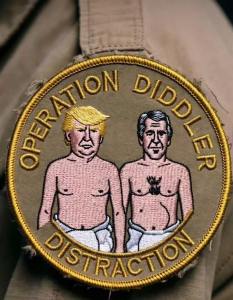 As I said, he’s making China great again. As for NATO, I think Orange Caligula has managed to blow it up. This is from Reuters. It’s the news behind all that analysis. “US allies rebuff Trump’s request for support in Strait of Hormuz.”
BERLIN/BRUSSELS/LONDON, March 16 (Reuters) – Several U.S. allies said on Monday they had no immediate plans to send ships to unblock the Strait of Hormuz, rebuffing a request by President Donald Trump for military support to keep the vital waterway open.Trump called on nations to help police the strait after Iran responded to U.S.-Israeli attacks by using drones, missiles and mines to effectively close the channel for tankers that normally transport a fifth of global oil and liquefied natural gas.
Politico’s Nette Nosslinger has more details. “Germany to Trump: We won’t help you reopen the Strait of Hormuz. Berlin says Iran is “not NATO’s war.”
Germany’s government rejected U.S. President Donald Trump’s demand that NATO allies help secure the Strait of Hormuz, declaring that the alliance had no place in the war.
“This war has nothing to do with NATO. It’s not NATO’s war,” Stefan Kornelius, a spokesperson for German Chancellor Friedrich Merz, told reporters in Berlin on Monday. “NATO is a defensive alliance, an alliance for the defense of its territory,” he added.
Trump had warned NATO allies on Sunday they face a “very bad future” if they refuse to help secure the Strait of Hormuz, pressing Europe to support an American effort to reopen the key maritime corridor.
The German government said it would not assist in that effort as long as the war rages on.
“As long as this war continues, there will be no involvement, not even in an option to keep the Strait of Hormuz open by military means,” Kornelius said, adding that he was not aware of an official request by the U.S. government to Germany to take part in such a mission.
“I would also like to remind you that the U.S. and Israel did not consult us before the war, and that Washington explicitly stated at the start of the war that European assistance was neither necessary nor desired,” Kornelius said.
 Heather Cox Richardson puts it into perspective at her SubStack “Letters from an American.” We had quite the Ides of March yesterday; however, the Roman version was a bit more successful in ridding themselves of the bad guy.
Today, as the country enters its third week of war against Iran, President Donald J. Trump was on the golf course, illustrating the observation of journalist E.J. Dionne in the New York Times that “from the very beginning of this war, we got a sense that there wasn’t a great deal of serious thought put into it by the president of the United States about how it might end, what our objectives were, what needed to be done to protect Americans who are in the Middle East, what might happen to oil in the Strait of Hormuz.”
Although the administration appears to be trying to convince Americans that the U.S. military’s destruction of the Iranian military means the U.S. has won the war, Iranian leadership needed simply to continue in power to declare victory. Then, blocking the 20% of the world’s oil that flows through the Strait of Hormuz would give them leverage over the war’s outcome.
On March 10, Helene Cooper and Eric Schmitt of the New York Times reported that senior defense officials told them the Iranian military is adjusting its tactics to strike at the communications and defense systems protecting U.S. troops. Those tactics include drone strikes. The same day, Marc Caputo, Barak Ravid, and Colin Demarest of Axios reported that Ukrainian officials had tried several months ago to sell the U.S. anti-drone technology for downing Iran-made drones as a sign of thanks for U.S. support and as a way to strengthen ties between the U.S. and Ukraine, but the U.S. did not pursue the offer.
White House spokesperson Anna Kelly responded: “This characterization made by these cowardly unnamed sources is not accurate and proves that they are simply outside looking in. [Defense] Secretary [Pete] Hegseth and the armed forces did an incredible job planning for all possible responses by the Iranian regime, and the undisputed success of Operation Epic Fury speaks for itself.”
And yet the fallout from the strikes on Iran by the U.S. and Israel appears to have caught the administration by surprise. Trump told Kristen Welker and Alexandra Marquez of NBC News yesterday that he was “surprised” that Iran attacked other countries after the U.S. and Israeli strikes. He also said strikes on Saturday on Kharg Island, which is about fifteen miles off the Iranian coast and is home to Iran’s primary oil export terminal, “totally demolished” most of the island but that “we may hit it a few more times just for fun.”
President Donald J. Trump posted on social media Saturday morning: “Many Countries, especially those who are affected by Iran’s attempted closure of the Hormuz Strait, will be sending War Ships, in conjunction with the United States of America, to keep the Strait open and safe. We have already destroyed 100% of Iran’s Military capability, but it’s easy for them to send a drone or two, drop a mine, or deliver a close range missile somewhere along, or in, this Waterway, no matter how badly defeated they are.”
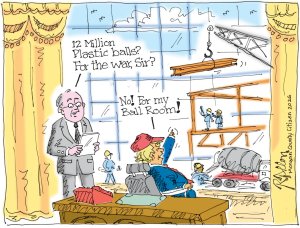
 Well, that didn’t happen, did it? China is full-speed ahead in transitioning away from its fossil-fuel-based energy grid. Trump still shakes his fist at windmills. I did enjoy Kyle Cheney’s take at Politico. “Trump is losing one battle after another. Cue the posts. The president’s Sunday night diatribe was most notable for his attacks on the highest court in the land.”
President Donald Trump is increasingly at the mercy of forces he unleashed but can’t control — so he’s taking aim at the umpires.
Gas prices surging. Unemployment climbing. War with Iran threatening to engulf his presidency. The fracturing of his political coalition. The collapse of his signature trade-negotiations-by-tariff strategy. Relentless scrutiny of the Epstein files. A public backlash to his agenda that could swamp Republicans in the midterms. Failure after failure to criminalize the conduct of his political adversaries.
So it was, in a fit of Sunday night fury that set Washington’s armchair psychoanalysts ablaze, that the president channeled his rage at the few functioning checks on his power: the media, independent regulators and — most pointedly — the federal judiciary.
Trump’s Sunday night outburst took on all of them, but it was most notable for how he cast the Supreme Court — one that has staved off the destruction of his agenda and even his own criminal prosecution — as “a weaponized, and unjust Political Organization.”
“This completely inept and embarrassing Court was not what the Supreme Court of the United States was set up by our wonderful Founders to be,” the president blared on Truth Social. “They are hurting our Country, and will continue to do so.”
It was a remarkable attack. Until the Feb. 20 tariff ruling, the Trump administration had been touting its winning streak at the Supreme Court. The justices have salvaged Trump’s broadest efforts to end legal protections for hundreds of thousands of noncitizens in the United States, allowed him to assert unprecedented control of once-independent agencies and unilaterally slash congressionally authorized spending.
The court, as Trump knows, is arguably responsible for his return to power in the first place: The justices blocked an effort by some blue states to keep Trump off the 2024 ballot by labeling him an insurrectionist responsible for the Jan. 6, 2021 attack on the Capitol. And the court’s decision to adopt a sweeping view of presidential immunity helped stave off special counsel Jack Smith’s most potent criminal case against Trump.
But to Trump, that’s ancient history.
The core of the attack is the frustration that Trump often exhibits when he brushes up against the limits of his power. He spent Sunday lashing out at the news media, cheering on FCC Chair Brendan Carr’s threat to revoke broadcast licenses for stations that report unfavorably on the war in Iran, and lamenting his inability to control the independent Federal Reserve’s interest rate decisions.
Trump describes the high court’s recent rejection of his unfettered ability to levy tariffs against American trading partners as a deeply personal affront — one that contradicted the ethos of his entire decade in public life.
Since the stinging tariffs decision last month, Trump has seemed fixated on the ruling, weighing in against the high court every few days.
“Our Country was unnecessarily RANSACKED by the United States Supreme Court,” he wrote Sunday.
I’m not sure I’d call this a Come-to-Jesus moment for the Supreme Court. Maybe Roberts doesn’t want to go down as the worst Chief in history. Your guess is as good as mine. And once more, we have more Epstein stories. Basically, you have to chase them down to read about them. Here’s something from The Guardian. “‘Attention will swing back’: Epstein outrage unlikely to subside despite Trump’s Iran war. Advocates say 24/7 coverage of US attacks will not last for ever – and spotlight will return to Epstein and his crimes.”
As the US woke to news that Donald Trump had bombed Iran, domestic discord was fast simmering.
There was unrelenting outrage over ICE raids. There was frustration with the rising cost of living. There was fear over rocketing healthcare prices, mounting household debt, not to mention many Americans’ nagging sense of desperation in a country, some warned, where democracy itself was under threat.
And then there was Jeffrey Epstein.
During his third presidential run, Trump promised to release investigative files involving someone Trump had once called a “terrific guy”. This pledge served as ideological catnip to the far-right flank of Trump’s base, many of whom believe that a cabal of elite figures participated in Epstein’s trafficking of teenage girls.
Trump’s administration botched the initial release, however, with his justice department disseminating documents in dribs and drabs before announcing in July that there would be no more disclosures – spurring backlash among longtime supporters. In a rare display of bipartisanship, members of Congress took matters into their own hands, conducting their own investigations and passing the Epstein Files Transparency Act in November.
Trump, despite repeatedly calling the Epstein files a “hoax”, signed the bill into law. His justice department had 30 days to disclose publicly all Epstein files, with rare exceptions.
Trump’s DoJ did not meet Congress’s deadline, disseminating one tranche at the 30-day mark and several others days and weeks later – including a 3 million document disclosure on 30 January – prompting still more ire from opponents and some diehard supporters who believe more files remain.
But now US headlines are dominated by the US-Israel attack on Iran – and the economic and diplomatic chaos it has unleashed. Yet advocates and observers say that Epstein-related outrage is still unlikely to die down.
Gretchen Carlson and Julie Roginsky, who pursued sexual harassment claims against former Fox News chief executive Roger Ailes and started the non-profit Lift Our Voices, told the Guardian that the Iran war can draw attention from the Epstein files – but not in perpetuity.
“We all know that the Trump administration is very good at flooding the news market with a lot of different stories every single day, and so it’s very difficult in the news media to keep up with all of them and give them what they all deserve, as far as time [is concerned],” Carlson said.
“The way the news media works, especially on 24/7 cable news, is that you are covering the biggest story of the moment. Right now that appears to be Iran.”
Carlson said she is still seeing Epstein stories – including news that authorities never searched his New Mexico ranch – and said conservative figures’ opposition to the war portends prolonged attention over Epstein.
“Influencers, especially on the right, criticize the Iranian war and the reasons that the United States got involved,” Carlson said. “I believe that will bring us right back to Epstein.”
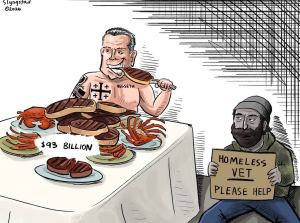
So, I’ll quit and just say we’re coming apart at the seams in this country. Tech Bros and Bankers and Pedophiles! Oh My!
What’s on your Reading, Action, and Blogging list today?

 peej
peej Carissa
 bostonboomer
 dakinikat
 ecocatwoman
 mablue2
 Mama Lopez
 peggysue22
 quixote
 skydancingguestblogger
 Mona (aka Wonk the Vote)



 Sky Dancing
Recent Comments