
Finally Friday Reads: Burning down the Economy
Posted: August 1, 2025 Filed under: #FARTUS, #MAGAnomics, #We are so Fucked | Tags: Burning Down the Economy, MAGAnomics will kill us, trade wars, Trump Tariffs 15 Comments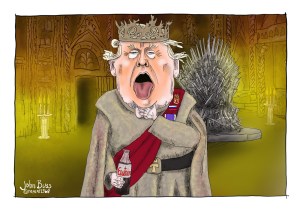
“I’m pretty sure Rosie O’Donnell isn’t the one who is a threat to humanity. No one chokes better than King Donald.” John Buss, @repeat1968
Good Day, Sky Dancers!
Our country’s economy is in trouble. The first signs of stagflation are showing up in our jobs and GDP numbers. More are coming as the chaos surrounding a chaotic and dangerous tariff scheme is put into effect based on political gripes and whims. The gripes of wrath are upon us. It’s too hot to wear my hood and robe because climate change is also throttling the world. None of this was necessary. We are ruled by greedy men of small vision. I’ll start with the weak jobs report and the downward revisions to the recent jobs numbers because it will be easier to speak to. The tariff mess is so chaotically applied that it takes a more detailed look because each country brings different goods to us. Grab your support buddy or blanket. Bad news is never a solo event.
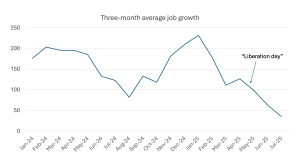
Jeff Cox of CNBC analyzes the oncoming economic crash. “U.S. added just 73,000 jobs in July, and numbers for prior months were revised much lower.” I assume Yam Tits will try to blame Biden, but this is on him. Well, he did get some help from DOGE, which is probably the most costly debacle in the country’s history outside of invading Iraq. This will undoubtedly cost the Republican Party some seats in the midterms. It’s probably why they’re scurrying around to gerrymander states like Texas. As of now, I trust the numbers coming out of the usual agencies. But, I will warn you that I fear the administration will try to cook the books as this gets worse.
Nonfarm payroll growth was slower than expected in July and the unemployment rate ticked higher, raising potential trouble signs for the U.S. labor market as President Donald Trump ramps up tariffs.
Job growth totaled a seasonally adjusted 73,000 for the month, above the June total of 14,000 but below even the meager Dow Jones estimate for a gain of 100,000, the Bureau of Labor Statistics reported Friday. June and May totals were revised sharply lower, down by a combined 258,000 from previously announced levels.
At the same time, the unemployment rate rose to 4.2%, in line with the forecast.
The June total came down from the previously stated 147,000, while the May count fell to just 19,000, revised down by 125,000.
Stock market futures fell further after the news while Treasury yields also were sharply lower.
“This is a gamechanger jobs report,” said Heather Long, chief economist at Navy Federal Credit Union. “The labor market is deteriorating quickly.”
The weak report, including the dramatic revisions, could provide incentive for the Federal Reserve to lower interest rates when it next meets in September. Following the report, futures traders raised the odds of a cut at the meeting to 75.5%, up from 40% on Thursday, according to CME Group data.
The problem with that last statement is that we still have inflation on the upper policy bound, and the tariffs will make that worse in the coming weeks. Stagflation is the one phenomenon that makes monetary policy quite weak. You have to decide which is worse because if you go after inflation, you get more unemployment. The reverse is also true. You have to be my age or older to remember the terrible stagflation of the 1970s. It’s the worst of both worlds. Nobel Prize-winning Paul Krugman writes on “The Meaning of a Weak Jobs Report. It’s (probably) the tariff uncertainty, stupid.” He plans to write a piece on tariffs on Sunday, so please be sure to read that. Most of us never thought we’d see the stupidity of tariffs again, so we never plan too much lecture or reading time for it. But no one expected a president so unfit for office as Yam Tits.
It’s highly likely that what we’re seeing is the effect of Trump’s tariffs — or more precisely the uncertainty that his erratic tariff policy has created.
Contrary to myth, tariffs don’t necessarily cause high unemployment. They make the economy less efficient and poorer, but don’t necessarily reduce the total number of jobs. For example, Britain in the 1950s had high tariffs and import controls, but also full employment. The claim that Smoot-Hawley caused the Great Depression is a myth, one fostered in part by anti-Keynesians who didn’t want to admit that the problem was inadequate demand and the answer fiscal stimulus.
But Trump has brought something special to the mix: Not just high tariffs, but unpredictable tariffs. Since April 2 nobody (probably Trump included) has had no idea what tariff rates will be for the next few months, let alone for the long term.
As many of us pointed out, this uncertainty was a huge deterrent to business investment. Build a factory based on the assumption that tariffs will go back down to more normal levels, and you risk having a stranded investment if 20-25 percent tariffs are here to stay. Build a factory based on the assumption that high tariffs are the new normal, and you’ll have a stranded investment if Trump chickens out.
So many of us predicted an economic slowdown caused not by the level of tariffs but by uncertainty. Yet the predicted slowdown, while visible in “soft” data like surveys, kept not showing up in the hard data, making these predictions look all wrong.
Hard data, however, aren’t as hard as we’d like. Payroll numbers, in particular, rely a lot on assumptions and interpolations, and are often revised.
And the revised numbers now show exactly the kind of uncertainty-induced slowdown I and many others predicted.
These numbers don’t show the long-run damage from Trump’s tariffs, which are really a completely different story. In fact, the short-run jobs picture may improve now that it’s clear that there won’t be any real trade deals, just Smoot-Hawley redux as far as the eye can see.
One thing is clear: The previously reported good numbers were proof of Trump’s brilliance. Now that they’ve been revised away, the bad numbers are clearly Biden’s fault, or maybe Jerome Powell’s, or Barack Obama’s.
 Forbes put these depressing numbers right in the headline. “Unemployment Rose To 4.2% in July, As Hiring Fell Sharply. The U.S. job market appeared to lose steam last month, according to Labor Department data released Friday, as the Federal Reserve warned the effects of President Donald Trump’s tariffs on the economy have yet to be seen. “ The analysis is by Ty Roush. I’m going to remind you of the Humphrey-Hawkins mandate to the Fed by Law before we go into this one. It’s also called The Full Employment and Balanced Growth Act. This is a Wiki overview, so it’s short and sweet. It was signed just as I entered graduate school to study Economics.
In response to rising unemployment levels in the 1970s, Representative Augustus Hawkins and Senator Hubert Humphrey created the Full Employment and Balanced Growth Act. It was signed into law by President Jimmy Carter on October 27, 1978, and codified as 15 USC § 3101. The Act explicitly instructs the nation to strive toward four ultimate goals: full employment, growth in production, price stability, and balance of trade and budget. By explicitly setting requirements and goals for the federal government to attain, the Act is markedly stronger than its predecessor (an alternate view is that the 1946 Act concentrated on employment, and Humphrey–Hawkins, by specifying four competing and possibly inconsistent goals, de-emphasized full employment as the sole primary national economic goal). In brief, the Act:
- Explicitly states that the federal government will rely primarily on private enterprise to achieve the four goals.
- Instructs the government to take reasonable means to balance the budget.
- Instructs the government to establish a balance of trade, i.e., to avoid trade surpluses or deficits.
- Mandates the Board of Governors of the Federal Reserve to establish a monetary policy that maintains long-run growth, minimizes inflation, and promotes price stability.
- Instructs the Board of Governors of the Federal Reserve to transmit a Monetary Policy Report to the Congress twice a year outlining its monetary policy.
- Requires the President to set numerical goals for the economy of the next fiscal year in the Economic Report of the President and to suggest policies that will achieve these goals.
- Requires the Chairman of the Federal Reserve to connect the monetary policy with the Presidential economic policy.
The Act set specific numerical goals for the President to attain. By 1983, unemployment rates should be not more than 3% for persons aged 20 or over and not more than 4% for persons aged 16 or over, and inflation rates should not be over 4%. By 1988, inflation rates should be 0%. The Act allows Congress to revise these goals over time. (As of 2017 the Federal Reserve has had a target inflation rate of 2%, not 0%. 0% inflation is not considered ideal and can lead to deflation which can hurt the economy.)
If private enterprise appeared not to be meeting these goals, the Act in its original form, though not in its ultimate iteration, expressly allowed the federal government to create a “reservoir of public employment,” provided of course that the legislation to establish the “reservoir” managed to become ratified. These jobs would have been required to be in the lower ranges of skill and pay to minimize competition with the private sector.
The Act directly prohibits discrimination on account of sex, religion, race, age, and national origin in any program created under the Act.
 I can only imagine the ketchup flinging in that gaudily redone Oval Office if someone explains this to him. However, he does think he’s above the law, as are his stupid sharpie orders. But let’s get back to the current unemployment problem.
It’s not immediately clear whether Trump’s tariffs have directly affected the number of jobs available, though retail and automotive sectors have recorded an increase in layoffs. The retail market cut nearly 80,500 jobs in July, a year-over-year increase of 249%, according to the Challenger report, as companies cited tariffs, inflation, and economic uncertainty.
Following the Federal Reserve’s policymaking meeting in July, during which the agency opted to hold interest rates between 4.25% and 4.5%, Fed Chair Jerome Powell noted there were several economic reports ahead before the Fed considers a rate easement, including Friday’s labor report. Powell said the unemployment rate would be a focus, as the Fed operates on a dual mandate of setting rates to keep inflation and unemployment low, though he warned about the looming impacts of Trump’s tariffs, as there is a “long way to go” before the long-term effects of those are known. Tariff costs are starting to raise consumer prices, Powell said Wednesday, and “we expect to see more of that.” The Fed’s policymaking panel will meet again on Sept. 17, and there’s about 39% odds the agency opts for a quarter-point reduction, according to CME’s FedWatch. There’s a higher chance during its Oct. 29 meeting, at 61.3% odds.
 The worst American President ever announced his latest version of the tariff schemes today that he thinks will punish other countries, but will, indeed, punish American Businesses and households. His executive orders will undoubtedly go down in history as attempts to overrule what should be the business of Congress. “FURTHER MODIFYING THE RECIPROCAL TARIFF RATES.” Yes, it was in all caps, so when in Rome. (Maybe I should say Rome burning)
By the authority vested in me as President by the Constitution and the laws of the United States of America, including the International Emergency Economic Powers Act (50 U.S.C. 1701 et seq.) (IEEPA), the National Emergencies Act (50 U.S.C. 1601 et seq.), section 604 of the Trade Act of 1974, as amended (19 U.S.C. 2483), and section 301 of title 3, United States Code, I hereby determine and order:
Section 1. Background. In Executive Order 14257 of April 2, 2025 (Regulating Imports With a Reciprocal Tariff To Rectify Trade Practices That Contribute to Large and Persistent Annual United States Goods Trade Deficits), I found that conditions reflected in large and persistent annual U.S. goods trade deficits constitute an unusual and extraordinary threat to the national security and economy of the United States that has its source in whole or substantial part outside the United States. I declared a national emergency with respect to that threat, and to deal with that threat, I imposed additional ad valorem duties that I deemed necessary and appropriate.
I have received additional information and recommendations from various senior officials on, among other things, the continued lack of reciprocity in our bilateral trade relationships and the impact of foreign trading partners’ disparate tariff rates and non-tariff barriers on U.S. exports, the domestic manufacturing base, critical supply chains, and the defense industrial base. I also have received additional information and recommendations on foreign relations, economic, and national security matters, including the status of trade negotiations, efforts to retaliate against the United States for its actions to address the emergency declared in Executive Order 14257, and efforts to align with the United States on economic and national security matters.
For example, some trading partners have agreed to, or are on the verge of agreeing to, meaningful trade and security commitments with the United States, thus signaling their sincere intentions to permanently remedy the trade barriers that have contributed to the national emergency declared in Executive Order 14257, and to align with the United States on economic and national security matters. Other trading partners, despite having engaged in negotiations, have offered terms that, in my judgment, do not sufficiently address imbalances in our trading relationship or have failed to align sufficiently with the United States on economic and national-security matters. There are also some trading partners that have failed to engage in negotiations with the United States or to take adequate steps to align sufficiently with the United States on economic and national security matters.
After considering the information and recommendations that I have recently received, among other things, I have determined that it is necessary and appropriate to deal with the national emergency declared in Executive Order 14257 by imposing additional ad valorem duties on goods of certain trading partners at the rates set forth in Annex I to this order, subject to all applicable exceptions set forth in Executive Order 14257, as amended, in lieu of the additional ad valorem duties previously imposed on goods of such trading partners in Executive Order 14257, as amended.
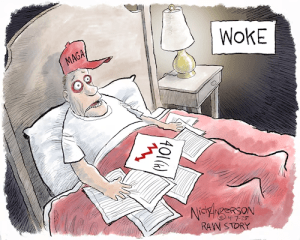 That basically is a bunch of gibberish. Wall Street Journal, our nation turns its lonely eyes to you and the analysis of Sharon Terlep. “Why Ford’s Made-in-America Strategy Hurts It in Trump’s Trade War. The company says new tariff deals with Japan, the EU, and South Korea put it at a disadvantage.'” Do you suppose he’s killing the American Automobile Industry just to spite Obama, who once saved it?
There is an irony in Detroit right now: The automaker most reliant on U.S. manufacturing is among the hardest hit by tariffs.
Ford Motor F -2.94%decrease; red down pointing triangle, the second-largest American carmaker, prides itself on making most of its vehicles in the U.S. Some 80% of the cars Ford sells in the U.S. are built there, and it makes more vehicles in the U.S. than any other automaker.
But the Dearborn, Mich., company said the Trump administration’s latest trade deals with Japan, the European Union and South Korea put it at a disadvantage with foreign rivals. Those deals now set a 15% tariff rate, which is lower than the 25% auto tariff that went into effect this spring.
Ford faces steeper tariffs on many parts as well as higher costs for imported aluminum, which is subject to 50% duties. Ford, one of the industry’s biggest users of aluminum, buys the material from U.S. suppliers who pass on a chunk of their tariff costs.
Treasury Secretary Scott Bessent said in a CNBC interview that Ford’s predicament is due to “idiosyncratic” factors, as the company’s F-series pickups are made with aluminum, which isn’t readily available in the U.S. Bessent said the administration hopes to cut a deal with Canada to address aluminum costs in particular. “I admire Ford,” he said.
When President Trump rolled out his tariff plan in April, he railed against the tariffs other countries had imposed on U.S.-made vehicles and said his new trade policy would help restore the U.S. to be an industrial powerhouse.
U.S. automakers have long complained that they struggle to compete with foreign rivals that enjoy lower labor costs, higher levels of government support and less-stringent regulations.
“For decades now, it has not been a level playing field for U.S. automakers globally, with either tariffs or trade barriers,” General Motors Chief Executive Mary Barra said earlier this year. “So I think tariffs is one tool that the administration can use to level the playing field,” she said.
As the trade policy was rolled out, the U.S. automakers found themselves also vulnerable to the tariffs. Trump slapped duties on steel and aluminum, on automotive parts and on all imported foreign vehicles, even those made by American carmakers.
During the era of the North American Free Trade Agreement, GM, Ford and Stellantis expanded significant portions of their manufacturing capacity to Mexico and Canada. Those products became subject to tariffs.
Around half of what GM sells in the U.S. it makes abroad; Ford builds most of its vehicles in the U.S. but relies heavily on imported parts. A trade deal that helps one might weaken the other.
“Ford has more reason to complain,” said Daniel Roeska, a Bernstein analyst. “If you’re now lowering tariffs and letting more cars and content flow into the U.S., that relatively disadvantages Ford more than others.”
All three companies have reported big tariff costs. Ford said it paid $800 million in the second quarter. GM put its tab at $1.1 billion. Stellantis, which makes the U.S. brands Chrysler, Ram and Jeep, said tariffs shaved $350 million from its bottom line.
Tesla, which builds all the vehicles it sells in the U.S. domestically and gets most parts in North America, said tariffs cost its automotive unit $200 million.
When the Trump administration started striking deals with big trading partners in recent weeks, Ford executives cringed with each deal.
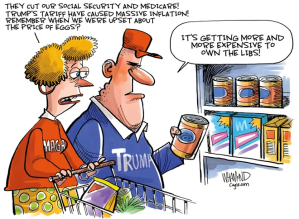 This is the headline at CNBC. “Live Updates: Trump’s tariffs kick in, reversing decades of global trade expansion.” Your homework today is to compare the minimum wage ($7.25) to a pound of any meat or fresh vegetable. Then, develop a budget that can feed 2 adults and 2 kids. “U.S. Trade Representative Jamieson Greer is calling Trump’s new tariffs a “knockout win.” He just doesn’t follow up with who exactly Trump has knocked out.
Trump’s new tariffs are hitting several countries’ imports harder than the rates that had initially been announced for those nations on April 2.
Brazil’s rate jumped from 10% to 50%, as Trump ramps up criticism of the country’s treatment of former Brazilian President Jair Bolsonaro.
Canada is also facing a large increase, with its previously announced rate of 25% being upped to 35%.
Trump cited Canada’s “continued inaction” in curbing the flow of fentanyl and drugs for imposing the higher rate, according to an executive order.
Switzerland was hit with a jump from 31% to 39%, among the highest rates of the new tariffs.
Swiss President Karin Keller-Sutter said that she spoke to Trump on Thursday but did not reach an agreement with him to forestall that spike.
– Laya Neelakandan
To continue …
Switzerland reels from 39% tariff announcement
Swiss businesses broadly believed they were close to a framework trade deal with the U.S. — instead they have been rocked by news of a 39% tariff, one of the highest in the world, to apply from Aug. 7.
“This unpredictability imposes a rising risk premium on financial assets,” Beat Wittmann, chairman and partner at Porta Advisors, said in emailed comments. “This will lead to a weakening of the Swiss economy, the Swiss Franc and the Swiss equity market, particularly the all-important export sector.”
Consultancy Capital Economics estimates that a 39% tariff could knock 0.6% off Swiss GDP, or more if it extends to pharmaceuticals.
However, analysts also noted Friday that there was still time for Switzerland to negotiate new rates before the end of next week. Read more here.
— Jenni Reid
 This is from USA Today.
 President Donald Trump imposed sweeping new tariffs on imports from across the world, escalating an aggressive trade policy aimed at spurring domestic manufacturing in the United States.
In addition, Trump took separate action on July 31 to raise tariffs on Canadian goods from 25% to 35%.
U.S. stocks were lower on August 1, ahead of what turned out to be a disappointing July jobs report that saw unemployment rise from 4.1% to 4.2%.
The new tariff rates, which will go into effect in seven days, came before an Aug. 1 deadline Trump gave about 180 countries to either reach trade deals or face higher import duties. Trump had twice set earlier deadlines for new tariffs before backing down.
In April White House trade advisor Peter Navarro had predicted “90 deals in 90 days,” but the haul has been modest: U.S. negotiators made eight trade deals in 120 days before Trump ordered the new tariffs.
A top White House economic adviser acknowledged that “uncertainty” over President Trump’s tariffs contributed to the weaker than expected jobs report.
Council of Economic Advisers Chairman Stephen Miran argued on MSNBC that July’s number was “decent” but admitted that downward revisions to May and June “are not great.” He chalked those up to seasonal factors such as teachers on summer break and cited Trump’s border policies, which he said were eliminating jobs held by foreign workers.
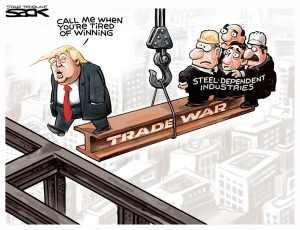 Just so you know, the Commerce and Labor Departments use statistical tools to remove the seasonal factors in the unemployment rates. So the BBC has a heading we can all appreciate today. This is from Jennifer Clarke. “What tariffs has Trump announced and why?” Anyone who takes a shot at why Trump does something is a hero in my book.
US President Donald Trump has announced a 35% tariff on Canada from 1 August. He also announced new tariff rates for dozens of countries that will come into effect on 7 August.
Since returning to office in January, Trump has introduced a series of these import taxes, and threatened many more.
He argues that the tariffs boost American manufacturing and protect jobs.
However, his volatile international trade policy has thrown the world economy into chaos, and a number of firms have increased prices for US consumers as a result.
What are tariffs and how do they work?
Tariffs are taxes charged on goods bought from other countries.
Typically, they are a percentage of a product’s value.
A 10% tariff means a $10 product has a $1 tax on top – taking the total cost to the importer $11 (£8.35).
Companies that bring foreign goods into the US have to pay the tax to the government.
They may pass some or all of the extra cost on to customers. Firms may also decide to import fewer goods.
At the end of May, a US trade court ruled that Trump did not have the authority to impose some of the tariffs he has announced, because he did so under national emergency powers.
But the following day, an appeals court said the relevant taxes could stay in place while the case continued.
Why is Trump using tariffs?
Trump says tariffs will encourage US consumers to buy more American-made goods, increase the amount of tax raised and boost investment.
He wants to reduce the gap between the value of goods the US buys from other countries and those it sells to them – known as the trade deficit. He argues that America has been taken advantage of by “cheaters”, and “pillaged” by foreigners.
The president has announced different tariffs against specific goods, and imports from individual countries.
Many of these have been subsequently amended, delayed or cancelled altogether.
Critics accuse Trump of making dramatic and sometimes contradictory policy statements as a negotiating tactic to encourage trade partners to agree deals that benefit the US.
Trump has made other demands alongside the tariffs.
Setting out the first tariffs of his current term against China, Mexico and Canada, he said all three countries must do more to stop migrants and illegal drugs reaching the US.
Separately, on 14 July, Trump threatened to introduce significant tariffs against companies trading with Russia, if a deal to end the war in Ukraine was not reached within 50 days.
- 50% tariff on steel and aluminium imports
- 50% tariff on copper imports from 1 August
- 25% tariff on foreign-made cars and imported engines and other car parts
On 8 July, Trump threatened to impose a 200% tariff on pharmaceutical imports but no further details have been confirmed.
Trump has also said the global tariff exemption covering goods valued at $800 or less will end on 29 August.
He had already removed the so-called “de minimis” exemption for products from China and Hong Kong, to restrict American’s purchase of cheap clothes and household items from commerce sites like Shein and Temu.
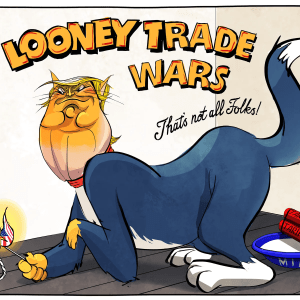 Continue reading the article for more really good basic information. And now you know why it’s called the dismal science. Well, not exactly, that was originally because of clergyman Thomas Robert Malthus and the entire idea that we’d eventually overpopulate the world, use up all the resources, and die. Early economists studied that notion, but quickly dropped it when the entire notion of technological changes came about. The problem is that just like climate change, we know a lot about what helps and hurts an economy, but that doesn’t mean the leaders of a given country will use it. (Especially if they’re as stupid as our current president.)
Sorry, this is so late, but I’ve had to change my entire sleeping hours based on when it’s cool enough to get the house temperatures down. The humidity and heat here have been awful. But hey, Climate change is fake, right?
What’s on your Reading, Blogging, and Action list today?
Mostly Monday Reads: Into the Woods
Posted: March 10, 2025 Filed under: #FARTUS, #MAGAnomics, Citizen's United & Super Pacs, kakistocracy, MAGA Political Carnage, Polycrisis | Tags: @johnbuss.bsky.social John Buss, Fairly Imbalanced Fox News, Justice Sotomayor, MAGA Big Lie Budget, MAGAnomics will kill us, overturn citizen's united, Piddle, Trump's bad economy, Twiddle and Resolve 7 Comments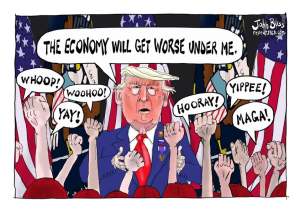
“Wait, what?” John Buss,
@johnbuss.bsky.social. @repeat1968
Good Day, Sky Dancers!
I’m still in that hazy period where I can’t believe it’s that dark, and I’m supposed to get up and function like it’s a normal day. Even my cats gave me a strange look since they know that morning kibble comes with the sunrise. Wasting the morning darkness is seriously cruel.
I admit I’m also in a hazy period as the US has been making history in ways I never thought possible. Sondheim’s great musical, which is referenced in the title, is my oldest daughter’s favorite. She endlessly listened to it, attended it, and played the Public TV version. It’s a good metaphor for what we’re going through. It’s a journey we must make to find something.
I’ll reference another song, but it’s from Paul Simon this time. “They’ve all gone to look for America.” You’re allowed to sing “Kathy, I’m lost” to me. My response is that I am, too. We’re in some kind of twilight but need more discovery. These days, a soundtrack is in demand.
This sad news is from The Guardian. It jolted me awake. “US added to international watchlist for rapid decline in civic freedoms. Civicus, an international non-profit, puts country alongside Democratic Republic of Congo, Italy, Pakistan and Serbia.” We may no longer be ‘the home of the free or the brave.’ Let me warm up here if I start referencing songs, I’m going to need to wake up a bit more so I can keep pitch.
The United States has been added to the Civicus Monitor Watchlist, which identifies countries that the global civil rights watchdog believes are currently experiencing a rapid decline in civic freedoms.
Civicus, an international non-profit organization dedicated to “strengthening citizen action and civil society around the world”, announced the inclusion of the US on the non-profit’s first watchlist of 2025 on Monday, alongside the Democratic Republic of the Congo, Italy, Pakistan and Serbia.
The watchlist is part of the Civicus Monitor, which tracks developments in civic freedoms across 198 countries. Other countries that have previously been featured on the watchlist in recent years include Zimbabwe, Argentina, El Salvador and the United Arab Emirates.
Mandeep Tiwana, co-secretary general of Civicus, said that the watchlist “looks at countries where we remain concerned about deteriorating civic space conditions, in relation to freedoms of peaceful assembly, association and expression”.
The selection process, the website states, incorporates insights and data from Civicus’s global network of research partners and data.
The decision to add the US to the first 2025 watchlist was made in response to what the group described as the “Trump administration’s assault on democratic norms and global cooperation”.
In the news release announcing the US’s addition, the organization cited recent actions taken by the Trump administration that they argue will likely “severely impact constitutional freedoms of peaceful assembly, expression, and association”.
The group cited several of the administration’s actions such as the mass termination of federal employees, the appointment of Trump loyalists in key government positions, the withdrawal from international efforts such as the World Health Organization and the UN Human Rights Council, the freezing of federal and foreign aid and the attempted dismantling of USAid.
The organization warned that these decisions “will likely impact civic freedoms and reverse hard-won human rights gains around the world”.
The group also pointed to the administration’s crackdown on pro-Palestinian protesters, and the Trump administration’s unprecedented decision to control media access to presidential briefings, among others.
Civicus described Trump’s actions since taking office as an “unparalleled attack on the rule of law” not seen “since the days of McCarthyism in the twentieth century”, stating that these moves erode the checks and balances essential to democracy.
“Restrictive executive orders, unjustifiable institutional cutbacks, and intimidation tactics through threatening pronouncements by senior officials in the administration are creating an atmosphere to chill democratic dissent, a cherished American ideal,” Tiwana said.
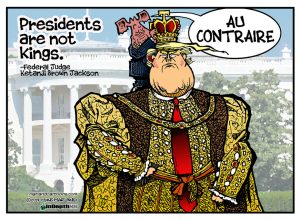 You may not have shared “An Evening with U.S. Supreme Court Justice Sonia Sotomayor” at the Knight Foundation event in Miami. I’d like to share some of her thoughts here this morning. The purpose of the visit was summarized thusly. “Civil institutions are the foundation of a thriving democracy.” This highlight is from The New York Times. “Sotomayor Says Presidents Are Not Monarchs and Must Obey Rulings. Speaking in general terms at a Florida college and not naming President Trump, the Supreme Court justice’s remarks took on potency in the current climate.” The reporter on this is Adam Litpek. The event happened on February 11th.
Justice Sonia Sotomayor, speaking at a Florida college on Tuesday, made pointed remarks about the limits of presidential power and her fear that government officials might flout court decisions.
“Our founders were hellbent on ensuring that we didn’t have a monarchy,” she said, “and the first way they thought of that was to give Congress the power of the purse.”
The justice made clear that she was speaking in general terms, but against the backdrop of President Trump’s blitz of executive orders to halt federal programs and the scores of legal challenges that followed, her comments took on a more telling cast.
In the first weeks of his new administration, Mr. Trump has argued that he is free to root out what he says is fraud and waste in the federal government even in the face of congressional commands to spend allocations. A federal judge ruled on Monday that the administration had defied his order to release billions in grant money.
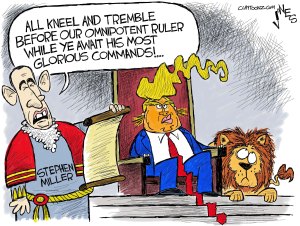 On March 7th,
A federal judge gave the Trump administration until Monday to pay several nonprofit groups and aid organizations affected by President Donald Trump’s broad freeze on foreign aid spending and his attempts to shut down the U.S. Agency for International Development (USAID), AP reports.
District Court Judge Amir Ali, who was appointed by President Joe Biden, issued the new deadline at the end of a four-hour hearing that came a day after the Supreme Court rejected the Trump administration’s emergency appeal asking it to stay one of Ali’s previous orders in the case.
The new deadline comes in a lawsuit filed by a global health group, an AIDS/HIV relief organization and a nonprofit journalism network challenging Trump’s day-one executive order to halt all foreign assistance for 90 days.
The total amount of aid kept from USAID contractors and grant recipients is around $2 billion, but Ali in his order limited payouts to only those organizations involved in the lawsuit. In the judge’s previous directives, he required the Trump administration to unfreeze all funding.
It’s unclear exactly how much money the administration will have to dispense by Monday. In a filing Friday, the plaintiffs said the government has yet to fulfill around 1,200 outstanding invoices totalling approximately $420 million for work already completed. The Trump administration said in a filing Thursday that it released around $70 million to the plaintiffs earlier this week.
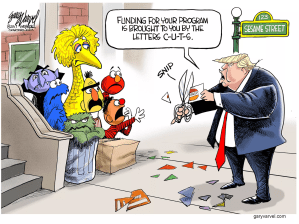 So, we’re waiting. Will he do it? So, that’s my civics wandering today. I do want to discuss the economy. The amount of anxiety I feel about this should seriously be burning a lot more calories than it appears to be doing. Maybe it’s been offset by the Trulys and cookies. Who knows? So, Brian Beutler sums this situation up neatly in his blog Off Message. “Be Prepared. Trump is sabotaging the economy, but we shouldn’t assume public opinion will follow automatically.”
Donald Trump has done rapid, serious damage to the U.S. economy, and the MAGA elite knows it.
Saturated as the Trump movement is in fantasies and conspiracy theories, many of the people who manufacture myths for the Republican base do keep abreast of material reality. They fear being caught by surprise. They don’t feel any obligation to prepare for and mitigate risks on behalf of American citizens, but rather to generate storylines about looming crises that hold Trump personally harmless, or paint him as victim or hero.
In a recent New Republic article, the writer Greg Sargent documented the wave of panic washing over Fox News as its hosts and contributors reckon with the fact that Trump has already squandered his inheritance.
Treasury Secretary Scott Bessent admitted to CNBC that “this economy that we inherited” could be “starting to roll a bit.”
Even Trump himself seems to understand that headlines and indicators are about to turn south.
Which is to say: When they shit-talked the Biden economy throughout the 2024 campaign, they knew they were lying. They know that Joe Biden bequeathed Trump a strong economy, and they know Trump’s convulsive policy edicts (indiscriminate firings, indiscriminate tariff threats, the imposition and partial removal of actual tariffs, etc.) have already throttled growth and driven prices higher.
We may not see recession, we may not see inflation, we may not see the dreaded combination of the two. But we’ll be incredibly lucky to avoid all three.
And if any occur, we’re going to test the power of MAGA propaganda techniques. Can concerted lying convince enough people to deny the existence of economic hardship, or celebrate it, or blame it on Democrats, such that it doesn’t become a political drag on Trump?
For all the brain poison MAGA propagandists pump into our information environment, these early signs of discomfort suggest they know the truth of the matter. Which means they’re conscious of the coming deception: they’ll blame Biden and foreigners and liberals and Jews for causing economic pain, and circle their wagons around Trump, fully aware of their own lies.
 Let’s take a look at that article from The New Republic written by Greg Sargent last week. “Fox News Suddenly Starts Panicking About Trump’s Economy: “Weakening!” Yes, they’re still blaming Joe Biden, but the talking heads at Fox are getting awfully nervous that President Trump might be on the verge of sending the economy into a tailspin.”
Fox News figures are willing to propagandize on President Trump’s behalf on pretty much every horror that he throws our way. Do Fox personalities back Trump when he sells out our allies in tandem with murderous tyrant Vladimir Putin? Yes, indeed. Do they support Trump when he tries to purge federal workers by the thousands to corruptly replace them with loyalists? Enthusiastically. Do they stick with Trump when he declares himself above the law, explicitly using the language of world-historical dictators to do so? Without reservations.
But it turns out there are limits. One topic Fox personalities are not quite as willing to run interference for Trump on is the economy. And with signs mounting that Trump’s economy is hitting the skids, they are beginning to sound the alarm.
It’s the latest indication that Trump’s political project is suddenly looking quite fragile. And it’s a sign that more dissent is coming.
On Fox News on Friday morning, host Maria Bartiromo practically shouted that “the jobs picture is weakening!” She tried to spin this somewhat positively, insisting investors are rallying because the weakening job market means the Federal Reserve will cut interest rates. But Bartiromo was blunt about the latest jobs report, which she pronounced “weaker than expected.”
That jobs report found that the economy created 151,000 jobs in February, which was slightly under expectations. This left some economists seeing a continued softening in the labor market and some news organizations discerning a “slowdown.”
Beyond this, the overall picture is darkening even more: This jobs report does not fully register the federal job losses unleashed by Elon Musk’s cuts via the so-called Department of Government Efficiency, which are expected to show up any day now. Trump’s tariffs are deeply spooking investors, and his sudden, temporary cancellation of many tariffs intended for Canadian and Mexican exports is only increasing the agitation. As a scalding New York Times assessment of Trump’s economy put it, the “sudden deterioration in the outlook is striking, because it is almost entirely the result of Mr. Trump’s policies.”
Yet what’s also striking is that Fox News figures are willing to go here—sort of, at least.
“I think the boom times are over,” Fox anchor Charles Payne declared Friday, implicitly admitting that the economy under Trump’s predecessor was a lot better. Payne pointed to declines in consumer spending, which he pronounced “scary.”
 The problem is that they know that we will all hang out together. I’m not sure Republican Congress Critters know this, but let’s move on before I start singing, “You see, we piddle, twiddle, and resolve. Not one damn thing do we solve.” Noah Belatsky has this analysis in public notice as we creep closer to breaching the budget deadline. “MAGA’s Big Lie budget. Trump’s economic agenda is about fooling the American people.” It’s becoming evident that many people in the country need a civics and economics course. Those of us who have often had both are screaming from our rooftops. And yes, I’m a dismal scientist, and I wish I didn’t feel the need to depress you with all of this.
“In the near future I want to do what has not been done in 24 years — balance the federal budget, we’re gonna balance it,” Trump declaimed in his speech before a joint session of Congress last week.
Trump is obviously lying, as his spending and revenue proposals do not suggest he’s even attempting to make a good faith effort to balance the budget. Nor is this new. Republicans have for decades — at least since Reagan — mounted up massive deficits while claiming to put forward responsible budgets.
Political scientist Jonathan Bernstein refers to this as the GOP war on budgeting. Trump is expanding that war in an especially shameless fashion. Not only is he lying about his desire to cut deficits, he’s also obfuscating about his spending priorities and preferences — especially as they relate to Social Security and Medicaid.
The result is budgeting as Big Lie, as Republicans immiserate the public, give massive handouts to billionaires, jack up enormous deficits, and then pretend to be the party of compassion and fiscal responsibility.
Trump’s economic plans are incoherent and incomprehensible at least partially by design. The goal, by this longtime scam artist, is to bamboozle the American people and take their money.
Insulting your intelligence
Trump has said so much nonsense about the budget and priorities that it’s difficult to summarize. But the central contradiction is that he has said he wants to do three incompatible things:
1. Balance the budget
2. Extend the tax cuts from his first term
3. Keep Social Security, Medicare, and Medicaid fully funded
Doing all these simply isn’t possible. You can’t slash revenue by trillions, refuse to cut the biggest items in the budget, and eliminate the deficit. The numbers simply don’t add up.
Trump himself has tacitly admitted that his stated priorities are mutually contradictory. He’s endorsed the House budget framework, which extends his first term tax cuts. That plan raises the deficit by $2.8 trillion through 2034. In contrast, the Senate has proposed a balanced bill, putting votes on extending the tax cuts off until later. But, again, Trump prefers the House bill.
Consider donating to Public Notice and other independent news sources, given they’re far more valuable than most of our legacy media.
 So, here’s another thing I thought I’d never see but wow, our Canadian friends are really pissed and they’re not going to take it. This is from the brave folks at the AP. “Ontario slaps 25% tax increase on electricity exports to US in response to Trump’s trade war.”
Ontario’s premier, the leader of Canada’s most populous province, announced that effective Monday it is charging 25% more for electricity to 1.5 million Americans in response to U.S. President Donald Trump’s trade war.
Ontario provides electricity to Minnesota, New York and Michigan.
“I will not hesitate to increase this charge. If the United State escalates, I will not hesitate to shut the electricity off completely,” Ontario Premier Doug Ford said at a news conference in Toronto.
“Believe me when I say I do not want to do this. I feel terrible for the American people who didn’t start this trade war. It’s one person who is responsible, it’s President Trump.”
Ford said Ontario’s tariff would remain in place despite the one-month reprieve from Trump, noting a one-month pause means nothing but more uncertainty. Quebec is also considering taking similar measures with electricity exports to the U.S.
Ford’s office said the new market rules require any generator selling electricity to the U.S. to add a 25% surcharge. Ontario’s government expects it to generate revenue of $300,000 Canadian dollars ($208,000) to CA$400,000 ($277,000) per day, “which will be used to support Ontario workers, families and businesses.”
The new surcharge is in addition to the federal government’s initial CA$30 billion ($21 billion) worth of retaliatory tariffs have been applied on items like American orange juice, peanut butter, coffee, appliances, footwear, cosmetics, motorcycles and certain pulp and paper products.
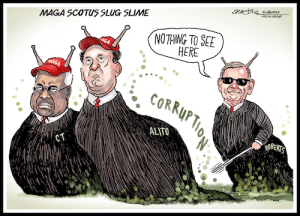 This will make an interesting case study in someone’s textbook. I may need to fire up the STATA and see what happens unless FARTUS and his merry band of poseurs soon suppress the GDP numbers. I wouldn’t put it past them, but I do believe some brave commerce department official will sneak them off to the Fed. Okay, this is too full of brilliant yellow prose for me to ignore. It comes via The Bulwark and Jill Lawrence. “The Road from ‘Citizens United’ to Trump, Musk, and Corruption. A ‘naïve’ Supreme Court delivered lawless greed and cruelty. We’ll have to save ourselves, if we can.”
WHAT HAPPENS WHEN a greedy geezer with the most powerful job in the world cements himself to a greedy grabber who is the richest man in the world? You get Donald Trump, Elon Musk, and a superpower emeritus about ready to be stripped for parts.
Few foresaw this in 2010, when the Supreme Court launched us onto a dark path. The court’s 5–4 Citizens United decision, allowing unlimited corporate, interest-group, and individual spending on elections, did trigger dire predictions from plenty of doomsayers. But even the most pessimistic among them fell short of imagining American reality today.
“We knew that it was going to be really, really destructive for our democracy,” says Tiffany Muller, president of the group End Citizens United, which is dedicated to electing Democrats committed to seeing the ruling overturned. “Fifteen years after that decision, we’re seeing the full culmination of living under a Citizens United world—where it’s not just elections that are for sale, but it’s that our entire government, and the apparatus of our government, is up for sale.”
It’s hard to believe, but once upon a time there was bipartisan common ground on gun safety, health care, voting rights, climate change, and even limits on campaign funding. The Senate in 2006 voted 98–0 to reauthorize the Voting Rights Act, and George W. Bush signed the law. He also added a voluntary prescription benefit to Medicare, with help from Democrats in both chambers.
Bipartisan Senate pairs introduced major climate bills in 2003 and 2007, but their prospects faded amid opposition from the fossil-fuel industry. In 2010, a few months after Citizens United, a cap-and-trade tax designed to reduce carbon emissions passed the House in a landmark vote, but it fell short in the Senate. Democrats had 59 seats and needed just one Republican vote to advance the bill—and they couldn’t get it.
The oil and gas sector now floods the election zone with over six times as much cash as it spent in the 2010 cycle. And it has amassed all the clout you’d expect as contributions have skyrocketed—from defeating a carbon tax–friendly House Republican in 2010 to helping to elect Trump last year.
When Citizens United turned ten, in 2020, the political money-tracker Open Secrets reported on what the ruling had wrought. Super PACs—the non-party committees created to legally raise cash in unlimited amounts to independently promote issues and candidates—spent $4.5 billion over the decade (up from $750 million over the previous twenty years).
The major players of the new era, it turned out, were not corporations. They were millionaires and billionaires. “The 10 most generous donors and their spouses injected $1.2 billion into federal elections over the last decade,” Open Secrets found.
It’s a good read full of good sources. I highly recommend it.
My social security check got deposited today! It’s something I now fret about and didn’t before. Off to pay the mortgage and such. You have a very good week. Escape with whatever takes the anxiety off of the 11 setting! Sorry, I plagued you my musicisms today. We all have to cope somehow!
What’s on your Reading and Blogging list today?

 peej
peej Carissa
 bostonboomer
 dakinikat
 ecocatwoman
 mablue2
 Mama Lopez
 peggysue22
 quixote
 skydancingguestblogger
 Mona (aka Wonk the Vote)



 Sky Dancing
Recent Comments