
Pay Check Fairness Act and the Politics of the Gender Gap
Posted: April 29, 2012 Filed under: Paycheck Fairness Act, War on Women, Women's Rights, worker rights | Tags: Gender Gap politics, Harry Reid, Lily Ledbetter Act 62 Comments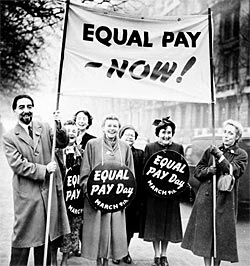 It’s evident that the Democratic Party wants that wide Gender Gap to stay right where it is until the November Elections. The introduction of the Pay Check Fairness Act may be a ploy to put Republicans and Blue Dawg Dems on the spot but it will be an interesting ploy and one to watch. The last time the bill came to the floor was in 2010.
Senate Majority Leader Harry Reid (D-Nev.) will bring to the floor in coming weeks legislation to protect women from retaliation by employers if they inquire about salaries paid to male colleagues
Republicans voted in unison to block the bill, the Paycheck Fairness Act, when it came to the floor in November of 2010.
Democrats say it will be difficult for GOP senators to back out of their opposition, especially because the U.S. Chamber of Commerce has staunchly opposed the legislation.
Mitt Romney will either have to split with Republicans and an important business group or take a position that could further erode his support among women.
“Romney’s going to be on defense on the Paycheck Fairness Act,” said a senior Democratic aide.
“Women are making 70 cents on a dollar of what a man is making. This will resonate with females across the spectrum. If Republicans to a person are coming down against it, it will be at their political peril,” the aide said.
A spokeswoman for Romney’s campaign did not respond to a request for comment.
The bill would prohibit employer discrimination for inquiring about, discussing or disclosing the wages of another employee.
It would expand the definition of wage discrimination by allowing employees to compare the pay of male colleagues not only within the same office but also with colleagues in other local offices. A female employee could allege wage discrimination if she is paid less than a male working the same job for the same employer across town.
Not a single Republican voted to advance the legislation when Reid brought it to the floor during the 2010 lame duck session, after Republicans scored a huge electoral victory but Democrats still controlled the House and Senate.
Forty Republicans and Sen. Ben Nelson (D-Neb.) voted against the legislation. Sen. Lisa Murkowski (R-Alaska) did not vote.
So why exactly do Republicans dislike the Equal Pay Act so much since its only function is to level the playing ground and prevent discrimination? Well, for one, Republicans deny that women are paid differently from men.
This morning, during a heated discussion with Rachel Maddow on Meet The Press, GOP consultant Alex Castellanos denied that women make 77 cents for a man’s dollar in the workplace and noted, “there are lots of reasons for that.” Maddow expressed shock at the assertion, but concluded that it explained why Republicans and Mitt Romney are so hesitant to embrace the Lilly Ledbetter Fair Pay Act of 2009, a law that helps women hold accountable employers who discriminate in the pay practices based on gender.
“Now we know, at least from both of your perspectives,” Maddow said, pointing to Castellanos and Romney surrogate Rep. Cathy McMorris Rodgers (R-WA), “women are not fairing worse than men in the economy that women aren’t getting paid less for equal work.” “It’s about policy and whether or not you want to fix some of the structural discrimination that women really do face that Republicans don’t believe is happening,” she added. Castellanos responded to Maddow’s policy argument by remarking on her passion, to which the MSNBC host took offense:
CASTELLANOS: It is about policy and I love how passionate you are. I wish you were as right about what you’re saying as you are passionate about it. I really do.
MADDOW: That’s really condescending. This is a stylistic issue. My passion on this issue is actually me making a factual argument on it.
My guess is that the introduction of this law is geared to force Romney to take a stand on something he’s been trying to avoid. Romney has been quite coy about his position on the Lily Ledbetter Act which was the first bill signed into law by Obama. Romney’s position on the law is unclear. This comes behind the miserable behavior of Republicans on renewal of the Violence Against Women Act. Every GOP member of the judiciary committee voted against scheduling a vote on the Act.
Romney sidestepped the controversy by announcing his support for reauthorizing the Violence Against Women Act without specifically endorsing the Senate Democratic bill. Senate Republicans quickly conceded and allowed the bill to receive a final vote without waging a filibuster.
Clearly, Reid is maneuvering these bills to put Romney and Republicans in the hot seat. This makes me wonder if we’re even going to get a fair hearing on the issues themselves. Even though Republicans will likely tank the bill, it would be nice to bring the topic into a discussion that is more about the issue and less about the political process. Greg Sargent of WAPO’s Plum Line has some of the behind the scene maneuvers.
The looming vote could revive a recent controversy that erupted around equal pay issues. On a recent Romney campaign conference call, HuffPo’s Sam Stein asked Romney surrogates whether Romney supports the Lily Ledbetter Fair Pay Act of 2009, which mad e it easier for people to challenge pay discrimination. The campaign at first waffled, but then released a statement confirming that Romney “supports pay equity and is not looking to change current law.”
But Romney’s campaign has not said whether he would have signed that law in the first place.
Now Romney’s rhetorical support for pay equity faces another test in the looming Senate vote on the Paycheck Fairness Act.
This Act would put more pressure on employers to prove that differences in wages are not rooted in gender difference, and would make it easier for employees to divulge information about their salaries, which would in turn facilitate deterring or challenging pay discrimination.
Two years ago Senate Republicans opposed the Paycheck Fairness Act, which had strong support from Obama, and it’s likely they will do so again. But Romney is on record supporting “pay equity” in principle, so he’d either have to break with that principle, or break with Senate Republicans, at a time when the battle over the female vote is raging in the presidential race. If Romney supports the measure, it could make passage of it more likely.
“This is an issue that a number of women Democratic Senators are absolutely intent on addressing — they know that with women still being paid 77 cents to each male worker’s dollar, this is an issue of fundamental fairness that women across the country face daily,” a senior aide to a female Senator says. “A lot of women who don’t necessarily see this as a partisan issue will be watching.”
The Romney campaign, in its pitch for female voters, has argued that women don’t care about social issues as much as they do about jobs, and that pocketbook issues will ultimately drive the female vote. But the Paycheck Fairness Act is a gender issue that’s all about the pocketbook and the economy.
Guess we’ll have to stay tuned to see how much we actually get to discuss this issue compared to the political wrangling designed to keep the gender gap working for the benefit of democratic politicians. Hopefully, the women in congress will add some substance to the discussion so that it becomes more than just one more partisan sideshow.

 peej
peej Carissa
 bostonboomer
 dakinikat
 ecocatwoman
 mablue2
 Mama Lopez
 peggysue22
 quixote
 skydancingguestblogger
 Mona (aka Wonk the Vote)



 Sky Dancing
Recent Comments