
Judicial Restraint My Old Lady A$$
Posted: March 29, 2012 Filed under: Affordable Care Act, SCOTUS | Tags: Judicial Activism, Kennedy, Scalia, Thomas 20 Comments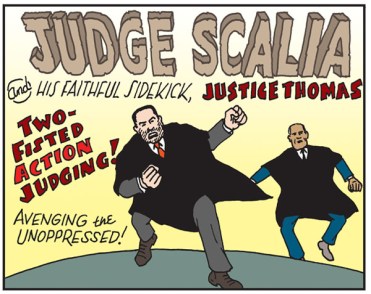 Methinks these Justices protest too much. It’s actually pretty telling too. Scalia seems to be getting his questions from old Fox News shows and Thomas has once again proven that no questions are necessary when you know exactly how you’re expected to vote to keep the perks pouring in. It makes one wonder if Roberts is the least bit concerned about how “his” court will go down in history. If comparing the health care market to broccoli is a sign of great intellect, please, buy my a ticket to Palookaville. Here’s how Charlie Pierce puts it.
It is plain now that Scalia simply doesn’t like the Affordable Care Act on its face. It has nothing to do with “originalism,” or the Commerce Clause, or anything else. He doesn’t think that the people who would benefit from the law deserve to have a law that benefits them. On Tuesday, he pursued the absurd “broccoli” analogy to the point where he sounded like a micro-rated evening-drive talk-show host from a dust-clotted station in southern Oklahoma. And today, apparently, he ran through every twist and turn in the act’s baroque political history in an attempt to discredit the law politically, rather than as a challenge to its constitutionality. (What in hell does the “Cornhusker Kickback” — yet another term of art that the Justice borrowed from the AM radio dial — have to do with the severability argument? Is Scalia seriously making the case that a banal political compromise within the negotiations from which bill eventually is produced can affect its ultimate constitutionality? Good luck ever getting anything passed if that’s the standard.) He’s really just a heckler at this point. If he can’t do any better than that, he’s right. Being on the court is a waste of his time.
Better yet, check out Jonathan Chait’s piece on Conservative Judicial Activists Run Amok. It reintroduces an essay by Jeffrey Rosen from 2005 on how the court was undergoing some fairly radical changes. The Rosen essay specifically references a Thomas decision written with an amazing amount of paraphrasing from a libertarian kook named Richard Epstein who is obsessed with protecting property at all costs; including human ones.
As Epstein sees it, all individuals have certain inherent rights and liberties, including ”economic” liberties, like the right to property and, more crucially, the right to part with it only voluntarily. These rights are violated any time an individual is deprived of his property without compensation — when it is stolen, for example, but also when it is subjected to governmental regulation that reduces its value or when a government fails to provide greater security in exchange for the property it seizes. In Epstein’s view, these libertarian freedoms are not only defensible as a matter of political philosophy but are also protected by the United States Constitution. Any government that violates them is, by his lights, repressive. One such government, in Epstein’s worldview, is our government. When Epstein gazes across America, he sees a nation in the chains of minimum-wage laws and zoning regulations. His theory calls for the country to be deregulated in a manner not seen since before Franklin D. Roosevelt’s New Deal.
After Thomas joined the Supreme Court, Biden’s warnings seemed prescient. In 1995, echoes of Epstein’s ideas could be clearly heard in one of Thomas’s opinions. By a 5-4 majority in United States v. Lopez, the court struck down a federal law banning guns in school zones, arguing that the law fell outside Congress’s constitutional power to regulate interstate commerce. Lopez was a judicial landmark: it was the first time since the New Deal that the court had limited the power of the federal government on those grounds. Thomas, who sided with the majority, chose to write a separate opinion in which he suggested that even his conservative colleagues had not gone far enough. The real problem, he wrote, was not just with the law at hand but with the larger decision of the court during the New Deal to abandon the judicial doctrines of the 19th century that established severe limits on the government’s power. He assailed his liberal colleagues for characterizing ”the first 150 years of this Court’s case law as a ‘wrong turn.”’ He continued, ”If anything, the ‘wrong turn’ was the Court’s dramatic departure in the 1930’s from a century and a half of precedent.”
Thomas did not cite Epstein directly in his opinion. But to anyone familiar with Epstein’s writings, the similarities were striking. Indeed, Thomas’s argument closely resembled one Epstein had made eight years earlier in ”The Proper Scope of the Commerce Power” in the Virginia Law Review — so closely, in fact, that Sanford Levinson, a liberal law professor at the University of Texas, accused Thomas of outright intellectual theft. (”The ordinary standards governing attribution of sources — the violation of which constitutes plagiarism — seem not to apply in Justice Thomas’s chambers,” Levinson wrote in the Texas Law Review.) Biden’s fear that Epstein’s ideas might be written into law had apparently been realized. And the fear would continue to be realized in other courts throughout the 90’s as a small but energetic set of lower-court judges, sympathetic to libertarian arguments, tried to strike down aspects of the Clean Water Act, the Endangered Species Act and other laws, challenging powers of the federal government that had come to be widely accepted during the second half of the 20th century.
Chait takes this essay into the present and the analysis presents a chilling future of judicial activism unlike anything we’ve seen before. The hearings this week on the ACA imply a SCOTUS willing to rewrite legislation in the name of ideology. The so-called swing vote, Justice Kennedy, has created loopholes in cases before that have allowed state legislatures to drive huge right-depriving laws through constitutional rights. By introducing the factually inaccurate, unscientific idea of “fetal pain” in Gonzales V Carhart, Kennedy opened a can of whoop ass based on religious propaganda on American Women.
Writing for the majority, Justice Anthony Kennedy said:
“States . . . have an interest in forbidding medical procedures which, in the State’s reasonable determination, might cause the medical profession or society as a whole to become insensitive, even disdainful, to life, including life in the human fetus . . . A State may take measures to ensure the medical profession and its members are viewed as healers, sustained by a compassionate and rigorous ethic and cognizant of the dignity and value of human life, even life which cannot survive without the assistance of others.”
The National Right to Life Committee thinks that Kennedy’s directive, particularly the bit at the end —”even life which cannot survive without the assistance of others”—leaves open the possibility of revising the viability standard. As Olivia Gans, an NRLC spokesperson, told me a few weeks ago, before the law had passed, “What Kennedy was saying was that states can and should look at other variables to figure out what’s in the best interest of the state.”
This is to medical science as the broccoli argument is to economics. It’s clear that the justices are venturing into something beyond judging constitutionality. Consider this thought offered by Chait.
The spectacle before the Supreme Court this week is Republican justices seizing the chance to overturn the decisions of democratically-elected bodies. At times the deliberations of the Republican justices are impossible to distinguish from the deliberations of Republican senators. They are litigating the problem of adverse selection, and doing it very poorly. (Here are health economists Henry Aaron and Kevin Outterson tearing their hair out over the justices’ bungled attempts to describe the economic dynamics at work.)
Scalia himself offers the most blatant case. His famed thunderings against meddlesome judges are nowhere to be found. He is gleefully reversing his previous interpretation of the Commerce Clause, now that it is being deployed against big government liberals rather than pot smokers. He is railing against Obamacare like an angry Fox News-watching grandfather:
In the morning session — in which the court weighed how much of the law should stand if the mandate is ruled unconstitutional — Scalia cited the horsetrading required to pass the bill — including the politically embarrassing, and failed, Cornhusker Kickback. He also admitted that he’d like to see the whole law fall if the mandate is ruled out of bounds.
In the afternoon, he took pains to remind the court of the unpopularity of the individual mandate.
The exchange occurred when Solicitor General Donald Verrilli Jr. rejected a hypothetical that relied on the notion of Congress passing a massive new tax. This, he argued, would have to overcome massive political constraints.
At that point Scalia chimed in: He would’ve thought the individual mandate would also be too much of a political liability to ever pass Congress.
In fact, the “Cornhusker Kickback” was stripped out before the final bill, but Scalia seems not to know that.
Just two years ago, the idea that conservatives might win the health-care fight in Court rather than the Senate seemed absurd. Just seven years ago, the notion that Republican jurisprudence would be defined by aggressive economic judicial activism seemed even more fantastical. But just as there are few atheists in foxholes, there aren’t a lot of justices of any persuasion willing to walk away from a chance to overturn a duly-passed law that they personally detest.
Whatever issue you may have with the ACA, it was passed by an overwhelming number of Senators and Representatives after a year of hearings, testimony, and rewrites. It deserves a fair hearing before something other than a Kangaroo Court.
“The Public Option is not your Enemy”
Posted: June 16, 2009 Filed under: Health care reform, Human Rights, Team Obama, Uncategorized | Tags: Affordable health Choices Act, American Medical Association, Congressional Budget Office, Dodd, Kennedy Comments Off on “The Public Option is not your Enemy”
Finally, if we are to win the battle that is now going on around the world between freedom and tyranny, the dramatic achievements in space which occurred in recent weeks should have made clear to us all, as did the Sputnik in 1957, the impact of this adventure on the minds of men everywhere, who are attempting to make a determination of which road they should take. Since early in my term,our efforts in space have been under review. With the advice of the Vice President, who is Chairman of the National Space Council, we have examined where we are strong and where we are not, where we may succeed and where we may not. Now it is time to take longer strides-time for a great new American enterprise-time for this nation to take a clearly leading role in space achievement, which in many ways may hold the key to our future on earth.
President John F. Kennedy, May 25, 1961
Why can’t we put the same determination that put a man on the moon into finding a solution for affordable health care for all? What are the sticking points?
Some of the first efforts toward that goal were put into play yesterday. We had the usual Presidential teleprompter read before the American Medical Association yesterday. It was characterized this way by Sam Stein.
“The public option is not your enemy, it is your friend,” Obama declared at one point.
His prepared remarks were a bit more detailed:
If you don’t like your health coverage or don’t have any insurance, you will have a chance to take part in what we’re calling a Health Insurance Exchange…. You will have your choice of a number of plans that offer a few different packages, but every plan would offer an affordable, basic package. And one of these options needs to be a public option that will give people a broader range of choices and inject competition into the health care market so that force waste out of the system and keep the insurance companies honest.
Back in the world of where the rubber hits the road, the Congressional Budget Office (CBO) returned an estimate of the Affordable Health Choices Act that was proposed by Dodd and Kennedy. Ezra Klein of WaPo used the adjective “devastating”.
According to the agency, the bill would cost a hefty trillion dollars over 10 years and extend insurance to a mere 16 million people. That’s a lot of money to spend if you’re only going to achieve a third of your goal. Frankly, I was pretty surprised by the results.
And so, it turns out, were the people writing the bill.
A couple of months ago, the Health, Education, Labor, and Pensions Committee sent the CBO a sketch of a draft of its legislation. And the CBO sent the members back a stab at an outline of an estimate. It was all very early, and very rough. But CBO’s response was encouraging. The total cost was a bit higher, but the number covered was much higher. More like what you’d expect. More like what health reform is trying to achieve.
The draft the CBO examined last week, however, was in certain respects even less complete than the outline they were given months ago. In an effort to buy some extra time to negotiate with Republicans on the committee, the Democrats on HELP left out some of the more controversial policies in the hopes of reaching a bipartisan agreement sometime this week. The public plan, the employer mandate and the individual mandate were all absent from the proposal the CBO examined. The employer and individual mandates — the first of which pushes employers to offer coverage and the second of which force individuals to purchase coverage — are particularly key to increasing the number of Americans with health insurance.
You might ask what the HELP Committee was thinking, sending Swiss cheese legislation to CBO. Well, the HELP Committee’s expectation was that the CBO, in crafting its preliminary score, would assume something similar to the outline it had seen months before. The CBO didn’t. In fact, it did the opposite. CBO ran its estimates with no employer mandate and an individual mandate with a laughably small penalty.
“Swiss cheese legislation”, is this what the American people deserve?

 peej
peej Carissa
 bostonboomer
 dakinikat
 ecocatwoman
 mablue2
 Mama Lopez
 peggysue22
 quixote
 skydancingguestblogger
 Mona (aka Wonk the Vote)



 Sky Dancing
Recent Comments