
Finally Friday Reads: The Republican Plans to Deny your Vote
Posted: August 9, 2024 Filed under: 2024 presidential Campaign, Voter Suppression drive by Donald | Tags: Citizen's United, Georgia voter suppression, Keep Our Democracy, Michigan Voter Suppression, Trump's Stealing the Vote 5 CommentsGood Day, Sky Dancers!

“The Mar a Lago Presser was one for the ages. Donald found his way out of his basement to assure the masses he was sharp as ever as he didn’t even nod off once.” John Buss. Repeat 1968
Today, I’m sharing the incredible number of actions being taken to ensure your vote does not count. One of the incredible recent patterns in national Presidential Elections is that Republican candidates cannot get the majority of the vote. This is why a few swing states get all the attention.
My undergraduate degree was your basic liberal arts degree with a Major in History and minors in Political Science and Economics. All three areas are essential to know what it means to be an American, to vote, and to recognize that a lot of our history, governance, and wealth distribution was built on protecting slavery, stealing land and lives from our Indigenous, and ensuring that entitled White Men are in charge. Some may be technically illegal now, but their impact and the dynamics remain.
I want to share some of the past to understand the immense wealth and effort put into play by billionaires Elton Musk, Harlin Crowe, and Paul Weyrick, which concentrates on political power by getting what they want through strategies that don’t include getting votes. This includes wining and dining the two most despicable Associate Justices sitting on the Supreme Court.
The Presidency is determined by a few states that move the Electoral Vote in one direction. I’ve written about this a lot. There are a lot of movements that would either reform or eliminate the Electoral College, which is a vestige of Slave owners making sure the primarily rural, unpopulated states could not be forced to free their slaves. It played a key role in the Adams/Jefferson election. This is a brief history of its impact from the Brennen Center. It was originally published in The Atlantic in 2020. The analysis of its historical importance is provided by
Right from the get-go, the Electoral College has produced no shortage of lessons about the impact of racial entitlement in selecting the president. History buffs and Hamilton fans are aware that in its first major failure, the Electoral College produced a tie between Thomas Jefferson and his putative running mate, Aaron Burr. What’s less known about the election of 1800 is the way the Electoral College succeeded, which is to say that it operated as one might have expected, based on its embrace of the three-fifths compromise. The South’s baked-in advantages—the bonus electoral votes it received for maintaining slaves, all while not allowing those slaves to vote—made the difference in the election outcome. It gave the slaveholder Jefferson an edge over his opponent, the incumbent president and abolitionist John Adams. To quote Yale Law’s Akhil Reed Amar, the third president “metaphorically rode into the executive mansion on the backs of slaves.” That election continued an almost uninterrupted trend of southern slaveholders and their doughfaced sympathizers winning the White House that lasted until Abraham Lincoln’s victory in 1860.
In 1803, the Twelfth Amendment modified the Electoral College to prevent another Jefferson-Burr–type debacle. Six decades later, the Thirteenth Amendment outlawed slavery, thus ridding the South of its windfall electors. Nevertheless, the shoddy system continued to cleave the American democratic ideal along racial lines. In the 1876 presidential election, the Democrat Samuel Tilden won the popular vote, but some electoral votes were in dispute, including those in—wait for it—Florida. An ad hoc commission of lawmakers and Supreme Court justices was empaneled to resolve the matter. Ultimately, they awarded the contested electoral votes to Republican Rutherford B. Hayes, who had lost the popular vote. As a part of the agreement, known as the Compromise of 1877, the federal government removed the troops that were stationed in the South after the Civil War to maintain order and protect black voters.
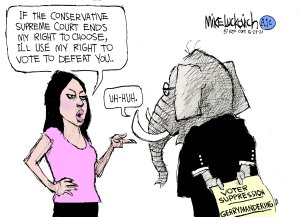 That compromise was basically the one that ended the reconstruction. We all remember the crowning of Dubya Bush by the Supreme Court in 2000. All of these current movements are firmly rooted in what was called the Reagan Revolution. He was the first of modern Republican presidents unsuitable for the job. Reagan, however, won the popular vote.
The last republican President to win the popular vote was George W. Bush in 2004. He undoubtedly got a boost from his misguided war. The Electoral College has created some complex history and, at times, threatened our concept of being a democratic Republic. Okay, enough of history. 50 years ago, Nixon quit the job of the Presidency after his re-election effort was riddled with criminal activities. He was at least a crook capable of governing.
Let’s look at the goal of manipulating the election results put into play by right-wing Republicans who recognize that those swing states have to stay in their column for them to maintain power. I will rely heavily on information from Democracy Docket, although I will supplement it with current media coverage. Marc Elias is a lawyer who has fought in court to stop all voter suppression actions since 2020. You may have seen him on news programs.
Marc Elias is the Firm Chair of Elias Law Group, a mission-driven firm committed to helping Democrats win, citizens vote, and progressives make change. Marc is a nationally recognized authority and expert in campaign finance, voting rights, redistricting law, and litigation.
As a litigator, Marc has handled hundreds of cases involving politics, voting rights, and redistricting. He has successfully argued and won four cases in the U.S. Supreme Court, as well as dozens of cases in state supreme courts and U.S. courts of appeal.
He has represented the Democratic Senatorial and Congressional Campaign Committees, several presidential campaigns, as well as dozens of U.S. senators, governors, representatives, campaigns, and other Democratic and progressive organizations.
When Trump contested the outcome of the 2020 election, Marc met every futile challenge at the courthouse, notching over 60 legal victories against the former president and his allies during the post-election period, alone. He has also successfully represented several House and Senate candidates in post-election litigation, recounts and challenges. In 2024, Marc was named to Forbes’ inaugural list of America’s top 200 lawyers.
Marc is also the founder of Democracy Docket, the leading digital news platform dedicated to information, analysis and opinion about voting rights and elections in the courts.
Marc is an alumnus of Hamilton College, Duke Law School and Duke Graduate School. He is a proud owner of a Portuguese Water Dog named Bode.
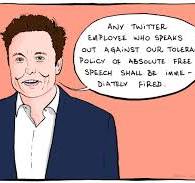 Okay, here we go. This is from Public Notice and written by Lisa Needham. The dateline is today. “Elon Musk tries to dismantle the foundations of US democracy’ From blatant election interference to ending the NLRB, he’s doing all kinds of damage.”
Let’s start with the NLRB.
It’s no surprise that Musk is no friend to labor. He doesn’t believe in unions, saying that they create “a lords and peasants sort of thing,” whatever that means. When workers at his Fremont, California, plant began an organizing campaign, he tweeted that they would lose their stock options if they joined the union. This sort of threat is extremely illegal, and the NLRB sided with the workers who brought multiple unfair labor practices charges against Tesla.
Tesla also prohibited workers from wearing t-shirts with union insignias, even though the right to wear pro-union clothing at work has been a legally protected activity for several decades. Then, of course, there’s the class-action lawsuit in California state court, where almost 6,000 Black workers at the Fremont factory recently got the right to sue Tesla for ignoring massive racism at that plant. How massive? Nooses at the workstations of Black workers massive.
Of course, why follow the law when the lower federal courts are now stuffed with anti-worker Federalist Society denizens and the Supreme Court just gutted the regulatory state? After the NLRB filed a formal complaint against SpaceX over its firing of several employees who wrote an internal letter critical of Musk, SpaceX made sure to find a friendly Trump-appointed judge in Texas, Alan Albright, to entertain its theory that the NLRB itself is unconstitutional.
In late July, Albright issued an injunction blocking the NLRB from proceeding against SpaceX, saying that it is likely the company would prevail in showing that the NLRB, which was created by Congress nearly 90 years ago, impermissibly infringes on the president’s power. Members of the NLRB board and the Administrative Law Judges (ALJ) cannot be removed by the president. That insulation from removal, of course, is critical, as otherwise the NLRB would basically cease to exist every time a Republican president takes power.
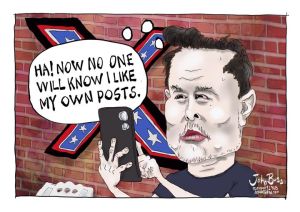
“Some Twitter humor as Elmo hides likes on his platform.” @repeat1968, John Buss
You can read more about that one at the link. There is also this at the same link.
America PAC purports to help people register to vote. If you live in a state that isn’t a swing state, that’s what the PAC’s website does — sends you over to your state’s voter registration page. But if you live somewhere in play this November, the America PAC website asks you for detailed personal information, including things utterly unrelated to voter eligibility, like your cellphone number.
After all that is entered, the PAC doesn’t register you at all. It doesn’t even send the user to their state registration website. It just displays a “thank you” page.
So, swing state voters may think they’re registering, but they’re not. Instead, they’ve handed over their data to a PAC that is coordinating with the Trump campaign. While PACs are generally not allowed to work directly with campaigns, America PAC is a door-to-door canvassing group, and those, inexplicably, can work hand in hand with a candidate. However, pretending to register people to vote is probably a bridge too far.
The Michigan Secretary of State’s office is in the early stages of an investigation of the PAC. So is the North Carolina Attorney General’s Office, as in North Carolina, it’s an actual crime to say you’re submitting someone’s voter registration form and then not do so, which is pretty close to what Musk’s PAC is doing.
The problem here is the relative toothlessness and extreme slowness of American jurisprudence when it comes to election violations.
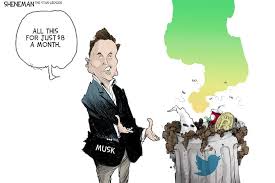 Here we are, 90ish days before the election, and the investigations are just starting. Sweet Lady Liberty, help us! Here’s a Max Boot editorial on the Washington Post. It’s from March of this year. I like this because Boot reminds us that Musk is a defense contractor and rakes in billions of dollars from U.S. taxpayers.”Musk is a MAGA megaphone and a federal contractor. That’s a problem.” And he’s writing a biography on Ronald Reagan which is the last thing we need to read. But he’s also the broken clock on this one.
Like a lot of other people, I don’t use my X account much anymore. I prefer to post on Threads, because X (formerly Twitter) has become such a cesspool of hate speech and conspiracy-mongering. The problem became especially acute following Hamas’s Oct. 7 attack on Israel when the platform was flooded with antisemitic and anti-Muslim misinformation. It’s like watching a once-nice neighborhood go to seed, with well-maintained houses turning into ramshackle drug dens.
What galls me is that, as a taxpayer, I wind up subsidizing X’s megalomaniacal and capricious owner, Elon Musk. His privately held company SpaceX is a major contractor — to the tune of many billions of dollars — for the Defense Department, NASA and the U.S. intelligence community. He is also chief executive of Tesla, which benefits from generous government subsidies and tax credits to the electric-vehicle industry.
Musk needs to decide whether he wants to be the next Donald Trump Jr. (i.e., a major MAGA influencer) or the next James D. Taiclet (the little-known CEO of Lockheed Martin, the country’s largest defense contractor). Currently, Musk is trying to do both, and that’s not sustainable. He is presiding over a fire hose of falsehoods on X about familiar right-wing targets, from undocumented immigrants to “the woke mind virus” to President Biden … while reaping billions from Biden’s administration!
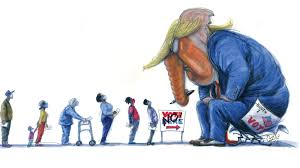 Now, we move to the complex legal landscape of voter suppression. First, I just want to list all the legal litigation that’s going on in Marc Elias’ work load. Five headline lines here, all in different states but all crucial to the election.
A new rule in Georgia could allow some local election boards to refuse to certify results, raising concerns ahead of November’s election in the crucial swing state.
It’s the latest partisan flashpoint in a battleground state over certification — a step in the election process that’s usually ministerial and routine.
Local boards confirm the number of voters who cast ballots matches up with the total votes. Legal challenges to results are heard in the courts.
But when it came to certifying the May primary in Fulton County, which includes Atlanta, one board member refused.
“It’s time to fix the problems in our elections by ensuring compliance with the law, transparency in elections conduct and accuracy in results,” Republican Julie Adams said before abstaining from the vote.
Adams said she didn’t have access to enough underlying election records to verify the vote herself. Adams’ colleagues overruled her and the May certification went ahead.
But for some, it signaled a worrying trend. Adams is one of several local officials in Georgia who declined to certify results this year — and that number could grow.
The new state rule allows local boards to conduct “reasonable inquiry” before certifying results. The measure passed 3-2, backed by Republicans with the sole Democrat and nonpartisan chair opposed.
“If I’m going to ask a county election worker to sign their name on a legal document saying this is accurate, when in fact they may see there is some discrepancy, then we’re setting them up for failure,” says Janelle King, a Republican on the state board who voted for the rule.
But some election experts worry a local board member, driven by unsupported claims of election fraud, might refuse to certify if they argue they could not conduct that inquiry or say it turned up problems.
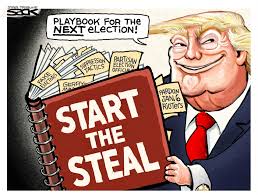 So, finally, I will bring Marc Elias into the discussion. “Georgia Election Deniers Deliver for Trump.”
At his rally last Saturday night, Donald Trump praised three members of the Georgia State Election Board. Calling them “pit bulls fighting for honesty, transparency, and victory,” Trump lavished praise and attention on these members of the obscure state agency — by name.
The odd exchange raised more than a few eyebrows. When I wrote about it earlier this week, I suggested that the least damning explanation was that the “three who Trump mentioned from the stage: Janice Johnston, Rick Jeffares and Janelle King have refused to acknowledge that Joe Biden won Georgia in 2020.” We now know that the real reason for Trump’s support for the election officials was far more sinister.
Late yesterday, the board approved a new rule that seeks to expand the role and authority of county boards of election in the certification process. This new rule redefines the certification process to include “reasonable inquiry” into whether the results are “complete and accurate.”
The vote to adopt this new rule was 3-2, with the Trump-endorsed members commanding the majority. It seems that Trump was prescient when he said these three members would fight for his “victory.”
That this violates state law seems clear. The obligation of county boards to certify elections is mandatory and ministerial. Nothing in Georgia law permits individual members to interpose their own investigations or judgment into a largely ceremonial function involving basic math.
For Trump, these legal niceties are beside the point. He wants to be able to pick and choose which election results are accepted based solely on the outcome. This rule is a step in that direction.
If the new rule survives the inevitable court challenge, Trump will have another powerful tool in his election subversion arsenal. If it is struck down, which seems more likely, he will claim to be the victim of biased judges and an unspecified conspiracy.
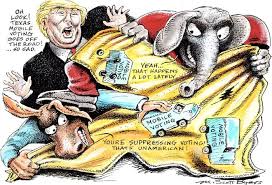 And a final one here from Matt Cohen writing at Democracy Docket. These are the people who ultimately want to replace the 14th and other Amendments concerning who votes with something more agreeable for rich old right-wing white men. “Meet the Trump-Linked Think Tank Waging a Legal War on Elections.”
By all accounts, the May presidential primary election in Georgia went as smoothly as it could have. There were no reports of long lines or malfunctioning voting machines. “Virtually none, nothing I really can report on,” Secretary of State Brad Raffensperger (R) told reporters when asked if there were any irregularities in the election. “So it’s been very, very quiet. So we’re pleased with that.”
But Julie Adams, an election board member in Fulton County — the state’s most populated county — wasn’t satisfied with the election process and refused to certify the county’s election results. Adams, who is a member of the controversial right-wing Election Integrity Network, said she wouldn’t certify because she was denied access to data and “key election information” that she claimed was necessary to see to sign off on the county’s election results. Her abstention didn’t matter, the other four board members voted to certify the election. But Adams soon filed a lawsuit against the board’s director, Nadine Williams, over the election certification process.
The lawsuit was filed on Adams’ behalf by America First Policy Institute (AFPI), a conservative think tank founded in 2021 by a handful of prominent Republicans with ties to former President Donald Trump. Although AFPI’s work spans the spectrum of right-wing policies and issues — like promoting free enterprise, immigration policy, foreign policy and other policies championed by the Trump administration — the Georgia litigation is one of several recent voting-related lawsuits that the group is involved with.
AFPI is hardly the first right-wing think-tank to get involved in election litigation. Groups like the Public Interest Legal Fund, America First Legal and Judicial Watch have made a name for themselves in the past few years for their legal assault on voting rights. But AFPI’s recent pivot to election litigation is part of a larger right-wing focus on rolling back voting rights and sowing discord in elections through the courts.
Given AFPI’s leadership ties to the Trump administration, it’s no secret that their litigation efforts in Arizona, Georgia and Texas are strategic legal moves that, should they prove successful, could have far-reaching implications in the 2024 election.
You may read more at the link. I recommend you make the site one of your daily visits. Also, you may support them and subscribe. This is one of those places where democracy matters and something is being done about it.
So, now that I’ve gone way longer than usual, I will turn the comments over to you.
What’s on your reading and blogging list today?

 peej
peej Carissa
 bostonboomer
 dakinikat
 ecocatwoman
 mablue2
 Mama Lopez
 peggysue22
 quixote
 skydancingguestblogger
 Mona (aka Wonk the Vote)



 Sky Dancing
Recent Comments