
Unemployment Details
Posted: March 4, 2011 Filed under: jobs, U.S. Economy, unemployment | Tags: BLS, Economic policy, Job Market, jobs, unemployment 12 Comments
Here’s the details on the current BLS job survey for February. It came in pretty much as anticipated. The nifty graph and the following analysis come via Calculated Risk. We can say definitively that this is the worst job market since World War 2. The recovery path has created far few jobs than any of the previous post WW2 recessions. You can’t judge a jobs market by the unemployment rate alone. The devil is definitely in the details so let’s get into the report’s finer points.
This wasn’t a great report. Heck, it wasn’t a “good” report. But it was a little better than most recent reports.
If we average the last two months together, the 63,000 payroll jobs added in January and the 192,000 payroll jobs in February, that gives 127,500 payroll jobs per month. And that is a barely enough to keep up with the growth in the labor force. Private payrolls were a little better at an average of 145,000 per month, as state and local governments continued to lay off workers (something we expect all year).
The decline in the unemployment rate from 9.0% to 8.9%, was good news, especially since the participation rate was unchanged at 64.2%. Note: This is the percentage of the working age population in the labor force.
The decreases for the long term unemployed, and for the number of part time workers for economic reasons, and the decline in U-6 to 15.9% is all welcome news – although the levels are still very high.
The average workweek was unchanged at 34.2 hours, and average hourly earnings ticked up 1 cent. Both disappointing.
You can see the details here at the BLS site. The details that are most overlooked by people that don’t know how to view unemployment statistics representing people that have become so discouraged they either leave the labor force or become what is known as ‘marginally attached’. Another tell tale sign of problems are the underemployed, workers who can only find part time jobs when they really want to work full time, and workers that are stuck working as temporary workers.
The number of persons employed part time for economic reasons (sometimes referred to as involuntary part-time workers) was essentially unchanged at 8.3 million in February. These individuals were working part time because their hours had been cut back or because they were unable to find a full-time job. (See table A-8.)
In February, 2.7 million persons were marginally attached to the labor force, up from 2.5 million a year earlier. (These data are not seasonally adjusted.) These individuals were not in the labor force, wanted and were available for work, and had looked for a job sometime in the prior 12 months. They were not counted as unemployed because they had not searched for work in the 4 weeks preceding the survey. (See table A-16.)
Among the marginally attached, there were 1.0 million discouraged workers in February, a decrease of 184,000 from a year earlier. (These data are not seasonally adjusted.) Discouraged workers are persons not currently looking for work because they believe no jobs are available for them. The remaining 1.7 million persons marginally attached to the labor force in February had not searched for work in the 4 weeks preceding the survey for reasons such as school attendance or family responsibilities. (See table A-16.)
This is a very sluggish recovery that suggests policymakers are just letting the recession take its ‘natural path’ to recovery. We definitely have do-nothing economic policy right now. What really frightens me is the forthcoming do-damage austerity policy coming from states and the federal government. We wouldn’t have the size of budget deficits that we know have if the government had spent last time healing the capital positions of Wall Street shadow banks and more time healing the jobs and household situation. After all, the real wealth and well-being in an economy comes from actual goods and services produced that add-value. There is a lot more economic well-being derived from better roads, households with modern cars and appliances, and more thriving small businesses than paperwork mills that stand between buyers and sellers of goods and services and financial gambling that drives prices of things unrealistically high through speculation.
What we need is some real leadership with knowledge of economic policy. It’s obvious from these sluggish numbers that we don’t have that at all.
There’s a good article up at Truth Out that you may want to check out. It’s called “How the Rich Soaked the Rest of Us”. It’s got some nifty graphs too. It basically explains how hoarding of money in the hands of a very few has cut off the kind of growth in industries, jobs, and commerce that would allow every one to share in a robust economy.
Over the last half-century, the richest Americans have shifted the burden of the federal individual income tax off themselves and onto everybody else. The three convenient and accurate Wikipedia graphs below show the details. The first graph compares the official tax rates paid by the top and bottom income earners. Note especially that from the end of the Second World War into the early 1960s, the highest income earners paid a tax rate over 90 percent for many years. Today, the top earners pay a rate of only 35 percent. Note, also, how the gap between the rates paid by the richest and the poorest has narrowed. If we take into account the many loopholes the rich can and do use far more than the poor, the gap narrows even more.
One conclusion is clear and obvious: the richest Americans have dramatically lowered their income tax burden since 1945, both absolutely and relative to the tax burdens of the middle income groups and the poor.
It’s obvious this tax policy has contributed to this horrible middle class against middle class anger that is contributing to the current war on teachers, firefighters, and police. The wealth accumulated from the last few decades of economic growth has shifted to the top while the burden of taking care of everything has shifted to the middle and bottom. This has fueled this dangerous resentment. Many people are clearly mad at the wrong folks. The old conservative adage is that these rich people create businesses and jobs. Evidence shows that this clearly isn’t the case.
How do the rich justify and excuse this record? They claim that they can invest the money they save from taxes and thereby create jobs etc. But do they? In fact, cutting rich people’s taxes is often very bad for the rest of us (beyond the worsening inequality and hobbled government it produces).
Several examples show this. First, a good part of the money the rich save from taxes is then lent by them to the government (in the form of buying US Treasury securities for their personal investment portfolios). It would obviously be better for the government to tax the rich to maintain its expenditures, and thereby avoid deficits and debts. Then, the government would not need to tax the rest of us to pay interest on those debts to the rich.
Second, the richest Americans take the money they save from taxes and invest big parts of it in China, India, and elsewhere. That often produces more jobs over there, fewer jobs here, and more imports of goods produced abroad. US dollars flow out to pay for those imports and so accumulate in the hands of foreign banks and foreign governments. They, in turn, lend from that wealth to the US government because it does not tax our rich, and so we get taxed to pay for the interest Washington has to give those foreign banks and governments. The largest single recipient of such interest payments today is the People’s Republic of China.
Third, the richest Americans take the money they don’t pay in taxes and invest it in hedge funds and with stockbrokers to make profitable investments. These days, that often means speculating in oil and food, which drives up their prices, undermines economic recovery for the mass of Americans and produces acute suffering around the globe. Those hedge funds and brokers likewise use part of the money rich people save from taxes to speculate in the US stock markets. That has recently driven stock prices higher: hence, the stock market recovery. And that mostly helps – you guessed it – the richest Americans who own most of the stocks.
It’s obvious that we’ve basically slowed the US jobs and growth machine down with policy that siphons off economic growth to wealth hoarding instead of job-creating businesses and infrastructure. It’s time to find some leaders that realize this and will do what it takes to get us off the ‘natural’ sluggish path and on the path to a better future for every one. Until we actually have real commerce producing real goods and services being serviced by people with real jobs, we’re not going to see much of a change. Shuffling paper, creating exotic financial instruments and bubbles, and devastating people’s home values and savings through speculative quagmires isn’t getting the majority of us anywhere. It’s time for the majority of us to stand up and demand that our tax dollars and policies represent improvements for all. It’s time to end privatization schemes, excessive speculation, and captured regulators and move back to the days of when our economy benefited more than just the privileged few.
update: You may want to check out this study at Brookings Institute: Have Earnings Actually Declined?
This analysis suggests that earnings have not stagnated but have declined sharply. The median wage of the American male has declined by almost $13,000 after accounting for inflation in the four decades since 1969. This is a reduction of 28 percent!
Don’t Quit Your Job if you can Help It!
Posted: May 8, 2009 Filed under: U.S. Economy, Uncategorized | Tags: Job Losses, Job Market, Unemployment Rate Comments Off on Don’t Quit Your Job if you can Help It!April’s employment data was released today. We now stand at an 8.9% unemployment rate which represents a 26 year high. Every one appears to be spinning away the bright side of over 539,000 lost jobs with the refrain that at least it’s not as bad as it was in January. 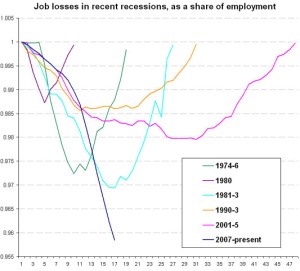 But, just because it’s marginally better, doesn’t mean the worst is over. All time series have variation and this may or may not signal the end of the worst of the worst monthly losses.
I’m still trying to figure out how people are finding glimmers of hope in this news given the historical perspective shown in this graph from the NY Times as presented by its blog Economix. This compares the current recession to previous recessions. As you can see, we’re still straight off the cliff at this point. Equally impressive is this graph from Market Watch which shows the monthly change in nonfarm payroll growth. It seems that the monthly changes may have bottomed, but it’s way too early to tell if there’s going to be any improvement. That’s when you have to examine some of the underlying factors in the market. Remember, variation in any series is to be expected so you’ll get ups and downs just from random variation. Those movements don’t necessarily indicate a trend. What do economists say about these numbers?
From Economix:
“The employment data do not yet corroborate the extent of the diminishment of the intensity of the recession suggested by other economic indicators (ISMs, consumer confidence, etc,). However, if we continue to see declines in the four-week average of jobless claims (which has fallen for four straight weeks), this may suggest smaller declines in employment later in the second quarter. Nonetheless, relating this report to the bank stress tests, the unemployment rate in April is already at the “alternative more adverse” average level assumed for the 2009…” — John Ryding, Conrad DeQuadros, RDQ Economics
“In April, more than one in four unemployed workers, 27.2 percent, had been without jobs for six months or longer, the highest rate on record since the government started calculating this statistic in 1948.” — National Employment Law Project
“The unemployment rate rose to 8.9 percent, but this is entirely due to a surge in the size of the labor force, as household employment is reported to have risen…
“[W]ith the smaller headline job loss number, many are interpreting the April employment report
as yet another sign that the economy is “stabilizing,” but the more accurate assessment is that the economy’s pace of contraction is slowing, which is not quite the same as stability and is still a long way from the economy actually improving.” – Richard F. Moody, chief economist, Forward Capital, LLC


 peej
peej Carissa
 bostonboomer
 dakinikat
 ecocatwoman
 mablue2
 Mama Lopez
 peggysue22
 quixote
 skydancingguestblogger
 Mona (aka Wonk the Vote)



 Sky Dancing
Recent Comments