
Many Saw It Coming
Posted: May 19, 2012 Filed under: financial institutions, Global Financial Crisis | Tags: James Kenneth Galbraith 19 CommentsOne of the weirdest memes I’ve heard recently is that no economist or person with a finance background could have seen the global financial crisis coming. That’s quickly followed by no one knew it would be so deep and so hard to escape. Then, there’s the entire weirdness surrounding the tropes that just cutting taxes and balancing budgets will solve all the problems.
 I read this Galbraith article over at Truthdig and wanted to share it because it just says all that many of us economists saw coming, see happening, and shake our heads at now. I personally expected the subprime credit markets to blow up sometime in 2005. I was watching the subprime contagion spread into the major banks by 2006. I heard from Social Workers what kinds of crap was being pushed on to their clients. You can ask my colleagues. I was vocal about it. The only people that seem flummoxed are those that were taken in by Fama and his Chicago acolytes. They are also the ones spreading the worst nastiness now. It does not surprise me that Paul Ryan is one of their groupies. They’ve been perpetually wrong on things.
I don’t have a lot of time to do a big analysis of this. I also think that Saturday is the last day you want to read it. Anyway, go read the article. It’s excellent.
The most important common ground was over the depth and severity of the financial crisis. We placed it in a different league from all other financial events since the early thirties, including the debt crises of the eighties and the Asian and Russian crises of the late nineties. One of us called it “epochal” and “history-making.” And so it has turned out. What distinguishes this crisis from the others are three facts taken together: (a) it emerges from the United States, that is, from the center, and not the periphery, of the global system; (b) it reflects the collapse of a bubble in an economy driven by repetitive bubbles; and (c) the bubble has been vectored into the financial structure in a uniquely complex and intractable way, via securitization.
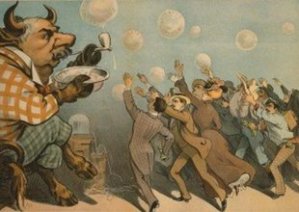
Bubbles are endemic to capitalism, but in most of history they are not the major story. In the nineteenth century, agricultural price deflation was a larger problem. In the twentieth, industrialization and technology set the direction. It was only in the information technology bubble of the late nineties that financial considerations including the rise of venture capital and the influx of capital to the United States following the Asian and Russian crises—came to dominate the direction of the economy as a whole. The result was capricious and unstable—vast investments in (for instance) dark broadband, followed by a financial collapse—but it was not without redeeming social merits. The economy prospered, achieving full employment without inflation. And much of the broadband survived for later use.
The same will not be said for the sequential bubbles of the Bush years, in housing and now commodities. The housing bubble—deliberately fostered by the authorities that should have been regulating it, including Alan Greenspan and Ben Bernanke—pushed the long-standing American model of support for homeownership beyond its breaking point. It involved a vast victimization of a vulnerable population. The unraveling will have social effects extending far beyond that population, to the large class of Americans with good credit and standard mortgages, whose home values are nevertheless being wiped out. Meanwhile, abandoned houses quickly become uninhabitable, so that, unlike broadband, the capital created in the bubble is actually destroyed, to a considerable degree, in the slump.
We’re still seeing overheated securitized assets. We’re seeing more canaries in the mine again. Think JP Morgan’s big hedge. We never have the right minds in the District dealing with the problem. This has been the case for all of this century. There’s a lot of bad thing bubbling in the financial markets right now. Now is the time to bring in the people that knew better. Not the same old suspects.

 peej
peej Carissa
 bostonboomer
 dakinikat
 ecocatwoman
 mablue2
 Mama Lopez
 peggysue22
 quixote
 skydancingguestblogger
 Mona (aka Wonk the Vote)



 Sky Dancing
Recent Comments