
Food and Gas Prices are on the Rise
Posted: March 16, 2011 Filed under: Economy | Tags: inflation 6 CommentsThe labor department released price indexes that show that how tame inflation has been in every area except two  essential things: food and oil. Most consumers do not follow the Wholesale Price Index. This is because it takes awhile for price increases in wholesale items to translate into inflation at the retail level. It doesn’t translate into a one to one increase either so it’s not a precise indicator of future inflation. Economists are interested in the wholesale index because its usually a precursor to future general price movement. The index was up 1.6 percent with most of the increase attributable to food or energy. These are price increases considered outside ‘core’ inflation. I wanted to explain some differences in inflation measures to you so you know how to understand this information.
Economists generally track the GDP deflator and the core PCE. The GDP deflator is the broadest of all the price indexes that measure inflation (price increases) or deflation (price decreases). It’s a weighted index that relies on the buying habits of current year/quarter/month GDP to weight the various contributions of price changes of goods and services. Thing bought more frequently or with larger prices have a larger weight in the index. The Consumer Price Index or CPI relies on a fixed basket or typical budget to weight the contributions of price changes to the selected group of consumer items in that index. The Personal Consumption Expenditure index or PCE is similar to the CPI in that it measures just retail prices like the CPI but it uses the average prices increases using weights on each price from the current and preceding periods. It does not rely on the fixed basket which can be seen as a typical household budget. This index removes some of the problems inherent with using the CPI that relies on its fixed basket. The most notable problem is the substitution impact which means people move their budgets around when prices change. They substitute one item for another. This switch isn’t captured when the index relies on a fixed basket that doesn’t change very often.
The importance of the ‘core’ inflation measures cannot be understated here. Core indexes don’t include the most volatile items. Food and energy prices are typically removed from core indexes because they are subject to ‘shocks’ from bad weather and supply disruptions. We’re seeing a large number of disruptions right now from both weather and the political unrest in oil producing countries. Future inflation at the retail level will show up first in wholesale prices so the Wholesale Price index is seen as a predictor of future, overall, inflation. What we’re seeing now is the impact of price instability from food and energy which are not part of core inflation but are highly essential to both businesses and households. Energy is obviously important to developed economies. Food is an essential expenditure in developing nations both as an important and export.
The Labor Department said Wednesday that the Producer Price Index rose a seasonally adjusted 1.6 percent in February — double the 0.8 percent rise in the previous month. Outside of food and energy costs, the core index ticked up 0.2 percent, less than January’s 0.5 percent rise.
Food prices soared 3.9 percent last month, the biggest gain since November 1974. Most of that increase was due to a sharp rise in vegetable costs, which increased nearly 50 percent. That was the most in almost a year. Meat and dairy products also rose.
Energy prices rose 3.3 percent last month, led by a 3.7 percent increase in gasoline costs.
Separately, the Commerce Department said home construction plunged to a seasonally adjusted 479,000 homes last month, down 22.5 percent from the previous month. It was lowest level since April 2009, and the second-lowest on records dating back more than a half-century.
The building pace is far below the 1.2 million units a year that economists consider healthy.
There was little sign of inflationary pressures outside of food and energy. Core prices have increased 1.8 percent in the past 12 months.
So, what does this mean besides higher grocery bills and fill ups at the gas station? Well, first it means that households will have to rearrange their budgets so more money will go to these things than other things. But, there’s other news that could offset some of this. Oil prices are actually falling on the news of Japan’s nuclear problems.
Gas prices spiked in February and are even higher now. The national average price was $3.56 a gallon Tuesday, up 43 cents, or 13.7 percent, from a month earlier, according to the AAA’s Daily Fuel Gauge. Rising demand for oil in fast-growing emerging economies such as China and India has pushed up prices in recent months. Turmoil in Libya, Egypt and other Middle Eastern countries has also sent prices higher.
But economists expect the earthquake in Japan to lower oil prices for the next month or two, which should temper increases in wholesale prices in coming months. Japan is a big oil consumer, and its economy will suffer in the aftermath of the quake. But as the country begins to rebuild later this year, the cost of oil and other raw materials, such as steel and cement, could rise.
Oil prices fell sharply Tuesday as fears about Japan’s nuclear crisis intensified. Oil dropped $4.01, or 4 percent, to settle at $97.18 per barrel on the New York Mercantile Exchange.
There are several other things in this report. First, most of the food price increases appear to be due to really bad weather in several countries. The other more worrying contributor was the increased demand by ethanol producers for crops. This is due to increased subsidies. It seems really weird that we’re willing to cause hunger just for some energy production but that appears to be a building, long term issue. Second, the cost of clothing appears to be on the increase. This may be due to the increased costs of transportation coming with the oil or it might be an indication of future inflation. Prices rose 1 percent for clothing. That was the most in 21 years. Costs also increased for cars, jewelry, and consumer plastics. Many of these items also use petroleum products as well as require transportation. That’s a possible explanation for the price change so that would be more temporary than permanent. So, while its cheaper to buy electronics and such, it’s much more expensive to eat and drive around for the time being. Too bad we can’t eat our MP3 players.
I’m sure the FED is watching this since many gold bugs will see this as proof that the QE2 is ratcheting up the money supply and creating inflation. The problem with this explanation is that the majority of these price increases can be attributable to fundamentals in markets that are typically volatile anyway. At this point, I still wouldn’t worry about inflation if I were in charge of policy. I’m still focused on the horrible unemployment rate and the recessionary pressures that decreased state and federal spending will bring. My best guess is that as folks adjust their budgets for food and gas price increases that we’ll see some pretty good sales on other things. You’ll feel these price increases more if you’re poorer and your budget is mostly food and gas expenditures. Otherwise, you’ll see offsets in other expenditures so it will just shift your expenditures around.
If the Turkey didn’t put you to sleep …
Posted: November 26, 2010 Filed under: The Great Recession, U.S. Economy | Tags: Bruce Bartlett, Bush tax cuts, deflation, FOREX, inflation, Martin Feldstein, QE2, supply side fairy tales, voodoo economics 9 CommentsEconomics doesn’t take holidays. It’s probably why we economists are so grim. Just in case you need a good nap, here’s some of my pointy head friends with 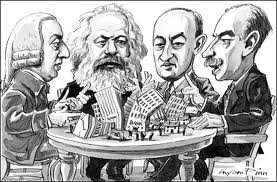 bow ties discussing things economic. I was going to try to spare you out of holiday cheer, but Mark Thoma reeled me in and now I must share.
I’ve mentioned recently how absolutely baffled I am by the number of “conservative” (i.e. radical) Republicans who keep buying into economic fallacies that even conservative (i.e. authentically conservative) economists can’t support. I mentioned Nobel Prize winning and father of the Monetarists Milton Friedman’s huge study on the Great Depression. His thesis was that very poor Fed policy made the Great Depression. In 2002, Bernake even agreed and apologized to him for the FED’s errant ways. Friedman was a consummate free marketer and wrote pop books and pop Newsweek columns during his heyday as a conservative icon. I’m sure he would not be suffering these fools were he alive today.
Thoma points to two recent columns by two former Reagan Team economists. One article is from Martin Feldstein who is probably the closest thing remaining to Milton Friedman in terms of conservative, free market, economic thought. The other is from Bruce Bartlett who was one of the fathers of Supply Side economics during the Reagan years but has since repented. He’s really adapted the Friedman statement “We’re all Keynesians now”. Both economists are intent on stopping this current batch of policy nincompoops from recreating The Great Depression.
The first Thoma thread references Feldstein who writes on the QE2 at Project Syndicate. Feldstein was Chair of Reagan’s Council of Economic Advisors and was President of the NBER. You may recall that NBER dates business cycles for the country. I want to hit his bottom line first so those of you that are using this for nap material can see that it’s ludicrous to think the QE2 is wild-eyed and out-there policy experimentation.
In short, the Fed’s policy of quantitative easing is likely to accelerate the rise of the renminbi – an outcome that is in China’s interest no less than it is in America’s. But don’t expect US officials to proclaim that goal openly, or Chinese officials to express their gratitude.
China is experiencing inflation. We are experiencing deflation. The reason this is good for both countries is that it will offset each of these pressures. Feldstein explains the goal of the QE2 in terms of US policy first. I’ll cover that quote. You’ll need to go read the explanation for the China side of the equation too.
The United States Federal Reserve’s policy of “quantitative easing” is reducing the value of the dollar relative to other currencies that have floating exchange rates. But what does the new Fed policy mean for one of the most important exchange rates of all – that of the renminbi relative to the dollar and to other currencies?
The effect of quantitative easing on exchange rates between the dollar and the floating-rate currencies is a predictable result of the Fed’s plan to increase the supply of dollars. The rise in the volume of dollars is causing the value of each dollar to fall relative to these currencies, whose volume has remained constant or risen more slowly.
The Fed’s goal may be to stimulate domestic activity in the US and to reduce the risk of deflation. But, intended or not, the increased supply of dollars also affects the international value of the dollar. American investors who sell bonds to the Fed will want to diversify the dollars that they receive from it. One form of that diversification is to buy foreign bonds and stocks, driving up the value of those currencies.
The result of this move will be to make our exports more competitive abroad and to make every one else’s exports–including those countries that have pegged their currencies to the dollar in an unfair manner–less competitive. We are simply turning the tables on the beggar-thy-neighbor growth policy China and others have adopted. The Fed is doing this because there is no will on the part of domestic policy makers to stimulate the demand in our country for consumers or government. There are 4 major parts of GDP. If fiscal policy doesn’t stimulate Consumption or Government demand, then there remain Investment and Exports. Investment is the least reliable form of demand and is rather small compared to the rest of the economy. The Fed is trying to tackle the aggregate demand shortage as best it can in response to the laws that compel it to act when unemployment is high.
Which brings me to the Bruce Bartlett thread. Bartlett has a piece today up at The Fiscal Times called ‘Starve the Beast: Just Bull, not Good Economics’. As some one who is currently suffering from a governor who has selectively adopted the policy as a path to the White House, I personally can tell you that it is very much Bull and causes a lot of undue suffering. It is ideology chosen over fact, logic, and above all, compassion. Bartlett goes straight to the heart of Voodoo Economics by using data to show that Dubya Bush’s embrace of of tax cuts in his first term as president did nothing to further economic growth and did everything to drive us in to unnecessary deficit spending.
It ought to be obvious from the experience of the George W. Bush administration that cutting taxes has no effect whatsoever even on restraining spending, let alone actually bringing it down. Just to remind people, Bush inherited a budget surplus of 1.3 percent of the gross domestic product from Bill Clinton in fiscal year 2001. The previous year, revenues had been 20.6 percent of GDP, spending had been 18.2 percent, and there had been a budget surplus of 2.4 percent.
When Bush took office in January 2001, we were already well into fiscal year 2001, which began on Oct. 1, 2000. He immediately pushed for a huge tax cut, which Congress enacted. In 2002 and 2003, Bush demanded still more tax cuts, even as the economy showed no signs of having been stimulated by his previous tax cuts. The tax cuts and the slow economy caused revenues to evaporate. By 2004, they were down to 16.1 percent of GDP. The postwar average is about 18.5 percent of GDP.
Spending did not fall in response to the STB decimation of federal revenues; in fact, spending rose from 18.2 percent of GDP in 2001 to 19.6 percent in 2004, and would continue to rise to 20.7 percent of GDP in 2008. Insofar as the Bush administration was a test of STB, the evidence clearly shows not only that the theory doesn’t work at all, but is in fact perverse.
There is nothing better than an addict who has fought their demons and comes out the other side to explain exactly why the demon should die. Bartlett succinctly explains why the Republicans continue to support the ideology and the drivel despite evidence that everything they believe is quite false.
Nor was Bush’s budgetary profligacy limited to programs that could be justified, however loosely, on national security grounds. As I detailed last week, he and a Republican Congress created a massive new entitlement program, Medicare Part D, to buy the votes of seniors and buy themselves reelection in 2004. Among those voting for this monstrosity were many Republicans still in Congress today who are unjustly considered to be staunch fiscal conservatives, including incoming Speaker of the House John Boehner, House Majority Leader Eric Cantor, and House Budget Committee chairman Paul Ryan.
Because of its obvious ridiculousness, one seldom hears conservatives say openly that tax cuts automatically reduce spending. But it still underpins the entire Republican budget strategy — tax cuts never have to be paid for, no meaningful spending cuts are ever put forward, earmarks and foreign aid are said to be the primary sources of budget deficits, and similar absurdities.
Both of these men have written tractable–albeit, tough–reads on policy decisions that people really need to understand. I know there is a tendency this time of year to wallow in football games, shopping binges, and short term feel good embrace of childhood memories, but really, there is a lame duck congress in session and an incoming group of Congressional morons with a President in office who wants to play Let’s Make a Deal with them.
If you can awake from tryptophan dreams long enough to read these two articles thoroughly, please do so. We can’t afford any more Voodoo policy mistakes.
Inflation: Not a Problem
Posted: November 18, 2010 Filed under: The Media SUCKS, U.S. Economy | Tags: CPI, inflation, logical fallacies, PCE, PPI, stupid conservative idealogues 36 Comments
Core Inflation: the Japanese Stagnation compared to the U.S. Great Recession via the SF Fed and Mary Daly.
This is one of the posts that I want to use to debunk that stupid cartoon that I keep seeing on Facebook. That cartoon also brought on many comments that come under the classification of ‘fallacy’. A fallacy is a type of error in reasoning. I have to identify the common ones we see when folks discuss economics when teaching economics. The fallacy associated with comments I see about inflation recently come under the heading of unrepresentative samples. People make hasty generalizations that because one thing they experience is true, they can generalize that experience to everything.
These inflation fallacies pretty much fall into line. It’s like, I went to the grocery store, I’ve been keeping track of what I’ve been paying for meat and that’s going up. Therefore, inflation must be a problem. (The other one I’ve been hearing is about rising taxes which I’ll debunk in another post. Let me stick to this one first.) So, first, inflation is not just the increase in one or two prices, it’s the increase in the average price levels in a country. That means everything. Not only the meat at the grocery store in your town, but the average prices every where in the country for the price of meat and everything else. While, your meat is going up, I’ll raise you that pound of brisket and tell you how cheap it is to buy a HD TV or a normal pair of jeans these days, or for that matter any apparel. But then, I’d just be engaging in the same fallacy. So, instead I’ll go with defining inflation, showing you how we measure it as economists, and then letting you look at the numbers. That graph top left is a good illustration of the average prices in the country as measured by the CPI or Consumer Price Index through September. Average Prices as measured by this index–which is the index quoted in that silly cartoon–show a distinct downward trend. This indicates deflation not inflation.
That’s just the CPI which actually tends to overstate prices which is why economists and the FED don’t use the CPI to gauge inflation. It’s been discredited since the 1980s as having distinct biases. Part of this is because it only applies to retail prices. Another part is that it uses a basket of typically purchased consumer goods and until the basket is changed, the weights of each price in the index reflect the basket. For example, if the basket still had VCR players in it, that would be a problem. The basket has to be re-arranged ever so often or it doesn’t reflect the actual buying patterns or budgets of typical U.S. consumers in the top 40 cities where the prices are collected by the BLS. The Fed doesn’t even collect the inflation numbers, the BLS does. The BLS also collects the unemployment and jobs market information. The FED reports them in addition to the BLS and uses them for their studies.
The three main inflation indexes most people hear about are the CPI(the Consumer Price Index), the PPI (the Producer Price Index) and the GDP Deflator. The CPI only tracks retail prices. The PPI tracks whole sale prices. The GDP Deflator tracks and weights all prices by what they represent of the current period GDP. It’s the most broad-based and least biased because of that weighting system instead of the basket. It reflects “average prices” of everything in the country. Most economists use the GDP Deflator unless they are specifically interested in how prices impact households.
The FED uses the PCEPI or Personal Consumption Expenditures Price Index to measure inflation for households. It is less volatile than the CPI and looks at ‘core inflation’. It is also a chained index which means there is no fixed base and it looks at inflation from quarter to quarter. The other indexes use base years which is why you typically see things like REAL (meaning it’s deflated) GDP in 1984 dollars or 1991 dollars. That means those measures are tied to the purchasing power of the base year of the index.
The FED uses the PCE–and has since 2000-which has indicated about 1/3 less inflation than the CPI. This is because of those statistical biases we mentioned above in the way the CPI is calculated (not a chain index) and in the way it uses a basket. The reason that the FED pays attention to “core” prices is because of seasonality that is present in things like food prices and gas prices. Food prices tend to change based on season for obvious reasons and people will substitute in and out of products that are lower in price and ‘in’ season. The CPI does not reflect this because of its use of the constant basket. It has a ‘substitution’ bias.
Economists detect and detrend series like these for seasonality. The biggest example of seasonality is in retail sales which typically peak extensively in November and December. It’s not part of an overall trend in the series. It’s just a recurring blip that we can account for by figuring out what magnitude it tends to be each season.
So let me go back to FedViews and an article over at Mark Thoma’s Economist’s View and talk about why inflation is not a problem, even though the meat prices at your market may be. Then there’ this from the Clelevand FED’s expectations of future inflation today.
The Federal Reserve Bank of Cleveland reports that its latest estimate of 10-year expected inflation is 1.50 percent. In other words, the public currently expects the inflation rate to be less than 2 percent on average over the next decade.
The FT puts this in perspective.
Expected inflation over every time horizon longer than six years is now at its record low in the period since 1982 that the series covers. Expected inflation over the next ten years is now down to 1.5 per cent per annum.
The Cleveland Fed index is not the last word on inflation expectations but it is certainly reason to think that those QE2 = hyperinflation fears are somewhat misplaced…
Mark Thoma responds to an outrageous letter by a bunch of miscreants at the WSJ that have the audacity to scare people with inflation fears. It links to this “Open Letter To Ben Bernanke” and includes such ‘distinguished’ economists as “William Kristol, Editor, The Weekly Standard“. Actually, the signatories aren’t distinguished economists at all. They’re mostly political hacks and conservative policy ideologues.
I doubt the invisible inflation vigilantes will change their tune, but it’s hard to find evidence of inflation worries in the data. If anything, markets are reassessing the Fed’s ability to stop disinflation.
You can also see that Paul Krugman has disinflation concerns and he has a nifty graph up also. There is no inflation, there is deflation or disinflation.
The people who put out that cartoon also fall under the heading of ideologues and miscreants. The cartoon uses cute little funny speaking creatures to lead you into logical fallacies. You watch them and think, why yes this must be true because I just paid more for a pack of pork chops last week when the price most likely reflected the hog cycle. (Yes, hogs have gestational periods and some times even the best farmers don’t plan pig pregnancies at opportune times for household demand.)
So, I hope this gives you enough information on inflation to know that it is not a problem for the country. You really don’t want me to make you do the underlying calculations to all these indexes, but if you want to torture yourself, any Principles of Economics textbooks will put you through the paces. Oh, and don’t buy used cars or the Brooklyn Bridge from any of the shiesters who signed that WSJ editorial or any of them that put out that silly cartoon.
Update: Here’s some data on State Revenues from taxes even though I said I’d wait for another post to debunk that portion of that silly little cartoon. I’ve already explained how quantitative easing is not printing money, but I’ll do it again shortly because the blasted cartoon is getting more steam. It’s like some stupid chain letter now!
The data is from The Nelson Rockefeller Institute of Government at NYU-Albany and it shows how revenues from taxes are way down from the pre-recession period although slightly up this year from last. That includes all forms of taxes taken in at the state level. You can see if your state’s tax revenues are up or down in a Table 3.
It’s the Jobs Stupid!!
Posted: July 15, 2009 Filed under: U.S. Economy | Tags: Consumer Price Index, economic growth, inflation, jobs, US Industrial Production Comments Off on It’s the Jobs Stupid!!
From Brad DeLong: http://delong.typepad.com/sdj/2009/07/bad-news-about-industrial-production-sigh.html
Here’s a trajectory for POTUS to chew on from the recently released statistics on Industrial Production and Capacity. This is a key indicator of an economy’s well being. It’s down again. There’s something about Obama’s use of the words “right trajectory” on Anderson Cooper the other night that makes me think he should ask Harvard to give him a bit of a refund on that ‘education’. How hard is to understand that when production keeps falling that is not a good trend? He’s had to have the inside scope on these numbers for at least a week. Why give Cooper and the world the impression of something else?
Industrial production decreased 0.4 percent in June after having fallen 1.2 percent in May. For the second quarter as a whole, output fell at an annual rate of 11.6 percent, a more moderate contraction than in the first quarter, when output fell 19.1 percent. Manufacturing output moved down 0.6 percent in June, with declines at both durable and nondurable goods producers. Outside of manufacturing, the output of mines fell 0.5 percent in June, and the output of utilities increased 0.8 percent. The rate of capacity utilization for total industry declined in June to 68.0 percent, a level 12.9 percentage points below its average for 1972-2008. Prior to the current recession, the low over the history of this series, which begins in 1967, was 70.9 percent in December 1982.
The graph (which uses seasonally adjusted data) comes from Brad Delong’s “Bad News About Industrial Production”. I would imagine his education taught him the right frame for what is the ‘right trajectory’ and the ‘wrong trajectory’ when discussing macroeconomics with his UC Berkely Students. I know my economics professor Campbell R. McConnell taught me well at the more humble University of Nebraska where I cut my economist baby teeth. Now, I know we’re supposed to be a service economy and that things like manufacturing, transportation and mining aren’t supposed to be relevant to us any more. I still can’t help asking how many young people with nothing more than a devalued high school diploma would rather face a life building cars than mowing the lawns of Goldman Sachs Bankers? Is any one beginning to have similar questions on the mythical hope and change meme of last year? Is it still just you and me? The Sinoperuvian lesbians of hillbilly America?
Today, even the editorial page of the Gray Lady even asked the right questions.
Unemployment is rising. Foreclosures are surging. Lending is still constrained. So why exactly is the Obama administration waiting to act?
Their answer is not so different from mine of the past two days.
If wait-and-see is anything other than a near-term tactic, it’s bound to be a miscalculation. The need for expanded relief and recovery efforts is compelling. Rather than avoid those fights, the Obama team must win them.
The Index of Industrial Production is a key leading indicator of macroeconomic health. It is released monthly by the Fed. “The indicator measures the amount of output from the manufacturing, mining, electric and gas industries. The reference year for the index is 2002 and a level of 100.” It is sitting now at 95.4 (which of course is less than 100) which means it’s lower than it was when the index was set. It measures REAL production output. This means were producing less stuff and of course, that means there are less people necessary to hired to produce less stuff. That’s not good.
Charge! (Or Not)
Posted: June 4, 2009 Filed under: Equity Markets, Global Financial Crisis, Team Obama, U.S. Economy | Tags: Bernanke Testimony, Budget Deficit, Deficit Spending, fiscal policy, inflation Comments Off on Charge! (Or Not)Fed Chairman Ben Bernanke testified before congress this week and highlighted one of the big future worries facing the economy. What will be the impact of all this government borrowing on the near and long term economic look and the financial markets? Brad Setser put the deficit explosion into perspective in his blog at the Council of Foreign Relations on June 2.
The story is clear. Government borrowing has increased dramatically. It topped 15% of GDP in the last two quarters of 2008. In 2007 and early 2008 it was more like 3% of GDP. But private borrowing has fallen equally sharply. Total borrowing by households and firms fell from over 15% of GDP in late 2007 to a negative 1% of GDP in q4 2008.
…
Both charts highlight the risk that worries me the most. In both the early 1980s and the first part of this decade, both the private sector and the government were large borrowers. And in both cases, borrowing rose faster than domestic savings, so the gap was filled by borrowing from the rest of the world. The trade and current account deficit rose. In the early 1980s, the US attracted inflows by offering high yields on its bonds. More recently, it did so by borrowing heavily from Asian central banks, together with the governments of the oil-exporting countries. But now yields are low (even after the recent rise in the yield on the ten year Treasury bond), and need to be low to support a still weak US economy. And China (and others) are visibly uncomfortable with their dollar exposure; banking on their continued willingness to finance a large external deficit seems like a stretch.
The challenge this time around consequently will be to bring down the government’s borrowing as private borrowing resumes.

 peej
peej Carissa
 bostonboomer
 dakinikat
 ecocatwoman
 mablue2
 Mama Lopez
 peggysue22
 quixote
 skydancingguestblogger
 Mona (aka Wonk the Vote)



 Sky Dancing
Recent Comments