
Chain, Chain, Chain …
Posted: July 13, 2011 Filed under: Economy | Tags: Chained CPI, inflation impacting the elderly 19 CommentsSo I thought I’d write a brief post on one of the topics that has come up with social security reform. That would be switching the Social Security COLA (Cost Of Living Adjustment) from the CPI-W to the Chained CPI. E conomists widely agree that the CPI-W overstates the rate of inflation. However, there are some other considerations to look at when undertaking any change. Kevin Drum from MoJo explains the problems with the CPI-W which is an inflation index based on a fixed basket of goods and is widely criticized for having a bunch of problems including substitution bias.
The reason is something called “upper level substitution bias,” which means that instead of always buying a standard basket of goods and services, people change their buying habits over time as prices change. When the price of hamburger goes up, they eat more chicken. When the price of chicken goes up, they switch back to hamburger. A version of CPI that takes this into account is called chained CPI, and overall it’s considered a more accurate reflection of actual inflation. But technical merits aside, there are always winners and losers when you make changes to statistics like this. One big loser would be Social Security beneficiaries. Initial Social Security benefits upon retirement are calculated based on wage levels, so they’d be unaffected by a switch to chained CPI. But annual COLA increases would be affected, and they’d be lower than they are now.
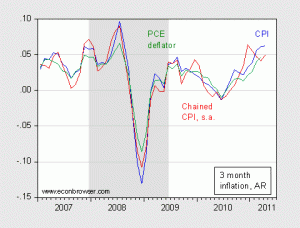 Menzie Chinn at Econbrowser has a nifty graph showing the differences in three measures of inflation. The blue line is the traditional CPI that’s now the basis of the Social Security COLA. The Green line is the PCE Deflator which is a more general measure of consumer inflation that’s not attached to a fixed basket of goods. This is the measure that the Fed tends to follow. The red line is the Chained CPI.
Chinn has a general discussion of each of these indices too. The CPI basket which is used to weight price changes updates every two years now. The chained CPI uses weights that are constantly changing and more realistically reflect changes in consumer buying habits. This avoids the substitution bias.
The BLS collects the buying habits and prices of typical urban consumers monthly and provides the data in the form of the inflation indices. You can read about the chained CPI and the methodology used to calculate it here. It’s been in use since 2002. The most basic explanation of the differences is explained at the FAQ provided by the BLS.
In its final form, the C-CPI-U is a monthly chained price index with the expenditure weights varying each month. The CPI-U and CPI-W, on the other hand, are biennial chained price indexes where their expenditure weights are updated every two years. Within the two-year span, these indexes are fixed-weight series, where the changes in these indexes reflect only changes in prices, and not expenditure shares, which are held constant.
Dean Baker has some information worth considering before we suggest that the change to the chained index is the best move. Using the Chained CPI may reduce overall costs while still providing a COLA, but the index may not reflect price changes that specifically impact the elderly population in the US.
It is not clear that the Chained CPI is more accurate than the current measure. The Bureau of Labor Statistics (BLS) has found that an experimental elderly index (CPI-E), that tracks the consumption patterns of people over age 62, actually shows a higher rate of inflation for the elderly than the CPI currently used for adjusting Social Security benefits.
While the CPI-E is not a full index since it does not look at the specific items bought by the elderly and the specific outlets they use for their shopping, there is no reason why BLS could not construct a full CPI-E. If the concern is having an accurate cost of living adjustment then it would seem that you should support having Congress instruct BLS to construct a full CPI-E. For my part, I don’t know whether this measure would show a higher or lower rate of inflation than the current CPI used for indexing benefits, but it would be a more accurate measure.
As it stands, switching to a Chained CPI would undoubtedly mean a cut in scheduled benefits, regardless of whether or not it involves a more accurate cost of living adjustment. Using this measure of the CPI would reduce benefits for retirees by 3 percent in 10 years, 6 percent in 20 years and 9 percent in 30 years. We know that the vast majority of retirees are struggling to make ends meet already. Retirees are not the people responsible for wrecking the country’s economy. Social Security benefit cuts of this magnitude seem like a major step in the wrong direction.
Inflation has not been much of a problem for this country since the mid 1980s. Since we are aware that too much money chasing too few goods is the basis of inflation and the FED is committed to not letting inflation get out of hand, it’s unlikely that we’ll see problems with inflation. The only thing that would lead–at this point in my mind–to major price disruptions would be a politicized FED that abused monetary policy or some brand of gold bug craziness that put us back on a hard currency. The last problem would cause incredible, destabilizing deflation since a fixed medium of exchange in a growing economy causes the opposite problem. That would be too little money chasing lots of goods.
Probably the best thing to do at this point would be to ask the CBO to study which index realistically represents changes to the cost of living, then seeing if the savings is worth it at the aggregate level. Dean Baker has this suggestion.
The Bureau of Labor Statistics’ (BLS) Experimental Price Index for the Elderly has consistently shown a somewhat higher rate of inflation for the elderly population.
If the concern is accuracy, then the route should be to have the BLS construct a full elderly index that could take account of actual purchase substitution patterns among elderly consumers. Simply switching to the C-CPI-U without undertaking this research is consistent with a desire to cut Social Security, not to make the COLA more accurate.
This is probably a better idea since the elderly are more likely to spend more on health care where costs have been rising astronomically. They are also less likely to buy other kinds of consumer goods. A CPI based on a senior basket of goods may be more appropriate.

 peej
peej Carissa
 bostonboomer
 dakinikat
 ecocatwoman
 mablue2
 Mama Lopez
 peggysue22
 quixote
 skydancingguestblogger
 Mona (aka Wonk the Vote)



 Sky Dancing
Recent Comments