
Unnamed Hedge Fund or Investor Earned $10 Billion Betting on U.S. Downgrade
Posted: August 8, 2011 Filed under: U.S. Economy, U.S. Politics | Tags: Eric Cantor, gambling, George Soros, hedge funds, Standard and Poor's, The Daily Mail 22 Comments
A mystery investor or hedge fund reportedly made a bet of almost $1billion at odds of 10/1 last month that the U.S. would lose its AAA credit rating.
Now questions are being asked of whether the trader had inside information before placing the $850million bet in the futures market.
The Daily Mail suggests this might involve George Soros, but a knowledgeable source denied it. The article also suggests that whoever made the bet could have had inside information–arguing that Obama and Geithner seem to have known for some time that a downgrade by S&P was in the works. Of course The Daily Mail is a conservative rag.
The latest bet was made on July 21 on trades of 5,370 ten-year Treasury futures and 3,100 Treasury bond futures, reported ETF Daily News.
Now the investor’s gamble seems to have paid off after Standard and Poor’s issued a credit rating downgrade from AAA to AA+ last Friday.
Whoever it is stands to earn a 1,000 per cent return on their money, with the expectation that interest rates will be going up after the downgrade.
Recall that Eric Cantor was revealed to have an investment that would have paid off handsomely if the U.S. had defaulted. Salon reported on June 27:
Last year the Wall Street Journal reported that Cantor, the No. 2 Republican in the House, had between $1,000 and $15,000 invested in ProShares Trust Ultrashort 20+ Year Treasury EFT. The fund aggressively “shorts” long-term U.S. Treasury bonds, meaning that it performs well when U.S. debt is undesirable. (A short is when the trader hopes to profit from the decline in the value of an asset.)
According to his latest financial disclosure statement, which covers the year 2010 and has been publicly available since this spring, Cantor still has up to $15,000 in the same fund. Contacted by Salon this week, Cantor’s office gave no indication that the Virginia Republican, who has played a leading role in the debt ceiling negotiations, has divested himself of these holdings since his last filing.
Why are these kinds of investments bets even legal? This is nothing but high stakes gambling, and it’s just plain wrong.
Should US Congressmen be able to make Financial Bets Against the US?
Posted: July 8, 2011 Filed under: John Birch Society in Charge, Psychopaths in charge, The Media SUCKS, We are so F'd | Tags: betting against America, Eric Canttor, hedge funds, TPS 34 Comments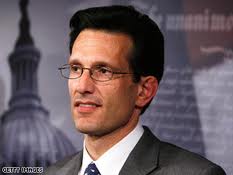 Just about the time I think I’ve seen about the worst of the worst coming out of the US congress, another Congressman finds a new bottom. The WSJ has reported that House Majority Whip Eric Cantor stands to gain financially from a U.S. default on the debt ceiling . (Basically, he’s shorted Treasuries). That’s something Cantor seems hellbent on happening. Congressman Cantor has made bets against US Treasury bonds that stand to pay if he can make it happen. Unfugginbelievable!
Putting his money where his mouth is? Eric Cantor, the Republican Whip in the House of Representatives, bought up to $15,000 in shares of ProShares Trust Ultrashort 20+ Year Treasury ETF last December, according to his 2009 financial disclosure statement. The exchange-traded fund takes a short position in long-dated government bonds. In effect, it is a bet against U.S. government bonds—and perhaps on inflation in the future.
Salon‘s Jonathan Easley looked into the potential financial windfall for Cantor right after Cantor shut down talks with Biden and other Democrats on the budget and the debt ceiling. Cantor is the House Majority Leader so he plays an important role in getting the majority to vote for any potential deal. Even if a deal can be reached, Cantor could stall it and make money.
Unless an agreement can be reached, the U.S. could begin defaulting on its debt payments on Aug. 2. If that happens and Cantor is still invested in the fund, the value of his holdings would skyrocket.
“If the debt ceiling isn’t raised, investors would start fleeing U.S. Treasuries,” said Matt Koppenheffer, who writes for the investment website the Motley Fool. “Yields would rise, prices would fall, and the Proshares ETF should do very well. It would spike.”
The fund hasn’t significantly spiked yet because many investors believe Congress will eventually raise the debt ceiling. However, since Cantor abruptly called off debt ceiling negotiations last Thursday, the fund is up 3.3 percent. Even if an agreement is ultimately reached before Aug. 2, the fund could continue to benefit between now and then from the uncertainty. (One tactic some speculators are using is to “trade the debt ceiling debate” — that is, to place short-term bets on prices as they fluctuate with the news out of Washington.)
A Completely Unofficial Blog About Eric Cantor has more information on the disclosure statements filed by Cantor that indicates he has taken multiple positions against the U.S. Government. Besides buying into a vanilla mutual fund, Cantor specifically went after investments that would pay if U.S. Government finances were troubled.
Picking individual financial products is more trouble than buying mutual funds. When Eric Cantor took the trouble to pick individual investments, he chose the following:
$1-15,000 ProShares Trust Ultrashort 20+ Year Treasury ETF (TBT)
$1-15,000 iShares Barclays TIPS Bond Fund (TIPS)
$1-15,000 WisdomTree International Basic Materials (DBN)
$1-15,000 SPDR SP Metals Mining (XME)So yeah, that acronym TIPS ring a bell? It should if you read Paul Krugman..
TIPS, as I read it is basically the interest difference between nominal U.S. Bonds and Treasury Inflation-Protected Securities.Eric Cantor’s bet on the iShares Barclay’s TIPS Bond Fund is ANOTHER bet that U.S. Treasury Bonds will lose value (relative to inflation). That story from last year is actually twice as bad as it sounds.
There are huge implications here:
1. When Eric Cantor had a spare $2,000 to $30,000 laying around, he didn’t just go and buy some extra shares of Exxon or FOX stock or gold or whatever average wingnuts buy, he actively sought out a way to bet that U.S. Treasury Bonds would decline in value. He literally bet against America.
2. Eric Cantor is in the Republican leadership, and has been making open threats that he may push the United States toward defaulting on their bond obligations. If he does this, he has set himself up to profit from it. This is a really big conflict of interest.
You can learn more about how this deal works at Seeking Alpha. Hedging and speculating with these kinds of funds is not exactly a beginning investor operation.
PoliticusUSA draws the logical conclusion.
Cantor has a history of betting against America. The difference is that in 2011, he now has the power make sure that his bets pay off.
Conflict of interest, abuse of power, it doesn’t matter what you call it. Eric Cantor’s desire to make a profit based on the pain and misery of very people that he has taken an oath to represent is just plain wrong.
Eric Cantor is the Republican House leader who can’t wait to see America fail.
In fact, he’s counting on it.
Your financial destruction will be Eric Cantor’s gain.
I guess this is what Republicans mean when they refer to one of their own as a “Real American.”
So, while the country was obsessed with sexted pictures of Anthony Wiener’s junk, Eric Cantor was putting the country in the position where could make money and the rest of us could suffer. Who has the real ethics problem here?
Update: From Amanda Terkel at HuffPo
House Democrats are circulating a resolution accusing House Majority Leader Eric Cantor (R-Va.) of having a conflict of interest in the debt ceiling debate, a move that could provide an awkward C-SPAN moment for one of the lead Republicans in the budget negotiations.
The resolution goes after Cantor’s investment in ProShares Trust Ultrashort 20+ Year Treasury ETF, a fund that “takes a short position in long-dated government bonds.”
The fund is essentially a bet against U.S. government bonds. If the debt ceiling is not raised and the United States defaults on its debts, the value of Cantor’s fund would likely increase.
The Democratic resolution, obtained by The Huffington Post from a Democratic source on the Hill, argues that Cantor “stands to profit from U.S. treasury default, which thereby raises the appearance of a conflict of interest,” and that he “may be sabotaging [debt ceiling] negotiations for his own personal gain.” It’s not clear how widely the measure was being circulated, with a House Democratic aide saying they hadn’t seen the resolution or heard it being discussed.
“Majority Leader Cantor has compromised the dignity and integrity of the Members of the House by raising the appearance of a conflict of interest in negotiations with the executive branch over raising the debt ceiling,” adds the measure.
The Hedge Fund Empire Strikes Back
Posted: May 1, 2009 Filed under: Bailout Blues, Equity Markets, Global Financial Crisis, Uncategorized | Tags: bond holders, Chrylser bankruptcy, Chrysler bailout, hedge funds 2 Comments The role of hedge funds in the bankruptcy of Chrysler and GM will probably be discussed and studied for some time. It’s not often this POTUS singles out a Financial Institution for scorn since they’ve all been major donors to his campaign but POTUS made an exception when announcing the Chrysler bankruptcy. Evidently, POTUS was not amused that a few of them would not bend to his will on the deal.
The most interesting thing is that the spoilers are now responding. They are not only responding, they are making it clear that the group the cut the deal were TARP fund babies and they were not. They are actively referring themselves as the No-Tarp Gang just to make that perfectly clear.
Also, interesting is the tone of the coverage concerning the bankruptcy. A Motor Trend blog has a headline screaming Chrysler Bankruptcy “Cruel” Result of Hedge Fund Greediness. Motor Trend obviously has more interest in the Car Makers than the Deal Makers and there in lies the rub. The government-brokered deal, led by four of the biggest Tarp Babies, puts interests that are usually at the back of the line in corporate bankruptcy at the front. Basically the union employees could potentially lose it all in the bankruptcy court.
This deal, turns the entire idea of the safety and primacy of bonds in a bankruptcy deal upside down which could argueably further destabilize financial markets. So, before you accuse me of being anti-union here, which I’m not, let me talk about that. Bonds are usually first in line in any bankruptcy. It’s why they are considered less risky and yield less than their riskier cousins, the equities. Folks that buy corporate bonds play an important role in the market. They provide corporations with huge, long term sources of cash at better terms than any one of them could get from a bank.
If a deal can be cut that undercuts the nature of bonds, what would this mean to other bond holders in other deals that are likely in the bankruptcy pipe? (This would include GM and other industries.) Could this deal actually destabilize the primacy of bonds in the bankruptcy hierarchy? Is that what the fuss is about? Are they being greedy? Are they looking out for their investors? Are they posturing? I don’t think we quite know yet. But, the Hedge Funds spoke up as reported in today’s WAPO.
President Obama’s harsh attack on hedge funds he blamed for forcing Chrysler into bankruptcy yesterday sparked cries of protest from the secretive financial firms that hold about $1 billion of the automaker’s debt.
Hedge funds and investment managers were irate at Obama’s description of them as “speculators” who were “refusing to sacrifice like everyone else” and who wanted “to hold out for the prospect of an unjustified taxpayer-funded bailout.”
“Some of the characterizations that were used today to refer to us as speculators or to say we’re looking for a bailout is really unfair,” said one executive who spoke on condition of anonymity because of the sensitivity of the matter. “What we’re looking for is a reasonable payout on the value of the debt . . . more in line with what unions and Fiat were getting.”
George Schultze, the managing member of the hedge fund Schultze Asset Management, a Chrysler bondholder, said, “We are simply seeking to enforce our bargained-for rights under well-settled law.”
“Hopefully, the bankruptcy process will help refocus on this issue rather than on pointing fingers at lenders,” he said.
I supposed that I don’t have to tell you that hedge funds are not charitable organizations but many of them actually invest for charitable organizations, along with unions and state and government workers. Their clientele can be anything from a small group of rich investors, to you and me, actually. We’ve heard a lot about them recently but most people, I’d speculate, don’t know a lot about what they are and what they do. Hedge funds came onto the scene in the 1950s and what mostly defines them is their regulation regime.
Here’s an easy definition from a website at the University of Iowa.
“Hedge fund” is a general, non-legal term that was originally used to describe a type of private and unregistered investment pool that employed sophisticated hedging and arbitrage techniques to trade in the corporate equity markets. Hedge funds have traditionally been limited to sophisticated, wealthy investors. Over time, the activities of hedge funds broadened into other financial instruments and activities. Today, the term “hedge fund” refers not so much to hedging techniques, which hedge funds may or may not employ, as it does to their status as private and unregistered investment pools.
Hedge funds are similar to mutual funds in that they both are pooled investment vehicles that accept investors’ money and generally invest it on a collective basis. However, they are regulated in significantly different ways. Up until 2005, hedge funds in the United States often relied on Section 4(2) and Rule 506 of Regulation D of the Securities Act of 1933 to avoid having to register their securities with the Securities and Exchange Commission of the United States (SEC). Further, to avoid regulation regarding mutual funds (a type of “investment company”), hedge funds relied on Sections 3(c)(1) and 3(c)(7) of the Investment Company Act of 1940. In short, hedge funds escaped most U.S. regulation directed at other investment vehicles such as mutual funds.
European nations regulate hedge funds by either regulating the type of investor who can invest in a hedge fund or by regulating the minimum subscription level required to invest in a hedge fund. In the years to come, experts are predicting the rise of an alternative regulatory framework that will be tiered yet flexible.
So Long and Thanks for All the Fish!
Posted: October 21, 2008 Filed under: Equity Markets, U.S. Economy | Tags: Financial markets crisis, hedge funds 1 CommentI was reminded of that quote from Hitch Hiker’s Guide to the Galaxy when I read this article in the UK’s Guardian. Yes, I’m an anglophile and delight in all things British from Willy S down to Monty Python. A similar goodbye came from a 37 year old retiring hedge fund manager. If you ever needed a really good clue to the issues underlying the Financial Crisis as well as what’s really wrong with our government, Andrew Lahde’s retirement tome is a good place to start.
The boss of a successful US hedge fund has quit the industry with an extraordinary farewell letter dismissing his rivals as over-privileged “idiots” and thanking “stupid” traders for making him rich.
Well, that was succinct enough, wasn’t it? Andrew Lahde’s $80m Los Angeles-based firm Lahde Capital Management in Los Angeles made it huge by betting against subprime mortgages. One of his funds returned 866% last year by taking up the position that the US home loans industry would collapse. Lucky you if you got in on his ground floor. Not content with just going quietly into the night, Lahde added this zinger to his retirement speech.
“The low-hanging fruit, ie idiots whose parents paid for prep school, Yale and then the Harvard MBA, was there for the taking,” he wrote. “These people who were (often) truly not worthy of the education they received (or supposedly received) rose to the top of companies such as AIG, Bear Stearns and Lehman Brothers and all levels of our government,” he said.
“All of this behaviour supporting the aristocracy only ended up making it easier for me to find people stupid enough to take the other side of my trades. God bless America.”
Indeed. Do we really need yet another Harvard man at the helm?

 peej
peej Carissa
 bostonboomer
 dakinikat
 ecocatwoman
 mablue2
 Mama Lopez
 peggysue22
 quixote
 skydancingguestblogger
 Mona (aka Wonk the Vote)



 Sky Dancing
Recent Comments