
Evening Reads: The Barlow* Edition
Posted: August 2, 2012 Filed under: 2012 presidential campaign, Black Agenda Report, Civil Liberties, corporate greed, GLBT Rights, Hillary Clinton, Human Rights, poverty, Women's Rights | Tags: american exceptionalism, Boehner of our existence, Chick-fil-A, Harry Reid, Michael Moore, the Constitution 19 Comments
Click for more flapper fun over at Collector’s Weekly…
Hey all, I’m filling in for Mink while she continues to rest up and recover from a nasty migraine. There’s no way I can compete with the excellent work she does on a daily basis, but I’ll try to do her Evening News space at least a fraction of the justice it deserves. Feel better soon, JJ! Sending you lots of healing energy!
So, I’d like to start with some reading on the Chick-fil-A idiocracy we live in, which IMHO, is the most definitive piece you’ll read about this mindboggling madness (though “The Chick Fellatio” gets an honorable mention.) Via Huffpo Gay Voices…
Chick-fil-A: 5 Reasons It Isn’t What You Think, by David Badash, founder and editor of The New Civil Rights Movement. I especially appreciated the last reason on the list:
5) Chick-fil-A is just exercising their First Amendment rights by running a business based on the Bible, right? Wrong. There’s a line between the “free exercise of religion” and violating the law. If Chick-fil-A is violating the law by discriminating against gay people, or by firing women so that they can be “stay home” moms, as one woman who is suing Chick-fil-A says in court documents, that’s not exercising religious expression or free speech, and that’s not a First Amendment issue. It may be, if the court decides, a violation of the law.
Thank you, David Badash!
Before I continue, I’d just like to note that we live in an era where a gun-toting embryonic chicken sandwich has more authority on interpreting the Bill of Rights and the Constitution than the average, living, breathing human being. Sad.
On the upside, Chick-fil-A manager goes against flock, sponsors gay pride festival! REFUDIATE DAT, HATERS!
Unfortunately, internal politics is a-roostin’…
“As all this news was swirling around yesterday about the Chick-Fil-A sponsorship for PrideFest, we started hearing that some people from within our own community are coming together to stand against us,” said Ryan Manseau, senior director for NH Pride Fest.
On Wednesday Manseau got a call about a major sponsor for Pride Fest being pressured by another local group to drop out because of the Chick-Fil-A sponsorship.
Let’s hope they get their feathers straightened out!
And, that is all I will link to on that. Otherwise, my puns will go further south than they already have… oops, I guess they just did 😉
Moving along. Michael Moore says… he wouldn’t say he supports Obama. And, the cow jumped over the moon.
Oh, but no worries! He and Susan Sarandon still hope O gets four more years. Well, ok. I guess that’s clarity of some sort…that means absolutely nothing.
Incidentally, because I know y’all are just dying to know. Here’s where Mona the Wonk stands:
- I’m Switzerland on Obama 2012.
- I don’t want to see Romney get four to eight years at any point on the space-time continuum.
- Hillary 2016.
 Speaking of which… While I was in the airport en route from Houston to Chicago last week, I picked up a copy of the lastest issue of Foreign Policy on the stands. I hope to do a separate post on the Hillary feature soon. A good way for me to start exercising those blogger muscles again… 😉
In the meantime, I’d like to direct you to another feature in this edition of FP–Anthropology of an Idea, “American Exceptionalism: A Short History,” by Uri Freedman. Teaser:
On the campaign trail, Mitt Romney contrasts his vision of American greatness with what he claims is Barack Obama’s proclivity for apologizing for it. The “president doesn’t have the same feelings about American exceptionalism that we do,” Romney has charged. All countries have their own brand of chest-thumping nationalism, but almost none is as patently universal — even messianic — as this belief in America’s special character and role in the world. While the mission may be centuries old, the phrase only recently entered the political lexicon, after it was first uttered by none other than Joseph Stalin. Today the term is experiencing a resurgence in an age of anxiety about American decline.
An enlightening little timeline follows at the link. Fascinating tidbits like:
1950s
A group of American historians — including Daniel Boorstin, Louis Hartz, Richard Hofstadter, and David Potter — argues that the United States forged a “consensus” of liberal values over time that enabled it to sidestep movements such as fascism and socialism. But they question whether this unique national character can be reproduced elsewhere. As Boorstin writes, “nothing could be more un-American than to urge other countries to imitate America.”
Touche. Click over and give it a look.
A couple DC headlines for y’all before I close this…
Taylor Marsh on Reid’s tax charges against Romney:
Majority Leader Reid isn’t backing down. The problem is that he’s turning into the story.
Meanwhile Boehner has stopped crying or some other such development:
House Speaker John Boehner (R-Ohio) said Thursday he is “feeling better” about Republicans’ chances of holding the House than he did in April, when he said the party faced a “one in three” likelihood of losing the majority.
“Our team’s in pretty good shape,” Boehner said as he briefed reporters in the Capitol for the final time before Congress departs for a five-week recess. “Our members have worked hard. Frankly, our candidates and challengers out there — a lot of them have been through tough primaries. And I feel good about where we are as a team. We’ve got a lot of work to do between now and November, but our team is doing well.”
Boehner’s comments in the spring warning about the possibility of losing the House were seen as an intended wake-up call to Republicans in advance of the election season. Most political analysts now believe the chances that Democrats will win back the House in November are slim. They need a net gain of 25 seats, but most projections show them gaining only in the single digits.
In other news…Americans and all citizens of Planet Earth? Still screwed.
The always essential Glen Ford at the Black Agenda Report sums it up well:
The Poverties of a Decaying System
A Black Agenda Radio commentary by Glen Ford
“This crisis of capitalism will be full of drama.”
A preview of new Census figures indicates that poverty in the United States will likely soon reach the highest levels in 50 years. Now, some of you optimists out there are saying: Well, there’s nowhere to go but up. Unfortunately, that’s not necessarily true. What I think is so depressing to many people about this particular historical juncture, is that there is absolutely nothing on the economic horizon on which even optimists can pin their hopes. There are no new industries on the verge of some huge explosion, no scientific breakthrough just around the corner. With education costs soaring, people can’t even hope to study themselves out of hard times.
It’s not a good time to be a child, because there is nothing sadder than growing up around adults who have themselves lost hope that our world will become a better place. It’s not a good time to be middle-aged, knowing that the Golden Age was 40 years ago, when the proportion of Americans in poverty was the lowest ever: only 11.1 percent. It’s expected to hit 15.7 percent under a president elected as an agent of Hope and Change.
But actually, there’s really nothing wrong with the world that a social revolution can’t fix. The fact that the two corporate political parties have no ideas worth listening to, simply means that the Democrats and Republicans can no longer even pretend that they can serve the 1% and take care of the rest of us at the same time. There’s no need to despair – just direct your political energies, elsewhere.
Well, now that I’ve brightened up your evening… 😉 … it’s your turn! Have at it in the comments, Sky Dancers.
*barlow: a girl, a flapper, a chicken.
Pay Check Fairness Act and the Politics of the Gender Gap
Posted: April 29, 2012 Filed under: Paycheck Fairness Act, War on Women, Women's Rights, worker rights | Tags: Gender Gap politics, Harry Reid, Lily Ledbetter Act 62 Comments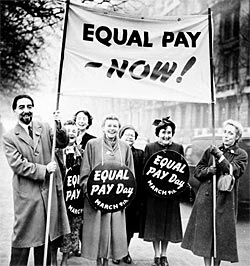 It’s evident that the Democratic Party wants that wide Gender Gap to stay right where it is until the November Elections. The introduction of the Pay Check Fairness Act may be a ploy to put Republicans and Blue Dawg Dems on the spot but it will be an interesting ploy and one to watch. The last time the bill came to the floor was in 2010.
Senate Majority Leader Harry Reid (D-Nev.) will bring to the floor in coming weeks legislation to protect women from retaliation by employers if they inquire about salaries paid to male colleagues
Republicans voted in unison to block the bill, the Paycheck Fairness Act, when it came to the floor in November of 2010.
Democrats say it will be difficult for GOP senators to back out of their opposition, especially because the U.S. Chamber of Commerce has staunchly opposed the legislation.
Mitt Romney will either have to split with Republicans and an important business group or take a position that could further erode his support among women.
“Romney’s going to be on defense on the Paycheck Fairness Act,” said a senior Democratic aide.
“Women are making 70 cents on a dollar of what a man is making. This will resonate with females across the spectrum. If Republicans to a person are coming down against it, it will be at their political peril,” the aide said.
A spokeswoman for Romney’s campaign did not respond to a request for comment.
The bill would prohibit employer discrimination for inquiring about, discussing or disclosing the wages of another employee.
It would expand the definition of wage discrimination by allowing employees to compare the pay of male colleagues not only within the same office but also with colleagues in other local offices. A female employee could allege wage discrimination if she is paid less than a male working the same job for the same employer across town.
Not a single Republican voted to advance the legislation when Reid brought it to the floor during the 2010 lame duck session, after Republicans scored a huge electoral victory but Democrats still controlled the House and Senate.
Forty Republicans and Sen. Ben Nelson (D-Neb.) voted against the legislation. Sen. Lisa Murkowski (R-Alaska) did not vote.
So why exactly do Republicans dislike the Equal Pay Act so much since its only function is to level the playing ground and prevent discrimination? Well, for one, Republicans deny that women are paid differently from men.
This morning, during a heated discussion with Rachel Maddow on Meet The Press, GOP consultant Alex Castellanos denied that women make 77 cents for a man’s dollar in the workplace and noted, “there are lots of reasons for that.” Maddow expressed shock at the assertion, but concluded that it explained why Republicans and Mitt Romney are so hesitant to embrace the Lilly Ledbetter Fair Pay Act of 2009, a law that helps women hold accountable employers who discriminate in the pay practices based on gender.
“Now we know, at least from both of your perspectives,” Maddow said, pointing to Castellanos and Romney surrogate Rep. Cathy McMorris Rodgers (R-WA), “women are not fairing worse than men in the economy that women aren’t getting paid less for equal work.” “It’s about policy and whether or not you want to fix some of the structural discrimination that women really do face that Republicans don’t believe is happening,” she added. Castellanos responded to Maddow’s policy argument by remarking on her passion, to which the MSNBC host took offense:
CASTELLANOS: It is about policy and I love how passionate you are. I wish you were as right about what you’re saying as you are passionate about it. I really do.
MADDOW: That’s really condescending. This is a stylistic issue. My passion on this issue is actually me making a factual argument on it.
My guess is that the introduction of this law is geared to force Romney to take a stand on something he’s been trying to avoid. Romney has been quite coy about his position on the Lily Ledbetter Act which was the first bill signed into law by Obama. Romney’s position on the law is unclear. This comes behind the miserable behavior of Republicans on renewal of the Violence Against Women Act. Every GOP member of the judiciary committee voted against scheduling a vote on the Act.
Romney sidestepped the controversy by announcing his support for reauthorizing the Violence Against Women Act without specifically endorsing the Senate Democratic bill. Senate Republicans quickly conceded and allowed the bill to receive a final vote without waging a filibuster.
Clearly, Reid is maneuvering these bills to put Romney and Republicans in the hot seat. This makes me wonder if we’re even going to get a fair hearing on the issues themselves. Even though Republicans will likely tank the bill, it would be nice to bring the topic into a discussion that is more about the issue and less about the political process. Greg Sargent of WAPO’s Plum Line has some of the behind the scene maneuvers.
The looming vote could revive a recent controversy that erupted around equal pay issues. On a recent Romney campaign conference call, HuffPo’s Sam Stein asked Romney surrogates whether Romney supports the Lily Ledbetter Fair Pay Act of 2009, which mad e it easier for people to challenge pay discrimination. The campaign at first waffled, but then released a statement confirming that Romney “supports pay equity and is not looking to change current law.”
But Romney’s campaign has not said whether he would have signed that law in the first place.
Now Romney’s rhetorical support for pay equity faces another test in the looming Senate vote on the Paycheck Fairness Act.
This Act would put more pressure on employers to prove that differences in wages are not rooted in gender difference, and would make it easier for employees to divulge information about their salaries, which would in turn facilitate deterring or challenging pay discrimination.
Two years ago Senate Republicans opposed the Paycheck Fairness Act, which had strong support from Obama, and it’s likely they will do so again. But Romney is on record supporting “pay equity” in principle, so he’d either have to break with that principle, or break with Senate Republicans, at a time when the battle over the female vote is raging in the presidential race. If Romney supports the measure, it could make passage of it more likely.
“This is an issue that a number of women Democratic Senators are absolutely intent on addressing — they know that with women still being paid 77 cents to each male worker’s dollar, this is an issue of fundamental fairness that women across the country face daily,” a senior aide to a female Senator says. “A lot of women who don’t necessarily see this as a partisan issue will be watching.”
The Romney campaign, in its pitch for female voters, has argued that women don’t care about social issues as much as they do about jobs, and that pocketbook issues will ultimately drive the female vote. But the Paycheck Fairness Act is a gender issue that’s all about the pocketbook and the economy.
Guess we’ll have to stay tuned to see how much we actually get to discuss this issue compared to the political wrangling designed to keep the gender gap working for the benefit of democratic politicians. Hopefully, the women in congress will add some substance to the discussion so that it becomes more than just one more partisan sideshow.
Reid Goes Nuclear
Posted: October 6, 2011 Filed under: Democratic Politics, jobs, unemployment | Tags: Harry Reid, Senate Nuclear option 8 Comments After endless Republican maneuvers to block any legislative progress in Congress, Harry Reid triggered the so-called “nuclear option” to stop a Republican attempt at symbolic vote on the President’s job bill that was bound to embarrass Reid. This move is a rarely used procedural option. The goal is to block republican amendments that are proposed after the senate has moved to vote on final passage of the bill.
Reid’s coup passed by a vote of 51-48, leaving Senate Republican Leader Mitch McConnell (R-Ky.) fuming.
The surprise move stunned Republicans, who did not expect Reid to bring heavy artillery to what had been a humdrum knife fight over amendments to China currency legislation.
The Democratic leader had become fed up with Republican demands for votes on motions to suspend the rules after the Senate had voted to limit debate earlier in the day.
McConnell had threatened such a motion to force a vote on the original version of President Obama’s jobs package, which many Democrats don’t like because it would limit tax deductions for families earning over $250,000. The jobs package would have been considered as an amendment.
McConnell wanted to embarrass the president by demonstrating how few Democrats are willing to support his jobs plan as first drafted. (Senate Democrats have since rewritten the jobs package to pay for its stimulus provisions with a 5.6 surtax on income over $1 million.)
Reid’s move strips the minority of the power of forcing politically-charged procedural votes after the Senate has voted to cut off a potential filibuster and move to a final vote, which the Senate did on the China measure Tuesday morning, 62-38.
Reid said motions to suspend the rules after the Senate votes to end debate — motions which do not need unanimous consent — are tantamount to a renewed filibuster after a cloture vote.
“The Republican Senators have filed nine motions to suspend the rules to consider further amendments but the same logic that allows for nine such motions could lead to the consideration of 99 such amendments,” Reid argued before springing his move.
Reid said Republicans could force an “endless vote-a-rama” after the Senate has voted to move to final passage.
This move came as a result of Reid trying to usher through a vote on the China currency bill. McConnell wanted to force the vote on the Obama jobs bill to demonstrate the split in the Democratic caucus on the measure. As outlined below, McConnell tried to attach the jobs bill to the Currency bill. Reid outmaneuvered them.
Tonight, McConnell made what’s called a “motion to suspend the rules,” to allow a vote on the amendments. Such motions are almost always defeated, because they require a two-thirds majority to pass. But they’re another way for the minority party to force uncomfortable votes. Even though the minority party doesn’t get a direct vote on the amendment, how somebody votes on the motion becomes a sort of proxy for such a vote. In this case, for instance, if Democrats had voted down a motion for a vote on Obama’s jobs bill, it would have put them in an awkward spot.
Though it’s been the standing practice of the Senate to allow such motions by the minority, tonight Reid broke with precedent and ruled McConnell’s motion out of order, and was ultimately backed up by Democrats.
So, the end result is that by a simple majority vote, Reid was able to effectively rewrite Senate rules making it even harder than it already is for the minority party to force votes on any amendments. Should Republicans retake the Senate next year, it’s something that could come back to haunt Democrats in a major way.
And just to clear up some confusion, what happened tonight was different than the so-called “nuclear option” to end filibusters. While triggering the “nuclear option” requires a Majority Leader to use the same sort of strategic maneuvers as Reid just did, tonight’s move had to do with the amendment process, not filibusters.
As I mentioned the other day, there are a lot of really nervous DINOs who are balking at the measures proposed by Obama to pay from the jobs act.
Democrats in the Senate were divided over the president’s original offsets to pay for his plan, most notably his call to cap deductions for families that earn more than $250,000 annually. But to unite their party, they scrapped his proposed offsets and instead added a 5.6 percent surtax on those who earn more than $1 million annually as the main way to pay for the $447 billion in spending on infrastructure and incentives for companies hiring new workers.
Before those changes were made and sensing Democratic divisions on the original plan, McConnnell went to the floor earlier this week and demanded that the president’s bill be voted on immediately — given the president’s repeated demands to pass his bill “now.”
But Reid blocked that effort, and Democrats are now moving forward with plans to bring the latest version to the floor early next week. Reid and his Democratic leadership team plan to meet at the White House on Thursday evening to talk about their strategy for the plan.
Republicans are opposed to the tax increases and spending levels in the plan and are well-positioned to block it next week since 60 votes are needed to break a filibuster. And there isn’t unanimity even among the 53-member Senate Democratic Caucus.
Nebraska Sen. Ben Nelson, a conservative Democrat who faces a tough reelection next year, said he’ll vote against efforts to bring the bill forward for debate.
If you want more background on the Democratic infighting, you can check out my post from a few days ago here. My guess is that the current polling situation has begun to make it clear to the Democratic party officials that they’re in a heap of trouble. Obama’s polling worse each day. Reid undoubtedly doesn’t want to lose his position in the Senate leadership. I keep wondering why they haven’t pulled the rug out from Mitch McConnell much earlier but I’m assuming they’ve taken their cues from the White House. Maybe this is the start of a bit more gumption.
Another Standoff
Posted: September 23, 2011 Filed under: Federal Budget, Federal Budget and Budget deficit, U.S. Politics | Tags: FEMA funding, government shutdown, Harry Reid, John Boehner 14 CommentsLet’s see. Selling out on tax cuts to millionaires was supposed to be the end all to all stand offs. Didn’t  happen. Putting together a likely unconstitutional supercongress was supposed to be the end all to all stand offs. Yeah. That really worked well, didn’t it?
Things in our federal government are so broke and so dysfunctional that the day-to-day business of governing is threatened on a quarterly basis. This is nuts. Republicans offered up a bandage approach in the House. Harry Reid’s gone Dirty Harry on them.
Washington lurched toward another potential government shutdown crisis Friday, as the House approved by a 219-203 vote a GOP-authored short-term funding measure designed to keep the government running through Nov. 18 and Democrats in the Senate immediately vowed to reject the bill.
“We expect a vote fairly quickly,” said Senate Majority Leader Harry Reid (D-Nev.) on Friday morning.
In an after-midnight roll call, House Republican leaders persuaded conservatives early Friday morning to support a stop-gap measure nearly identical to one they had rejected just 30 hours earlier. By a narrow margin, 213 Republicans supported the plan, along with six Democrats; 179 Democrats opposed it, joined by 24 Republicans.
The bill, which will keep federal agencies funded through Nov. 18, passed over staunch objections from House Democrats, who opposed a provision that would pair increased funding for disaster relief with a spending cut to a program that makes loans to car companies to encourage energy efficient car production.
But House Speaker John Boehner’s (R-Ohio) victory is likely to be short-lived. Reid said late Thursday that the measure could not pass his chamber, with a vote expected sometime Friday. A Senate defeat would leave Congress at a new standoff.
“It fails to provide the relief that our fellow Americans need as they struggle to rebuild their lives in the wake of floods, wildfires and hurricanes, and it will be rejected by the Senate,” Reid said of the House bill.
Without a resolution, the Federal Emergency Management Agency’s disaster relief fund will run out of money early next week and the rest of the government would be forced to shutdown Oct. 1.
What exactly did Agent Orange and the Rindettes offer up that made Harry mad?
On Wednesday night, House Republicans failed to pass a continuing resolution to keep the government funded beyond Sept. 30, as 48 Republicans cut ranks with their leadership and voted against the measure (as did all but six Democrats, who object to the bill’s level of disaster aid and cuts to a clean vehicle manufacturing program). House Speaker John Boehner (R-OH) was reportedly incensed at the members who abandoned him on the vote, deriding them as “know-it-alls who have all the right answers.”
But early this morning, the House was able to pass a CR, after Boehner and the Republican leadership added a $100 million cut to a Department of Energy clean-energy loan program. Other than that cut, the bill was exactly the same as the one the House defeated on Wednesday. But the additional cut was enough to entice 23 Republican members into flipping their votes.
Boehner has to be one of the worst Speakers in history. He couldn’t walk a dog through the house successfully. Here’s more on Reid’s response.
Democrats opposed the GOP bill en masse because it partially offsets $3.65 billion in funding for the Federal Emergency Management Agency (FEMA) with a $1.5 billion cut to a separate Department of Energy manufacturing loan program.
“The bill the House will vote on tonight is not an honest effort at compromise. It fails to provide the relief that our fellow Americans need as they struggle to rebuild their lives in the wake of floods, wildfires and hurricanes, and it will be rejected by the Senate,” Senate Majority Leader Harry Reid (D-Nev.) said in a statement Thursday night before the House vote.
“I was optimistic that my House Republican colleagues would learn from their failure yesterday and move towards the middle. Instead, they moved even further towards the Tea Party.”Reid said the Senate was ready to stay in session next week, potentially canceling its scheduled recess. The House bill would fund the government through Nov. 18.
By pushing ahead with a tweaked version of his original bill, Boehner is hoping to jam the Senate with time running out.
It hasn’t even been a year yet and we’ve already had three hostage taking situations. WTF is wrong with our country? We can’t even help our own people any more that have been devastated by flooding, tornadoes, wild fires and hurricanes with out turning in to a government is the problem moment?
update: Bohner lies in press conference.
“With FEMA expected to run out of disaster funding as soon as Monday, the only path to getting assistance into the hands of American families immediately is for the Senate to approve the House bill,” Boehner said in an official statement Friday morning.
Well, that’s not exactly true. The House legislation received only 36 votes in the Senate. As noted above, the Senate passed a stand-alone disaster bill last week, which the House could take up and pass instead of scattering to the four winds.
On the Senate floor just after the House bill was tabled, Reid and Senate Minority Leader Mitch McConnell (R-KY) reluctantly agreed to hold a Monday vote on compromise legislation to top-off FEMA’s disaster account, and keep the federal government funded. McConnell urged Reid to hold a Friday vote, but Reid asked for delay, with the expectation that cooler heads will prevail over the weekend. McConnell, Reid, Boehner and House Minority Leader Nancy Pelosi (D-CA) will negotiate through the weekend to break the gridlock.
Breaking: Boehner, McConnell Announce Picks for Catfood Commission II
Posted: August 10, 2011 Filed under: Medicaid, Medicare, Social Security, U.S. Economy, U.S. Politics, voodoo economics, We are so F'd | Tags: austerity, Catfood Commission II, Federal Deficit, Harry Reid, John Boehner, Mitch McConnell, Super Committe 23 Comments
Speaker John Boehner has appointed Ways and Means Chairman Dave Camp (R-Mich.), Energy and Commerce Chairman Fred Upton (R-Mich.) and Republican Conference Chairman Jeb Hensarling (R-Texas) as the House GOP members of the panel.
Hensarling will be co-chairman of the committee. Senate Minority Leader Mitch McConnell also announced Wednesday the Senate Republican members: Jon Kyl of Arizona, Pat Toomey of Pennsylvania and Rob Portman of Ohio.
Politico says that Kyl, who is not running for reelection,
will likely be a conduit to McConnell to keep him apprised of the ongoing negotiations – as he did when he served as the lead Senate GOP negotiator during the unsuccessful budget talks led by Vice President Joe Biden this summer. Portman, a former White House budget director under George W. Bush and a freshman GOP senator, has been given increased responsibilities from the leadership, including earlier this year when he helped draft a GOP jobs initiative.
From CBS News Political Hotsheet:
In a statement, McConnell said the three senators he’s chosen understand the “gravity” of the current economic climate and will bring to the table “the kind of responsibility, creativity, and thoughtfulness that the moment requires.”
“The American people know that we cannot dig ourselves out of this situation by nibbling around the edges, and I am confident that each of these nominees can be counted on to propose solutions that put the interests of all Americans ahead of any one political party,” McConnell said.
Boehner said in a statement he appointed “proven leaders who have earned the trust and confidence of their colleagues and constituents.”
How very reassuring. The good news is that Boehner didn’t appoint either Paul Ryan or Eric Cantor–probably because he wants them to be reelected in 2012.

As we heard yesterday, Harry Reid has chosen Patty Murray (Washington), John Kerry (Massachusetts), and Max Baucus (Montana), with Murray to serve as co-chair. Nancy Pelosi has not yet announced her choices for the “super committee” AKA Catfood Commission II.
At FDL, David Dayen has some great comments on Harry Reid’s choices.
Patty Murray and John Kerry have defense industry ties, and as the head of the Finance Committee Baucus is no stranger to health care or tax lobbyists. But I don’t think you could find a Senator in the Democratic caucus without those ties. Then there’s this allusion to a stirring speech by John Kerry, which should immediately set off a BS detector:
A Democratic source told The Huffington Post that Kerry “made it into the discussion” of who should serve on the committee by delivering “some powerful speeches” to the rest of the caucus. The speeches, the source added, were in defense of Democratic Party priorities, focusing on the need to protect entitlement programs and Kerry’s desire to strongly push back against (what the source referred to as) “the right-wing agenda.”
That gives me a great idea to stall out the committee: have John Kerry give the opening speech.
Meanwhile, if Baucus is not liked for being parochial and sure to vote against any program that emerged, and given his performance during the health care debate, when he went into a room with a small bipartisan group and wasted four months not finding a solution, I’d say it was a great choice!
Please post any relevant background information you have on these Senators and Representatives in the comments.

 peej
peej Carissa
 bostonboomer
 dakinikat
 ecocatwoman
 mablue2
 Mama Lopez
 peggysue22
 quixote
 skydancingguestblogger
 Mona (aka Wonk the Vote)



 Sky Dancing
Recent Comments