
George W. Bush, Plagiarizer
Posted: November 12, 2010 Filed under: just because | Tags: Decision Points, George W. Bush, plagiarism 32 Comments
A few years back, I had a freshman in my Psych 101 class who copied most of a paper from a Time Magazine cover story. Naturally, I knew right away she hadn’t written it herself, particularly because her opening and closing paragraphs were full of grammatical errors and misspellings. I sat down with her and explained that you simply can’t copy other people’s work and try to pass it off as your own. It’s called plagiarism, and it can get you kicked out of college. I gave her an F on the paper and said I wouldn’t report her to the administration this time.
What do you do when a former President does pretty much what that college freshman did? Ryan Grim has an exclusive at Huffpo with a number of examples of Bush’s brazen thefts of intellectual property in his recently released memoir, Decision Points.
When Crown Publishing inked a deal with George W. Bush for his memoirs, the publisher knew it wasn’t getting Faulkner. But the book, at least, promises “gripping, never-before-heard detail” about the former president’s key decisions, offering to bring readers “aboard Air Force One on 9/11, in the hours after America’s most devastating attack since Pearl Harbor; at the head of the table in the Situation Room in the moments before launching the war in Iraq,” and other undisclosed and weighty locations.
Crown also got a mash-up of worn-out anecdotes from previously published memoirs written by his subordinates, from which Bush lifts quotes word for word, passing them off as his own recollections. He took equal license in lifting from nonfiction books about his presidency or newspaper or magazine articles from the time. Far from shedding light on how the president approached the crucial “decision points” of his presidency, the clip jobs illuminate something shallower and less surprising about Bush’s character: He’s too lazy to write his own memoir.
Bush, on his book tour, makes much of the fact that he largely wrote the book himself, guffawing that critics who suspected he didn’t know how to read are now getting a comeuppance. Not only does Bush know how to read, it turns out, he knows how to Google, too. Or his assistant does. Bush notes in his acknowledgments that “[m]uch of the research for this book was conducted by the brilliant and tireless Peter Rough. Peter spent the past 18 months digging through archives, searching the internet[s], and sifting through reams of paper.” Bush also collaborated on the book with his former speechwriter, Christopher Michel.
Perhaps Bush should have titled his memoir Other People’s Points instead of Decision Points. I knew Bush was a “C” student, but this is ridiculous. Wouldn’t you think his collaborators would have known better, even if Bush didn’t? Certainly Laura Bush, a former librarian, could have explained plagiarism to her husband. Bush even stole from Bob Woodward’s books! Grim suggests that anyone who bought the book can go on a treasure hunt using plagiarism software.
Finding lifted passages in Bush’s book is like an Easter egg hunt. Look for passages with a number of quotes back to back and then slap the passage into Google Books or plagiarism detection software you might have access to. The slideshow below shows what HuffPost has found so far. If you find any more, send the passage to ryan@huffingtonpost.com and we’ll verify it and add it to the list.
Here are a couple of examples from Grim’s article.
From Decision Points, p. 267: “Several months later, four men came to see me at the White House. They were members of the Delta Team that had captured Saddam. They told me the story of the hunt…’My name is Saddam Hussein,’ the man said. ‘I am the president of Iraq and I want to negotiate.’ ‘Regards from President Bush,’ the soldier replied.”
BBC, Dec. 15, 2003: “How Saddam Hussein was captured”: “[Saddam] put up no resistance although armed with a pistol. ‘My name is Saddam Hussein. I am the president of Iraq and I want to negotiate,’ he told the US troops in English, according to Major Bryan Reed, operations officer for the 1st Brigade, 4th Infantry Division. ‘Regards from President Bush,’ US special forces replied, Major Reed recounted.”
A Time magazine story later questioned whether the story was accurate.
“Legends of the Fall,” Dec. 29, 2003: “A U.S. intelligence official, meanwhile, casts doubt on another widely reported tale: that a U.S. soldier hailed the nemesis of two Commanders in Chief named George Bush by saying: ‘Regards from President Bush.’ This person says some officials suspect the story is ‘apocryphal.’”
So did the soldiers tell Bush that story or did he lift it from the BBC?
Tommy told the national security team that he was working to apply the same concept of a light footprint to Iraq… “If we have multiple, highly skilled Special Operations forces identifying targets for precision-guided munitions, we will need fewer conventional grounds forces,” he said. “That’s an important lesson learned from Afghanistan.” I had a lot of concerns. … I asked the team to keep working on the plan. “We should remain optimistic that diplomacy and international pressure will succeed in disarming the regime,” I said at the end of the meeting. “But we cannot allow weapons of mass destruction to fall into the hands of terrorists. I will not allow that to happen.”
From General Tommy Franks American Soldier, p. 350:
“For example, if we have multiple, highly skilled Special Operations forces identifying targets for precision-guided munitions, we will need fewer conventional ground forces. That’s an important lesson learned from Afghanistan.” President Bush’s questions continued throughout the briefing…. Before the VTC ended, President Bush addressed us all. “We should remain optimistic that diplomacy and international pressure will succeed in disarming the regime.” … (p. 355-6) The President paused. “Protecting the security of the United States is my responsibility,” he continued. “But we cannot allow weapons of mass destruction to fall into the hands of terrorists.” He shook his head. “I will not allow that to happen.” (emphasis in the original text)
If you’re so inclined, take a look around the ‘net for good examples and share them here. I’m assuming no one here bought the book.
I just have one question about this situation. If one of the writers whose work Bush stole decides to sue him in court, will the Obama Justice Department weigh in to defend Bush? They defended Bush’s torture policy, so why not his plagiarism?
Thursday Reads
Posted: November 11, 2010 Filed under: Global Financial Crisis, WE TOLD THEM SO | Tags: Barack Obama, Catfood Commission, George W. Bush, michelle obama, News links, Social Security 39 Comments
Good Morning!! Today is Veterans Day.
The big news of the day is the draft report of the co-chairs President’s Catfood Commission, which is not going over too well even with the other members of the commission. Below are a few more reactions to yesterday’s announcement by Alan Simpson and Erskine Bowles–beyond the ones in Dakinikat’s post yesterday.
BTW, have you ever seen men who looked more dead inside than those two? As you would expect from such soulless men, they didn’t hesitate to advocate cuts to veterans’ benefits along with their attacks on the middle class, the poor, and old people.
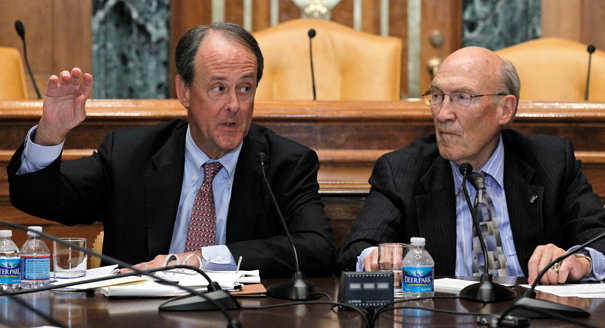
So, on to those reactions.
At Huffpo, Dan Froomkin lists “Ten Flash Points In The Fiscal Commission Chairmen’s Proposal”
…taken as a whole, the plan authored by Erskine Bowles and Alan Simpson would have devastating effects on the government and its ability to help the most vulnerable in our society, and it would put the squeeze on the middle class, veterans, the elderly and the sick – all in the name of an abstract goal that ultimately only a bond-trader could love.
For a summary of the attack on veterans, Froomkin links to David Dayen at FDL:
They want to add co-pays to the Veterans’ Administration and TRICARE, as well as pushing individuals covered by TRICARE into an employer policy. They also want to freeze noncombat military pay for three years. And, they want to end schools for families on military bases, instead reintegrating soldier’s kids into the public school system (because that’s so easy for a military family that moves every other year).
The attack on old people and future retirement benefits for everyone:
Deficit Comm. Chairs’ Social Security Cuts Mean Seniors Pay for Wall Street Instead of Their Own Retirement, Says Bob Weiner, Ex-House Aging Committee Chief of Staff
The Deficit Commission “Chairmen’s Mark” proposal today for Social Security cuts, including raising the retirement age and reducing the cost of living, means that “Seniors will be paying for Wall Street instead of their own retirement, will be forced to work longer, and will be squeezed into poverty, despite the fact that the Social Security system has no debt for 30+ years based on what seniors have paid into it,” says former House Aging Committee Chief of Staff Robert Weiner.
“Social Security adds not a dime to the national debt for at least 30 years. What is really happening is cuts advocates are using the Social Security funds literally paid for by seniors to reverse other federal programs that do have deficits or are unpaid, and to pay for the tax breaks for the wealthy,” Weiner continues.
Michael Hiltzik: The deficit commission chairs’ lies about Social Security
Look out — the enemies of Social Security are locked and loaded for a renewed attack on the program.
The new volley comes from the co-chairs of the National Commission on Fiscal Responsibility and Reform, the so-called deficit commission ginned up by the White House as a sop to conservatives. The co-chairs are the profoundly clownish former Sen. Alan Simpson and Erskine Bowles, a Democrat with his feet firmly implanted on Wall Street….
The co-chairs propose to gut Social Security under the guise of “saving” it, eliminate federal funding for services and programs that heavily benefit the middle- and working classes, and — surprise — steer even more income tax cuts to the wealthy.
The cuts to Social Security are subtle, and for that reason worthy of close scrutiny. The co-chairs’ key proposal is to raise the regular retirement age to as high as 69, and raise the minimum retirement age to 64. This imposes disproportionate harm on lower-income workers, whose working lives tend to be shorter than others’. They also want to reduce relative benefits for better-paid workers, and change the formula for cost-of-living increases to one that looks like it would customarily produce lower COLAs.
Bloomberg summarized a range of reactions: U.S. Debt Proposal Would Cut Social Security, Taxes, Medicare A few quotes:
Read the rest of this entry »

 peej
peej Carissa
 bostonboomer
 dakinikat
 ecocatwoman
 mablue2
 Mama Lopez
 peggysue22
 quixote
 skydancingguestblogger
 Mona (aka Wonk the Vote)



 Sky Dancing
Recent Comments