
Thursday Reads: Normalizing a Maniac
Posted: September 15, 2016 Filed under: Afternoon Reads | Tags: 2016 presidential election, Donald Trump and his crackpot advisors, Gary Johnson and other stoners I have known, Gratuitous Rudy Giuliani bashing for fun, spurious Ohio Polls I have read and debunked 25 Comments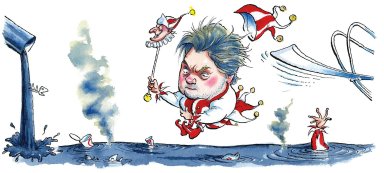 Good Afternoon!
I’m going back to ranting about the election since yesterday’s media coverage was so over the top. We heard more about the Crackpot Republican nominee putting on a Barnum & Bailey worthy side show on the TV show of a crackpot Doctor than we heard about the solid criminal investigation into his family’s Foundation which is an obvious scam and the excellent research into his business ties with foreign agents that are not friendly to US interests. Crackpots appear to have a major footing in the 2016 Presidential Election coverage. Dr. Oz is just the latest one.
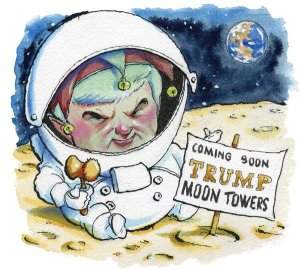
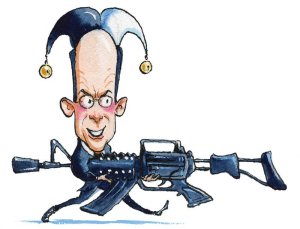
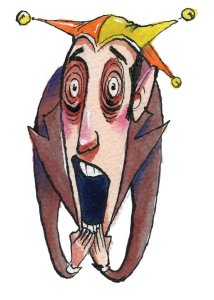
The wonderful cartoons are from TNR’s coverage of the unqualified disasters “advising” Donald Trump. Trump has gathered up a team of crackpots and you can read about them in the article cited below. The illustrator is MICHAEL WITTE and I’ve lifted many of his accompanying caricatures. You may see more of his illustrations here. I’m sure you’ll recognize a few of them. Rest assured, they are all losers and they are all crackpots. Every. Single. One. of. them.
The Headline of the TNR feature just speaks for itself. ‘Trumps Court Jesters: Meet the worst political team ever assembled’—an inner circle of outcasts, opportunists, and extremists with nowhere else to go. How can the media treat this campaign seriously? It’s like they normalize him for reading the words of other crackpots from a teleprompter.
With his showman’s flair, Trump has assured anyone who will listen that he will compensate for his political inexperience and policy indifference by surrounding himself with the “best people.” They’ll be the “smartest.” Not to mention the “greatest.” Unfortunately for Trump, no one with those qualifications wants to work for him. When his campaign approached hundreds of aides to the 16 losing GOP candidates—including more than 150 who worked for Ted Cruz—the vast majority passed on the opportunity. When Trump tried to scare up endorsements in Congress, he ended up with a handful of backbench extremists. When he cobbled together a foreign policy team, he couldn’t even find a respectable ex-general from CNN, much less a credible think-tank wonk. When he put together an economic advisory team, he found exactly one willing economist.
So Trump has been forced, for reasons of his own making, to assemble what could well be the worst political team in presidential history: a rogues’ gallery of outcasts and opportunists, has-beens and never-weres, conspiracy-mongers and crackpots. Few of the advisers in his inner circle possess any real qualifications for the positions they hold. Some have been ousted from their previous jobs for incompetence, corruption, or outright craziness. Many, exiled to the political fringes, see the campaign as a way to get back into the game. Most of them, sad to say, have sunk so low that Trump looks like a big step up.
Nicholas Kristoff also has a blunt headline today: ‘When a Crackpot Runs for President’ – The New York Times.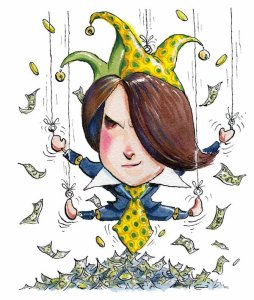
A CNN/ORC poll this month found that by a margin of 15 percentage points, voters thought Donald Trump was “more honest and trustworthy” than Hillary Clinton. Let’s be frank: This public perception is completely at odds with all evidence.
On the PolitiFact website, 13 percent of Clinton’s statements that were checked were rated “false” or “pants on fire,” compared with 53 percent of Trump’s. Conversely, half of Clinton’s are rated “true” or “mostly true” compared to 15 percent of Trump statements.
Clearly, Clinton shades the truth — yet there’s no comparison with Trump.
I’m not sure that journalism bears responsibility, but this does raise the thorny issue of false equivalence, which has been hotly debated among journalists this campaign. Here’s the question: Is it journalistic malpractice to quote each side and leave it to readers to reach their own conclusions, even if one side seems to fabricate facts or make ludicrous comments?
President Obama weighed in this week, saying that “we can’t afford to act as if there’s some equivalence here.”
I’m wary of grand conclusions about false equivalence from 30,000 feet. But at the grass roots of a campaign, I think we can do better at signaling that one side is a clown.
Even while explaining how Trump is a mythomaniac and a systematic cheater, Kristoff can’t help but run the narrative on Hillary Clinton that is based all of the debunked and discounted charges leveled at her for over 40 years.
What’s a voter to do?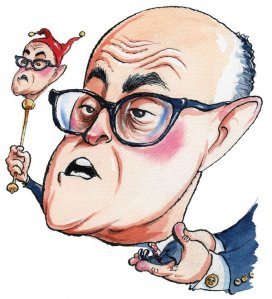
We were regaled yesterday with two polls supposedly showing Trump ahead in Ohio. Looking at the details and the polls themselves you’ll see the conclusions are quite spurious. The CNN poll literally reports results on no voters under 50 because they couldn’t get a sample large enough to get reliable results.
A new poll showing Donald Trump leading Hillary Clinton by 4 points in Ohio set the media buzzing, but a look at the polling data reveals that CNN under polled younger voters.
CNN touted their new poll of Ohio as Trump making gains in swing states, “With eight weeks to go before Election Day, Donald Trump holds a narrow lead over Hillary Clinton in Ohio and the two are locked in a near-even contest in Florida, according to new CNN/ORC polls in the two critical battleground states.”
Well, that certainly sounds dramatic, but a look at the crosstabs of the poll shows that things may not be exactly what CNN is suggesting they are in the Buckeye State.
There was something odd about the age of the respondents: (Note: go to the link to see the image of poll results here.)
Younger voters are not listed.
This could be a mistake in the CNN/ORC Poll crosstabs, but it is also easy to understand how Trump suddenly got a lead in Ohio when CNN under polled younger voters.
The CNN poll is a good reminder that all polls, whether they contain good or bad news for the candidate that you support, should be taken with a big grain of salt.
 The Bloomberg poll uses a distribution based on 2004 when turnout by Republicans was unusually high. How do we know that this and not the two most recent presidential elections will be the likely pattern? What’s the rationale here? I frankly can’t imagine any racial or religious minority NOT rushing to the polls to ensure a Trump loss. I frankly expect Hispanic turnout to be at an all time high although there may be only a few states where this matters. But still, the media are going crazy over two polls with extremely dubious polling methodology.
The Bloomberg poll differs from most other Ohio public polling in the race. A CBS News/YouGov poll, which was conducted via the internet last Wednesday through Friday and overlaps with the Bloomberg poll by one night, gave Clinton a 7-point lead over Trump, 46 percent to 39 percent.
A Quinnipiac University survey, conducted in late August and early September and released last week, showed Trump ahead of Clinton in Ohio by 1 point in a head-to-head matchup. But Trump held a 4-point lead in a subsequent question that gave respondents the option of choosing Libertarian Gary Johnson or Green Party nominee Jill Stein.
In the Bloomberg poll, Trump maintains a 5-point advantage over Clinton with Johnson and Stein included, 44 percent to 39 percent, with Johnson at 10 percent and Stein at 3 percent.
Incumbent GOP Sen. Rob Portman holds a big lead in Ohio’s closely watched Senate race, the poll also shows. Portman, who is seeking a second term, leads former Democratic Gov. Ted Strickland, 53 percent to 36 percent.
Recent polls have given Portman a significant advantage, but not to this degree. His previous high-water mark in a live-interview survey had been an 11-point lead in last week’s Quinnipiac poll.
Ann Selzer, the well-respected Iowa pollster who produced the survey, provided Bloomberg with a possible explanation for its divergent results: Voters who identified as Republicans were more likely to be classified as likely voters than those who said they identified as Democrats. Including those who lean toward one party, Republicans comprised about 43 percent of the sample, while Democrats made up roughly 36 percent.
“Our party breakdown differs from other polls, but resembles what happened in Ohio in 2004,” Selzer told Bloomberg, pointing to exit polling from 12 years ago when George W. Bush carried the state. “It is very difficult to say today who will and who will not show up to vote on Election Day. Our poll suggests more Republicans than Democrats would do that in an Ohio election held today.”
 My guess is that Ohio is a dead heat with a slight advantage to Clinton given the Republicans in office don’t like Trump and won’t campaign for him. This is one of the reasons why I don’t put much faith in any one poll at any one point in time but prefer to defer to two mathematical laws: the law of large numbers and the law of averages. I’ve been trained through 4 degrees to evaluate trends and averages based on time series only. This suggests the methodology used by Nate Silver and Sam Wang who forecast based on using all polls and producing an average and trend based on all polls with weights based on reliability of methodology. They are also quite aware of the tricks used by various pollsters which depends heavily on their political affiliation. It appears Trump could have a route to the White House without winning the popular vote according to FiveThirtyEight writer David Wasserman. This path is unlikely but frightening.
OK, before I say anything, a quick disclaimer: This piece is not a prediction. In fact, I’m a religious (maybe fanatical) adherent of FiveThirtyEight’s 2016 election forecast model, which I find to be both methodologically rigorous and intellectually honest. I don’t dispute its assessment that Hillary Clinton has a 63 or 64 percent chance of winning the election.
That said, in the event this race does tighten to a coin flip by Nov. 8, there is an unusually high chance Donald Trump could win the Electoral College while losing the popular vote — basically, Democrats’ version of the apocalypse.
Here’s why: Several of Trump’s worst demographic groups happen to be concentrated in states, such as California, New York, Texas and Utah, that are either not competitive or that aren’t on Trump’s must-win list. Conversely, whites without a college degree — one of Trump’s strongest groups — represent a huge bloc in three blue states he would need to turn red to have the best chance of winning 270 electoral votes: Florida, Ohio and Pennsylvania.
A repeat of 2000’s split verdict — except with more potential to plunge this much more polarized and anxious country into chaos — is still not very likely. Right now, the FiveThirtyEight polls-only model posits a 6.1 percent chance of Trump winning the Electoral College while losing the popular, and a 1.5 chance of the reverse outcome. But that’s not so remote, either, and if the national ballot were ever to tighten further, both “crazy” scenarios’ odds could rise.
The secret to how Clinton could win more votes nationally yet still fall short of the White House lies with Trump’s weakness among three geographically disadvantaged groups of voters:
You can go read the analysis or not depending on the strength of your heart. Larry Sabato of Rasmussen Reports has some additional analysis on the fundamentals as they exist today. He even refers to this a “strange race” which is probably why the press seem completely unable to cover the maniac in the room.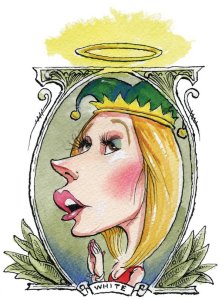
Nonetheless, the defining difference in this election is not Clinton but Trump. Forget Wendell Willkie: There has never been a presidential nominee like him. He has divided the Republican Party — separating party elites from much of the party’s populist base — and he has rearranged the electorate in ways we haven’t ever seen, at least to this extent. Minority groups appear to be rejecting him by margins as bad or worse than recent GOP nominees. Trump is having trouble winning a group that isnormally quite Republican: college-educated whites. At the same time, he has drawn very sizable, exceptionally intense backing from non-college whites and, disproportionately, blue-collar white men, and he has the potential to out-perform Mitt Romney’s 2012 showing among that group.
Regular readers will have noticed that we have been publishing political scientists’ predictive models for 2016, the quadrennial attempt to use certain variables to project the election results (at least the popular vote) months in advance. We’re publishing our final update on these models this week. They are mostly derived from election fundamentals that don’t change much over time — economic conditions, the number of consecutive terms a party has held the White House, and so on. Averaging all the forecasts together shows a two-party vote of Clinton 50.5% and Trump 49.5%. Obviously, that’s very close, and taken together these models produced a very similar prediction in 2012 (Obama 50.2%, Romney 49.8%). That undersold Obama, who won with 52.0% of the two-party vote.
The problem in 2016 is that the assumptions that undergird some models are disputable. Take our senior columnist, Alan Abramowitz of Emory University. His “Time for Change” model has an admirable record of prediction over many years, nailing the popular-vote winner in every cycle going back to 1988. Yet this time, Abramowitz has declared that his model will probably miss the mark. Why? As Abramowitz explains it, the assumptions upon which the model is built are unsound: “First, that both major parties will nominate mainstream candidates capable of unifying their parties and, second, that the candidates will conduct equally effective campaigns so that the overall outcome will closely reflect the ‘fundamentals’ incorporated in the model.”
Abramowitz’s model predicts a modest Republican victory this November, and considering Clinton’s myriad weaknesses and a competitive political environment, it is easy to imagine it if the GOP had nominated a mainstream candidate. (We’ll let you go through the 17 contestants and decide which ones might have been able to unite the party, run a solid campaign, and win.) Trump is neither mainstream nor conducting a campaign that is anything close technologically and financially to the Clinton effort.
In our view, this is why — along with strong partisan polarization — the contest, while close, has had Clinton pretty consistently in the lead: Trump is underperforming the fundamentals and reducing the odds of a GOP win. In another era, say the 1960s through the 1980s, the 2016 contest might well have produced a Democratic landslide much as outlier candidates in 1964 (Barry Goldwater) and in 1972 (George McGovern) generated big swings to the other party. Yet dislike of Clinton and polarization have kept her margin to a few points, excepting the post-convention bounce period. Clinton also faces an unprecedented challenge: She is not simply seeking President Obama’s third term and, in a sense, being responsible for the Obama record (good and bad), but in a way she is also pursuing Bill Clinton’s third term, too. Never before has a party nominee been held accountable for two two-term presidents.
It may be that Clinton, if she does indeed win, will mimic one of Obama’s victory margins (four percentage points in 2012 or seven in 2008). Polarization was especially evident in Obama’s reelection contest. A four-point margin would be consistent with the Electoral College map the Crystal Ball has largely maintained since March: Her total of 348 electoral votes would place her performance in between Obama 2012 (332) and Obama 2008 (365). For Clinton to duplicate Obama’s 2008 broader sweep, Trump would probably have to collapse in the final weeks because of the accumulation of controversies and the lack of preparation in the ground game. If Clinton barely wins or Trump pulls an upset to rival 1948 (Harry Truman over Thomas Dewey), it probably means that Trump did something to improve voters’ perceptions of his qualifications for office — right now, a majority of the electorate does not believe he’s qualified — and Clinton, through a combination of mistakes, controversies, and Democratic apathy, can’t generate the kind of Democratic turnout she needs.
The challenge for the Democrats is to keep 2016 from becoming a change election, which it might have been without Trump (and could still become). Prospective Clinton voters will have to be reminded constantly why she believes Trump is unacceptable and why they have to swallow hard and vote for a candidate many are not enthused about. While our Electoral College ratings still show a Clinton victory, the polls have clearly gotten closer in recent weeks. Clinton is generally up about two-to-four points nationally in polling averages (based on RealClearPolitics and HuffPost Pollster ), considerably tighter than the lofty eight-point lead she enjoyed in both averages about a month ago, when she was still basking in a post-convention glow and Trump was making mistake after mistake. In the lead-up to Labor Day, Clinton faced several questions about her emails and the Clinton Foundation, and Trump’s coverage became less negative by comparison.
 There is actually rumbling among Republicans who really really don’t want Trump to win and a few little glimmers of hope like the fact that the New Hampshire Union Leader just endorsed spacey, libertarian pothead Gary Johnson. I’m sorry, the man just reminds me of every freaking pot dependent person I’ve ever known. “Allepo, man, what’s that, man?” I have no idea why William Weld wasn’t put at the top of that ticket other than every libertarian I’ve ever met these days seems to hate the idea of being drafting and loves the idea of legal pot. Maybe they’re all potheads these days.
The most joyful day moment of the day was watching a Flint Methodist Minister kick Trump’s political grandstanding at her church to the ground. She totally caught him reading prepared remarks that were just more vile anti-Hillary bile. He was so unable to make a comeback that he flipped the page and read the last bits rather than doing what he was invited to do which was praise her community for coming to the aid of Flint Residents who still can’t drink their water. Brian Williams said Trump “pivoted”. No, he did not. He was basically totally flummoxed and he had that “bad dog” look on his face.
The pastor who hosted Donald Trump at her church in Flint, Michigan, interrupted the Republican presidential nominee during his speech Wednesday to ask him to refrain from attacking his rival Hillary Clinton.
“Mr. Trump, I invited you here to thank us for what we’ve done in Flint, not give a political speech,” Rev. Faith Green Timmons of the Bethel United Methodist Church told Trump after walking to the podium while Trump was speaking.
“OK. That’s good. Then I’m going back onto Flint, OK? Flint’s pain is a result of so many different failures,” Trump said.
Timmons, in a statement provided at the event, noted her church welcomes “all people.”
“This public event is open to all and today Donald Trump came to observe. Trump’s presence at Bethel United Methodist in no way represents an endorsement of his candidacy,” she had said.
On Thursday, Trump told Fox News “something was up” with Timmons, but he wasn’t bothered because “everyone plays their games.”Trump was responding to the host’s question about whether he was “bothered” by the fact that she purportedly had written on Facebook (according to the Fox hosts, who noted it was later erased) that she hoped to “educate” Trump on what had been going on in Flint.
“She was so nervous, she was shaking. And I said, ‘wow, this was kind of strange.’ And then she came up. So she had that in mind, no question about it,” Trump said, adding that he suspected that he might face an unfriendly reception at the church.
Trump not only accused the Pastor of sabotaging him but went on to fat shame her after the entire day’s news cycle basically discussed his obesity with the encouragement of Fox and Frauds. You can watch Pastor Faith Green Timmons of the Bethel United Methodist Church of Flint lecture the nasty orange one. Trump’s outreach to minority voters continues to fail as well it should. They certainly know a racist when they see one. Plus there is this, the Trump Campaign accepts and doesn’t return donations from known White Supremacists.
Now this is how I want my pastor to deal with a hater, not get on TV and proclaim him the candidate of Christians.
So, I’m going to give us a break from all of this again tomorrow, I promise. I will leave you with some words from the great poet Wendell Berry who has written a beautiful essay on racism in the age of Obama in the Lexington Herald Leader.
A good many people hoped and even believed that Barack Obama’s election to the presidency signified the end of racism in the United States.
It seems arguable to me that the result has been virtually the opposite: Obama’s election has brought about a revival of racism.
Like nothing since the Southern Strategy, it has solidified the racist vote as a political quantity recognizable to politicians and apparently large enough in some places to decide an election.
I grant the polite assumption that not one of the elected officers of the states or the nation is a racist. But politicians do not need to be racist themselves in order to covet, to solicit, or to be influenced by the racist vote. This is shown by the pronounced difference between two by-now established ways of opposing the president.
There is the opposition that is truly political and varyingly respectable. This opposition is identifiable by its incompleteness, which is to say by its focus upon particular issues about which a particular case or argument can be made. Such opposition is credible as such because it implicitly concedes the president’s humanity: Like the rest of us, he is a partial and fallible mortal who, if he is partly wrong, may also be partly right.
The other way of opposition is total. The president must be opposed, not on this or that issue, but upon all issues.
This opposition is often expressed in tones of contempt, not only of the president himself, but of the office he holds so long as it is held by him. Opposition to the president on a particular issue is understood by these opponents as incidental to a general condemnation: the intent, not only to defeat the president in any and all disagreements with him, but entirely to discredit and punish him and to nullify his administration.
This opposition is never mitigated by tokens or gestures of respect for the president’s office, any of his aims or programs, his character, his person or his family. An opposition so complete and so vividly emotional cannot be, in any respectable sense, political.
Some of the president’s congressional enemies – and these may be the most honest of them – have openly insulted him. But such candor is not necessary. Elected officials or candidates seeking the support or the votes of racists do not need to question the authenticity of Obama’s birth certificate or to call him a Muslim, a communist, a Nazi or a traitor.
They need only to stand silently by while such slurs and falsehoods are loudly voiced in public by others. To the racist constituency, their silence is a message that secures votes. Their silence declares that no truth or dignity is worth as much as a vote.
Nobody can doubt that virtually all of the president’s political enemies would vehemently defend themselves against a charge of racism. Virtually all of them observe the forms and taboos of political correctness. If any very visible one of their own should insult the president by a recognized racial slur, they would all join in the predictable outrage. But the paramount fact of this moment in the history of racism is that you don’t have to denominate the president by a recognized racial slur when his very name can be used as a synonym.
This subtilized racism is not only a perhaps unignorable lure to Republican politicians; it can also be noticeably corrupting to Democrats.
You can read the rest of his essay at the link. BostonBoomer is on her way back to Boston so hopefully, she’ll have some great comments to add tonight when she gets to her motel and the half way point some where in Ohio!
What’s on your reading and blogging list today Sky Dancers?

 peej
peej Carissa
 bostonboomer
 dakinikat
 ecocatwoman
 mablue2
 Mama Lopez
 peggysue22
 quixote
 skydancingguestblogger
 Mona (aka Wonk the Vote)



 Sky Dancing
Recent Comments