
Put a Cork in Corker
Posted: March 11, 2010 Filed under: Global Financial Crisis, The Great Recession, U.S. Economy | Tags: Bob Corker, Chris Dodd, financial regulation, pay day lenders Comments Off on Put a Cork in Corker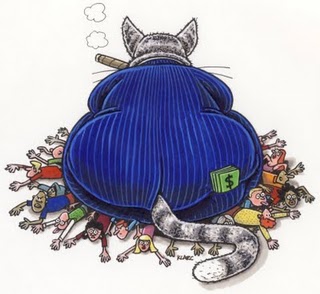 If you want a good example of politics-as-usual as well as something that is not in the interest of the public, this is it. Payday lenders are loan sharks without the kneecapping thugs. Senator Bob Corker wants them exempted from regulations aimed at protecting consumers from predatory and unfair lending practices. Senator Chris Dodd is basically going along with it. This is an egregious example of crony capitalism that enriches an industry by taking advantage of the poor and uninformed.
Senator Bob Corker, the Tennessee Republican who is playing a crucial role in bipartisan negotiations over financial regulation, pressed to remove a provision from draft legislation that would have empowered federal authorities to crack down on payday lenders, people involved in the talks said. The industry is politically influential in his home state and a significant contributor to his campaigns, records show.
This is really bad. If you have a congress critter sitting on Dodd’s committee, now is the time to write and scream. Here’s information on from the Center for Responsible Lending on just exactly how bad this particular brand of predators can get.
Twenty or so years ago, some finance companies figured out how to make loans of a few hundred dollars to people who were barely getting by. That may sound generous, but when you look deeper, the practice they developed amounts to nothing more than legal loan sharking.
The problem for the borrowers—and the payoff for the lenders—is that the terms of these loans are cleverly designed to be very difficult to meet. The borrower must keep coming back and renewing their loan because they aren’t allowed to pay it down and can’t afford to pay it off. They pay the lender another chunk of interest each time, about $50 for a $300 loan. How the debt trap works
These loans carry annual interest rates of 400%, and the industry relies for 90 percent of their revenue on borrowers who repeatedly renew or re-open their payday loans. The typical borrower ends up paying about $500 in interest for a $300 loan, and still owes the principal.
Corker has already damaged the bill that was designed to stop a repeat of the subprime lending crisis that triggered so much trouble back in 2007. Dodd is going along with everything like the lobbyist he surely will become in a short amount of time. We’ve already seen the take down of the new consumer agency that was originally created by the bill. The duties will now be given to the Fed. This is something that Fed Chair Ben Bernanke originally opposed but later accepted under duress from Treasury Secretary Timothy Geithner.
The Fed is a conservative organization that is more reactive than proactive. Under this new term, it is unlikely any one will activate regulation for this set of loans should they get any worse than they already are today. This basically ghettos the poorest of the poor (mostly the unbanked who rely heavily on checking cashing places and pay day loans) into the least controlled debt instruments. In other words, it’s going to take the most money and fees from those least able to pay for them. It perpetuates the loan trap. Most of the brick and mortar of the pay day loan industry is located in the poorest parts of cities where no bank will go any more. The industry says that it’s providing a much needed service. What’s really happening is that it’s ensuring there is no place else to go.
Under the proposal agreed to by Mr. Dodd and Mr. Corker, the new consumer agency could write rules for nonbank financial companies like payday lenders. It could enforce such rules against nonbank mortgage companies, mainly loan originators or servicers, but it would have to petition a body of regulators for authority over payday lenders and other nonbank financial companies.
Consumer advocates said that writing rules without the inherent power to enforce them would leave the agency toothless.
The consumer groups that seek to protect borrowers from the worst of abuses appear to have given up on Dodd and his committee. They’ve gone straight to the FED for help. The hope is that Bernanke can convince the committee to give the FED broader powers than just ensuring compliance with the Truth in Lending Act.
Consumer groups, however, say that enforcement is crucial to curbing abusive, deceptive or unfair practices.
On Tuesday, while Mr. Dodd and Mr. Corker continued negotiating other provisions of the regulatory overhaul — notably, the extent to which state attorneys general would be able to enforce consumer protection rules against banks — the Federal Reserve’s chairman, Ben S. Bernanke, met with National People’s Action, an activist group that wants the Fed to restrict the banks it oversees from financing payday lenders.
Mr. Bernanke, who had met with the group twice before, is trying to fend off proposals in the Senate to strip the Fed of much of its power to supervise banks. A recommitment to protection consumers is part of that strategy
It is just unbelievable to me that some of the very people who nearly brought the economy to the knees by taking on unbelievable risks, securitizing them and then passing the trash to the market will still be able to carry on like nothing ever happened. This is terrible news. The only hope now is that Barney Frank will stop the senate from changing the tougher language originally introduced by the White House and put through by the House. It certainly doesn’t look like the White House will stand up for its own bill.
Just Say No to Zombie Banks!
Posted: March 16, 2009 Filed under: Uncategorized | Tags: bad bank, ben bernanke managing market expectations, financial regulation, good bank, zombie banks 6 Comments The market seems to have stabilized for awhile as Ben Bernanke has been giving speeches and making appearances every where he can. For those of you that really want to take on empirical studies in Economics (econometrics and all), this is a part of a strategy he outlined in Monetary Policy Alternatives at the Zero Bound: An Empirical Assessment. (Bernanke and Reinhardt 2001). It’s 113 pages long so be prepared to spend some time with it like I did last year. However, my guess is you can read the front parts and the back parts and skip the methodology and findings and be just as happy. It is basically the Chairman’s take on the Japanese Lost Decade and monetary policy at the time. It talks about quantitative easing which is the new approach that even the Bank of England is using now. That is when the Central Bank uses its balance sheet to buy and sale various financial assets to try to unclog lending channels. Since this is the first time the acting Chairman of the Federal Reserve Bank has ever appeared on any major news channel to have a fire side chat as in last night’s appearance on Sixty Minutes, I thought I’d point you to the motive behind the method. It’s outlined in that academic paper. Bernanke and Reinhard argue that Federal Open Market Committee (FOMC) announcements of policy and other announcements by the Fed shape market expectations and results. (Yes, I know El Presidente told us we shouldn’t care about the DJ but the FED chair still does because he knows IT MATTERS.)
Has the Federal Reserve’s policymaking body, the Federal Open Market Committee, historically exerted any influence on investors’ expectations about the future course of policy? Although members of the FOMC communicate to the public through a variety of channels, including speeches and Congressional testimonies, official communications from the Committee as an official body (ex cathedra, one might say) are confined principally to the statements that the FOMC releases with its policy decisions.
…
The FOMC has moved significantly in the direction of greater transparency over the past decade. Before 1994, no policy statements or description of the target for the federal funds rate were released after FOMC meetings. Instead, except when changes in the federal funds rate coincided with changes in the discount rate (which were announced by a press release of the Federal Reserve Board), the Committee only signaled its policy decisions to the financial markets indirectly through the Desk’s open market operations, typically on the day following the policy decision. In February 1994, the FOMC began
to release statements to note changes in its target for the federal funds rate but continued to remain silent following meetings with no policy changes. Since May 1999, however, the Committee has released a statement after every policy meeting.
The FOMC statements have evolved considerably. In their most recent form, they provide a brief description of the current state of the economy and, in some cases, some hints about the near-term outlook for policy. They also contain a formulaic description of the so-called “balance of risks” with respect to the outlook for output growth and inflation. A consecutive reading of the statements reveals continual tinkering by the Committee to improve its communications. For example, the balance-of-risks portion of the statement replaced an earlier formulation, the so-called “policy tilt”, which characterized the likely future direction of the federal funds rate. Much like the “tilt”statement, the balance of risks statement hints about the likely evolution of policy, but it does so more indirectly by focusing on the Committee’s assessment of the potential risks to its dual objectives rather than on the policy rate. The relative weights of “forward looking”and “backward-looking” characterizations of the data and of policy have also changed over time, with the Committee taking a relatively more forward-looking stance in 2003 and 2004.
Of course, investors read the statements carefully to try to divine the Committee’s views on the economy and its policy inclinations. Investors’ careful attention to the statements is prima facie evidence that what the Committee says, as well as what it does,matters for asset pricing.
I’ve highlighted that last paragraph because it is extremely important in explaining both the Chairman’s sudden interest in TV appearances and the market’s relief rally recently. Bernanke has been out there saying that the Fed will not let major banks fail, he dislikes then entire AIG thing and wants to ensure it never happens again, he’s been asking the senate committees he visits for more regulation, and he’s repeatedly said that the FED expects the recession to experience the trough later this year. We’ve not seen any meaningful discussion about the type of recovery to expect (L shaped or otherwise). We have however, seen more upbeat statements geared to appease the markets and their role in asset pricing.

 peej
peej Carissa
 bostonboomer
 dakinikat
 ecocatwoman
 mablue2
 Mama Lopez
 peggysue22
 quixote
 skydancingguestblogger
 Mona (aka Wonk the Vote)



 Sky Dancing
Recent Comments