
Karl Marx: The Comeback Kid
Posted: April 10, 2011 Filed under: Economic Develpment, financial institutions, Global Financial Crisis | Tags: Commerce, economics, finance, Financial Development, Financial Institutions, Karl Marx 23 Comments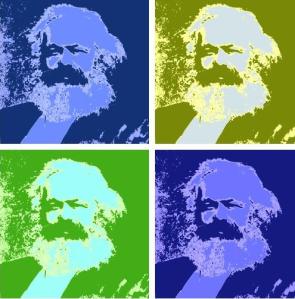 technology, pushing them to take more and more expensive credits, until their debt becomes unbearable. The unpaid debt will lead to bankruptcy of banks, which will have to be nationalised, and the State will have to take the road which will eventually lead to communism”
Karl Marx, Das Kapital, 1867
Okay, I got your attention and that’s my purpose. I’m really not a closet Marxist, but I do feel that some of that old school political economics he brought to the realm of economic thinking way back when is still worth contemplating. The above quote from Marx is a fairly good summation of his intellectual endeavors. He starts out with some really great assumptions then jumps the shark with vague, unmapped conclusions, But, Marx was a philosopher and jumping sharks seems to be an occupational hazard for them. Economics these days relies on mathematical models and empirical study.
Marx is one of those folks–along with equally fringe Frederick Hayek– who is getting a second look in a back-handed way. What’s pretty interesting is that a lot of the criticism of Marx and Lenin forgets that they had more against “financial capitalists” than they had against “industrial capitalists”. Both Rand and Ron Paul sort’ve remind me of them in that way. Marx actually looked at us ideally as a society of producers. He didn’t like how financiers fit into that picture at all. He railed against the UK’s Bank Act of 1844 that was a response to a fairly huge financial crisis. He argued that the “1844 Act had been deliberately designed to keep interest rates artificially high, benefiting the financial section of the capitalist class at the expense of the industrial section”. He also had a lot to say about paper money that wasn’t convertible to things like gold and it’s hard not to hear Marx in Ron Paul’s diatribes.
Marx also introduced the idea of commodity fetishism, which is a fairly compelling description of the modern US economy. He felt we’d all become slaves to it eventually. So, even though he never really fleshed out much worth implementing, he and Lenin had some interesting commentary on what they saw as problems that would arise from a society that became increasing focused on financial services and became addicted to consumer goods.
In an odd way, the financial crisis has brought on renaissance of the Marxist critique as well as a huge number of libertarians that are trying to have a Hayekian renaissance. Academics that study financial economics are asking similar questions but not quite in the way that you would think. The odd thing is that the very line of research that used to soundly tromp the Marxist assumption of the financial capitalist as parasite is sort’ve headed towards a refinement of the idea that too many bankers spoil the economy.
Every one is pretty much in agreement that much of the time, market economies do a fairly good job of sorting out who gets what. You can even speak with economists in Cuba and find out they are all planning for liberalization as long as it doesn’t reintroduce a flurry of exploitation. The problem is that real life markets don’t function very well when there are too many ‘frictions’. Just as in physics, frictions deform things. Frictions are basically things that cause less-than-efficient outcomes in markets where efficiency is strictly defined as the maximum quantity produced at a minimal price. In some cases, these things are caused by governments. Regulations, tariffs, quotas, and taxes can all cause frictions. Some are put in place purposely to warp the market outcome as is the case with sin taxes. Third party payers–like the health insurance industry–create frictions. Advertising creates incredible frictions.
Markets can have naturally occurring frictions like the placement of oil reserves or diamonds or gold in certain locations in the world. They can have frictions due to technology or economies of scale where it’s most efficient to have a single producer or monopoly because it is least expensive or necessary to create the minimal cost plant size. Think how huge car manufacturing or steel plants have to be so they are cost effective. Frictions are everywhere and they warp market outcomes. Free Market fetishists tend to ignore any friction not created by the government. In some cases, government is the source of the friction; in other cases, government–through regulation or policing of markets–can remove the frictions. Financial markets are riddled with two notorious frictions: information asymmetry and moral hazard. You can see how Marx grasped those problems philosophically. Lenin actually did studies using numbers. Hayek had his explanations of financial crises as did J.M. Keynes. Keynes went so far to say that financial markets were driven by “animistic spirits”. We’ve come a long way since all of them were actively writing but yet, some of the themes remain the same in new veins of inquiry.
There are several things out in the blogosphere that have brought me to discuss this topic with you. The first is a NYT editorial called ‘Banks are Off the Hook Again’. Banks are trying to get Federal lawmakers to override state laws on foreclosure in an attempt to avoid prosecution and the results from their foreclosure practices. They are–per usual–succeeding.
As early as this week, federal bank regulators and the nation’s big banks are expected to close a deal that is supposed to address and correct the scandalous abuses. If these agreements are anything like the draft agreement recently published by the American Banker — and we believe they will be — they will be a wrist slap, at best. At worst, they are an attempt to preclude other efforts to hold banks accountable. They are unlikely to ease the foreclosure crisis.
All homeowners will suffer as a result. Some 6.7 million homes have already been lost in the housing bust, and another 3.3 million will be lost through 2012. The plunge in home equity — $5.6 trillion so far — hits everyone because foreclosures are a drag on all house prices.
The deals grew out of last year’s investigation into robo-signing — when banks were found to have filed false documents in foreclosure cases. The report of the investigation has not been released, but we know that robo-signing was not an isolated problem. Many other abuses are well documented: late fees that are so high that borrowers can’t catch up on late payments; conflicts of interest that lead banks to favor foreclosures over loan modifications.
The draft does not call for tough new rules to end those abuses. Or for ramped-up loan modifications. Or for penalties for past violations. Instead, it requires banks to improve the management of their foreclosure processes, including such reforms as “measures to ensure that staff are trained specifically” for their jobs.
This is a really good example of maintenance of mutually destructive frictions in a market. It creates uncertainty. It does not contribute to translucence and information. It ensures a lop-sided process. In short, it guarantees certain market failure and it sets up the winners and the losers. It’s something about which both Marx and Hayek would rant. For that matter, J.M. Keynes wouldn’t be so judicious about it either.

 peej
peej Carissa
 bostonboomer
 dakinikat
 ecocatwoman
 mablue2
 Mama Lopez
 peggysue22
 quixote
 skydancingguestblogger
 Mona (aka Wonk the Vote)



 Sky Dancing
Recent Comments