
What’s wrong with this Picture?
Posted: April 4, 2013 Filed under: Women's Healthcare | Tags: female mortality rates in the USA 21 Comments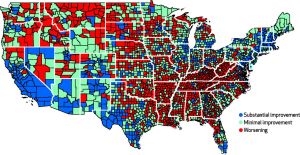 I suppose I should tell you more about what this multi-colored map of the US means before asking a set of questions including wtf is wrong with our country? No, this isn’t an indicator of which counties in the USA are ‘red’ v. ‘blue’ in the republican vs. democratic party scheme of things. However, before we go much further, I would like you to notice that most of the blue areas do line up with more democratically-inclined parts of the country. I can’t say that there’s a correlation however beyond the eyeball kind because that’s not in the data set.
What is in the data set should appall you. Red means “worsening” female mortality.
There is a frightening graph in a recent article in Health Affairs by David Kindig and Erika Cheng. Kindig and Cheng looked at trends in male and female mortality rates from 1992–96 to 2002–06 in 3,140 US counties. What they found was that female mortality rates increased in 42.8% of counties (male mortality rates increased in only 3.4%). The counties are mapped below: red means that female mortality worsened. You can see a strong regional pattern: just about every county showed had worsened female mortality in several southern states, while no county showed such decline in New England. There are many questions about what explains this pattern. For example, did healthier women migrate out of the south from 1992 to 2006? Nevertheless, the map depicts a shocking pattern of female hardship, primarily in the southeast and midwest.
Read that bolded (mine) statement again. It’s an outrageous statement of fact representing an unbelievable statement of what the current and future outlook of the USA will be. This undoubtedly impacts children too.
“Although we are accustomed to seeing varying rates of mortality reduction in states and nations,” Kindig and Cheng write, “it is striking and discouraging to find female mortality rates on the rise in 42.8 percent of US counties, despite increasing medical care expenditures and public health efforts.”
Kindig and Cheng looked at a number of factors that might give some context for why female morality went up in some counties but down in others. A somewhat surprising finding was that the availability of medical care — measured by the number of primary care providers or percentage of uninsured — didn’t really make a difference.
“Female mortality rates were not predicted by any of the medical care factors,” they write.
What could predict worsening mortality rates, however, were socioeconomic factors.
“Many people believe that medical care and individual behaviors such as exercise, diet, and smoking are the primary reasons for declines in health,” the authors write. “We did find significant associations between mortality rates and some of these factors, such as smoking rates for both sexes. But socioeconomic factors such as the percentage of a county’s population with a college education and the rate of children living in poverty had equally strong or stronger relationships to fluctuations in mortality rates.”
Here’s a great question by Incidental Economist Austin Frakt. (Bold mine again.)
I speculate, but do not have the expertise to test, that what we are seeing is that the widely discussed increase in economic inequality in late 20th century America is also an increase in geographic inequality. My guess is that not only are rich Americans rapidly pulling ahead of poor Americans, but that these groups are also increasingly segregated by region.
It takes a family and a village to raise a child. What happens when the moms in the village all get crushed?
Just think about this in terms of the number of women that will not be able to access health care in the near future because Legislatures in those same states are defunding Planned Parenthood which is one of the major source of low-cost to free healthcare for low income women? I’m shuddering at what those same statistics will grow to in the next five years. We need to seriously rethink our priorities in this country.

 peej
peej Carissa
 bostonboomer
 dakinikat
 ecocatwoman
 mablue2
 Mama Lopez
 peggysue22
 quixote
 skydancingguestblogger
 Mona (aka Wonk the Vote)



 Sky Dancing
Recent Comments