
Workers of the World Unite
Posted: May 2, 2013 Filed under: income inequality, worker rights | Tags: 401(k), diminishing real wage, Felix Salmon, Henry Blodgett, Income Inequality, Thomas Friedman whore 8 Comments We continue to see abuse of labor from the horrible explosions in a West, Texas chemical plant to the collapse of a building in Bangladesh. US workers continue to get the shaft when it comes to working harder and more productively for less. It is a sad trend that just keeps reaching new records. The gap between incomes going to workers and profits going to owners–mostly passive stockholders–continues unabated. This gap does not reflect a lack of labor productivity. It appears to reflect mostly the ability of capital owners to gamble themselves into strong positions. Industrialists are force to drive down costs to attract capital and to do some very short sighted things. The rush to increase ROE with no thought to other factors is a very bad omen for this country.
Henry Blodgett provides some very depressing May Day graphs at Business Insider.
Corporate profit margins just hit another all-time high. Companies are making more per dollar of sales than they ever have before. If you’re a shareholder, that seems like good news (in the very short term, anyway). Alas, most people aren’t shareholders. And for folks whose investment horizon is longer than “this quarter” and “this year,” it’s actually bad news. Companies are under-investing in their employees and the future.
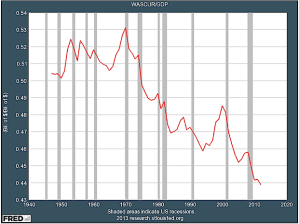 Normally, high profits are a good sign. What is disturbing is the the under-investing and the unequal increase in wages. Labor–in theory–should gain with productivity gains. This tends to stoke the growth of an economy and of a solid middle class. This trend means there is less purchasing power among the majority of households and more wage and job insecurity. This is Felix Salmon’s take.
It’s May Day, and Henry Blodget is celebrating — if that’s the right word — with three charts, of which the most germane is the one above. It shows total US wages as a proportion of total US GDP — a number which continues to hit all-time lows. Blodget also puts up the converse chart — corporate profits as a percentage of GDP. That line, you won’t be surprised to hear, is hitting new all-time highs. He’s clear about how destructive these trends are:
Low employee wages are one reason the economy is so weak: Those “wages” are represent spending power for consumers. And consumer spending is “revenue” for other companies. So the short-term corporate profit obsession is actually starving the rest of the economy of revenue growth.
In other words, we’re in a vicious cycle, where low incomes create low demand which in turn means that there’s no appetite to hire workers, who in turn become discouraged and drop out of the labor force. Blodget’s third chart is one we’re all familiar with: the employment-to-population ratio, which fell off a cliff during the Great Recession and which will probably never recover. The current “recovery” is not actually a recovery for the bottom 99%, for real people who need to live on paychecks. And today is exactly the right day to point that out.
And yet that’s Tom Friedman’s column this May Day:
If you are self-motivated, wow, this world is tailored for you. The boundaries are all gone. But if you’re not self-motivated, this world will be a challenge because the walls, ceilings and floors that protected people are also disappearing. That is what I mean when I say “it is a 401(k) world.”
This manages to be both incomprehensible and incredibly offensive at the same time. I have no idea what Friedman thinks he’s talking about when he blathers on about disappearing protective floors; I can only hope that he isn’t making a super-tasteless reference to the recent disaster in Bangladesh. But it’s simply wrong that today’s world is “tailored” for anybody who happens to be “self-motivated”. Both the self and the motivation are components of labor, not capital, and as such they’re on the losing side of the global economy, not the winning side.
Friedman is a billionaire (by marriage) who — like all billionaires these days — is convinced that he achieved his current prominent position by merit alone, rather than through luck and through the diligent application of cultural and financial capital. His paean to self-motivation recalls nothing so much as Margaret Thatcher’s “there is no such thing as society” quote: “parenting, teaching or leadership that ‘inspires’ individuals to act on their own will be the most valued of all,” he writes, bizarrely choosing to wrap his scare quotes around the word “inspires” rather than around the word “leadership”, where they belong.
True leadership, in a society where the workers are failing to be paid even half the fruits of their labor, would involve attempting to turn the red line in Blodget’s chart around, and to spread the nation’s prosperity among all its citizens. Rather than telling everybody that they’re “on their own” and that if they’re not a success then hey, they’re probably just not “self-motivated” enough.
The ultimate Friedman kick in the balls, however, doesn’t come from his lazily meritocratic priors. Rather, it comes from his overarching metaphor: the idea that if you have a 401(k) plan, then you’re somehow in charge of your own destiny. Friedman might be right that we’re living in a 401(k) world, but if he is then he’s right for the wrong reason. In Friedman’s mind, a 401(k) plan is an icon of self-determination: you get out what you put in. “Your specific contribution,” he writes, italics and all, “will define your specific benefits.”
We are learning more and more each day on how the finance industry games the kinds of investments available to you in those plans. We also know that mega corporations are getting congress to defund OSHA and any regulatory agency that watches over worker safety. Many investments are also subject to whacked performance because of excessive speculation that is encouraged by our tax laws. This has destroyed home values during the Great Recession and eaten up many folks retirement plans and savings. Frankly, it’s difficult to see how any one that relies on their sweat and has no rich family connections these days even crawls into the middle class. All of these things add up to major insecurities and risks. This is simply not the way things are supposed to work. But, it is the world that the Koch Brothers and others have carefully crafted by making politicians and pundits whores to their agenda of greed.
Pity the poor working man and woman.
Does Size Matter?
Posted: March 31, 2009 Filed under: Equity Markets, Team Obama, U.S. Economy | Tags: bank asset size cap, bank bailout, Felix Salmon, Geithner bank bail out, Kwak, Too big to fail banks 2 Comments The antithesis to market capitalism is monopoly. High market concentration has been historically a reason to use the US Justice Department to trust bust. We’ve had laws on the books since the late 19th century. The last real monopoly challenge was during the Clinton administration that took on Microsoft and its software bundling practices. The Bush 2 administration promptly walked away from enforcing the suit. The Eurozone found Microsoft guilty of monopoly behavior and are still in the process of enforcing their court’s findings. We’ve been ignoring monopoly-creating behavior on the part of lawmakers and corporations for decades now and we’re living with the high costs of market failure as a result.
Much of the problems in the current downturn can be traced to the behavior of some of the country’s largest banks. Banks that were allowed to grow to sizes that allowed them power in the market, power in congress, and power in the setting the terms of their regulation. Several rationalizations were used to allow banks to grow from the 1980s to present time. First, there were the arguments for economies of scale. Big banks were more able to process huge batches of ACH transactions and checks. These money center banks replaced the FED as the transaction processor of choice since they were generally cheaper given the various expenses of being a FED member bank that include leaving large amounts of money in reserve and on-going regulation and monitoring.
Second, there was the argument that huge money center banks were necessary to offset the power of the up and coming huge Japanese banks. During the 1980s period, one US bank after another on the top ten largest banks in the word was knocked off the list by a Japanese bank, then later by Eurozone banks. It was argued that in order to compete with these larger foreign institutions, US banks concentration should be looked at in a global context. In a global context, they were ‘competitive’ and not part of a market concentration problem. The basis of this argument was that the bank might be big in US terms, but as a global entity it was one of many. During the 1990s, it was typical for market concentration to be defined more on a global basis which in turn led to less prosecutions based on the traditional measures.
We now know that poor regulation and terrible understanding of the role of financial innovations in the financial system led to the current meltdown. We also know that many of the offenders and the biggest failures have been the huge money center banks. Many regional and small banks that continued to follow the loan and hold model of lending, rather than the loan, securitize and sell model are still thriving and did not contribute to the current crisis. Given the global financial crisis and the role of the mega banks and the resultant demands on tax payer funds to bailout those deemed too big to fail, should we look at regulations that limit bank size?
Many economists, liberal pundits, and I question the Geithner plan because it assumes we need the financial system to just work as it exists today. His paradigm doesn’t really question the failure of the system in terms of the current set-up of the system itself. Geithner’s plan blesses the poor system that was just swept off its feet by a passing oddity that surely won’t repeat itself. James Kwak of Baseline Scenario questions the basis of the Geithner plan that we need just need to prop up these too big to fail behemoths until they are back on their feet. Here’s the central part of the Geithner proposition questioned by Kwak and others.
“. . . [W]e must create higher standards for all systemically important financial firms regardless of whether they own a depository institution, to account for the risk that the distress or failure of such a firm could impose on the financial system and the economy. We will work with Congress to enact legislation that defines the characteristics of covered firms, sets objectives and principles for their oversight, and assigns responsibility for regulating these firms.
In identifying systemically important firms, we believe that the characteristics to be considered should include: the financial system’s interdependence with the firm, the firm’s size, leverage (including off-balance sheet exposures), and degree of reliance on short-term funding, and the importance of the firm as a source of credit for households, businesses, and governments and as a source of liquidity for the financial system.”

 peej
peej Carissa
 bostonboomer
 dakinikat
 ecocatwoman
 mablue2
 Mama Lopez
 peggysue22
 quixote
 skydancingguestblogger
 Mona (aka Wonk the Vote)



 Sky Dancing
Recent Comments