
Whatever Happened to the Department of Justice?
Posted: March 6, 2012 Filed under: Central Intelligence Agency, Civil Liberties, Injustice system, Middle East, Patriot Act, U.S. Politics | Tags: Assassination of US citizens abroad, Eric Holder, terrorism 13 CommentsMaybe we should change the name of the DOJ to the Department of Expedience. The War on Terrorism continues to be a War on the American and our Constitutional idea of justice. Eric Holder’s  speech yesterday at Northwestern’s School of Law puzzles many of us that had hoped a change from the Bush/Cheney regime would mean a return to civil liberties. Assassination of US citizens–implying no trial, no jury of peers, and no due process–by classifying them as terrorists is an end run around our Constitution that must not stand. Eric Holder’s thin justification of the Obama policy of assassination sounds a lot like triangulation.
Some have argued that the president is required to get permission from a federal court before taking action against a United States citizen who is a senior operational leader of Al Qaeda or associated forces. This is simply not accurate. “Due process” and “judicial process” are not one and the same, particularly when it comes to national security. The Constitution guarantees due process, not judicial process.
Glenn Greenwald explains it like this.
When Obama officials (like Bush officials before them) refer to someone “who is a senior operational leader of Al Qaeda or associated forces,” what they mean is this: someone the President has accused and then decreed in secret to be a Terrorist without ever proving it with evidence.
This process still seems to be a murky one as pointed out at Empty Wheel. This is beyond unacceptable.
As of a month ago–four months after Awlaki was killed–the Senate Intelligence Committee had not been provided with the legal framework for Awlaki’s kill. This, in spite of the fact that SSCI member Ron Wyden had been requesting that framework for over five months before Awlaki was killed.
I said when Wyden made that clear that it showed there had not been adequate oversight of the killing. By his words–if not his deeds–Holder effectively made the same argument.
The speech appears to be an elaborate justification of a policy that could basically spin on the whims of a president and his/her cronies. This is especially appalling given the FBI “stings” that have been aimed at catching terrorists that seem more aptly labelled as pushing some depressed, emotionally damaged people into becoming aspirational terrorists and then enabling them to do something dangerous. I can only assume that the CIA is probably just as bad if not worse.
The Holder speech was weak as a public explanation. It’s basis in law appears weaker.
Still, the speech contained no footnotes or specific legal citations, and it fell far short of the level of detail contained in the Office of Legal Counsel memo — or in an account of its contents published in October by The New York Times based on descriptions by people who had read it.
The administration has declined to confirm that the memo exists, and late last year, The Times filed a lawsuit under the Freedom of Information Act asking a judge to order the Justice Department to make it public. In February, the American Civil Liberties Union filed a broader lawsuit, seeking both the memo and the evidence against Mr. Awlaki.
Last month, Justice Department court filings against Umar Farouk Abdulmutallab, the Nigerian man who attempted to blow up a Detroit-bound airliner on Dec. 25, 2009, provided a detailed account — based on his interrogations — of Mr. Awlaki’s alleged involvement.
Mr. Holder, by contrast, did not acknowledge the killing of Mr. Awlaki or provide new details about him, although he did mention him in passing as “a U.S. citizen and a leader” of Al Qaeda’s Yemen branch when discussing Mr. Abdulmutallab.
Holder even objects to the word “assassinations”.
Holder also noted that in using lethal force, the United States must make sure that it is acting within the laws of war by ensuring that any target is participating in hostilities and that collateral damage is not excessive. And he noted that law-of-war principles “do not forbid the use of stealth or technologically advanced weapons” — an apparent reference to drones.
More broadly, Holder argued that the targeting of specific senior belligerents in wartime in not unusual, and noted the 1943 U.S. tracking and shooting down of the plane carrying Japanese Adm. Isoroku Yamamoto, the commander of the attack on Pearl Harbor.
He said that “because the United States is in an armed conflict, we are authorized to take action against enemy belligerents under international law . . . and our legal authority is not limited to the battlefields of Afghanistan.”
Holder said he rejected any attempt to label such operations “assassinations.”
“They are not, and the use of that loaded term is misplaced,” he said. “Assassinations are unlawful killings. Here, for the reasons I have given, the U.S. government’s use of lethal force in self-defense against a leader of al-Qaeda or an associated force who presents an imminent threat of violent attack would not be unlawful — and therefore would not violate the executive order banning assassination or criminal statutes.”
Holder said “it is preferable to capture suspected terrorists where feasible — among other reasons, so that we can gather valuable intelligence from them — but we must also recognize that there are instances where our government has the clear authority — and, I would argue, the responsibility — to defend the United States through the appropriate and lawful use of lethal force.”
I am not a constitutional lawyer. I do not even play one on TV so I can’t speak to the finer points of the due process clause. I just know this does not pass my “smell test”. I have read statements by lawyers. Here’s a sampling from MOJO and Adam Sewer.
Both supporters and opponents of the administration’s targeted killing policy offered praise for the decision to give the speech. They diverged, however, when it came to the legal substance. “It’s essential that if we’re going to be doing these things, our top national security and legal officials explain why it’s legal under international and constitutional law,” said Benjamin Wittes, a legal scholar with the Brookings Institution, who said he thought the speech fulfilled that obligation. “I think [the administration] is right as a matter of law.”
In a statement, Hina Shamsi, director of the ACLU’s national security project, called the authority described in the speech “chilling.” She urged the administration to release the Justice Department legal memo justifying the targeted killing program—a document that the ACLU and the New York Times are currently suing the US government to acquire. “Anyone willing to trust President Obama with the power to secretly declare an American citizen an enemy of the state and order his extrajudicial killing should ask whether they would be willing to trust the next president with that dangerous power.”
Here’s a point-by-point list of things that I think is worth reading from Lawfare. This is a small portion of that article. I really suggest you go read all of the points to get an understanding of the policy and its process.
That is, the speech asserts that Due Process permits targeting of a citizen at least when the target is:
(i) located abroad rather than in the United States,
(ii) has a senior operational role
(iii) with al Qaeda or an al Qaeda-associated force,
(iv) is involved in plotting focused on the death of Americans in particular,
(v) that threat is “imminent” in the sense that this is the last clear window of opportunity to strike,
(vi) there is no feasible option for capture without undue risk, and
(vii) the strike will comply with the IHL principles of necessity, distinction, proportionality, and humanity
All of this takes away from the many questions surrounding the first recipient of the assassination treatment. Marcy at Empty Wheel reminds of the thin ice upon which Holder skates.
Perhaps it’s because of all the dubious reasons the Administration continues to keep its case against Anwar al-Awlaki secret, but Eric Holder gave the impression of not knowing precisely what evidence the government had shown against Awlaki.
Or, deliberately misrepresenting it.
Holder mentioned Awlaki just once–purportedly to summarize Abdulmutallab’s case against Awlaki they released last month.
For example, in October, we secured a conviction against Umar Farouk Abdulmutallab for his role in the attempted bombing of an airplane traveling from Amsterdam to Detroit on Christmas Day 2009. He was sentenced last month to life in prison without the possibility of parole. While in custody, he provided significant intelligence during debriefing sessions with the FBI. He described in detail how he became inspired to carry out an act of jihad, and how he traveled to Yemen and made contact with Anwar al-Aulaqi, a U.S. citizen and a leader of al Qaeda in the Arabian Peninsula. Abdulmutallab also detailed the training he received, as well as Aulaqi’s specific instructions to wait until the airplane was over the United States before detonating his bomb. [my emphasis]
Note, this misrepresents what Abdulmutallab said, at least as shown by the summary released last month (setting aside the reasons DOJ chose not to test those claims at trial). What the summary did say was that Awlaki gave Abdulmutallab specific instructions to ignite his bomb while over the US. It did not say Awlaki was “a leader of al Qaeda in the Arabian Peninsula.” That’s DOJ’s elaboration, a frankly dishonest one, given the construction (and one that was probably at least significantly challenged by the intelligence Jubeir al-Fayfi delivered ten months after Abdulmutallab gave his testimony).
This is obviously a complex situation that needs full time attention by a lot of folks with a lot more than I can provide here. It’s something, however, we all need to follow.
First Signs of DOJ stopping its defense of the indefensible?
Posted: February 23, 2011 Filed under: Breaking News, Feminists, GLBT Rights, Marriage Equality | Tags: Department of Justice, DOMA, Eric Holder, marriage equality 15 CommentsJust a short breaking news item here via the Wonk Room. I’m personally hoping this is the first sign the DOJ will stop  defending indefensible policies.
Moments ago, in a sharp reversal of policy, the Obama administration announced that it believes that Section 3 of the 1996 Defense of Marriage Act (DOMA) — which prohibits the federal government from recognizing same-sex marriages — is unconstitutional and will ask the Justice Department to stop defending the law. In a press release announcing the change, U.S. Attorney General Eric Holder also argues that laws regarding sexual orientation should be subject to a higher level of review:
Section 3 of DOMA has now been challenged in the Second Circuit, however, which has no established or binding standard for how laws concerning sexual orientation should be treated. In these cases, the Administration faces for the first time the question of whether laws regarding sexual orientation are subject to the more permissive standard of review or whether a more rigorous standard, under which laws targeting minority groups with a history of discrimination are viewed with suspicion by the courts, should apply.
After careful consideration, including a review of my recommendation, the President has concluded that given a number of factors, including a documented history of discrimination, classifications based on sexual orientation should be subject to a more heightened standard of scrutiny. The President has also concluded that Section 3 of DOMA, as applied to legally married same-sex couples, fails to meet that standard and is therefore unconstitutional. Given that conclusion, the President has instructed the Department not to defend the statute in such cases. I fully concur with the President’s determination.
Consequently, the Department will not defend the constitutionality of Section 3 of DOMA as applied to same-sex married couples in the two cases filed in the Second Circuit. We will, however, remain parties to the cases and continue to represent the interests of the United States throughout the litigation.
Well, It’s About Time! Justice Department Sues BP
Posted: December 15, 2010 Filed under: Gulf Oil Spill, New Orleans | Tags: BP oil spill, Eric Holder, Justice Department 27 Comments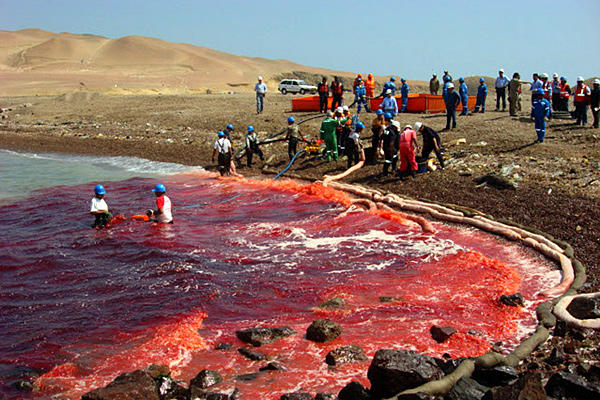
Finally! The Justice Department (PDF) is suing BP and eight other companies over the Gulf oil spill. From the Financial Times
BP faces penalties of $21bn-plus if found fully liable for damages in a lawsuit over the oil accident in the Gulf of Mexico launched by the US government on Wednesday.
Any damages would be on top of the $20bn (£17bn) BP has agreed to pay into a fund to compensate people on the Gulf coast who have suffered financially because of the spill. The final damages figures depend on the US government’s ability to prove gross negligence.
[….]
The US Department of Justice announced that it was suing BP, along with Anadarko of the US and Mitsui of Japan, its partners in the disastrous Macondo well; Transocean, the owner of the Deepwater Horizon drilling rig; and the QBE syndicate 1036 at Lloyd’s of London, which insured the rig.
Eric Holder, the US attorney-general, said: “We intend to prove that these defendants are responsible for government removal costs, economic losses and environmental damages without limitation.”
The lawsuit alleges that safety and operating regulations were violated in the period leading up to April 20.
It says that the defendants failed to keep the Macondo well under control during that period and failed to use the best available and safest drilling technology to monitor the well’s conditions. They also failed to maintain continuous surveillance and failed to maintain equipment and material that were available and necessary to ensure the safety and protection of personnel, equipment, natural resources and the environment, the suit charges.
Before Wednesday, potential class-action lawsuits had been filed in the Gulf oil spill by fishing and seafood interests, the tourism industry, restaurants and clubs, property owners losing vacation renters — even vacationers who claim the spill forced them to cancel and lose a deposit. So far, more than 300 suits have been spawned by the spill and consolidated in federal court in New Orleans.
Specifically, according to the Christian Science Monitor,
The complaint seeks to enforce provisions of the Oil Pollution Act, which government lawyers say provides for open-ended liability for pollution removal costs and other damages.
The lawsuit alleges that the companies failed to take necessary precautions to keep the oil well under control in the period leading up to the explosion. The companies also failed to rely on the best available and safest drilling technology, the suit says.
In addition, the companies are accused of failing to maintain continuous surveillance of the drilling operation and failing to ensure the safety and protection of workers, equipment, natural resources, and the environment.
The suit also seeks civil fines under the Clean Water Act for the oil that poured into the Gulf after the explosion.
The civil suits will be going on at the same time as the Justice Department’s criminal investigation.
The Justice Department is “at a different stage” with its criminal investigation compared with the civil case, Holder said. “We are moving as quickly as we can” on the criminal investigation, said Holder, who didn’t give any timetable for when it might conclude.
The Blog of the Legal Times notes the difficulty posed by running parallel criminal and civil legal actions:
The suit filed today in the U.S. District Court for the Eastern District of Louisiana comes amid an ongoing criminal investigation of the oil spill, which followed an explosion and fire in April that killed 11 workers.
The suit thrusts the government into the sometimes challenging world of parallel criminal and civil proceedings. The Justice Department also said in the complaint it reserves the right to conduct administrative proceedings against the defendants.
“It is difficult to have parallel proceedings going on at the same time,” said Attorney General Eric Holder Jr., addressing reporters this afternoon at Main Justice. “We need to be careful to make sure that we don’t do anything that violates any of the rules that we have to follow on the criminal side while at the same time proceeding on the civil side. It’s been a little tricky.”
Today was the final day to sue for damages caused by the BP oil spill.
The lawsuit makes it possible for the federal government to seek billions of dollars in penalties for polluting the Gulf of Mexico, beaches and wetlands, and reimbursement for its cleanup costs. More than 300 lawsuits filed previously by individuals and businesses, and now consolidated in the New Orleans federal court, include claims for financial losses and compensation for the families of 11 workers killed in the blast.
The judge overseeing those lawsuits had set Wednesday as the deadline to file certain types of complaints, though it was unclear whether the government was bound by that time frame.
“The Justice Department has left its options open to argue that there was gross negligence and therefore should be higher penalties,” said David Uhlmann, a law professor at the University of Michigan who headed up the Justice Department’s environmental crimes section for seven years. “The government has not limited itself in any way with the filing of its civil lawsuit.”
My main question is where will the money go if the suits are successful? Will the people in the Gulf states receive any compensation from damages paid to the government? I certainly hope so.

 peej
peej Carissa
 bostonboomer
 dakinikat
 ecocatwoman
 mablue2
 Mama Lopez
 peggysue22
 quixote
 skydancingguestblogger
 Mona (aka Wonk the Vote)



 Sky Dancing
Recent Comments