
In Other News … There’s an Environmental Disaster in My Back Yard
Posted: July 25, 2008 Filed under: New Orleans, U.S. Economy | Tags: Environmental disaster, Mississippi Oil Spill, New Orleans Oil Spill 6 Comments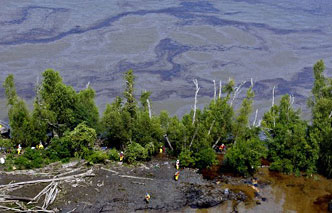 While the East Coast-centric press is following the very junior senator’s campaign to look presidential and world leaderly, there’s a major oil spill in my back yard. I live about three blocks from the Mississippi river in New Orleans and for the last three days, my home and my neighborhood have smelled like diesel. My nose is burning and I have a headache. About 9,000 barrels or 400,000 gallons of nasty, unrefined, sludgy oil spilled in the river that is the life blood of America’s trade–we’re loosing about $275 million in trade every day that it’s closed. That’s not a good thing for an economy teetering on recession.
There are a variety of issues going on with this huge spill and the coverage by the national media has been pathetic. The West Bank area of New Orleans along with two downriver parishes are in a state of water emergency. Their water purification facilities have had to close access to the water coming from the Mississippi and they’re about to run out of potable water. These two parishes were some of the hardest hit by Hurricane Katrina and the small towns scattered around the parishes are still experiencing problems even three years after the devastating storm. Just when these folks thought they were winding down their stormy relationship with FEMA, they’re now depending on the agency again. This time for drinking water and the oil washing up on their levees and coastlines.
Here we go again.
http://www.incidentnews.gov/incident/7861
There was an article in today’s NY Times on the devastating spill. We have yet to see the full environmental impact, but I think it’s safe to say, if you like to give baths to birds and swamp critters, we’re going to need you down here shortly as this putrid puddle is making its way down river to the environmentally sensitive wetlands and swamps. These same areas protect New Orleans from any hurricanes this year. The swamp grasses slow down hurricanes as they move on shore.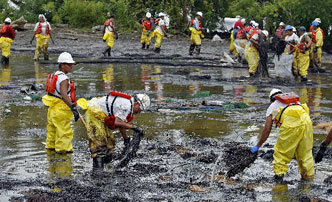
July 25, 2008
Oil Spill on Nearly 100 Miles of Mississippi River By ADAM NOSSITER
NEW ORLEANS — A sheen of oil coated the Mississippi River for nearly 100 miles from the center of this city to the Gulf of Mexico on Thursday following the worst oil spill here in nearly a decade. The fuel-laden barge that collided with a heavy tanker on Wednesday was still leaking.
The thick industrial fuel pouring from the barge could be smelled for miles in city neighborhoods up and down the river, even as hundreds of cleanup workers struggled to contain the hundreds of thousands of gallons. Some environmentalists worried about reports of fish and bird kills in sensitive marsh areas downstream, though officials said they had so far heard of only a handful of oil-covered birds. Booms to protect areas richest in wildlife, at the river’s mouth, were being deployed, officials said.
The Mississippi remained closed to all boat traffic, stranding about 65 vessels. The effect on the area’s economy was thought to be significant, with this city’s port estimating a loss of at least $100,000 a day and probably more as the river remained closed, and petrochemical facilities dependent on it for shipping were threatened with a bottleneck, the Coast Guard said. Some suburbs stopped drawing drinking water from the river.
“We’ve had a number of large spills in the New Orleans area, but this is a heavy, nasty product, problematic in the cleanup,” said Lt. Cmdr. Cheri Ben-Iesau of the Coast Guard, adding that it is of the sort normally used to fire up boilers at power plants.
“It’s a significant spill, if for nothing else because of its impact on the water supply,” Commander Ben-Iesau said. “We’ve got a lot of commerce dependent on this water supply, so we’re scrambling to get it cleaned up.”
On Thursday afternoon, the picturesque walk along the Mississippi at the French Quarter, normally full of tourists and pedestrians, was nearly deserted as a pungent chemical stench wafted up from the oil- covered water. A few skimmer boats, deployed to suck up the oil, constituted the only traffic on the nearly half-mile-wide river; a plastic boom to contain the fuel hugged the rocky shoreline, and the seagulls had disappeared.
“It’s going to take a good couple of weeks to get it all off,” said Petty Officer Jesse Kavanaugh of the Coast Guard, surveying the oily muck. Officials were unable to predict how long the river might remain closed, however. “We’re hoping days, not weeks,” Commander Ben- Iesau said.
The 61-foot barge that has been leaking heavy fuel oil for nearly two days could be seen underneath the mammoth Crescent City Connection bridge. It was carrying 419,000 gallons of the heavy fuel it had just picked up from an oil distributor when it collided with a 600-foot tanker ship around 1:30 a.m., just off this city’s Uptown neighborhoods. The tanker did not leak.
Coast Guard officials said the tugboat operator pushing the barge, from the local DRD Towing Company, was improperly licensed, possessing only the equivalent of an apprentice certificate. They said the incident was being closely investigated, though no blame had yet been assigned.
Oil continued to leak from the barge Thursday afternoon, and the Coast Guard was deploying a diver to check the flow.
Mayor C. Ray Nagin told residents of the city’s neighborhoods on the east bank of the Mississippi that they could safely drink the tap water, though he was more cautious about water in the one neighborhood on the west bank, Algiers. Meanwhile, water intake facilities in the neighboring parishes of St. Bernard and Plaquemines remained closed. There were no respiratory risks, officials said, despite the sometimes heavy odor.
As the oil slick moved downstream, officials remained concerned about the impact on the Delta National Wildlife Refuge, at the mouth of the Mississippi, and they were scrambling to place booms around it. Tens of thousands of feet of the plastic booms had already been put in place Thursday. If the oil flows through the main pass, or outlet, and on into the Gulf of Mexico, the effect will be limited; but if it seeps into the secondary passes, there is a more serious risk to the environment, they said.
“I’m very concerned, but I don’t think it’s a calamity of the proportions of Exxon Valdez,” said Robert A. Thomas, director of the Center for Environmental Communication at Loyola University. “Here, you’re talking about an enormous amount of oil, but it’s in a river that averages about 450,000 thousand cubic feet per second of flow,” he said.
“It’s going to flush this stuff out,” Mr. Thomas said.
Officials were generally guarded about the possible effects on fish, plants and wildlife in these rivers of grass and marshlands, but some in the state’s environmental community were not.
“When it goes down to the area where there are no longer levees, it gets into the swamp,” said Wilma Subra of the Louisiana Environmental Action Network. “It’s going to contaminate the marsh.”
Ms. Subra said she had heard reports of dead fish and birds, and of people vomiting, but officials and the local Sierra Club could not confirm these reports.
source:
http://www.nytimes.com/2008/07/25/us/25spill.html
Is it just me or is this a HUGE story that deserves front page coverage? Shouldn’t it be the lead story in TV News? We’re not talking chump change or small problem here.

 peej
peej Carissa
 bostonboomer
 dakinikat
 ecocatwoman
 mablue2
 Mama Lopez
 peggysue22
 quixote
 skydancingguestblogger
 Mona (aka Wonk the Vote)



 Sky Dancing
Recent Comments