
A Nobel Peace Prize for Women
Posted: October 7, 2011 Filed under: Violence against women, Women's Rights | Tags: Ellen Johnson Sirleaf, Leymah Gbowee, Nobel Peace Prize, Tawakkul Karman 4 Comments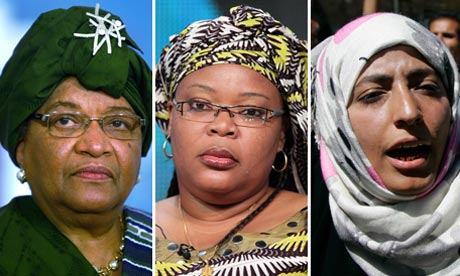
Ellen Johnson Sirleaf, Leymah Gbowee and Tawakul Karman. Photograph: Alex Wong/Getty, Frederick M Brown/Getty, Khaled Abdullah/Reuters
The 2011 Nobel Peace Prize has been awarded to Ellen Johnson Sirleaf, Leymah Gbowee and Tawakkul Karman for their work for women’s rights.
Liberia’s Ellen Johnson Sirleaf is Africa’s first democratic elected female president. Leymah Gbowee has worked to mobilize women across ethnic and religious dividing lines to bring end to the long war in Liberia.
Tawakkul Karman has played a leading role in the struggle for women’s rights and democracy in Yemen.
We’ve been covering a lot of news about women around the world here for as long as we’ve had a voice. It’s perhaps a natural offshoot of our roots in feminism and our roots as Hillary supporters. There has been a lot of major unrest in the world recently. Women and children have suffered tremendously. Women have been the victims of mass rape as a war weapon. Children have been recruited into armies. Women have been forced into early marriage, denied the right to participate in government and even to do the simple task of driving a car in major countries who we support, arm, and enrich. Our President is currently in the process of loosening punishment by our country for the use of children soldiers. That is hardly the act of a Nobel Peace Prize winner. The winning women are outstanding choices that do more than just symbolize the struggle of women to achieve independence, dignity, safety, and autonomy around the world.
These three women have campaigned for peace and democracy in Liberia and Yemen and are more than just symbols of the aspiration for peace. They have put their lives on the line for it in countries riddled with problems that we can barely imagine here. Sirleaf has been a personal hero of mine for some time since she is an economist as well as a leader. She spent time in prison and is the first woman president on the African Continent. She is a small woman with the heart of a lion. I look forward to learning more about the other two women. Here’s a few things to get his started!!!Here are some profiles of the winners from the UK Guardian.
The Liberian president, Ellen Johnson Sirleaf, and Leymah Gbowee, a social worker turned peace campaigner from the same country, will share the 10m kronor (£950,000) prize with Tawakul Karman, a journalist and pro-democracy activist in Yemen who has been a leading figure in the protests against President Ali Abdullah Saleh since January.
The Nobel committee said the three had been chosen “for their non-violent struggle for the safety of women and for women’s rights to full participation in peace-building work”.
“We cannot achieve democracy and lasting peace in the world unless women obtain the same opportunities as men to influence developments at all levels of society,” the committee said in a statement. They are the first women to be awarded the prize since 2004 when the committee honoured Wangari Muta Maathai, the Kenyan environmentalist who died last month, and bring the tally of female winners to 15, compared with 85 men.
Sirleaf, 72, is a Harvard-trained economist who became Africa’s first democratically elected female president in 2005, two years after the country achieved a fragile peace after decades of civil war. The committee said she had “contributed to securing peace in Liberia, to promoting economic and social development, and to strengthening the position of women”.
Seen as a reformer and peacemaker in Liberia when she first took office, Sirleaf declared a zero-tolerance policy against corruption and has made education compulsory and free for all primary-age children. She is currently running for re-election, with a vote to be held on Tuesday.
Gbowee, 39, was instrumental in helping bring Liberia to peace in the early 2000s, leading a movement of women who dressed in white to protest against the use of rape and child soldiers in the war. During the 2003 peace talks, she and hundreds of women surrounded the hall where the discussions were being held, refusing to let delegates leave until they had signed the treaty. The committee said she had “mobilised and organised women across ethnic and religious dividing lines to bring an end to the long war in Liberia, and to ensure women’s participation in elections”.
Since 2004, Gbowee has served as a commissioner on Liberia’s truth and reconciliation commission, and she is now executive director of the Women in Peace and Security Network, an organisation that works with women in Liberia, Ivory Coast, Nigeria and Sierra Leone to promote peace, literacy and political involvement.
“In the most trying circumstances, both before and during the Arab spring, Tawakul Karman has played a leading part in the struggle for women’s rights and for democracy and peace in Yemen,” the Nobel committee said of the third winner. Karman, 32, is a mother of three who in 2005 founded the group Women Journalists Without Chains.
She has been a key figure among youth activists in Yemen since they began occupying a square in central Sana’a in February demanding the end of the Saleh regime, and has often been the voice of activists on Arabic television, giving on-the-ground reports of the situation in the square outside Sana’a University, where dozens of activists have been shot dead by government forces.
She called her award “a victory for the Yemeni people, for the Yemeni revolution and all the Arab revolutions”.
“This is a message that the era of Arab dictatorships is over. This is a message to this regime and all the despotic regimes that no voice can drown out the voice of freedom and dignity. This is a victory for the Arab spring in Tunis, Egypt, Libya, Syria and Yemen. Our peaceful revolution will continue until we topple Saleh and establish a civilian state.”
More information can be found at BBC News as well. In some ways, I feel that this prize reflects Hilary Clinton’s priorities as she has made the rights of women and children and their oppression by strict and violent patriarchal regimes has been a focus of her work. I’m going to close this thread with a quote from then-First Lady Hillary Clinton that seems very appropriate.
Women have always been the primary victims of war. Women lose their husbands, their fathers, their sons in combat. Women often have to flee from the only homes they have ever known. Women are often the refugees from conflict and sometimes, more frequently in today’s warfare, victims. Women are often left with the responsibility, alone, of raising the children.
from a speech given at the Conference on domestic violence in San Salvador, El Salvador (17 November 1998)
Congratulations to these outstanding women whose quest for peace has come at great personal danger and sacrifice!!!!

 peej
peej Carissa
 bostonboomer
 dakinikat
 ecocatwoman
 mablue2
 Mama Lopez
 peggysue22
 quixote
 skydancingguestblogger
 Mona (aka Wonk the Vote)



 Sky Dancing
Recent Comments