
Dirty Little Secrets
Posted: February 2, 2011 Filed under: Corporate Crime, Team Obama, The Bonus Class, U.S. Politics, Voter Ignorance, We are so F'd | Tags: corporate tax rates, effective tax rates, self dealing 12 Comments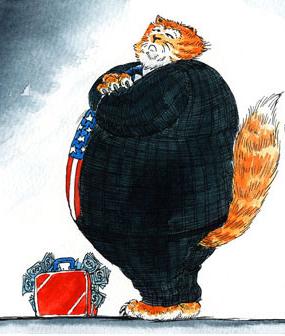 The overall corporate income tax was featured during the President’s SOTU address and by Republican circles. I have mentioned that this particular rate isn’t even relevant anymore in posts and down thread comments because corporations here really don’t pay any where near the effective rate.
There are several reasons for this. First, many of them now set up real or pseudo headquarters in tax and off shore banking havens like the Bahamas or Qatar and place a lot of their operations out of the reach of the IRS. The second is the efficiency of lobbying efforts in getting them so many loopholes that most corporate revenues become exempt. Despite this, corporations use public services and create social costs. Social costs are those costs that the society gets to foot when corporations create problems they or their consumers can pass to the public. A big example is smoking that creates incredible public health issues or pollution. BP is definitely not taking care of the tab for its destruction down here and will most likely escape prosecution for costs the spill will continue to wreck on the environment, livings, and health of people and wildlife in the area. Meanwhile, as an oil business, they are the beneficiary of many, many tax loopholes and direct subsidies.
I was glad to see some hard data–albeit anecdotal–on this phenomenon today in David Leonhardt’s op ed column in the NYT called ‘The Paradox of Corporate Taxes‘. The narrative begins with the example of Carnival Cruises that has a special, extreme loophole that leaves the majority of its revenues untaxed while it uses a number of public resources like services of the Coast Guard. Corporations are cost minimizing and profit maximizing things. They will employ an army of lobbyists and lawyers to help them. They even produce commercials that tout their environmental friendliness and their patriotism. I always shake my head at the commercials of companies like GE and Boeing for whom competitive markets are imaginary and no bid government grants are major sources of revenues. Yet, they act like they are burdened by taxes.
This is so untrue.
Carnival’s biggest government benefit of all may be the price it pays for many of those services. Over the last five years, the company has paid total corporate taxes — federal, state, local and foreign — equal to only 1.1 percent of its cumulative $11.3 billion in profits. Thanks to an obscure loophole in the tax code, Carnival can legally avoid most taxes.
It is an extreme case, but it’s hardly the only company that pays far less than the much-quoted federal corporate tax rate of 35 percent. Of the 500 big companies in the well-known Standard & Poor’s stock index, 115 paid a total corporate tax rate — both federal and otherwise — of less than 20 percent over the last five years, according to an analysis of company reports done for The New York Times by Capital IQ, a research firm. Thirty-nine of those companies paid a rate less than 10 percent.
President Obama indicated that he was willing to simplify the Corporate Tax Code and lower the overall Tax Rate for corporations. In exchange, he asked Congress to remove all the pork, breaks, and exclusions they’ve granted many businesses–including ones that really don’t need it like the Oil Industry–over the years. I doubt we’ll see any moves on the latter. My fear is that will only see movement on the former thus cementing the de-funding of government by the by the very people who benefit from government largess. Many study shows that far more rich and upper middle class Americans and American Businesses use public services and public assets than the poor and working class. After all, who uses the roads, the airways, the universities, the grants and loans, and the many tax loopholes?
While the official corporate tax rate is among the highest of developing countries, the effective rate is among the lowest of the countries that actually have economies that don’t function as tax havens or off shoring banking centers. Even Republican economists will pony up that data.
“A dirty little secret,” Richard Clarida, a Columbia University economist and former official in the Treasury Department under President George W. Bush, has said, “is that the corporate income tax used to raise a fair amount of revenue.”
Over the last five years, on the other hand, Boeing paid a total tax rate of just 4.5 percent, according to Capital IQ. Southwest Airlines paid 6.3 percent. And the list goes on: Yahoo paid 7 percent; Prudential Financial, 7.6 percent; General Electric, 14.3 percent.
Economists have long pleaded for an overhaul of the corporate tax code, and both President Obama and Republicans now say they favor one, too. But it won’t be easy.
Indeed, it won’t be easy. First, it’s difficult for even neutral academics to get a good look at the workings of loopholes because because tax filings are confidential. Loopholes are everywhere and folks that support simplifying the tax code can’t even get a handle on how widespread or huge the problem. Publicly held corporations provide for public stockholder reports but even these things are of limited use over time when studying corporate tax avoidance. My field specializations for my doctorate is International Finance and Trade and Corporate Finance so I lot of my class work and research work is based in corporate finance as well as economics. I know the literature, models, and theories well.

 peej
peej Carissa
 bostonboomer
 dakinikat
 ecocatwoman
 mablue2
 Mama Lopez
 peggysue22
 quixote
 skydancingguestblogger
 Mona (aka Wonk the Vote)



 Sky Dancing
Recent Comments