
The director of the National Security Agency, the powerful U.S. wiretapping and cyberespionage service, was fired Thursday, according to one former and two current U.S. officials.
Gen. Timothy Haugh, who also heads U.S. Cyber Command, was let go along with his civilian deputy at the NSA, Wendy Noble, according to the officials. Like others in this report, they spoke on the condition of anonymity to discuss personnel moves.
Far-right activist Laura Loomer advocated for the firings during a meeting with President Donald Trump on Wednesday, she confirmed to The Washington Post on Thursday evening.In the meeting,
Loomer, a fervent Trump supporter, pressed for the dismissals of a number of officials besides Haugh and Noble — in particular, National Security Council staff whose views she saw as disloyal to the president.
At least five key National Security Council aides were fired Thursday.
“NSA Director Tim Haugh and his deputy Wendy Noble have been disloyal to President Trump,” Loomer said in a post on X early Friday. “That is why they have been fired.”
Loomer told The Post that she urged Trump to dismiss Haugh because he was “handpicked” by Gen. Mark A. Milley, who was chairman of the Joint Chiefs of Staff in 2023 when Haugh was nominated to lead Cyber Command and the NSA.
Finally Friday Reads: It’s late but I took some ME time
Posted: April 11, 2025 Filed under: #FARTUS, #MAGAnomics, Broligarchy, Federal Budget and Budget deficit | Tags: @johnbuss.bsky.social John Buss, @repeat1968. John Buss, Disastrous Don, economic impact of #FARTUS tariffs, kakistocracy, Markets continue to Crash 1 Comment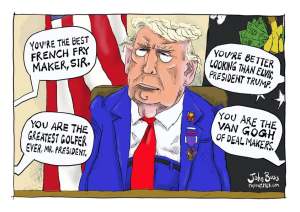
“Well, I don’t know why I came here tonight
I’ve got the feeling that something ain’t right
I’m so scared in case I fall off my chair
And I’m wondering how I’ll get down the stairs” John Buss, Repeat1968 with h.t t;o Stealers Wheels
Good Day, Sky Dancers!
I took some time today to enjoy a friend from FDL, sushi from Lin’s at St Roch Market, and the Bywater and Marigny right up to the edge of the Quarter. The only way to explore my neighborhood is by foot or by bus. That way, you really get to know us. The stores on LA49 (better known as St. Claude Avenue) are small, locally owned, and full of surprises. I don’t think I can ever emphasize how much I love this city. It’s probably why I stay here and don’t go elsewhere anymore. I first discovered this because when I ventured around the state or country, I had dreams about not being able to find or go home, which ended immediately when I opened the front door. I really wish you this feeling. It’s amazing.
It gave me a breath from reading stuff today. So, here I go, right into the thick of it. This is from Dr. Paul Krugman’s Substack. “The Third-Worlding of America. How to destroy 80 years of credibility in less than 3 months.” Like all excellent economists, he’s got charts and numbers to prove it. I got all these degrees to help people understand financial markets and economic policy. Now, I live with knowledge; I just pray it still empowers people, even if it feels disheartening today.
Remarkably, the sanewashing continues despite the unprecedented craziness of the past 10 days. Many observers assert that Trump has backed down on tariffs and will speedily make a bunch of trade deals. The first assertion is just false, while the second is very unlikely.
In fact, savvy traders have realized that there’s no coherent economic strategy. There’s an old line about military analysis: “Amateurs talk about tactics, but professionals talk about logistics.” Well, when it comes to taking the pulse of financial markets, amateurs talk about stocks, but professionals talk about bond and currency markets. That’s because bond and currency markets are generally less driven by emotion. There’s no “meme
gamblinginvesting” in bond and currency markets. And these markets are both signaling major loss of faith in America.First, about tariffs: It’s true that for the time being Trump has scaled back some of the tariffs displayed on his big piece of cardboard last week. For example, unless we have another policy swerve, the European Union will now face a 10 percent tariff over the next three months rather than a 20 percent tariff. But the tariff on China, our third-biggest trading partner after Canada and Mexico, has gone from 34 percent to more than 130 percent. And we still have high tariffs on steel, aluminum and so on. In effect, observers who claim that tariffs have gone down are missing the biggest part of the story.
Economists who have actually run the numbers, like those at the Yale Budget Lab, estimate that the April 9 tariff regime will raise consumer prices more than the April 2 regime because of the extraordinarily high tariff rate on Chinese imports. Specifically, the budget lab estimates that the latest version of Trump’s trade war will raise consumer prices by 2.9 percent. This is roughly ten times the probable impact of the infamous Smoot-Hawley tariff of 1930.
It’s hard to overstate the craziness of announcing a radical tariff plan, then announcing a quite different but equally radical plan just a week later. Furthermore, the claim that the wild zigzags in policy were always part of Trump’s plan just adds to the destruction of the administration’s credibility.
But are these tariffs just an opening gambit for trade negotiations? I doubt it. Bear in mind that Trump and Peter Navarro, his tariff guru, start from the premise that other countries are cheating, that they’re taking advantage of America and treating us unfairly. In fact, however, most of them aren’t. Take the case of the European Union. The EU imposes an average tariff on U.S. goods of just 1.7%, and there aren’t any significant hidden barriers.
So what are we supposed to be negotiating about? Nations can’t promise to lower their trade barriers when there aren’t any barriers. Navarro has been claiming that value-added taxes are de facto tariffs, but they aren’t, and EU nations literally can’t afford to give them up.
I guess other countries might make fake concessions that Trump can claim as fake victories. This is what he did with China during his first term, claiming that it had made significant concessions — claims which were, in the end, false. In fact, American soybean farmers have never fully recovered the loss of market share. And remember too how Trump made minor changes to NAFTA and claimed to have negotiated a whole new trade pact.
However, Trump is now clearly high on his own supply. Even with the April 9 tariff regime, Trump is imposing high tariff rates on our three largest trading partners. Currency and bond market traders — no fools they — are certainly not acting as if we’re on a path to successful deals.
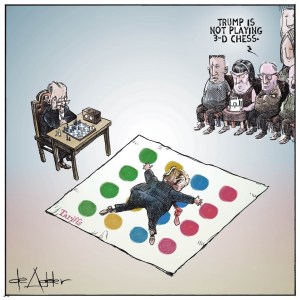 The Chinese are pranking Trump today. This is from the Washington Post. “China raises tariffs on U.S. goods to 125 percent as trade war deepens. Beijing hit back in response to the Trump administration’s move to raise tariffs on Chinese goods to 145 percent, saying it would “fight to the end.” They can afford to. They’re making deals with South Korea and Japan, among other countries. The only group this is hurting is US importers and Exporters. This includes farmers.
The response underscored China’s decision to stand firm in the face of pressure from Washington and deepened the showdown between the world’s two largest economies.
“If the U.S. insists on substantively damaging China’s interests, China will firmly retaliate and fight to the end,” China’sState Council said in a statement.
The move came after Trump increased the levies on Chinese goods to 145 percent on Wednesday, while also announcing that the tariffs he had previously imposed on more than six dozen other countries would be fixed at 10 percent during a 90-day pause.
The State Council derided Trump’s move to continue ratcheting up the levies and said it would ignore further hikes. The tariffs are a “joke” and “no longer have any economic significance,” its statement said, because the current levels make U.S. exports to China not financially viable. The new Chinese tariffs, which increased from 84 percent, are effective Saturday.
Chinese leader Xi Jinping, in a meeting with Spanish Prime Minister Pedro Sánchez on Friday, stressed that trade wars have no winners and called for China and Europe to “jointly oppose unilateral bullying,” according to state media. European leaders also emphasized the damaging effects of uncertainty beyond the 90-day pause.
Experts in Beijing expressed concern about the latest turn in tensions with Washington. “U.S.-China trade will soon be almost nonexistent,” said Shi Yinhong, an international relations professor at China’s Renmin University. “To ease tensions, Trump must first make concessions.”
 Turmoil over tariffs drove fluctuations in global markets on Friday.
Japan’s Nikkei 225 and Topix indexes dropped by5percent, before trimming their losses to under 3 percent by market close. South Korea’s Kospi and Australia’s ASX 200 fell by less than1 percent, while Taiwan’s bourse kicked off the day with a fall of under 1 percent before logging a 2.5 percent gain. Hong Kong’s Hang Seng Index and China’s Shanghai composite index were mostly flat, with the Hang Seng closing just over 1 per cent higher.
Major European markets fell slightly after opening on Friday, following rebounds the previous day. By 6 a.m. Eastern time, Germany’s DAX was down 1.62 percent, France’s benchmark CAC fell by 1.11 percent and London’s FTSE 100 was down around 0.3 percent.
 CNN has this headline today for a story written by Ella Nilsen. “Trump’s budget plan eviscerates weather and climate research, and it could be enacted immediately.” I guess I better hurry to put that Weather Station up in the Pergalo.
The Trump administration intends to eliminate the research arm of the National Oceanic and Atmospheric Administration, close all weather and climate labs and eviscerate its budget along with several other NOAA offices, according to internal documents obtained by CNN.
The documents describe the administration’s budget proposal for 2026, but indicate the administration expects the agency to enact the changes immediately.
The cuts would devastate weather and climate research as weather is becoming more erratic, extreme and costly. It would cripple the US industries — including agriculture — that depend on free, accurate weather and climate data and expert analysis. It could also halt research on deadly weather, including severe storms and tornadoes.
The administration intends to make significant cuts to education, grants, research and climate-related programs in NOAA, the plan says, which the administration believes “are misaligned with the … expressed will of the American people.”
While the phrase “climate change” refers to the manmade influence on the global climate system via planet-warming fossil fuel pollution, “climate” in NOAA parlance is simply the weather that has been observed over time.
CNN has reached out to the White House and the Department of Commerce, which houses NOAA, for comment on the plan.
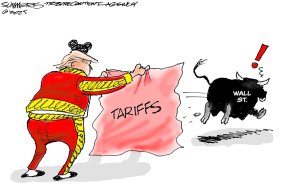 Additionally, NASA is on the chopping block! Does this include all that money going to Elonia? This is from ars TECHICA‘s Eric Berger. “Trump White House budget proposal eviscerates science funding at NASA. “This would decimate American leadership in space.” #FARTUS seems dead set on sending us back to the Gilded Age. Even the best of the Modern Era is about to be erased.
This week, as part of the process to develop a budget for fiscal-year 2026, the Trump White House shared the draft version of its budget request for NASA with the space agency.
This initial version of the administration’s budget request calls for an approximately 20 percent overall cut to the agency’s budget across the board, effectively $5 billion from an overall topline of about $25 billion. However, the majority of the cuts are concentrated within the agency’s Science Mission Directorate, which oversees all planetary science, Earth science, astrophysics research, and more.
According to the “passback” documents given to NASA officials on Thursday, the space agency’s science programs would receive nearly a 50 percent cut in funding. After the agency received $7.5 billion for science in fiscal-year 2025, the Trump administration has proposed a science topline budget of just $3.9 billion for the coming fiscal year.
Among the proposals were: A two-thirds cut to astrophysics, down to $487 million; a greater than two-thirds cut to heliophysics, down to $455 million; a greater than 50 percent cut to Earth science, down to $1.033 billion; and a 30 percent cut to Planetary science, down to $1.929 billion.
Although the budget would continue support for ongoing missions such as the Hubble Space Telescope and the James Webb Space Telescope, it would kill the much-anticipated Nancy Grace Roman Space Telescope, an observatory seen as on par with those two world-class instruments that is already fully assembled and on budget for a launch in two years.
 We’re also unlikely to see other countries send their best and brightest to our US Universities with all this craziness. As some with with multiple degrees and ones that aren’t that easy to achieve, I would just like to say that my teachers, my students and grad assistants, and my colleagues and fellow students were consistently the best part of higher education school. I owe so much of my math chops to fellow students from India, Iran, Hong Kong, Turkey, and Taiwan. Both of my Doctorate advisors came here as students. One from India. The other is from Bangladesh. This brain drain will put us on the road to mediocrity.
This is from the AP. “Immigration judge finds that Columbia University activist Mahmoud Khalil can be deported.”
Columbia University graduate student Mahmoud Khalil can be kicked out of the U.S. as a national security risk, an immigration judge in Louisiana found Friday during a hearing over the legality of deporting the activist who participated in pro-Palestinian demonstrations.
The government’s contention that Khalil’s presence in the United States posed “potentially serious foreign policy consequences” was enough to satisfy requirements for his deportation, Immigration Judge Jamee E. Comans said at the conclusion of a hearing in Jena.
Comans said the government had “established by clear and convincing evidence that he is removable.”
Lawyers for Khalil said they plan to keep fighting. The judge gave them until April 23 to seek a waiver. Meanwhile, a federal judge in New Jersey temporarily barred Khalil’s deportation.
Addressing the judge at the end of the hearing, Khalil mentioned that she said at a hearing earlier in the week that “there’s nothing more important to this court than due process rights and fundamental fairness.”
Let me just say that Jena, Louisiana, is a hell realm.
Is it a Constitutional Crisis Yet, Momma? Brad Reed has that Raw Story headline.
The United States Department of Justice said on Friday that it will not comply with an order from Judge Paula Xinis to reveal information on the whereabouts and status of deported immigrant Kilmar Abrego Garcia.
As reported by Politico’s Kyle Cheney on BlueSky, the DOJ information Judge Xinis that it would not be able to provide the information she requested on Garcia because the court set an “impracticable” deadline to do so.
Judge Xinis had originally demanded that the DOJ provide information about Garcia’s status by 9:30 a.m. on Friday after the United States Supreme Court ruled that the Trump administration needed to facilitate bringing him back from the prison in El Salvador where he had been sent improperly.
The judge extended the deadline to 11:30 a.m. on Friday morning and scheduled a court hearing on the case for 1 p.m.
So, I hope you’re trying to stay positive and calm. I’m going to go walk Temple and feed the kitties. That’s something I can do right now without feeling depressed.
What’s on your reading and blogging list today?
Black Friday: The Great Crash
Posted: April 4, 2025 Filed under: #MAGAnomics, tRump crimes against humanity | Tags: @johnbuss.bsky.social John Buss, economic impact of #FARTUS tariffs, FARTUS, grand wizards of the kleptocracy, kakistocracy, Land of Confusion, tariffs and farmers 4 Comments Good Day, Sky Dancers!
#FARTUS has deliberately tanked the equity markets and the dollar with record-level tariffs set with an equation that made no sense and included tariffs placed on islands with no human inhabitants. This is further evidence of the incompetency and utter ignorance of the Trump Administration. This is not economic policy. This is some personal brain fart of a very disturbed man.
The newest economic alignment is between Japan, Southern Korea, and China. They have negotiated a Trilateral Free Trade Agreement. The Europeans have basically given up on us. The dollar is no longer the safe currency as we saw in trading yesterday. It had its highest drop on record. The jobs report will be released shortly and will determine any further rate of decline. I watched an increasing level of lay-off announcements by major manufacturers, Whirlpool, Stellantis, and more have announced additional layoffs. This comes after Forbes announced, “Nearly 100 Companies Announce Layoffs In March, According To Reports.” This was the highest amount of layoffs since 2020 which was the start of the COVID-19 pandemic. The USD has regained some of its footing, but frankly, when economic policy is ruled by hubris and ignorance, there’s very little you can get from a forecasting model.
None of this makes sense from an Economic Policy Basis. We now have retaliatory tariffs, which signal a massive trade war has begun. Like the last Trump Tariff-induced trade war, US farmers will be on the front line. Manufacturers will also be severely hurt. Of course, the ultimate loser is the average American. I still see stagflation in our near term future. High inflation plus very lousy unemployment. The Fed’s tools are not as useful with this kind of economy. Stimulate the economy to end unemployment, and you get higher prices. Stop the high inflation, and you worsen the recession. What really kills me is that this destructive policy was fully preventable. But then, elections brought us this mess, and elections must pull us out of it.

les pingouins résistent
You may read all my sources if you are so inclined. I know they’re not the most exciting reads. Here’s a trio of dismal headlines from The Guardian. Note: FTSE is the UK equivalent of the Dow Jones.
Global trade war escalates as Beijing hits back against Donald Trump with new tariffs on US goods
- China retaliates to Trump’s ‘bullying practice’ with 34% tariffs on US imports
- IMF warns of ‘significant risk’ to global economy from Trump tariffs as markets slide
- Analysis: Trump’s ‘idiotic’ and flawed tariff calculations stun economists
I’m going to quote from the Analysis. This is the full Headline. “Trump’s ‘idiotic’ and flawed tariff calculations stun economists
Richard Partington, The Guardian’s Senior economics correspondent, wrote this analysis. “‘Willing sycophants’ came up with simplistic formula that has thrown global economy into disarray.”
Waving a big chart as a prop in the White House Rose Garden, Donald Trump suggested his new tariff plan was simple: “Reciprocal – that means they do it to us, and we do it to them. Very simple. Can’t get simpler than that.”
Perhaps a bit too simple. The method used to calculate the most important numbers in international trade, politics and economics has left some of the world’s leading experts shocked.
For each country, the White House looked up its trade in goods deficit for 2024, then divided that by the total value of imports. Trump, to be “kind”, said he would, however, offer a discount, so halved that figure. The calculation was even distilled into a formula.
For example, take the figures for China:
Goods trade deficit: $291.9bn
Total goods imports: $438.9bn
Those figures divided = 0.67, or 67%
And halved = 34%
For countries without a large deficit, the White House applied a 10% baseline, ensuring tariffs would be applied regardless. This was the case for the UK, which the US Census Bureau reckons had an almost-$12bn surplus in 2024.
“[It is] quite an extraordinary calculation after months of work behind the scenes,” said Jim Reid, the global head of macro research at Deutsche Bank. “[It] didn’t add much confidence on there being an in-depth strategic implementation plan.”
For weeks, Washington had been talking about an in-depth policy exercise to establish figures based on a combination of tariff and non-tariff barriers to trade, as it perceived them to be; including alleged “currency manipulation”, local laws, regulations, and taxes such as VAT.
In itself that approach raised eyebrows with experts who said VAT was highly unusual to include, because it is a sales tax paid on domestically produced goods and foreign imports alike.
However, the White House appears to have confirmed it took a simplistic approach to making this judgment:
Reciprocal tariffs are calculated as the tariff rate necessary to balance bilateral trade deficits between the US and each of our trading partners. This calculation assumes that persistent trade deficits are due to a combination of tariff and non-tariff factors that prevent trade from balancing.
There are multiple problems with this – not least that it vastly oversimplifies the drivers of trade deficits. Trade deficits occur when a country buys more than it sells abroad. The US has run a deficit persistently since the 1970s. Typically trade deficits balance over time, as they create downward pressure on a country’s currency (as the result of demand for foreign currency, to buy imported goods, outstrips demand for domestic currency).
Another part of the reason is US goods are too expensive for consumers in developing economies to buy – helping to explain some of the particularly large trade deficits – and new tariffs – for poorer countries.
Adam Tooze, an economic historian at Columbia University in the US, said there were “grotesque” policies for south-east Asian countries, including a 49% Cambodian tariff, and rates of 48% for Laos and 46% for Vietnam.
“This is not because they discriminate viciously against American exports, but because they are relatively poor. The US does not make a lot of goods that are relevant for them to import,” he said.
Vietnam in particular has become part of the global supply chain for major manufacturers, including US tech and clothing companies such as Nike, Intel, and Apple.
Lesotho, the tiny southern African country, one of the poorest in the world, is another odd example, facing a tariff of 50%. Among its main exports to the US are diamonds and clothes – demonstrating how links around the world for rare minerals are important for the US economy, but also how the US sought to boost development in African nations in recent years – with policies to encourage manufacturing by companies including Levi Strauss and Wrangler.
 There are three major trade models in economic theory. Basically, the first was mercantilism, which is the colonialist type of economy that caused the Boston Tea Party. The second is absolute advantage, and the third is comparative advantage. We generally have an absolute advantage in nearly all the markets because we’re a huge economy with many natural resources. There are still things we cannot provide, though. The example I always use is coffee.
This is where comparative advantage comes in. The countries in South America and Africa can sell us their coffee in return for goods and services we easily produce. We both benefit from the trade. It’s the basis of free trade. From this model, we’ve had many improvements as we’ve gone beyond the logic of the models to empirical testing. The last big change to this model was by Paul Krugman, but Stiglitz and Samuelson were prior researchers into trade between countries.
You may check out this short explanation from Google AI. Don’t worry, we haven’t got a semester to go through two classes in Internationl Economics and Finance. It took me about 10 years to achieve with my doctorate and thesis and publications on the topic.. I know there are very few of us who find it fascinating, but I really felt like I needed to give you a bit of information so you can figure out what’s going on. So, wherever those Tariff formulations came from, it appears to have come from a crazy theory that I would never have heard of if my Libertarian friends hadn’t noticed their right-wing buddies going off the deep end. You may have noticed that Senator Rand Paul was among the most outspoken Senators against the tariffs. Libertarians generally tend to be big on letting the factors of production and products go where they are most efficient. That basically means open borders for capital and labor plus free trade.
 So, that’s when I discovered this unhinged hypothesis. I had never heard of Critical Trade Theory before. I had heard of Critical Theory which basically has Marxist roots. When I originally entered University, I studied various forms of political and economic systems in a comparative class. Those are no longer taught in Economics because we recognize now that we have mixed markets models. The old command economies of the Soviet Union no longer exist. Central planning has gone completely the way of the Dodo, but there are economies that have more public provision of goods than others. Maoist and Stalinist planning are no longer carried out. That’s why it’s important to bring poor countries like Vietnam into a modern trade paradigm so they may develop quickly.
From what I can read of it, it actually appears to have a similar Marxist underpinning. One of the clues is that they use the word “fair” instead of “efficient.” The guy quoted over there is a bit off the rails, but at least I found out what the deal was. You may want to check out the ITIF site for better ways of identifying and correcting trade distortions rather than just using some made-up formula and hitting islands with subsistence farmers, fishermen, and penguins.
- The White House has given the Office of the U.S. Trade Representative, along with the departments of Treasury and Commerce, until April 1 to identify countries the administration should confront with corrective trade actions.
- It would be a mistake for the Trump administration to impose across-the-board tariffs on all nations, even if some run trade surpluses with America.
- The administration should focus on the nations that employ the most extensive arrays of unfair trade practices, including behind-the-border restrictions that specifically target U.S. companies or exports.
- Based on an index composed of 11 indicators covering America’s trade balances and key barriers U.S. industries face in markets around world, the administration should focus the greatest attention on China, India, and the European Union.
- While it is highly unlikely that tariffs or other pressure can convince China to reduce its trade distortions, such measures might work vis-à-vis U.S. relations with other nations.
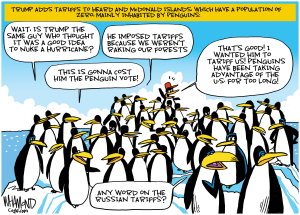 I did go to Influence Watch to check out their biases and funding sources. The methodology is better, using specific parameters to identify where possible trade distortions can happen. Plus, they don’t target Volcano Islands, seals, and penguins. So, I’m going back to the fallout now, which is not likely going to put you to sleep.
This TNR link goes to a podcast with Greg Sargent. ““Horrifying”: Trump’s Weird, Confused Rant to Media as Markets Tanked. As Trump’s shockingly destructive global tariffs cause the markets to crater and he rambles bizarrely about it to reporters, congressional scholar Norm Ornstein walks through how this madness can be stopped.” #FARTUS is not in a state of mind to feed himself, let alone make policy decisions. He’s totally disconnected from reality.
After President Trump imposed sweeping tariffs on imports from all over the globe, prompting the markets to implode, he took a question about it on Thursday. He ranted and rambled delusionally about how everything is just great. He bizarrely likened the country to a patient that had just undergone advanced surgery without grasping why this metaphor is the opposite of reassuring. And he spouted more nonsense about money pouring into our country. On top of all that, his imposition of the tariffs is likely an enormous and grotesque abuse of power. And because of this, the prospects for stopping them are not wholly nonexistent. We talked to congressional scholar Norm Ornstein, who walks us through how Congress can act, what Democrats can do to pressure Republicans to join in doing just that, and why Trump’s engaged in “horrifying folly.” Listen to this episode here. A transcript is here.
 And here’s a snip from the transcript.
Ornstein: They’re inexplicably high and a disaster. I agree. And obviously not only do the markets agree, but so do many people in the business world. I saw that the CEO of Restoration Hardware, as he watched his stock plummet today, responded with a simple two-word phrase, “Oh, shit.”And my guess is that that’s been replicated, probably in even more colorful language, by business leaders, economists, and investors all across America and probably around the world.
Sargent: “Oh, shit” seems like a pretty good reaction, or at least an apt one. So Trump was asked about all this on Thursday. The reporter pointed out that the markets are way down, that they’ve had their worst day in years because of his tariffs. Then the reporter asked Trump, “How’s it going?” Here’s Trump’s answer.
Donald Trump (audio voiceover): I think it’s going very well. It was an operation, like when a patient gets operated on. And it’s a big thing. I said this would exactly be the way it is. We have $6 trillion or $7 trillion coming into our country, and we’ve never seen anything like it. The markets are going to boom, the stock is going to boom, the country is going to boom.
What part of his dementia-riddled mind invents these things? Are there really people out there that consider him even lucid? Governors of many states–but especially farm states–are seeing if they can work around our incredibly insane President. This is from Axios. “Gavin Newsom angles for California exemptions to Trump trade war.”
California Gov. Gavin Newsom said Friday he is pursuing agreements with other countries to ensure California is exempted from retaliatory tariffs stemming from President Trump’s escalating trade war.
Why it matters: Trump’s “Liberation Day” tariffs spurred global blowback. Newsom — a reported 2028 presidential hopeful — is looking to insulate his state from the fallout.
Driving the news: “Donald Trump’s tariffs do not represent all Americans,” Newsom said in a video message Friday.
- California, whom he touted as “the tentpole of the U.S. economy,” aims to maintain “stable trading relationships around the globe,” he added.
- “I’ve directed my administration to look at new opportunities to expand trade and to remind our trading partners around the globe that California remains a stable partner.”
- California is “ready to talk” with global trading partners, Newsom wrote on X.
- Referring to the state’s economic might, Newsom added his state is “not scared to use our market power to fight back against the largest tax hike of our lifetime.”
State of play: The Golden State’s economy and its workers are heavily reliant on trade with Mexico, Canada and China, and retaliatory tariffs stand to have an “outsize” impact on California businesses, farmers and ranchers, according to a press release from Newsom’s office.
- The tariffs could also impede the state’s efforts to rebuild from this year’s devastating Los Angeles wildfires, by hurting access to construction materials like timber, steel, aluminum, and the components of drywall, the press release noted.
The other side: “Gavin Newsom should focus on out-of-control homelessness, crime, regulations, and unaffordability in California instead of trying his hand at international dealmaking,” White House spokesperson Kush Desai told Axios Friday.
Zoom in: Newsom is particularly concerned with retaliatory measures from other countries could impact California’s agricultural sector, especially its almond industry, according to Fox News, which first reported the news of theagreements.
- California is the world’s fifth-largest economy and its agricultural sector is a key economic driver for the state.
 This is from CNBC, as reported by Ruxandra Iordache. “China to impose 34% retaliatory tariff on all goods imported from the U.S.” Can you say Trade War?”
China’s Finance Ministry on Friday said it will impose a 34% tariff on all goods imported from the U.S. starting on April 10, following duties imposed by U.S. President Donald Trump’s administration earlier this week.
“China urges the United States to immediately cancel its unilateral tariff measures and resolve trade differences through consultation in an equal, respectful and mutually beneficial manner,” the ministry said, according to a Google translation.
It further criticized Washington’s decision to impose 34% of additional reciprocal levies on China — bringing total U.S. tariffs against the country to 54% — as “inconsistent with international trade rules” and “seriously” undermining Chinese interests, as well as endangering “global economic development and the stability of the production and supply chain,” according to a Google-translated report from Chinese state news outlet Xinhua.
Separately, China also added 11 U.S. firms to the “unreliable entities list” that the Beijing administration says have violated market rules or contractual commitments. China’s Ministry of Commerce also added 16 U.S. entities to its export control list and said it would implement export controls on seven types of rare earth-related items, including samarium, gadolinium and terbium.
Beijing has also filed a formal complaint against the U.S. with the World Trade Organization, the Ministry of Commerce confirmed in a Google-translated release, saying Washington’s tariffs policy “seriously violates WTO rules, seriously damages the legitimate rights and interests of WTO members, and seriously undermines the rules-based multilateral trading system and the international economic and trade order.”
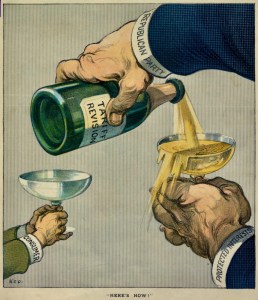
circa 1908 and a reminder from my Grandparents’ peers
Okay, enough of this. It makes me crazy. Not like the following doesn’t, but at least I know nothing about the field. This is from the Washington Post. We have all these #FARTUS appointments breaking security rules and they do this to who? “National Security Agency chief ousted after far-right activist urged his removal. Gen. Timothy Haugh was fired Thursday as director of the powerful wiretapping and cyberespionage service, according to U.S. officials.”
We are so fucked. Have you managed to crawl out of bed yet?
What’s on your reading and blogging list today?

 peej
peej Carissa
 bostonboomer
 dakinikat
 ecocatwoman
 mablue2
 Mama Lopez
 peggysue22
 quixote
 skydancingguestblogger
 Mona (aka Wonk the Vote)



 Sky Dancing
Recent Comments